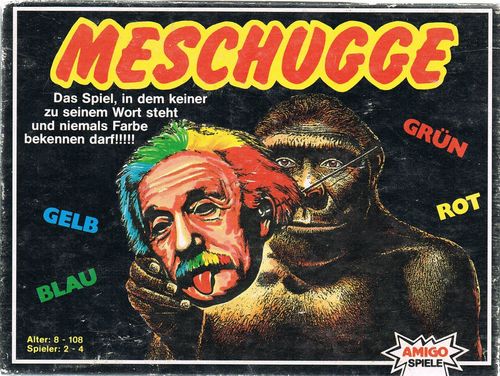
Meschugge
Meschugge Rulebook
Table of Contents
Table of Contents
Components
- 64 playing cards:
- 4 sets of 12 player cards, each set with the same number on the back (1 to 12). The card backs are numbered.
- 16 Command cards. These have no number on the back. Their front shows a coloured background and a printed colour word.
- 14 chips in each of 2 colours: black and red.
- 1 action die (Aktions-Würfel). Its faces show the two actions "Colour" (Farbe) and "Word" (Wort).
Game Idea
In this game nobody keeps to their word, and no player may ever declare a colour. The aim of the game is to be the first to play a matching card onto a Command card and so win a trick (Stich). Each trick scores points. The player with the most points after 16 tricks, at the end of the round, is the winner.
Setup
All cards are sorted by their backs. Each player receives their own card set of twelve cards, each with the same number on the back (for example the "1"), as a hand. If there are only two or three players, then two or one of the card sets go back into the box.
The 16 cards without a number on the back are the Command cards. They are shuffled and placed face down in the middle of the table as a stack.
Each player receives one black chip (worth two points) and two red chips (each worth one point). The remaining chips are sorted by colour and placed in the middle of the table as well.
The owner of the game receives the action die and begins the game.
The printed setup diagram for four players shows the example hands of four players (Rainer, Sven, Stefanie and Jana), with the chips and the Command card stack in the middle of the table. The diagram is not reproduced here.
Game Flow
The player holding the action die is the Commander (Kommandeur) for one round (Durchgang). After each round the role of Commander passes clockwise.
The Commander begins a round by rolling the die. The result is one of the two actions, "Colour" (Farbe) or "Word" (Wort). The Commander then turns over the top card of the Command card stack and places it on the stack.
Now all players, including the Commander, try as quickly as possible to play a matching card from their hand, face down, next to the Command card. This forms a small pile.
Once every player has played a card, the pile of played cards is turned face up. The bottom card belongs to the player who reacted fastest, so that card lies on top.
The owner of the first matching card wins one point. The order of the played cards is therefore very important. For example, if the top card does not match, the next card may win the point. If that card does not match either, the third card has the chance to win the point, and so on down to the fourth card.
The owner of the card that won the point is easily recognised by the number on its back. This player receives one red chip (worth one point). Each player takes their played card back into their hand. The Commander slides the current Command card, with its coloured front facing up, under the Command card stack, and passes the action die to the player on their left. This ends the round.
Note: if no player has played a matching card, the Commander receives the point, because rolling the die and turning over the Command card put the Commander at a time disadvantage compared with the other players.
When is a card matching?
Whether a card matches depends on the action rolled, "Word" or "Colour".
Action "Colour" (Farbe). If the Commander rolled the action "Colour", every player must play a card in the colour that matches the word written on the Command card.
Example 1: The Commander has turned over a red Command card with the written word "Blue" (Blau). The matching cards are now the blue cards of the players that bear the word "Yellow" (Gelb) or "Green" (Grün).
Example 2: The Commander has turned over a green Command card with the written word "Yellow" (Gelb). The matching cards are now the yellow cards of the players that bear the word "Blue" (Blau) or "Red" (Rot).
Action "Word" (Wort). If the Commander rolled the action "Word", every player must play a card with the word that matches the colour of the Command card.
Example 3: The Commander has turned over a red Command card with the written word "Blue" (Blau). The matching cards are now the yellow and green cards of the players that bear the word "Red" (Rot).
Example 4: The Commander has turned over a green Command card with the written word "Yellow" (Gelb). The matching cards are now all cards of the players that bear the word "Green" (Grün), regardless of the colours of those cards.
The Kontra card is never matching
A Kontra card is a card that says the exact opposite of the Command card. A Kontra card may never be played during a round. If it is played anyway, it does not count as matching, and the player must additionally hand over one red chip, provided they own chips.
Example: For a blue Command card with the word "Red" (Rot), a red card with the word "Blue" (Blau) must not be played. It does not matter which action was rolled.
Round without the action die!
For a group that plays this game for the first time, it is recommended to do without the action die, so that the group can become more familiar with the special features of the game.
The players play five rounds with only the action "Colour" and then five rounds with only the action "Word". The remaining six rounds then alternate between the two actions each round.
The following game can then be played normally with the action die.
The Meschugge Command cards!
Among the Command cards there are four special Meschugge cards. A Meschugge card is a card where colour and word are identical, for example a red card with the word "Red" (Rot).
If the Commander turns over such a card, no player may play a card. Every player who has nevertheless placed a card on the current Command card loses one point and must hand over the corresponding chip, provided they own chips.
Game End
After each round, points are awarded and the corresponding chips are distributed. The game ends after the 16th round, in which each Command card has been turned over once. The player who holds chips with the highest total value at the end of the game wins.
Scoring table (Punktetabelle), as printed:
| Event | Effect |
|---|---|
| Round won (Durchgang) | + one red chip |
| Wrong Kontra (Falsches Kontra) | − one red chip |
| Meschugge | − one red chip |
Chip values: a black chip is worth 2 points; a red chip is worth 1 point.
Note: the printed table shows the effect of each event as a chip icon (red chip), and the text of the rules describes the same effect; the table has been transcribed to match the rule text above.
Junior Variant (without die)
In this variant the game is played without the die, without chips and without the Meschugge cards. The Kontra card is now the centre of attention. During a round only Kontra cards may be played.
Example: For a green Command card with the word "Yellow" (Gelb), every player must play their yellow card with the word "Green" (Grün).
The player who plays their Kontra card fastest receives the Command card as a prize, provided that this card also matches. The player who has won the most cards after 12 rounds wins this junior variant.