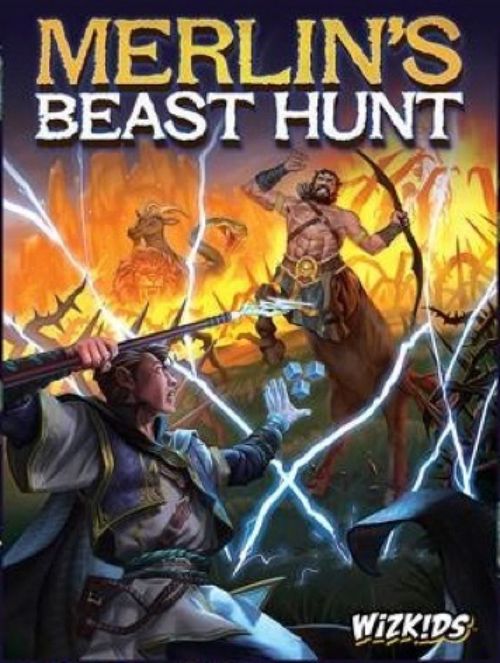
Merlin's Beast Hunt
Merlin's Beast Hunt Rulebook
Table of Contents
Table of Contents
Components
- 80 dice: 20 Player 1 (purple), 20 Player 2 (green), 15 Player 3 (orange), 10 Player 4 (yellow), 15 Neutral (black).
- 1 game board (2 parts). The game board is composed of a grid of 12 squares. There are 3 types of squares: Corner A, Edge B and Central C. At the grid intersections are holes to accommodate dice. Large holes D hold 4 dice and small holes hold 2 dice.
- 64 cards: 16 in each player color. The cards come in 4 types: water, thorns, lightning and bamboo.
- 18 beasts (and 18 bases): 6 Unicorns, 6 Chimeras, 4 Centaurs, 2 Basilisks.
- 35 tokens: 24 2-Victory Point tokens and 20 3-Victory Point tokens.
Object of the Game
Players place their cards on the board to form fences, which will be supported by dice being placed in the holes.
Fences will form enclosures to capture beasts.
The winner is the player who has gained the most points from capturing beasts, as well as placing dice and cards on the board to form fences.
Game Setup
On the previous page, the game board is set up for 3 players (purple, green and orange). Each player has a deck of 16 cards in their color and matching colored dice. The beasts and black "neutral" dice are also placed by the board.
The cards come in 4 types (water, thorns, lightning and bamboo) and form fences when played.
- Players shuffle their decks and deal themselves 4 cards. For ease of play, hands are played face up.
All dice have 4 faces that match the card types. The last 2 faces are a wild face and a beast face.
- For the 2-player game, each player's dice pool is 20 dice (purple and green dice).
- For the 3-player game, the dice pool is 15 dice (purple, green and orange).
- For the 4-player game, the dice pool is 10 dice.
Extra dice are placed back in the box as they are not used.
- From their dice pool, players each select 4 dice - their active dice.
2 VP and 3 VP tokens should be placed within easy reach of all players.
Choose a 1st player randomly. The player to the 1st player's right chooses 1 beast from the 18 beasts and places that beast on any square of the board. Then the 1st player is ready to start their turn.
Game Play
Turns are played in a clockwise direction, starting with the 1st player. Each player's turn consists of 4 phases. Once the phases are done by a player, their turn is over, and it is the turn of the next player.
The 4 phases are:
- Rolling active dice
- Placing dice, cards, and/or beasts on the board
- Checking for and scoring completed fences and enclosures
- Replenishing dice and cards
Phase 1: Rolling Active Dice
Players roll all 4 of their active dice, setting aside any dice they want to keep, but having to set aside at least 1 die.
Players reroll the dice that are not kept.
Players want to match dice icons (thorns, water, lightning and bamboo) to the same images on their cards or the icons of dice and cards already played to the board.
Phase 2: Placing Dice, Cards, and/or Beasts on the Board
Dice, cards, and beasts may be added to the board in any order.
Dice: 0-4 active dice may be added to the board subject to the following rules:
- A. Dice may only be placed in the holes in the board.
- B. Once a die of a given icon is placed in a hole, future dice placed in that hole must have the same icon. Fig. 1 shows an illegal dice placement. The yellow player added 2 thorn dice to the hole that already contained 2 orange bamboo dice.
- C. A die roll with a wild can represent a beast icon or any of the 4 card icons (bamboo, water, lightning or thorn). A die with a wild can be placed in any hole where a non-wild die has already been placed. Only 1 wild die may be used per turn.
- D. When added, dice must form a continuous network with existing dice and cards. Dice must be added to a hole that already contains dice or to an empty hole where an already-placed card reaches the hole.
- E. Once the player's turn ends, all placed dice may not be moved or changed.
Cards: 0-4 cards from a player's hand may be added to the board subject to the following rules:
- A. Cards may only be placed on the board along their long edges and must be supported between a pair of dice on at least one end of the card. A card so placed is called a fence.
- B. The card's image matches the icon on the pair of dice at one end and/or the other (Fig. 2).
- C. If a card is placed that does not match dice at one end, the hole at the opposite end of the card must be able to contain dice of a matching icon. Fig. 3 shows this play. Although the bamboo dice do not match the thorn card, the hole at the opposite end of the card can accept thorn dice. Fig. 4 shows a future turn when the purple player appropriately places 2 thorn dice. Fig. 5 shows an illegal play as the purple dice do not match the thorn card.
- D. Cards may only be added if they add to a continuous network of already-played cards and dice. A card must be placed so as to touch played dice or reach a hole with dice already present in the hole. Fig. 6 shows a continuous network of dice and cards while Fig. 7 shows a discontinuous network.
- E. Once a player's turn ends, all cards may not be moved or changed.
Beasts: Using a die roll showing a beast icon (or a wild used to represent a beast), a single beast may be added to or moved on the board. Multiple beast rolls can be used during a single player's turn. (Though only 1 wild die may be used per turn.)
Beasts are added or moved subject to the following rules:
- A. Players may only add beasts to the empty corner or edge squares of the board.
- B. Players may move beasts to adjacent, non-diagonal squares.
- C. Only 1 beast may occupy 1 square.
- D. No beast may be moved through a fence.
- E. No beast may be added to an already enclosed square.
When using a beast icon roll, the die is not placed on the board nor is it discarded. The die remains as an active die for the next turn.
As the basilisk beast may only be captured on 1 of the 2 center squares, players would need to use 2 beast rolls to get a new basilisk to a central square. 1 roll would add the basilisk to one of the edge spaces and a 2nd roll would move the basilisk to 1 of the center squares. These rolls need not be used during the same turn or even by the same player.
Phase 3: Checking for and Scoring Completed Fences and Enclosures
- A. Look where dice and/or cards were added to the board.
- B. If an added die or card completes a fence (1 card and 2 dice supporting each end), then the fence owner scores for their fence. Black "neutral" dice count toward the completion of a fence and can help with scoring reinforced fences.
- C. Use the chart below to determine the points scored:
| Item | Victory Points |
|---|---|
| Any Fence | 2 VPs |
| Reinforced Fence (the card image matches the support dice icons at both ends of the card, wilds allowed) | +2 VPs |
| Single most color of supporting dice (no wilds allowed) | +1 VP* |
| All support dice colors match the fence color (wilds allowed) | +2 VPs* |
| All support dice colors match the fence color (no wilds allowed) | +3 VPs* |
*The last 3 bonuses are not cumulative. A fence may only score 1 of the last 3 bonuses.
- D. Give VP tokens to the player(s) who scored their fence.
In the example below, the purple player has just placed 2 water icon dice after placing a water fence. Of the 4 fences in play, only the purple fence has all 4 supporting dice and thus scores. The purple player gets 3 VPs (2 VPs for owning the water fence and +1 VP for having the most supporting dice (2 water dice vs 1 orange thorn and 1 yellow wild).
See an additional scoring example on page 7.
- E. If the fences complete an enclosure, place the captured beast before the capturing player to be scored at game's end. The capturing player is the player who plays the last die or card to complete the enclosure. For an enclosure to be legal, all cards and their supporting dice must be played.
Most enclosures will be made up of cards and dice played by multiple players.
-
i. For the 2 central squares, 4 cards each supported by a total of 16 dice will capture the beast (Fig. 8).
-
ii. For the 6 edge squares, 3 cards with a total of 12 dice will surround a beast (Fig. 9).
-
iii. For the 4 corner squares, 2 cards with a total of 8 dice complete an enclosure (Fig. 10).
-
iv. Only single square enclosures are allowed.
-
v. Most beasts have additional requirements for capture as explained in the following chart:
| Beast | How to Capture |
|---|---|
| Unicorn | No additional requirements |
| Centaur | One fence must be a reinforced fence (card image matches all support dice icons at both ends) (Fig. 10) |
| Chimera | Fence cards must have 3 or more different card images (Fig. 9) |
| Basilisk | Four fence cards (only 2 center spaces) (Fig. 8) |
Phase 4: Replenishing Dice and Cards
- A. At turn's end, the player may discard none, some or all of the cards left in their hand.
- B. The player replenishes up to 4 cards from their draw deck. If the players' deck is exhausted, discarded cards are shuffled to form a new deck.
- C. The player adds dice from their dice pool to the sum of 4 active dice. If there are insufficient dice in the player's dice pool, black "neutral" dice are obtained instead. Aside from scoring, black "neutral" dice are subject to the same rules as players' colored dice.
- D. The play shifts to the player on the left.
Depending on how dice and cards are placed, multiple fences can be scored by different players during a single turn, as shown in the example below:
This image shows the board after the orange player has placed 2 bamboo dice into the central hole. 3 fences score, the yellow on the left, the orange in the middle, and the purple on the right.
The yellow fence has 3 yellow dice (2 thorns at one end and 1 bamboo at the other) as well as 1 orange die (bamboo). The yellow player receives 3 VPs (2 VP for the fence card itself + 1 additional VP for contributing the most of their color dice to supporting the fence (3 vs 1)).
The purple fence has 2 purple dice (bamboo on the left and wild on the right) and 2 orange dice (bamboo on the left and water on the right). The purple player receives 2 VPs for the purple fence card and no additional VPs as there are more orange dice than purple dice supporting the fence (the wild die does not count).
Only orange dice support the orange bamboo fence card and all the dice are bamboo (no wilds). Thus, the orange player receives tokens equaling 7 VPs - 2 for the fence card, +2 for being reinforced (bamboo at both ends of the fence card), +3 for all supporting dice being orange (and no wilds). Additionally, the orange player completes the enclosure, capturing the Unicorn beast. They take the Unicorn and place it in front of them. This will score 5 VPs at game's end.
Game End
The game may end in 1 of 2 ways:
- When one player no longer has any of their colored dice in their active dice. The remaining players may take 1 more turn each.
- When all holes contain their maximum allotment of dice and all grid lines have a fence, the game ends at the end of the turn.
Final Scoring
Players receive VPs for beasts they have captured.
Use the following chart to determine the VPs awarded for each captured beast:
| Beast | Victory Points (VPs) |
|---|---|
| Unicorn | 5 VPs |
| Centaur | 7 VPs |
| Chimera | 8 VPs |
| Basilisk | 10 VPs |
Total the sum of VPs gained during the game and those gained for capturing beasts: the winner is the player with the most VPs.
With a tie score, the player with the most beasts wins. If there is still a tie, the player with the most high-scoring beasts wins. If there is still a tie, the player with the most reinforced fences wins. In the really unlikely event of a continued tie, the player with the most high-scoring fences wins. If there is still a tie, the game ends in a tie.