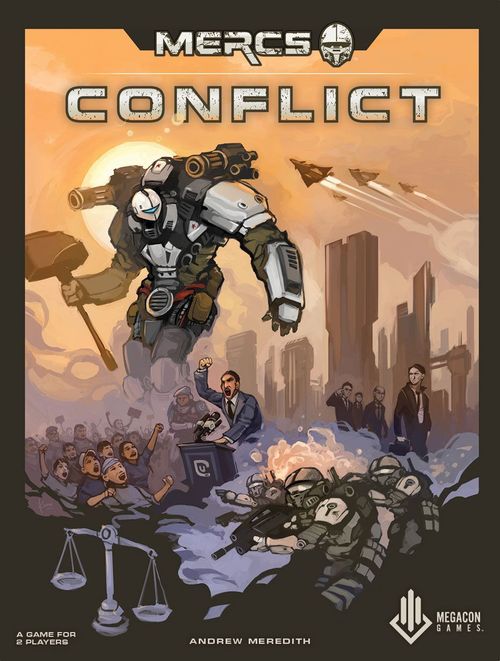
MERCS: Conflict
MERCS: Conflict Rulebook
Table of Contents
Table of Contents
Components
- 4 MegaCon sheets. A MegaCon sheet holds all the information a player needs to play that MegaCon. The sheets differ in their unique Corporate Abilities, their MERCS contracts, and their Influence abilities, which trigger when the matching face appears on a die.
- 5 reference cards. The reference cards give a complete breakdown of every die in the game and describe the action of each face.
- 15 yellow Infrastructure dice. Infrastructure dice represent the MegaCon's basic Resources: its market and economic foundation.
Asset dice
The green Politics dice, blue Espionage dice, grey Economy dice and red Military dice are collectively called Assets.
- 10 green Politics dice. These represent the MegaCon's ability to manipulate the system through the talent of its orators and lawyers.
- 10 blue Espionage dice. These represent the MegaCon's ability to interfere in the affairs of other MegaCons and disrupt their plans.
- 10 grey Economy dice. These give more resources than the standard Infrastructure dice, and include MegaCon abilities that trigger on certain faces.
- 10 red Military dice. These represent the MegaCon's military power across the world, and include the trigger for the MERCS contract, a force ready to destroy enemies on behalf of its MegaCon.
- 2 white Leadership dice. The Leadership die, which is most often used once per game, gives whoever rolls it a bonus unique to each face.
- 1 damage die. A standard six-sided die, used for any roll that involves chance.
- 1 ten-sided turn die. This shows the current round of the game. One game of MERCS: Conflict lasts 10 rounds.
- 8 sector block tokens. When a sector is blocked, these tokens are used to show this on the MegaCon sheet.
Examples of play are set in italics in the original rulebook. The source text used for this transcription does not preserve italics, so examples appear here as ordinary paragraphs, each introduced by the player or MegaCon concerned.
Setup
Before the game begins, each player chooses a MegaCon sheet and places it in front of them. Roll the six-sided die to determine the first player. Place the dice and block tokens in the centre of the table, the shared play area. Then each player prepares their MegaCon sheet by following these rules:
- Place one Infrastructure die on each Corporate sector square marked in yellow. This is the maximum supply of Infrastructure dice your MegaCon can have.
- Each MegaCon sheet has one colour-marked square in the Corporate sector. It denotes the one Asset die the MegaCon starts the game with. Take that die and place it on the marked spot.
- Take the Leadership die and place it in the white-marked Reserve sector.
Play Area
- MegaCon sheet. Tracks the corporation's abilities and holds the player's dice.
- Spent dice pool. When a die is spent, or is waiting to be moved during the Resolution phase, it is placed here.
- Discard pool. When an Infrastructure die is damaged by an opponent's attack, or is removed from play by an Asset, it is placed here.
- Resource sector. Dice chosen during the Planning phase are placed here. After they are rolled, the dice are lined up here so the opponent can plan attacks against the faces shown.
- Reserve sector. When dice with a Reserve ability are rolled, they can be placed here by paying the Reserve cost. At the start of the game you have access to only 2 Reserve sectors; the third is occupied by the Leadership die and becomes free only when that die is used.
- Corporate sector. Helps the player keep track of the number of dice and is the main target of an opponent's attacks. If your Corporate sector is empty, the game is over and you have lost.
The Corporate sector contains:
-
Politics sector
-
Espionage sector
-
Economy sector
-
Military sector
-
Corporate abilities. Actions unique to each MegaCon that it can use against an opponent. Some abilities work constantly, some require conditions to be met, and others require paying a cost to use.
-
Influence ability. Each MegaCon has a unique Influence ability, which activates when the matching symbol appears on an Economy die. Activating an Influence ability is always optional.
-
MERCS contract. When the MERCS face appears on a Military die, the player may choose to activate the MERCS contract ability, which is unique to each MegaCon.
-
Shared play area. The centre of the table, where dice and tokens that have no owner are kept.
Rules of Play
A game of MERCS: Conflict lasts 10 rounds. At the start of each round the players choose dice from their Corporate sector, roll them, and then, based on the faces shown, carry out actions. These actions may be unique abilities of each MegaCon, or common Assets.
Goal of the Game
After 10 rounds, the player who has kept the most dice in their Corporate sector is declared the winner. Spent dice and dice in the Reserve sector are not counted.
Each round consists of 3 phases:
- Phase 1: Planning. Players simultaneously choose dice to roll and place them in the Resource sector.
- Phase 2: Execution. Players take turns in initiative order, spending the resources of their dice to activate abilities.
- Phase 3: Resolution. Players simultaneously return dice to the Corporate sector and prepare for the next round.
Detailed Rules
Phase 1: Planning
- Advance the round counter.
- Choose dice.
- Move them to the Resource sector.
- Determine initiative.
- Roll, and without changing the faces, arrange the dice in the Resource sector.
- Reset block tokens.
Advance the round counter. Turn the ten-sided die to the next side in sequence.
Choose dice. At the start of the Planning phase, each player chooses from their Corporate sector the dice they will use this round. Dice may only be chosen from the Corporate sector, and at least 1 must be chosen. The sole exception is the Leadership die: once per game it may be taken from the Reserve sector and used together with the others. After it is used, it is placed in the discard pool.
If this is your first game, we strongly recommend that in the first round you use as many Asset dice as possible alongside your Resource dice. Still, keep a couple of dice in the Corporate sector just in case.
CCC and USCR each start the game with 7 Resource dice. CCC starts the game with one Military Asset die and intends to use it right away, so that it can "chop the beast of the East" as quickly as possible. USCR starts the game with one Politics Asset die, because it needs the greatest possible protection against CCC's attacks. Fortunately, protection is exactly what a Politics Asset is good at.
Move them to the Resource sector. Once the players have decided which dice to roll and how many, they place them in the Resource sector. At this point the faces do not matter. What matters is that the Leadership die does not occupy a space in the Resource sector. (The exception is EU, Inc.: its corporate ability Executive Training requires the Leadership die to take a space in the Resource sector when it is rolled.)
Example: the player for CCC takes 6 dice to roll, since their Resource sector is limited to 6 spaces. They decide to roll 5 Infrastructure dice and their single Military Asset. They place all of them into spaces in the Resource sector.
Example: the player for USCR decides to use 4 Infrastructure dice, their single Politics Asset and the Leadership die. The USCR Resource sector is limited to 5 spaces, but because the Leadership die does not occupy a space, they are entitled to do so.
Time is valuable. To speed up this phase, it is considered that once a player has taken their hand off a die placed in the Resource sector, they may not undo that action. Players must also announce aloud, once all preparations are complete, that they are finished. Dice whose position the player forgot to change automatically go to the spent dice pool.
Redistributing resources. At the same time as moving dice into the Resource sector, a player may redistribute the Infrastructure dice remaining in the Corporate sector as they see fit, without being limited to the yellow-marked squares. If, as a result, one of the Asset sectors is filled completely with dice, the use of dice from that Asset costs 1 less (to a minimum of 0).
Example: the player for CCC decides to fill their Military sector with 1 Military Asset die and 3 Infrastructure dice. In that case the use of ANY other Military Assets costs 1 less, for as long as the Military sector is completely full.
Determine initiative. After the players have finished arranging their dice, they must say aloud how many dice each of them has in the Resource sector (including the Leadership die). The player with more dice in the Resource sector holds initiative until the end of the round.
If the count is tied, the players look at the Asset dice they have chosen. The priority of Asset dice for determining initiative follows their order on the Corporate sector: Politics > Espionage > Economy > War. In other words, if the number of dice in the Resource sector is equal, the player who also has a Politics Asset in that sector keeps initiative this round.
If all the Assets are also tied, initiative is decided by rolling the six-sided die.
Example: USCR and CCC each have 6 dice in the Resource sector. However, USCR has placed a Politics Asset, so USCR keeps initiative.
Roll, and without changing the faces, arrange the dice in the Resource sector. The players simultaneously roll the dice to the right of their MegaCon sheets (so that they do not get mixed up with the dice in the shared play area and the spent dice pool). Then the players return the rolled dice to the Resource sector without changing the faces shown.
Several abilities use the mechanic of "Reveal." These abilities trigger immediately when the rolled dice are returned to the Resource sector. All of them must be resolved immediately, because they can affect the later phases of the round. For example, the ability "Ambitious Move" counts the Leadership die as 2 dice, which can change initiative in the later phases of this round.
Example: the player for CCC rolls their 6 dice. On 3 Infrastructure dice they get 2 resources each. On the other 2 Infrastructure dice they get 1 resource each. On the Military Asset die they get the ability "Strike," costing 1 resource.
Example: the player for USCR gets 2 resources on one Infrastructure die and 1 each on three others. The Politics Asset shows the face "Legislation," and the Leadership die shows the face "Fortress." Because "Fortress" has the Reveal mechanic, the player may apply it immediately. In this case they decide to change the face of the Politics Asset from "Legislation" to "Reparations."
Excess. If a player rolls more dice than their Corporate sector can hold, the entire excess is discarded at the end of the Resolution phase.
Reset block tokens. If the MegaCon sheet has block tokens on it, remove all of them before moving on to Phase 2 of the round.
Phase 2: Execution
- Reserve dice.
- Take actions:
- activate a corporate ability
- acquire an Asset
- activate a die
- deal damage to an opponent
- block a sector
Reserve dice. Several abilities use the mechanic of "Reserve." Before the player holding initiative takes their first action, the players simultaneously select the abilities with the Reserve mechanic and resolve them, paying their cost. After this, these dice must be placed in the Reserve sector. This means that if the player has not yet used the Leadership die, they can use and send only 2 dice to Reserve in a turn.
Example: the player for USCR used their Politics Asset with the face "Reparations," which has the Reserve mechanic. It costs 0, so the player may resolve it immediately, without paying any resources, and place it in the Reserve sector, which is what they do.
Take actions. Starting with the player who holds initiative, players take turns carrying out actions, one at a time. A player may also pass on their turn. In that case they end their turn completely, sending all dice remaining in the Resource sector to the spent dice pool.
-
Activate a corporate ability. Activating some corporate abilities costs resources. These abilities may only be activated during the turn of the player who owns them. A corporate ability may be activated no more than once per turn, unless its description says otherwise. Corporate abilities whose activation does not cost resources are used according to their descriptions on the MegaCon sheet.
-
Acquire an Asset. Once per round, a player may acquire an Asset. This can be done in one of two ways.
- A player may, on their turn, spend 4 resources to acquire an Asset of any colour. The acquired Asset is placed in the spent dice pool, together with the resources spent to acquire it.
- Or, a player may spend 3 resources and exchange any of their unspent Assets or Infrastructure dice for any Asset they need. This Asset is also placed in the spent dice pool, together with the resources spent to acquire it. The exchanged die is returned to the shared play area.
When acquiring Assets, remember that you may not have more Assets than the spaces for them on your MegaCon sheet. You must also account for the space needed by Infrastructure dice, which must always occupy their starting spaces. For example, CCC has two spaces in the Espionage sector, one of which is occupied by an Infrastructure die. Until CCC exchanges that Infrastructure die, the second space is not free for an Espionage Asset.
Example: USCR holds initiative, so it acts first. It decides to acquire an Asset by spending 4 resources. The Infrastructure dice it spent go to the spent dice pool. Then it decides that it needs a Military Asset, and moves 1 red die from the shared play area to its spent dice pool.
-
Activate a die. A player may activate any die (Asset or Leadership die) in their Resource sector by paying its activation cost. Most Assets can be used without a response from the opponent. The exception is abilities with the "Attack" mechanic: the opponent may block or cancel them with abilities that have the "Block" property. If the activation of a die requires a target, the player chooses the target, unless the Asset's description says otherwise.
Resources cannot be split. For example, if a player has 2 resource dice with values of 2, and an ability's activation requires 3 resources, they must give up both dice, and they do not receive change.
Example: on CCC's turn, it decides to activate the "Strike" ability from its Military Asset. This costs it 1 resource. Seeing this, the player for USCR uses the "Reparations" ability from its Politics Asset. It now has a choice: either receive 2 resources for the opponent activating its Military Asset, or increase the activation cost of the Military Asset for the opponent by 2. It chooses the latter. Now, for CCC to activate "Strike," it must spend 3 resources. CCC sends these resources to its spent dice pool, and USCR sends its played Politics Asset to its own spent dice pool.
If you have another copy of the game, you may play with three or four players. In that case, any player who chooses as a target an opponent who has already been attacked by another player receives an activation cost increase of +1 for each player who has already attacked that opponent this round.
-
Influence ability. Each MegaCon has a unique Influence ability. When a die shows the "Influence" face, the player may use this ability by paying its cost. Reserving such a die follows the normal rules.
-
MERCS contract. Each MegaCon has a unique MERCS ability. When a die shows the "MERCS" face, the player may use this ability by paying its cost. Reserving such a die follows the normal rules.
-
Deal damage to an opponent. Damage to an opponent, unless stated otherwise, is dealt to a specific sector and always at random (using the six-sided die). To determine the sector, roll the damage die. The number shown on the die is the sector that takes the damage. When a sector takes damage, the player who controls it chooses one die from that sector and sends it to the discard pool. Damaged dice are always sent to the discard pool.
Example: the player for CCC activated the Military Asset "Strike" and rolled a 2 on the damage die. The Politics sector of USCR has only one die, so the opponent is forced to send that die to the discard pool.
-
Block a sector. If, for one reason or another, no dice remain in a sector, then when that sector takes damage it is considered blocked. A blocked sector follows these rules:
- Blocking a sector applies to all Assets belonging to it. That is, if a sector is blocked, the player may not use the abilities of that sector's Assets until the block is lifted. However, resources may still be used, regardless of where the die is located (Resource sector or Reserve). This rule does not apply to Infrastructure dice.
- If the Resource sector is blocked, none of the dice lying there may be activated and, if the block is not lifted in the Planning phase, dice may not be placed there either.
- If the spent dice pool is blocked, all spent dice are considered damaged and are sent to the discard pool.
- A block may be lifted at any time by damaging any die in the Corporate sector. For example, the spent dice pool of CCC is blocked, and USCR uses the ability "Excuse" to send a die from CCC's Corporate sector to the spent dice pool. That die will be considered damaged and will go to the discard pool, unless CCC voluntarily sacrifices another die from its Corporate sector to lift the block on the discard pool. That is, a die already taking part in some mechanic may not be sacrificed. If a player forgets, or for some reason does not lift the block on the spent dice pool before moving dice there, then all those dice are considered damaged, and that moment may not be replayed.
Phase 3: Resolution
- Redistribute dice to the Corporate sector.
- Determine whether the game has ended.
Redistribute dice to the Corporate sector. During the Resolution phase, the players simultaneously distribute their dice across their territories. They must return all dice from the spent dice pool to the Corporate sector.
In the Resolution phase, unspent dice in the Resource sector are NOT removed.
If a player has a blocked sector, dice may not be placed there until the block is lifted. If the player decides not to lift the block, all dice that were to be placed there remain in the spent dice pool.
Assets may only be redistributed to their own sectors. Infrastructure dice may only be redistributed to the sectors marked with a yellow triangle.
Always remember that a player may under no circumstances have more Assets than their MegaCon sheet allows.
Determine whether the game has ended. If the round counter shows 10 at this stage, the game ends.
End of Game
The game may end early for several reasons.
- If a player has no dice left in their Corporate sector, the game ends immediately with their defeat.
- If a player cannot move a single die into the Resource sector, the game ends immediately with their defeat.
Only the Corporate sector matters for determining a player's defeat. A player may have six dice under their control in other sectors (Reserve, spent, Resource), but as soon as their Corporate sector loses its last die (however that happens), the player is eliminated.
If, after 10 rounds (that is, at the end of the tenth Resolution phase), no winner has been determined, the game ends. The player who keeps more dice under their control is the winner. In the event of a tie, the winner is determined by the initiative rules, with the one difference that the Leadership die is taken into account. That is, if the players are equal in number of dice but one player still owns their Leadership die, that player wins. If this does not settle it, follow the hierarchy of your Corporate sectors. If that still does not settle it, a final battle called "The Eleventh Hour" is declared.
The Eleventh Hour
If the players are completely tied at the end of ten rounds, a special eleventh round is played. In this last, bloodiest battle between MegaCons, only damage matters. In this round, using Assets does not send dice to the spent dice pool; instead, they return to the Corporate sector. The only way to put a die into the spent dice pool is through abilities that directly force it (for example, "Overthrow"). Also, all damaged dice go to the spent dice pool rather than the discard pool. At the end of the round, the player with fewer dice in their spent dice pool is declared the winner.
Glossary
- Attack - dealing damage to an opponent
- Block - cancelling abilities that have just been played
- Blast - dealing damage to several opponents
- Control - influencing the dice of an opponent
- Finance - abilities that can be exchanged for resources
- Intrigue - changing the location of an opponent's dice
- Recovery - getting your own dice back, bypassing the basic rules
- Reserve - abilities that can be planned
- Reveal - abilities that trigger in the Planning phase
- Special - something unique, specifically described on the MegaCon sheet