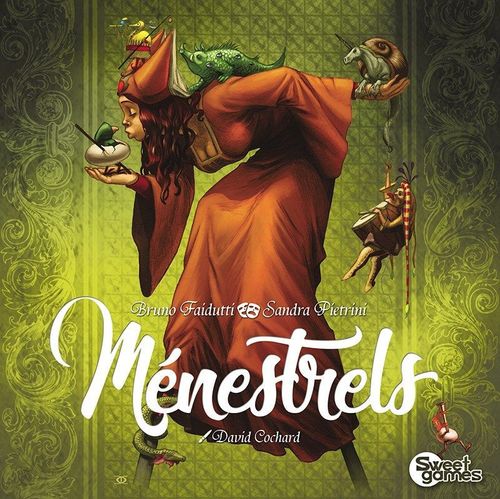
Ménestrels
Ménestrels Rulebook
Table of Contents
Table of Contents
Components
- 9 Noble cards
- 60 Artist cards
- 1 King card
- 2 Reminder cards
- 40 gold coins (30 worth 1 and 10 worth 5)
- 3 bubble tokens (for the Bishop)
Setup
- The 2 Reminder cards are made available to the players.
- Each player receives one Noble card. The Noble cards may be dealt at random or chosen by the players. Each player reveals his Noble card and presents its power to the other players. Noble cards that are not dealt out are removed from the game.
- Each player receives gold coins according to the number of players:
- 5 players: 4 coins
- 4 players: 5 coins
- 3 players: 7 coins
- 2 players: 8 coins
- Special case: the Marquis or the Prince starts the game with a different number of gold coins.
- The King card is set aside, then the Artist cards are shuffled.
- The first four cards of the deck are placed face up in the centre of the table. This forms the market (place du marché).
- The other cards form the draw pile.
- The King card is shuffled into the last ten cards of the draw pile.
- The draw pile is placed face down next to the four face-up cards.
- The player holding the lowest-ranked Noble goes first. Play then continues clockwise.
- Two-player game: remove 15 cards from the game without looking at them, and return them to the box.
The Player's Turn
On his turn, a player must do one of the following:
- Take one of the four Artist cards visible in the market. He places it face up in front of him, in his company. Artists of the same type (musicians, acrobats, etc.) have a background of the same colour and may be arranged in a column, slightly offset so that they are all visible. He then reveals the top card of the draw pile, which replaces the card he took.
- Draw the top card of the draw pile. He keeps it in his hand, hidden from the other players.
- Gain one gold coin. In that case he takes no card.
Some rules apply to specific cards:
- Cards with a gold coin cost. Some artists have a gold coin on both the front and the back of the card. When a player takes such a card, whether it is visible or hidden, he must pay one coin. Most cards costing a coin are artists that either count double, or can be placed in two categories (for example, a dancer may be an acrobat or a musician). A player who takes such a card does not have to decide immediately which category he places it in; he makes that choice at the end of the game.
- Cards with an ACTION symbol in the upper left corner have an immediate effect when a player takes them. If a player draws such a card face down, he cannot keep it secret in his hand: he must reveal it, add it to his company, and apply its effects.
- Grey-background cards are not really artists. They have an effect either when a player takes them or later in the game, and are then discarded.
Special cases:
- If a player has no gold coins left and every available card costs one gold coin, he can only gain one gold coin, without taking a card.
- If a player takes a card whose effect cannot be applied (for example, the Falconer when no player has a hidden card), that effect is ignored.
Noble Cards
Each Noble has a rank, which determines the first player and the order in which the players prepare their party, and a unique special power:
- 9 – Prince: The Prince may pay one gold coin to take two free cards instead of one. One of them may be taken from the draw pile. With fewer than 5 players, he starts the game with fewer gold coins.
- 8 – Marquis: The Marquis starts the game with additional gold coins.
- 7 – Princess: The Princess may look at the top card of the draw pile before choosing her card.
- 6 – Viscount: The Viscount scores 9/6 points instead of 6/3 if he is first/second for the Interpreters (blue).
- 5 – Viscountess: The Viscountess scores 9/6 points instead of 6/3 if she is first/second for the Acrobats (yellow).
- 4 – Duke: If the card the Duke has taken allows him to form a pair of visible cards, he may play again. This may mean revealing the card he has just drawn face down, and/or one of his other hidden cards. Special case: if the Duke forms a pair of illusionists, he plays twice.
- 3 – Count: At the end of the game, the Count wins all ties: for wealth, for the different categories, and even for victory.
- 2 – Bishop: Three times during the game, the Bishop may spend a bubble token to say "no" to a player taking a card. That player must then make another choice.
- 1 – Baron: The Baron plays first and prepares his party last. He has no special power.
Players with less powerful Nobles therefore prepare their party knowing how the more powerful Nobles arranged theirs.
End of the Game
The game ends immediately when the King card is turned face up or is drawn by a player.
If a player has the Impostor, he may play one last time before the end of the game.
Final Arrangement
In descending order of rank (starting with the Prince, then the Marquis, and so on), each player reveals the cards in his hand and arranges all the cards in his company into the different categories.
Two-coloured cards, like the three-coloured dwarves, must be assigned to one specific artist type (INTERPRETERS, MUSICIANS or ACROBATS) and placed in the column corresponding to that category.
Scoring
Scores are calculated for all players at the same time, using the gold coins to count points.
Wealth (gold coins). First, determine the player who has the most gold coins left. He scores 2 points. He keeps two coins and returns the rest, while the other players return all their coins. If he has fewer than two coins, he takes the missing coins.
Categories. Next, determine the players with the most cards in each of the three main categories: Musicians (red), Acrobats (yellow) and Interpreters (blue). The categories are considered one after the other.
- Musicians: the player with the most Musicians scores 8 points, and the second-place player scores 4 points (*).
- Acrobats and Interpreters: in each of these categories, the player with the most artists scores 6 points, and the second-place player scores 3 points (*).
- Artists with a "two cards" symbol are particularly appreciated, and therefore count as two Artist cards.
Women. The player with the most female artists scores 4 points. Artists with a "two cards" symbol do not count as two women.
Animal trainers. The Animal Trainers (green) are worth 1 or 2 points each (as indicated on the card).
Couples. Each pair of cards forming a couple (for example, Storyteller male/female, Dwarf male/female, and so on) scores 1 point. Couples are recognised by their name and by the victory-point icon shared by the two cards.
* The second-place score is not counted in a two-player game.
Summary of the scoring table (as printed on the rulebook's last page):
| Category | 1st | 2nd |
|---|---|---|
| Wealth (gold coins) | 2 | – |
| Musicians | 8 | 4 |
| Interpreters | 6 | 3 |
| Acrobats | 6 | 3 |
| Women | 4 | – |
| Animal Trainers | 1 or 2 per card | – |
| Couples | 1 per couple | – |
Ties in a category. The Count wins ties. If the Count is not one of the tied players, the tied players share the points, rounded down. For example, two players tied for first in Musicians each score 6 points (the 8 and 4 points combined, divided by two), and two players tied for second in Musicians each score 2 points.
Ties for victory. The Count wins the tie. If the Count is not one of the tied players, the highest-ranked Noble wins the victory.