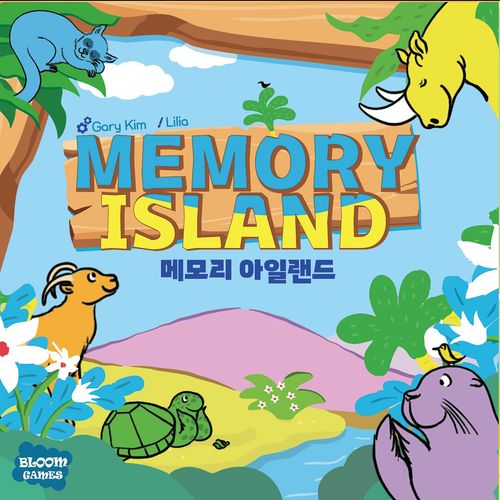
Memory Island
Memory Island Rulebook
Table of Contents
Table of Contents
Contents
48 Cards: 8 "1", 6 "2", 5 "3", 5 "4", 4 "5", 4 "6", 3 "7", 3 "8", 3 "9" and 7 "10".
Set Up
Shuffle all cards and lay them face down in a 6x8 form. Start with the player who visited the island most recently.
How to Play
- On your turn, choose the cards you want and reveal them one by one.
- As soon as the sum of the revealed cards reaches 10, you acquire all the revealed cards and your turn ends. The acquired cards are laid out faceup in front of you so that anyone could see the numbers and how many cards you have.
- If the first card revealed is '10', acquire the card immediately and proceed a turn once more (if the next first card revealed is another '10', take another turn again).
- If the sum of the revealed cards is greater than 10, the turn ends immediately and the cards are turned face down again in their place.
- When the current player has completed his turn, the next player proceeds in a clockwise direction.
Example 1) The first revealed card is '5', the next is '2', and the next is '3'. Since 5+2+3=10, take all 3 revealed cards, place them in front of you, and end your turn.
Example 2) The first revealed card is '4', and the next is '7'. 4+7=11 over 10, so the turn ends immediately. '4' and '7' are placed face down.
Example 3) The first card revealed is '10'. Take that card, put it in front of you, and take one more turn.
End of the Game
The game ends immediately when one of the two conditions is met.
- When someone places exactly 10 cards in front of him, the game ends with that player winning.
- The game ends immediately when all 7 '10' cards (by one or several players) have been acquired. In this case, the player with the most cards in front of them wins. If it is still the same, the person with more '10' cards wins. If the number of '10' cards is the same, they share the victory.
Important! You may not have more than 10 cards in any case.
For example, if you currently have 8 cards in front of you, you can get 2 more cards. If it is your turn and you reveal 2 cards and their sum is less than 10, you cannot win this turn, but you still have to reveal cards until the sum of your revealed cards is 10 or more. As soon as the sum of the revealed cards reaches 10 or more, the turn ends with all cards face down. If you currently have 8 cards, and the first card you reveal on your turn was '10', now you have a total of 9 cards. So, to win, you need to find one more '10' card.
Variant Rules for the Experts
The following two rules can be applied individually or together.
- Unorgnized Island: When preparing for the game, place them in a random form instead of 6x8.
- Luck calls luck!: If you have acquired a card this turn, take another turn immediately. There is more luck factor and the game ends faster than the usual.
Animals of Memory Island
The animals of Memory Island are endangered species. Please remember and protect the animals that are disappearing due to environmental pollution and poaching!
-
The black-and-white ruffed lemur is an endangered species of ruffed lemur, one of two which are endemic to the island of Madagascar. Despite having a larger range than the red ruffed lemur, it has a much smaller population that is spread out, living in lower population densities and reproductively isolated. It also has less coverage and protection in large national parks than the red ruffed lemur. Three subspecies of black-and-white ruffed lemur have been recognized since the red ruffed lemur was elevated to species status in 2001.
-
The green sea turtle, also known as the green turtle, black (sea) turtle or Pacific green turtle, is a species of large sea turtle of the family Cheloniidae. It is the only species in the genus Chelonia. Its range extends throughout tropical and subtropical seas around the world, with two distinct populations in the Atlantic and Pacific Oceans, but it is also found in the Indian Ocean. The common name refers to the usually green fat found beneath its carapace, not to the color of its carapace, which is olive to black.
-
Pangolins, sometimes known as scaly anteaters, are mammals of the order Pholidota. The one extant family, the Manidae, has three genera: Manis, Phataginus, and Smutsia. Manis comprises the four species found in Asia, while Phataginus and Smutsia include two species each, all found in sub-Saharan Africa. These species range in size from 30 to 100 cm (12 to 39 in). A number of extinct pangolin species are also known.
-
The long-tailed goral or Amur goral (Naemorhedus caudatus) is a species of ungulate of the family Bovidae found in the mountains of eastern and northern Asia, including Russia, China, and Korea. A population of this species exists in the Korean Demilitarized Zone, near the tracks of the Donghae Bukbu Line. The species is classified as endangered in South Korea, with an estimated population less than 250. It has been designated South Korean natural monument 217. In 2003, the species was reported as being present in Arunachal Pradesh, in northeast India.
-
Tristram's woodpecker is a Korean subspecies of the white-bellied woodpecker. Tristram's woodpecker, with its 46 cm length, is among the largest of all woodpeckers. Both the tuft and the cheek patches are crimson red; its upper parts are black, which contrast with its white underparts, wing tips and a white rump. It has four toes, of which two are directed backwards. Its tail feathers are firm. Its native name was derived from its strange call, which sounds like "kullak!"