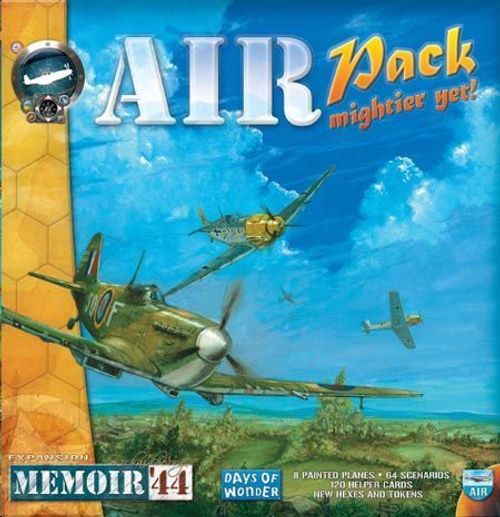
Memoir '44: Air Pack
Memoir '44: Air Pack Rulebook
Table of Contents
Table of Contents
The Air Rules
Memoir '44 - Air Rules
In standard games of Memoir '44, the impact of aviation on the battlefield was limited to the occasional play of an Air Power card, whose effect was designed to simulate the indirect and relative strength of Allied versus Axis air power during the later years of the War. With the introduction of the Air rules and the appearance of new Airplane units of various nations onto the battlefield proper, the war is about to quite literally take another dimension. The pages that follow tell you how...
How and When to Use Air Rules
All of the scenarios enclosed in this book may now be played using these accompanying Air rules.
Playing an Air Sortie Card
Unless specified otherwise in the scenario's Special rules section, when players agree that Air rules are in effect, each player receives one new Air Sortie card in his hand at the start of the game.
When Air rules are in effect, an Air Sortie card may be played during a player's turn, like any other Command card in the player's possession.
The Air Sortie card is used to fly an Airplane of the player's nationality (or as dictated by the Scenario) onto the battlefield; the Airplane enters the battlefield, airborne, anywhere on an edge hex of the player's choice. Edge hexes are all the full (not half) hexes that border the entire game board's four sides.
This card is placed face up, next to the player's cardholder and visible to his opponent. The card does not count towards the player's total set of Command cards received at game's start.
From there on, this airborne Airplane is considered one of the player's units, and follows the same sequence of phases (Orders, Movement, Air Battle Action) as all other units in the game.
Furthermore, if at any point during the game, an Air Sortie card is drawn from the deck (after it had been played, discarded and reshuffled, or because it was directly shuffled in the deck to start with), it is immediately placed face up next to the cardholder of the player who drew it, and this player immediately draws an additional Command card.
Unlike other Command cards, no new Command card is ever drawn to replace the Air Sortie, at the end of the turn during which it was played.
These two new Air Sortie Command cards can be found in the deck of Summary cards that comes with your Air Pack.
In some scenarios, Air rules are now compulsory rather than optional (i.e. the Scenario must be played using them), and the starting conditions for each player might then differ: One side might receive both Air Sortie cards, in a clear sign of air superiority over the opposite camp; the Air Sortie cards might be shuffled into the deck instead of handed out at game's start; etc...
However, when countering an opponent's Air Sortie with the play of a Counter-Attack card, you still draw a replacement card for your Counter-Attack.
Unlike other Command cards, the Air Sortie card may also be played in conjunction with a Section card. In this case, it acts as a modifier to the Section card, letting the player use one order from the Section card just played to make an Air Sortie in the corresponding section while simultaneously issuing the remaining orders to other units on the ground! At the end of the turn, the Section card is replaced as normal, but no card is drawn to replace the Air Sortie card played along with it.
The starting conditions that apply will be clearly specified in the scenario's Special rules section.
When countering an opponent's Air Sortie played in conjunction with a Section card, the Counter-Attack card only lets you counter his Section card, not the Air Sortie played along with it.
One Airborne Airplane per Player Max!
Playing an Air Sortie Equivalent
If a player plays an Air Sortie card (or equivalent) when he already has an airplane unit on the battlefield, the card's effect is to order this particular Airplane for the turn with no Air check required (see Air Check Roll p. 8).
In addition, when Air Rules are in effect, Air Power cards must be played as if they were Air Sortie cards instead; And cards that are deemed equivalent by the Scenario's Special rules - such as a Recon 1 card when Air Strikes & Blitz rules are in effect -, may be played, at the player's option, as indicated on the card (e.g. a Recon 1) OR as an Air Sortie card instead. Unlike true Air Sortie cards, these cards are never placed face up nor shown to the other player beforehand; they can never be played in combination with a Section card; and they are replaced as normal, once played, at the end of the player's turn.
If the card played as an Air Sortie is a Recon 1 card (as might be the case for an Axis player under Air Strikes & Blitz rules, for instance), the player is still subject to the initial card's Section limitation when playing it; i.e., the card can only be played to start an Air Sortie from an edge hex of the matching board's section; and if the Airplane is already airborne, the card's Recon section must match the section of the board over which the Airplane is currently loitering.
Card note: with Air Strikes & Blitz rules in effect for the Axis, this Recon 1 card may be used to make an Air Sortie instead. The Airplane must make its entry onto the battlefield through one of the edge hexes highlighted above.
In any given turn, there can only ever be a maximum of one airborne Airplane unit on the battlefield for each player.
Alternatively, the player may opt to let its Airplane disappear off the board and initiate a new Air Sortie with a fresh Airplane instead!
When an Air Sortie equivalent is countered with a Counter-Attack, it must be played the same way as the initial card was; i.e., as an Air Sortie if the card was played that way, and per the countered card's normal effect otherwise.
From here on, any mention of an Air Sortie card in the pages that follow refers and applies to the Air Sortie card itself AND to any equivalent of it as may be allowed by the Scenario's Special rules.
Airplane Selection
The Air Pack introduces 8 different types of aircrafts: the American Curtiss P-40 Warhawk, Lockheed P-38 Lightning and Vought F4U Corsair; the British Supermarine Spitfire; the German Fieseler Fi 156 Storch and Messerschmitt Bf 109; the Japanese Mitsubishi A6M Zero; and the Russian Yakovlev Yak-1/7/9.
When an Air Sortie is made, if no specific Airplane was assigned in the Special rules of the scenario being played, the following guidelines must be used to select a proper aircraft type:
Scenarios featuring British Forces (and Allied nations not on this list)
- Spitfire: entire war, all theaters
- P40: August 1941 onward, Mediterranean Theater
- Corsair: Carrier-based from June 1943, Pacific Theater
Scenarios featuring German Forces (and Axis nations not on this list)
- Storch: entire war, all theaters
- Me109: entire war, all theaters
Scenarios featuring Japanese Forces
- Zero: entire war
Scenarios featuring Soviet Union Forces
- Yak-1 (use same model as Yak-9): entire war
- Yak-7 (use same model as Yak-9): entire war
- Yak-9: from October 1942 onward
- P40: from January 1942 onward
Scenarios featuring United States Forces
- P38: entire war, all theaters
- P40: entire war, all theaters
- Corsair: ground-based Marine squadrons from January 1943; based on carriers from September 1943, Pacific Theater
Orders
An Airplane that enters the battlefield via an Air Sortie card (or any card deemed equivalent by the Scenario's Special rules) is considered ordered for the turn, and does not require another order until the next turn.
Once on the battlefield, an Airplane is ordered like any other unit in the game, at the cost of 1 Order from a matching Section card or from Direct from HQ. The Airplane may also be ordered at the cost of 1 Order if a Star is rolled while playing Their Finest Hour... or via the play of another Air Sortie card (or equivalent).
Keep 'em flying! Rule: Once airborne, an Airplane must be ordered every turn, during the Orders phase; otherwise it must be removed from the battlefield, at no Medal cost to its owner, when its player fails to order it again.
Pre-positioned and On the Ground Airplanes
When indicated in a Scenario's map or Special rules section, some Airplanes may be pre-positioned and deployed on Airfields or Aircraft Carriers at the start of a game.
An airplane model of the corresponding nationality must be placed on the corresponding hex, during the game set-up.
Such an Airplane is considered landed or on the ground, and does NOT need to be ordered until the turn during which its player wishes it to take-off and leave this hex. At that point, the Airplane may be ordered, using a single order from a Section card or applicable Command card, much like other units are ordered in the game.
This means that pre-positioned Airplanes do not require an Air Sortie card or equivalent to take-off. Any standard order will suffice (though there is still some benefits to using an Air Sortie card or equivalent, since it will negate the risk of a failed Air Check - See Air Check on p. 8).
Note: You may want to remove the airplane from its stand until the turn in which it takes-off. This will help you visualize the airplane as being on the ground.
Additional, Ready-to-Take-off markers of matching nationality, may also need to be pre-positioned on an Airfield or Aircraft carrier, to indicate this Airfield or Aircraft carrier's capacity to launch additional, successive Airplanes throughout the course of the game.
The limit of one airborne Airplane for each side at any given time still applies, though!
Movement
Each turn it is ordered, an Airplane must move at least 1 hex; and an Airplane can never move twice over the same hex during the course of a single turn nor end its move on the hex it started on.
Once airborne, an Airplane may move up to 4 hexes per turn and do a single Air Battle Action of the player's choice each turn - (see Air Battle Actions p. 6).
When entering the map from a board's edge, the first full hex is counted as the first hex of movement. Half hexes along the board's sides are not valid entry hexes and do not count.
Unlike ground units, an Airplane may fly over any hexes, including unit-occupied hexes, terrain hexes and even impassable terrain hexes during its movement, provided it ends its movement on a vacant hex. A vacant hex is any terrain hex that is clear of units - friends or foes.
The reverse is not true, however, and a ground unit cannot move onto or through a hex occupied by an Airplane, even if this Airplane is airborne.
Landing
An Airplane that ends its movement on a friendly Aircraft carrier or Airfield hex containing no other unit (with the sole possible exception of additional friendly, Ready to Take-off markers) can safely land there; it does not need to be ordered again in future turns, until its owner wishes for it to take-off again.
Air Battle Special Actions
Airplanes do not battle in the traditional way. Instead, an Airplane may use its "air battle" action to accomplish a single Special Action from among those available to its Aircraft type. This Special Action takes place during the Combat phase of the Airplane player's turn, unless specified otherwise in the Special Action's phase of play.
Strafing (All airplanes except Storch)
Special Action: Roll 1d against each enemy unit in up to 3 contiguous adjacent hexes, ignoring terrain protection on all of these hexes. Carry out the Airplane's full movement of up to 4 hexes before rolling the dice. Unit symbols and Grenades rolled apply as normal. Stars rolled also cause hits, and Flags rolled cannot be ignored.
Note that Strafing differs from playing the standard Air Power command card in that not all hexes need to be occupied by enemy units; some may be vacant or occupied by friendly units, against which no die is rolled. One less hex can be targeted, because the Airplane must end its movement on a vacant hex; and only 1 die is rolled against each unit on a strafed hex, even when attacking with Allied Airplanes.
Phase of play: This action takes place during the Airplane's move, in the Movement phase.
Ground Support (Corsair, P38, Yak-1, Yak-9)
Special Action: Airplane negates terrain protection for all enemy units adjacent to the Airplane and attacked by ground troops in Close Assault this turn.
Phase of play: This action takes place during the Airplane player's Combat phase.
To help distinguish between enemy ground units that start their turn adjacent to the Airplane and those that move next to it, and to remember that these units do not count toward the Airplane's Air Check value, we recommend using the Bomb Crater markers that come with this pack. When the Airplane finishes its move, place a Bomb Crater marker next to each enemy ground unit presently adjacent to the Airplane.
Kamikaze Attack (Zero)
Special Action: Airplane dives on an adjacent enemy ground or ship unit, rolling 2 dice and ignoring terrain protection. Any symbol rolled that scores a hit on the unit targeted causes the entire unit (not just a single figure!) to be removed from the battlefield. Flags and Stars are ignored. The Airplane is removed from the field regardless of the dice results, but does not give a Medal to its opponent unless at least 1 Grenade was rolled.
Phase of play: This action takes place at the end of the Airplane's move during the player's Movement phase.
Ground Interdiction (Me 109, P40, Spitfire, Yak-7)
Special Action: Any ordered enemy ground unit that starts its turn adjacent to the Airplane cannot move this turn, though it may still battle, and will not add to the Airplane's Air Check roll, unlike other enemy units (see Air Check Roll p 8), when the Airplane is activated again. Any ordered enemy ground unit that moves onto a hex adjacent to the Airplane must stop and cannot battle this turn, but adds to the Airplane's Air Check roll as normal.
Phase of play: The benefit of this action occurs during the Airplane Opponent's Movement and Combat phases. A player's Airplane may not do strafing on his turn and Ground Interdiction on his Opponent's turn.
Recon (Storch)
Special Action: If Airplane is adjacent to at least 1 enemy ground (but not Airplane!) unit when you replenish your hand of Command cards, you may draw 2 Command cards instead of 1; choose 1 and discard the other.
Phase of play: This action takes place at the end of the Airplane player's turn.
Rescue (Storch)
Special Action: Airplane may be used to remove an adjacent friendly infantry unit with a single figure off the board, at no Medal cost. Airplane is considered to end its Air Sortie immediately, and is also removed from the board at no Medal cost. If the infantry unit was moved before the Airplane's move, it may still be picked up and saved!
Phase of play: This action takes place at the end of the Airplane's move, during the Movement phase.
Take-off/Land on Aircraft Carriers or Airfields
Special Action: Airplane may take-off/land on Aircraft Carrier (Corsair, Zero) or Airfield (all Airplanes). This is a free action (i.e. the Airplane can still do another Special Action this turn); of course, the Airplane must be still be ordered to take-off during the Orders phase, and might be subject to an Air Check roll.
Airplane Losses
In Memoir '44, an Airplane that is flying is never attacked directly. But flying is a dangerous business nonetheless: An Airplane can run out of fuel; fly into the face of a mountain; get pummeled by bad weather or become lost at sea; get spotted by search lights and shot down by anti-Aircraft batteries, etc...
On any turn at the start of which your Airplane is already airborne, you must do an Air check roll immediately after ordering your Airplane, but before the start of your Movement phase.
Air Check Roll
Roll a number of dice equal to the Airplane's underlying hex Air check value, as marked on its summary card (see the Summary deck p 11). Countryside hexes have a 0d Air Check value.
If there are adjacent enemy units, roll 1 additional die for each adjacent enemy unit and 2 for each adjacent enemy Airplane. In this case, it is the Opponent that rolls the dice for the Air check.
Ready to Take-off markers may be targeted directly. They are all lost when a Grenade is rolled, and the attacker only collects a single Victory medal, no matter the number of Ready to Take-off markers that were stacked on this hex.
Airplanes on Aircraft Carriers cannot be targeted directly, but are eliminated if the Aircraft carrier they are on is sunk. The enemy only collects a Victory medal for the Aircraft carrier sunk, not for any Airplane model or Ready to Take-off markers it may still contain.
Airplanes on the ground (represented by actual models or Ready to Take-off markers) block line of sight, and prevent adjacent enemy units from firing at more distant targets, like any other ground unit in the game.
An Airplane on the ground cannot conduct any Special Action except Take-Off.
Note: Airplanes can never become the target or the beneficiary of an Ambush card, even when on the ground!
If at least 1 Grenade is rolled, the Airplane is lost and the order it was given is wasted! All other dice results are ignored.
If the Airplane was lost, remove it from the board. Opponent gains a Medal only if one of his units (including Opponent's Airplane, if any) was adjacent to the Airplane at the time of the Air check.
Attacking On the Ground Airplanes
A model Airplane that is on the ground (before take-off, or after landing on an Airfield hex) can be targeted like any other unit. It is eliminated if 1 Grenade is rolled against it.
If Ready to Take-off markers are present, they are also all lost at once when a Grenade is rolled, but the attacker will still collect a single Victory medal only.
Airborne Airplanes
Airborne airplanes do NOT block line of sight, and do NOT prevent adjacent enemy units from firing at more distant targets.
Airplanes that are ordered to take off from an Airfield or an Aircraft Carrier are subject to an Air check roll during the turn in which they are ordered to take off, unless ordered to take off through the play of an Air Sortie (or equivalent) card that negates the need for the Air check.
For this purpose, an Airfield is considered as having 0d terrain effect on the Air check so if there are no enemy troops adjacent to the Airfield when the Airplane takes off, no die is rolled.
Aircraft Carriers are considerably more dangerous for takeoff, and 1d must be rolled each time an Air check roll is required (it overrides the Air check value of the underlying Ocean hex).
The Game Components
Your Air Pack comes with 3 punchboards and a comprehensive deck of Summary cards, all designed to let you get the most out of the single board Memoir '44 scenarios published to date.
The Punchboards
The three punchboards included in your Air Pack are there mostly for visual effect, and will help you best match the proper terrain style (campaign/countryside, winter, or desert) of the battles you wish to play.
They include 60 terrain tiles, split as follows:
- 22 Winter Hills and 10 Desert Hills, whose terrain effect is the same as Hills.
- 2 Winter Airfields and 2 Campaign Airfields, whose terrain effect is the same as Airfields. The Campaign Airfields are perfect to simulate Airdrop zones and rustic, improvised Airfields such as those used by the French Resistance.
- 6 Straight and 4 Curved Gullies, whose terrain effect is the same as the Wadis released in the Terrain Pack expansion.
- 8 Trenches identical to those already released in the Pacific Theater expansion.
- 6 Russian Villages identical to those already released in the Eastern Front expansion.
You will also find:
- 2 Bomb Craters of each basic terrain type (countryside, winter and desert), to use as Markers during ground interdiction against enemy units (see Ground Interdiction p. 7).
- 6 Exit markers, used in some scenarios to designate specific hexes - or range of hexes - through which a unit may successfully exit the map to safety and claim a Victory Medal.
Other Components
- 2 British, Japanese and Russian, and 3 German and US Ready to Take-Off markers used to mark pre-positioned Airplanes on the battlefield. (See Pre-positioned Airplanes p 5).
- 2 Winter Field Bunkers and 2 Dragon's Teeth, identical to those already released in the Eastern Front expansion. They block line of sight.
- 1 Aircraft Carrier, identical to the Aircraft Carrier already released in the Pacific Theater expansion.
- A Destroyed Bridge, reserved for future use.
- 6 new Landing Craft, which are put to good use in the D-Day beach landing scenarios and described on the Troops 15 card included in your summary deck.
Landing Craft
These Landing Craft function as follows:
- You may deploy them under any unit in the water, situated on the last line of Ocean hexes on the board (the line of hexes closest to the board's border).
- They are designed to represent all types of landing craft, and as such may be used in user-designed scenarios to carry not only Infantry, but also Armor and possibly Artillery units.
- They are not a "unit" per se, in that they do not give any medal to the opponent, and cannot be targeted directly. Instead, they act as a vehicle that improves and supplements the capabilities of the units they carry.
- They (and the unit they carry) can move up to 2 hexes, on Ocean hexes and onto the beach hexes that are the closest to shore. They can also retreat, even on Ocean hexes.
- When they finish their moves on a beach or shore hex, they are automatically removed, at no medal cost, and the unit they carried left on the hex they landed on.
- They have no direct battle capability, and the units they carry may not battle while in them or during the turn in which they land on the shore.
- If the unit inside a Landing Craft is eliminated, the Landing Craft is immediately removed from the board, but yields no Victory medal, unlike the unit.
The Summary Card Deck
The Air Pack also contains 118 Summary cards (and 2 Air Sortie cards, described in Air Sortie on p. 3).
These cards were designed with great care, and will answer most rules related questions during game play. They override previous versions of rules and existing cards, where available.
For further reference, each card indicates the expansion(s) and page number(s) where the corresponding items were first introduced into the Memoir '44 game system. The expansion icons are: Memoir '44 base game, Terrain Pack, Eastern Front, Pacific Theater, Air Pack, and Winter/desert Board.
Each type of Summary card features its own distinctive back; each card is also indexed with a unique reference number for that type, located in the upper left corner of the card's front side.
The cards are grouped as follows:
- 62 Terrain cards, describing in detail all the terrain types introduced in the base game and the Terrain Pack, Eastern Front, and Pacific Theater expansions.
- 19 Actions cards, summarizing the most common Special rules introduced this far.
- 15 Troops summary cards, detailing all the Troop types introduced in the game and its expansions.
- 10 Air Rules cards, describing the Air rules and Air Battle actions in this booklet.
- 8 Airplanes cards, one for each Airplane model in this pack.
- 4 Nation cards, one for each of the Nations introduced up to now.
A Note About the Air Sortie Cards
Depending on the wear and tear, and print run variations of the deck of Command cards that came with your game of Memoir '44, differences between these cards' colored back and the 2 new Air Sortie Command cards may be noticeable to the naked eye.
This will make no difference to your game, since these Air Sortie cards are always displayed face up visible to all, but players wishing for a perfect match should consider purchasing a Memoir '44 Command cards replacement deck.
Exit Markers
When placed on the map with their arrows pointing toward the players' sides, the Exit markers designate specific edge hexes through which a unit exiting the board might be saved and collect a Victory medal. The unit that moves through an exit hex is removed from the board, and one of its figures is placed on the player's Victory track.
Exit marker #1 is an isolated Exit hex; All edge hexes between, and including, Exit markers 2 and 3 form a line of Exit hexes through which enemy units can exit and collect Victory medals.
When turned sideways, a pair of Exit markers designates an interval of edge hexes; this interval includes the two hexes on which the Exit markers are placed.
Victory Conditions
The following terms are used to describe some common Victory conditions:
Temporary Medal Objective - The Victory Medal in this objective hex is held and captured only as long as a unit of the appropriate side holds the hex. If the unit vacates the hex for any reason (movement, retreat or elimination), the medal is immediately lost and placed back in play in its original position on the objective hex.
Temporary Majority Medal Objective - The Victory Medal for this group of objective hexes goes to the side that has units in an absolute majority of these hexes.
Permanent Medal Objective - The Victory Medal in this objective hex is captured and permanently gained the moment a unit of the appropriate side enters this hex. The medal is not returned or put back in play, even if the unit later vacates this hex.
Sudden Death Objective - As soon as the designated side fulfills the Sudden Death conditions set forth, it immediately ends and wins the game.
How to Use the Scenarios
The Scenarios that follow have all been edited in some way from their original. In a few, the game's flavor or historical accuracy has been improved; in some, the game balance has been tweaked; and in yet others, the battlefield's appearance has changed or the Special rules have been clarified. Moreover, a few fun What-ifs have been added, that showcase the new Air rules.
If you do not own the requisite terrain tiles, you can revert to the older version of the scenario, which will continue to be available on our web site, and still take advantage of the Air rules introduced in the present Air pack.
These versions of the scenarios now officially supersede previously published versions. In some instances, they may now require the ownership of an expansion that was previously unused; in particular, some of the base game scenarios have been tweaked to gain advantage of the terrain tiles published since then.
To facilitate playing, the Special rules in all of the Scenarios now take advantage of the Summary deck that comes with this pack. Instead of repeating the same rules over and over, we now simply refer to the corresponding summary card's type, reference # and title, when appropriate. Victory conditions have also been standardized, whenever possible.
The scenarios have been grouped by theater of operation; within each theater, they are now presented in chronological order. The following icons indicate at a glance which expansions are used in a particular scenario.
The icon key and the scenario book are on printed page 14 onward, which is not in the source file.