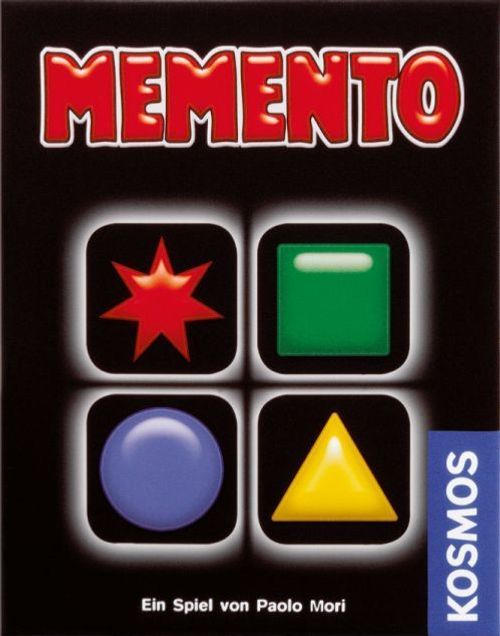
Memento
Memento Rulebook
Table of Contents
Table of Contents
Components
- 64 playing cards
- 18 scoring cards
- 8 arrangement cards (Ordnungskarten)
- Pencil and paper (not included)
Setup
For the first game, the rulebook recommends playing with only three shapes and three colours. To do this, sort out the playing cards with blue symbols and with squares and return them to the box. Likewise, return the arrangement cards with the blue symbols and the squares to the box. In later games, and for greater challenges, play with all cards.
Lay out all arrangement cards side by side in the middle of the table. First lay out the arrangement cards with symbols in one colour, and next to them the arrangement cards with symbols in different colours.
Shuffle the scoring cards and place them as a face-down pile next to the arrangement cards.
Have a piece of paper and a pencil ready to note down the points after each round.
Start of Each Round
Place one scoring card from the face-down pile face up next to each arrangement card. This card shows how you can score with cards in that category.
Note: If you play with all playing cards, you must shuffle the scoring cards used so far before the third round and place them together with the two remaining cards of the draw pile.
Shuffle all playing cards. Place 10 cards (in the introductory version only 6 cards) as a face-down pile in the middle of the table. From the remaining playing cards, form three equally high card piles, which are also placed in the middle of the table, face up.
The player with the fewest points begins the round; in case of a tie, the younger player. In the first round, therefore, the youngest player begins.
Course of Play
The active player has two options:
- Either take the top card from one of the piles in the middle of the table,
- or pass and take no card.
If a player takes a card, he places it face down in front of him and thereby forms his own discard pile. Players should remember well which cards they have taken, because it is strictly forbidden to look through one's discard pile during the round. If the card came from the face-down pile, it need not be told or shown to the other players which card it was. The active player may of course look at the card himself.
If the active player has passed, he may later take cards again. He is therefore not eliminated from the round.
Regardless of which option the active player chose, his turn is over, and the next player clockwise becomes the active player.
A round ends when all players have passed in succession, or when no cards are left on display. Then scoring takes place.
Scoring
The players first sort their discard pile by colour. Then the individual colours are scored for each player according to the respective scoring cards.
Then the players should sort their playing cards again by shape. Now score the shapes according to the respective scoring cards on display.
Note down the points for each player.
Example:
In a two-player game, the players (Sarah and Arne) have collected the following cards:
(Sarah's and Arne's collected cards are shown as card images in the rulebook.)
The following scoring cards are displayed for the colours:
(Scoring card images in the rulebook.)
Sarah receives 1 point for each green card, so 6 points. Furthermore, 5 points for yellow, because she has exactly 4 yellow cards. Since she has an odd number of red cards, she receives no penalty points for them. For her blue cards she receives no points either, because not all shapes are represented (the square is missing). She therefore receives 11 points.
Arne receives 5 points in total: 6 for green, 0 for yellow, -6 for red and 5 for blue.
Now the two sort their cards by shape:
(Sarah's and Arne's cards sorted by shape are shown as card images in the rulebook.)
For the shape arrangement cards the following scoring cards are displayed:
(Scoring card images in the rulebook.)
For this, Sarah receives only 5 points, because she has more circles than any other colour or shape. She does not fulfil any of the other conditions with her cards.
Arne, however, fulfils the condition for the triangles (10 points) and receives 6 points for the squares.
After the first round, Arne therefore leads with 21 points, Sarah has 16 points.
End of the Game
The game ends after three rounds. The player who has achieved the most points is the winner. In case of a tie between several players, the higher score in the third round decides.