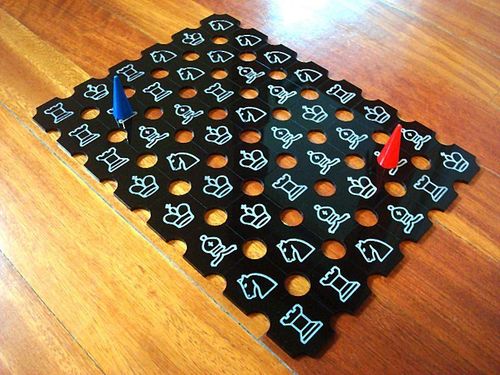
Melting Chess
Melting Chess Rulebook
Table of Contents
Table of Contents
Components
- 48 board tiles, each depicting a chess piece (12 kings, 12 rooks, 12 bishops, 12 knights).
- 2 playing pieces (red and blue cones).
- Carrying case
Preparation
Randomly distribute the 48 board tiles so they form a 6×8 rectangle (once you have some experience you can also try other shapes). Each player chooses a playing piece (red or blue).
Game Play
The game is played in turns. During the first turn, each player places his piece on one of the tiles.
Thereafter, on your turn, you must perform the following two steps:
- Move your piece according to the movement of one of the chess pieces depicted on an orthogonally adjacent, empty tile.
- Turn the tile from which you started your move face-down.
Movement Rules
- You can only end your move on an empty, face-up tile.
- Regardless of which chess piece's movement you are using, you are always allowed to pass through your opponent, and you are always allowed to pass over face-down tiles.
- Choose an orthogonally adjacent, empty, face-up tile, and then move your piece according to the movement of the chess piece depicted on your chosen tile.
Example
- Blue's turn. Because Blue has both a rook tile and a knight tile orthogonally adjacent to it, Blue can move either orthogonally (rook) or in an L-shape (knight). Thus, Blue could move to any of the spaces marked with a circle. Blue opts to move like a rook in order to move beside Red, removing one of Red's movement options.
- Blue eliminated Red's option to move one step to the left. Red can still move like a rook or a bishop, which includes all the same spaces a king could have reached anyway. Red chooses to move like a rook, and moves 6 spaces down.
- Blue's movement options: rook or knight. Blue chooses to make a rook move 1 space down.
- Red's only option is to move like a knight. Red makes a knight move to the one o'clock position — a fatal mistake, as you will see.
- Blue's only option is to move like a bishop. He moves beside Red, to cover Red's rook option.
- Red's only remaining option is to move like a bishop, but there are no face-up tiles on any of the diagonals from Red. Blue wins!
End of the Game / Winner
The game ends as soon as one player can't make a legal move. The other player is the winner.