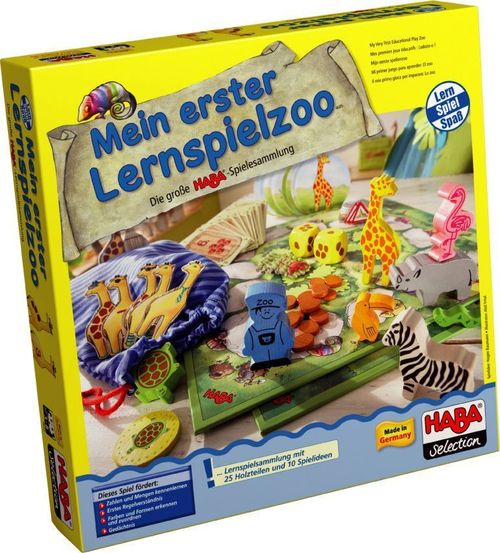
Mein erster Lernspielzoo
Mein erster Lernspielzoo Rulebook
Table of Contents
Table of Contents
Games in This Collection
- Touching Animals — tactile memory game for 2 - 4 children, age 3+
- 1, 2, 3 – Counting Giraffes — counting game with four degrees of difficulty for 2 - 4 children, age 3+
- Zoo Competition — colorful competition for 2 - 4 children, age 3+
- What a Charade! — tactile game with shapes for 2 - 4 children, age 3+
- Giraffe Twins — memory game with numbers and quantities for 2 - 4 children, age 3+
- Colorful Chameleon Hunt — color memory game for 2 - 4 children, ages 3½+
- Greedy-Guts — card game about comparing quantities for 2 - 4 children, age 4+
- Giraffe Detectives — number memory game for 2 - 4 children, age 4+
- Hubbub Number Zoo — card game about number sequences for 2 - 4 children, age 4+
- 2 + 5 = Coconut — first addition game for 2 - 4 children, age 4+
Contents
- 1 rhinoceros, 1 zebra, 1 flamingo, 1 seal, 1 giraffe, 1 toucan, 1 snake, 1 turtle, 1 zookeeper Tim, 2 giraffe dice, 1 fabric bag, set of game instructions
- Game board "Charade" and "Chameleons"
- Game board "Palm trees" and "Zoo Competition"
- 30 fruit box cards
- 22 number and non-number giraffes
- 12 geometrical shapes (3 squares, rectangles, triangles and circles)
- 11 chameleon tiles
- 10 turtle ladder parts (of different heights)
- 1 animal coin
- 12 coconuts
- 8 cardboard "animal" tiles
Hint: Before starting to play, carefully punch the following pieces out of the boards: 22 giraffes, 11 chameleon tiles, 10 turtle ladder parts, 3 circles, 3 rectangles, 3 squares, 3 triangles, 12 coconuts, 1 animal coin, 8 cardboard "animal" tiles.
1. Touching Animals
A tactile memory game with animals for 2 - 4 children, age 3+.
Skill Focuses: The sense of touch, first counting from numbers 0 to 5, memory
Game Material: Zookeeper Tim, 8 cardboard animal disks, 1 giraffe die, 12 coconuts, all wooden animal figures, fabric bag
Game Setup
Arrange the eight animal disks showing the animals face up in a circle. Place the zookeeper Tim outside the circle beside any animal disk. Place the 12 coconuts in the center of the circle. Place the eight wooden animals into the bag and get the die ready.
How to Play
Something is rustling in the bush! Is it the rhinoceros, the flamingo or the giraffe? Zookeeper Tim stretches his hand into the shrubs and tries to discover by touch who is hiding there. Can you help him?
Play in a clockwise direction. Whoever has petted an animal most recently may start and rolls the die. Count out loud the patches shown on the die and move Tim the corresponding number of squares in a clockwise direction. If no patches are shown, Tim just stays where he is. Have a look at the animal that Tim is now standing next to. Take the bag and try to find the matching animal by touch only (no peeking). Pull it out and place it on the animal disk to check. Does the wooden animal match the picture shown?
- Yes? Well done! As a reward you receive a coconut from the center.
- No? Fiddlesticks! There is no reward for you.
Place the wooden animal back into the bag. Try to memorize the animal on the animal disk and then flip it face down.
Important
While moving around, Tim may stop beside an animal disk that is face down. You have to remember the animal on this disk and try to find by touch the matching figure in the bag. Pull it out and then turn the animal disk over to check. If it is the right animal you get two coconuts this time! Place the figure back in the bag. The animal disk then stays face up. Then it is the turn of the next player.
End of the Game
The game ends as soon as all the coconuts have been distributed. Pile your coconuts into a little tower. The player with the tallest tower wins the game. In case of a tie, everyone tied wins.
Hint: The game is easier to play if you don't flip the animal tiles over.
The game can be made harder if the players have to memorize all the animal tiles at the start of the game and the tiles are all flipped face down before the game starts. At the end of each turn, the animal tile is turned face down again.
2. 1, 2, 3 – Counting Giraffes
An exciting die game for 2 - 4 children, age 3+, with four degrees of difficulty.
Skill Focuses: First counting, numbers and quantities from 0 to 5, reading and naming of numbers
Game Material: 6 non-numbered giraffes, 1 giraffe die
Game Setup
Sort out the giraffes with 0 to 5 patches and place them face up in the center of the table. Get the giraffe die ready.
How to Play
Leo and Susie are overwhelmed; so many different giraffes live in the enclosure and they all have a different number of patches. Or not? Can you count the patches and find out how many each giraffe has?
Play in a clockwise direction. Whoever has the fewest stains on their sweater starts and rolls the die. Count out loud the number of patches appearing on the die. Choose the giraffe showing the same number of patches and place it in front of you. Then check together. Does the number of patches appearing on the die match the number of patches on the giraffe?
- Yes? Great! Keep the giraffe.
- No? You counted wrong. Count again and then place the giraffe back in the center of the table.
During the game, the giraffe you are looking for may be with another player. You can take it from this player. But if you counted wrong, you have to return it to them.
Then it is the next player's turn.
End of the Game
When there are no giraffes left in the center of the table, the player with the most giraffes wins.
Variations
Degree of difficulty 2: The game becomes a little trickier if you use the numbered giraffes with 0 to 5 on them instead of non-numbered giraffes. Using this variation builds skills with counting and reading numbers from 0 to 5.
Degree of difficulty 3: The game becomes trickier if you use both dice and all eleven of the non-numbered giraffes. Using this variation builds skills with counting and reading numbers from 0 to 10.
Degree of difficulty 4: The game becomes really tricky if, instead of the non-numbered giraffes, you use all the numbered giraffes and both dice. Using this variation builds skills with counting and reading numbers from 0 to 10.
3. Zoo Competition
A colorful color competition for 2 - 4 children, age 3+.
Skill Focuses: Recognition and naming of colors (Red, Yellow, Green, Blue), precise observation
Game Material: The "Zoo Competition" game board, 2 to 4 animal figures by choice, 4 chameleon tiles in red, yellow, green and blue, fabric bag
Game Setup
Place the game board in the center of the table and put the four chameleon tiles into the bag. Each player takes an animal figure of their choice and places it on the starting stone.
How to Play
The animals have gathered once again for the popular Zoo Competition and you are welcome to join. The signposts show you the way and the different colored chameleons tell you which signposts you should look out for.
Play one by one in a clockwise direction. Whoever can spin in a circle for the longest starts and takes the bag. Pull out one chameleon and announce what color it is. Now count the signposts of the same color on the space your animal is standing on. How many signposts have you counted?
- One or two signposts? Move your animal that number of spaces in the same direction as the arrow on the signpost. If the arrow points backwards, unfortunately you have to move your animal backwards. All spaces, including the occupied ones, count. There can be more than one animal on a space.
- No signpost? What bad luck! Your animal has a rest.
Then place the chameleon back in the bag and shake it. Hand it to the next player so that they can take their turn.
End of the Game
The game ends as soon as a player has gone all the way around the board once and lands back on the starting stone, winning them the game.
Hint: You can also play several rounds. Agree on the number of coconuts you want to collect. If you move on or past the space showing the stone, you receive a coconut. The first to collect the agreed amount of coconuts wins the game.
4. What a Charade!
A tactile game with shapes for 2 - 4 monkey fans, ages 3+.
Skill Focuses: Recognition and comparison of geometrical shapes, finding shapes by touch, counting from 0 to 5
Game Material: The "Charade" game board, Zookeeper Tim, 1 giraffe die, 12 coconuts, 12 geometrical shapes, fabric bag
Game Setup
Place the game board in the center of the table and the 12 coconuts on the palm tree in the center of the board. Put the monkeys' toys (the geometric shapes) into the bag. Place Zookeeper Tim on any square. Get the die ready.
How to Play
The monkeys are mad and are kicking up a fuss! Where are their toys? The geometric shapes next to each monkey indicate the shape of the toy that monkey wants. A good sense of touch is needed to find the toys inside the bag. You can only use your sense of touch to find the toys. No peeking! If you find the right toy for the right monkey, they'll reward you with a coconut.
Play goes in a clockwise direction. Whoever makes the best monkey sounds is the first player and rolls the die. Count out loud the patches on the die and move Zookeeper Tim that number of squares in a clockwise direction. If no patches appear on the die, Tim stays where he is. Have a good look at the shape next to where Tim is now standing. Is the place of this shape empty?
- Yes? Grab the bag and try to find a toy of the same shape using only your sense of touch. When you think you have found the toy, pull it out and place it on the shape next to the monkey to see if you are correct. If it matches exactly, you can take a coconut from the palm tree as a reward. Leave the toy on the shape. If the shape does not match, place it back in the bag.
- No? This monkey has already found their toy. Unfortunately, you don't win a coconut, and your turn is over.
Then it is the next player's turn to roll the die.
End of the Game
The game ends as soon as all of the coconuts are gone from the center. Stack your coconuts up in a pile. The player with the highest pile wins! If there is a tie, everyone tied shares the win.
Hint: The game becomes easier if, instead of putting the geometrical shapes in the bag, you place them with the green side facing up around the game board. Now the matching shape has to be found by close observation instead of touching.
5. Giraffe Twins
A classic memory game for 2 - 4 children, age 3+.
Skill Focuses: First understanding of numbers, correlation and assignation of numbers and quantities from 0 to 10, memory
Game Material: 22 number and non-numbered giraffes
Game Setup
Look at the fronts of the giraffe tiles and sort them into two piles: one for numbered giraffes and one for non-numbered giraffes. Shuffle the non-numbered giraffes and place them face down in a row. Then shuffle the numbered giraffes and arrange them into a second row below the non-numbered giraffes.
How to Play
There's a ruckus in the giraffe enclosure! The giraffes have disguised themselves and have organized a funny animal parade. In the colorful chaos, whoever discovers the most giraffe twins is invited to the party!
Play moves in a clockwise direction. Whoever can stretch their throat up the furthest, like a giraffe, starts and turns over a giraffe from the top row. Have a good look at it. A giraffe can have up to 10 patches and may also have a little accessory, for example a colored sock or a big earring. Count out loud the patches and try to find the giraffe with the matching number. Turn over a giraffe in the row below and compare it. If you are not sure and wish to check your answer, look to see if both giraffes have the same accessory.
Does the quantity of the patches on the giraffe above coincide with the number of the giraffe below?
- Yes? You found a twin! Take the pair. You can immediately turn over another giraffe and go again.
- No? Everybody tries to memorize the giraffes that are face up. Then turn both giraffes back over again so they are face down. It is now the next player's turn.
End of the Game
Have all the giraffe twins been matched up? Then each player stacks their giraffes in a pile. The player with the highest pile wins. If there is a tie, the tied players share the win.
Hint: The game becomes trickier if you shuffle all giraffes before starting to play and distribute them face down on the table.
6. Colorful Chameleon Hunt
A color memory game for 2 - 4 eagle-eyed children, aged 3+.
Skill Focuses: Recognition and naming of colors, memory
Game Material: The "Chameleons" game board, rhinoceros, turtle, animal coin, 9 coconuts, 11 chameleon tiles
Game Setup
Place the game board in the center of the table. Shuffle the chameleon tiles and distribute them face down onto the corresponding squares of the bushes in the center of the game board. Place the rhinoceros and the turtle each on a square showing a rainbow chameleon. Get the nine coconuts and the animal coin ready.
How to Play
The chameleons are once again playing their favorite game: hide and seek! Together with the wise turtle and the fast rhinoceros, you search for the colorful chameleons in the bushes. Who will discover the most?
Play moves in a clockwise direction. Whoever is dressed the most colorfully is the first player and takes the animal coin. Toss the animal coin by dropping it from approximately the height of your nose onto the table. Move the animal shown – either the rhinoceros or the turtle – one square further around the board in a clockwise direction. If there is already an animal on the square, jump over the animal to the next square.
Which chameleon is the animal next to? Announce the chameleon's color.
If the animal is standing next to a rainbow chameleon, you choose a color and announce it to the other players. Now try to discover a chameleon of the same color in one of the bushes by turning over any tile.
Do both chameleons have the same color?
- Yes? You found a match! As a reward, take a coconut. Then turn the tile back over.
- No? Never mind! Try to memorize the color of the chameleon you turned over. Then turn the tile back over again. If the animal you moved this turn was the rhinoceros, you have a second try and may turn over a second tile to try and find the match.
Now it is the next player's turn.
End of the Game
The game ends as soon as one player has collected three coconuts, thus winning the game.
7. Greedy-Guts
A delicious game of cards for 2 - 4 children, age 4+.
Skill Focuses: Comparison and distinguishing numbers and quantities from 0 to 10
Game Material: 30 fruit box cards, rhinoceros, turtle, animal coin
Game Setup
First shuffle the cards. Each player receives three cards and places them face up in front of themselves. The remaining cards are placed in a face-down deck. Draw the top card and place it in the center of the table as the first card of the food pile that will be stacked there. Place the rhinoceros and the turtle next to the card so that they are facing each other.
How to Play
Fred Greedy Guts, the rhinoceros, has invited the turtle, Wilbert Whitebeard, to a banquet. While glutton Fred likes gobbling up boxes full of apples the most, Wilbert prefers nibbling small portions. Who is the first to be able to assign all their boxes?
Play one by one in a clockwise direction. Whoever has eaten an apple most recently is the first player and now has to try and place one of their cards on the food pile.
Important: Have a good look at the card on the food pile. It shows a number and a matching quantity of apples. The card you place on top must either show more or less apples, or a smaller or bigger number. The animal coin will indicate whether a "bigger" or "smaller" card is needed.
Let the animal coin drop from approximately the height of your nose. Which animal is shown?
- Fred the rhinoceros! Place a card showing more apples or a higher number onto the food pile.
- Wilbert the turtle! Place a card showing fewer apples or a lower number onto the food pile.
If you don't have a matching card, you have to turn over one from the deck. If this is a match, you can immediately play it. If not, place it face up in front of you with your other cards. Then it is the turn of the next player.
End of the Game
The game ends as soon as a player has placed all their cards and thus wins the game.
Hint: You can play various rounds. Agree on the number of coconuts you want to collect. As soon as a player has placed all their cards, they win the round and receive a coconut. Then a new round starts. The first to collect the agreed number of coconuts wins the game.
8. Giraffe Detectives
An exciting die memory game for 2 - 4 good noses, ages 4+.
Skill Focuses: Numbers and quantities from 0 to 10, comparing quantities, memory
Game Material: 11 non-numbered giraffes, 2 giraffe dice, 12 coconuts
Game Setup
Shuffle the 11 non-numbered giraffes and distribute them face down in the center of the table. Get the giraffe dice and the coconuts ready.
How to Play
Hush! Quiet! Soft-footedly we sneak up as the giraffes are playing thief chase. They have all hidden. But only one of them is the thief, and the dice will tell you which one it is. Who is the best giraffe detective? Who can find the animal with the right number of spots?
Play moves in a clockwise direction. Stretch up as far as you comfortably can with your neck, just like a giraffe. The tallest player begins. The game starts with both dice being thrown. Count out loud the number of patches on both dice and add them up. You want to find a giraffe showing the same number of patches as the dice sum. Turn over one giraffe and compare.
Does the quantity of patches on the dice match the quantity on the giraffe?
- Yes? You caught the thief! As a reward you receive a coconut.
- No? You missed them! Try to memorize the number of patches on the giraffe. Turn the giraffe back over. Now it is the next player's turn.
End of the Game
The game ends when all the coconuts have been won. Now stack your coconuts up in a pile. The player with the highest pile wins. In the case of a tie, all tied players share the win.
Hint: The game becomes easier if you play with only one die and the non-numbered giraffes 0 to 5. The game becomes trickier if you use the numbered giraffes instead of the non-numbered giraffes.
9. Hubbub Number Zoo
A game of cards about number sequences for 2 - 4 helpful children, ages 4+.
Skill Focuses: Learning of numbers and quantities from 0 to 10, number sequences, comparing and distinguishing quantities
Game Material: 30 fruit box cards, toucan, zebra, giraffe
Game Setup
Place the animals on the table in a row, spaced about the width of a card apart. Start with the toucan, then the zebra, and then the giraffe. Shuffle the cards. Each player receives three cards and takes them face down in their hand. Now place three cards in a row under the zebra. Place the rest of the cards face down as a deck.
How to Play
What chaos! Fred Greedy Guts, the rhinoceros, has mixed up the fruit boxes when nibbling at them. The toucan, the zebra and the giraffe all want to tidy up the mess. The small toucan looks for the crates with the small numbers, and the big giraffe for the ones with the big numbers. Can you help them sort the crates into the right order?
Play in a clockwise direction. Whoever has eaten the most fruit today is the first player and tries to place one of their cards.
Take a close look at your cards and the ones on the table. They all show a number and a matching quantity of apples. Pick a row and place one of the cards from your hand into it.
If your card shows …
- … one apple more than the last card in the row, on the side of the giraffe: place your card beside this last card, on the side of the giraffe.
- … one apple less than the last card of a row, on the side of the toucan: place your card beside this last card, on the side of the toucan.
If you don't have a card you can play, draw the top card of the deck. If it fits on the end of a row, you can place it where it belongs. Otherwise, keep the card in your hand.
Now it is the next player's turn.
End of the Game
The game ends as soon as a child is left without any cards in their hand, thus winning the game.
Hint: The players of course can also place their cards face up in front of them.
10. 2 + 5 = Coconut
An exciting guessing game about addition for 2 - 4 children, age 4+.
Skill Focuses: Understanding of numbers from 0 to 10, introduction of addition, estimating length
Game Material: The "Palm Trees" game board, turtle, 1 giraffe die, 12 coconuts, 10 turtle ladder parts
Game Setup
Place the game board in the center of the table and place the turtle underneath palm tree number 8. Randomly distribute the coconuts on the crowns of the palm trees, up to a maximum of 2 coconuts per tree. Place the ladder parts next to the game board so that everybody can see them clearly. Get the giraffe die ready.
How to Play
The turtles are baffled. How can they reach the delicious coconuts high up in the palm trees? Together they form a wobbly ladder, but it is still too short. Can you help them build a tall enough ladder?
Play moves in a clockwise direction. Whoever has eaten some coconut most recently is the first player and rolls the die. Count the patches on the die and move the turtle that number of squares to the right or the left.
Important: You always have to move the complete number of patches. If this is not possible in one direction, you have to move in the other direction. If no patch appears on the die, the turtle stays where it is. If the turtle is underneath the palm tree with number two and the die shows 5 patches, the turtle also stays where it is.
If there are coconuts on the palm tree the turtle is under, try to pick one. If there aren't any coconuts left on the tree, unfortunately you were unlucky and it is the next player's turn.
Harvesting coconuts: Take a look at the palm tree where the turtle is now. The palm tree shows a green crown (there are the delicious coconuts) and the tree trunk. The trunk starts at a mark on the ground and ends at a mark underneath the crown. Now try to place a ladder of this height, consisting of at least two parts, in order to reach the coconuts.
Take a ladder part and place it so that it lines up with the mark of the trunk below. Now place another ladder part on top of the other, until you reach the crown of the palm tree.
Repeat this ladder stacking until …
- … the ladder reaches exactly the upper mark on the palm trunk. Hit! If your ladder has at least two parts, you receive a coconut from this tree as a reward. If the ladder has only one part, you don't receive a reward.
- … the ladder reaches beyond the upper mark on the palm trunk. Oh no, too high! Next time, try to make the ladder shorter.
Illustration captions: "Right!" "Wrong! The ladder reaches beyond the mark."
Return the ladder parts next to the game board. Now it is the next player's turn.
End of the Game
The game ends as soon as a player has collected three coconuts and thus wins the game.
Tip: The game can be made harder by laying the ladder sections face down. The players then have to guess the height of the ladder parts and are no longer able to count the number of turtles.