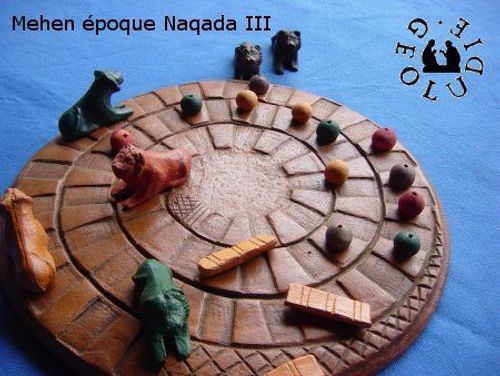
Mehen
Mehen Rulebook
Table of Contents
Table of Contents
Components
Board, 6 pawns per player, number of lions equal to number of players, four throwing sticks.
Setup
Place the Barque of Ra adjacent to and touching the board at any point on the circle. For each player in the game, place all 6 of their pawns off the board adjacent to the tail section and place a single lion (per player) on the table near the Barque of Ra. Example: For a three player game, place 18 pawns near the tail and 3 lions near the Barque of Ra.
Object and Time Limit
Mehen is an ancient Egyptian game in which the object is to race to the center of the board without being devoured by Mehen (the snake god) or a lion. To win, you must manage to get at least 3 of your pawns into the center space. Mehen periodically grants access to Ra ("enlightenment") to those pawns waiting at the center. The first pawns to attain enlightenment become lions, which can be moved by any player, and, in their attempt to guard Ra against the impure, will devour pawns remaining on the board. The first player to have 3 of their pawns achieve enlightenment wins the game.
It is recommended that players agree upon a time limit for each game of Mehen. If the win condition hasn't been met when the time elapses, the player with the most enlightened pawns wins. This is often necessary, as Mehen is a dangerous game in which few pawns survive!
Pawn Movement
Basic Movement
Toss 4 throwing sticks. Each stick has a round side and a flat side; make sure that you give significant spin to the sticks when you throw them or other players will be unsatisfied with your throw. Each flat side tossed grants you 2 movement points. Apportion your movement points between two pieces on the board: either your own pawns or any lions on the board. If you cannot move two pieces, you cannot move at all. You may forfeit some of your movement points, as long as you still move two pieces. You may also forfeit your move entirely.
You may move through other pieces. Pawns must end their movement on an empty space.
Pawns must always move toward the center of the board, never backwards.
You must move one piece the full number of movement points you've allotted it, and then move your second piece. You may not alternate movement back and forth between two pieces. When you lift your hand away from a piece, it is considered moved; you cannot then change your mind.
Entering the Board
Pawns enter the board at the first "blank" space after the tail section (which doesn't count as a space) for one movement point. When playing with only two or three players on the larger board, pawns enter at the space marked with six "teeth":
You may only move a maximum of one pawn onto the board on a given turn. On your first turn you will only be able to move a single pawn (because all of your pawns start off of the board), but on this turn only you may apportion up to all of your movement points to that piece if you wish.
Blocking
Two or more pawns of the same color on touching spaces are said to form a blockade. Blockades impede some forms of movement and provide protection against lions (see below). A blockade can be formed in a single coil ("in a line") (Figure 1), across coils (Figure 2), or both (Figure 3):
[Figure 1: Linear Blockade]
[Figure 2: Coil Blockade]
[Figure 3: Hybrid Blockade]
Sliding
If a pawn lands on another pawn that isn't part of a blockade, it automatically slides forward linearly until it reaches either a free space or a pawn that is part of a blockade. If you have movement points remaining, you may continue to move after a slide. If a slide ends on a blockade, you must continue to move past the blocked piece via basic movement (expending movement points), as a pawn may not end its movement on an occupied space. Note that a single pawn's movement on a turn may involve multiple slides, even if a blockade forces basic movement somewhere in the middle. See the examples below (a gray arrow indicates the expenditure of 1 Movement Point; red arrows are free movement).
[Figure 4: Slide]
[Figure 5: Multiple Slide]
[Figure 6: Complex Sliding]
You may slide over your own pawns, but can also be blocked by your own pawns.
You may not use a pawn to slide that has already been slid over on your same turn. Nor you can you slide over a pawn that has jumped on your same turn. Thus if the first pawn you move on your turn slides or jumps, and then the second pawn you move encounters that first pawn, you must use movement points to move through it. Thus you may not perform a "leapfrog" action.
Jumping
Jumping refers to a move from a space in one coil to a touching space in the adjacent coil. The apportioning of 5 movement points allows a piece to jump. When making a jump, it must be the first piece moved of your two pieces. Note that where you have multiple options, you may choose a touching space that would be slightly "backwards" in relation to normal movement direction. In the example illustrated below, the brown piece may jump to either of the two red spaces.
[Figure 7: Jump]
The inner coil (the red spaces in the diagram below, which includes Mehen's head and all surrounding spaces until they are past Mehen's head) has a special restriction: you may never jump from any one of its spaces.
[Figure 8: Inner coil of spaces from which you cannot jump.]
Mehen's Head
The center space is Mehen's head. For movement purposes, this counts as a single space. However, an unlimited number of pieces may occupy the head, and pawns and lions can coexist.
The Mehen Throw
If you throw a 0 or 4 (all flat or all round sides up), Mehen (the snake god) stirs to life. This movement is out of your control. Perform the following steps:
-
On the very first Mehen throw of the game, move one of the off-board lions into the Barque of Ra. On the second Mehen throw of the game, move this lion onto the center section of the board, but in the indented area (not on top of Mehen's head). On the third Mehen throw of the game, move this lion onto Mehen's head. It is now considered in play. Ignore this step for future Mehen throws (all further lions that enter the board are the result of pawns becoming enlightened).
-
Any pawns currently occupying the center of the board now become enlightened. Place them in the Barque of Ra. If there are off-board lions available, each enlightened pawn is replaced on Mehen's head with a lion, up to the number available. Once all lions (equal to the number of players in the current game) have been placed on the board, enlightened pawns are simply placed in the Barque of Ra and are not replaced with lions. If a lion exits the board, however, it becomes available to replace the next enlightened pawn.
[Figure 9: The Barque of Ra]
-
All pawns currently on the board are moved forward 2 spaces. Start with the pawn closest to the center and work your way outward until every pawn has been moved closer to Mehen.
-
If any pawns, as a result of this involuntary movement, are pulled into/through a lion or Mehen's head, they are immediately devoured and are removed from the game (place them in the box so they are not confused with off-board or enlightened pawns).
-
The player that threw the Mehen now re-throws and moves normally. However, on a post-Mehen throw, you may not move any lions. Note that it is possible to throw more than one Mehen in a row, in which case this procedure is repeated and the player throws again.
Lion Movement
Once there are one or more lions on the board, any player may move them as one or both of that player's two pieces on each turn. Lions follow normal movement rules, with the following exceptions:
Lions may only move outward, away from the center of the board.
Lions may never slide, but they may move through other pieces, including pawns. It is up to the player moving a lion when and where to make it stop.
If a lion lands on (ends its movement on) a pawn, it devours it as an enemy of Ra. Remove the pawn from the game and place it in the box. However, a lion may not land on (and therefore may not devour) a pawn that is part of a blockade.
Lions may jump to an adjacent coil with only one movement point, but only if the space they jump to is occupied by an unblocked pawn. Lions may jump to a blank space normally using the usual 5 movement points. However, in no case may a lion jump from one of the inner coil spaces (i.e., though they are moving in the opposite direction, they must follow this rule the same as the pawns).
A lion may sprint, or double the movement points you have alloted to it, provided that it doesn't move through a blockade or land on (devour) a pawn. These movement points can be applied to linear movement or jumps; in the latter case, a jump would require 5 movement points, which could be managed by allotting 3 or more to the lion. (Strategic Tip: This is a good way to move a lion past you if you are approaching with a lone pawn.)
Once a lion reaches the tail, it moves off of the board. Any player who makes this movement gets to immediately move one of their pawns on the board to the center (head).
Elimination
When you have only one pawn left either on the board or at the tail (not counting eliminated pawns or those in the Barque of Ra), you may, optionally, allot all of your movement points to that single piece on your turn.
When you have no more pieces on the board or waiting at the tail, you may still take your turn normally; you only have the option of moving lions.
End of Game
Play continues until the time limit is reached or three of a player's (or team's) pawns have achieved enlightenment, whichever occurs first. If more than one player achieves the goal of 3 enlightened pawns at the same time, the player with the most enlightened pawns wins the game. A tie is also possible. (Because pawns wait in the center space until a Mehen throw occurs, just getting three pawns to the head is not a guaranteed win; another player may get just as many or more pawns to the center before the next Mehen throw.)
If the agreed-upon time limit is reached, play ends. The player (or team) with the most enlightened pawns wins. If it is a tie, count up the total number of remaining pawns on the board (but not including pawns waiting at the tail). The player or team with the most pawns on the board wins.
The game also ends if all remaining pawns are eliminated or cannot legally move. At that point, the player with the most enlightened pawns wins.
Optional Advanced Rules
If all players are experienced and wish to play a more advanced, strategically complex game, any or all of the following rules can be introduced (from most significant/recommended to least):
Gated Blockades: A gated blockade is one that is formed through coil adjacency only, i.e. it includes no linearly adjacent pawns. A gated blockade does not block your own pawns from sliding through (though it still blocks opponents' pawns). Recommended for all games once players have learned the basic rules.
The Push: If one of your pawns is coil-adjacent to an opponent's pawn (one space away but on a different coil), and they are not part of a multi-coil blockade, and that pawn (or linear blockade of pawns) is enclosed on both ends (by pawns of any color), then you may move that pawn as one of your two pieces. (In the example illustrated below, the brown player is able to move the second white pawn because the second brown pawn is coil-adjacent to it, the white pawn isn't part of a coil blockade, and the linear string of white pieces is enclosed by the first brown and black pawns.) You may not move an opponent's pawn into a lion, but are otherwise unrestricted. This is an effective way to either break an opponent's (linear) blockade or to clear the way for a jump that otherwise couldn't take place. This rule is highly recommended for larger numbers of players.
[Figure 10: The Push]
Lions Unleashed: Remove the inner coil can't-jump-from restriction from the outermost three spaces, for lions only. I.e., pawns may still not jump from these three spaces, but lions may. This rule is highly recommended for most games, but especially for 2 player games and for groups with less aggressive players (with regard to lion movement).
Tickling the Tongue: When a player ends their turn with at least one pawn in the center of the board, they throw one more time. No movement occurs, but if they throw a Mehen, a Mehen action occurs.
Tie Breaker: In this variation, instead of a game immediately ending once one player (at least) achieves three enlightened pawns, in case of a tie, continue to play until the tie is broken.
Radical Elimination: If you prefer, you can eliminate players from the game when they have no more pawns on the board or waiting at the tail. This reduces the danger for the remaining players (fewer Mehen throws and fewer lion moves), and isn't recommended, unless you feel that players without pawns still in the "race" shouldn't have any further influence on the outcome of the game for kingmaking or vendetta reasons.
Team Mehen
Mehen can be played in teams of two players each: four players in two teams, or six players in three teams. Team members should not sit next to each other: you must alternate the turn order between different teams. The number of lions in the game is still equal to the total number of players (not the number of teams). The game is played normally, except for the following:
- You must incorporate these Advanced Rules: Gated Blockades and The Push. The other Advanced Rules remain optional.
- You may slide through your teammate's gated blockades as well as your own.
- You can Push your teammate's pawns merely by having one of your own coil-adjacent; the other conditions for Pushing don't need to be met.
- A team wins when either one of its members, or a combination of the two of them, have achieved three enlightened pawns (or more in the case of a tie-breaker).