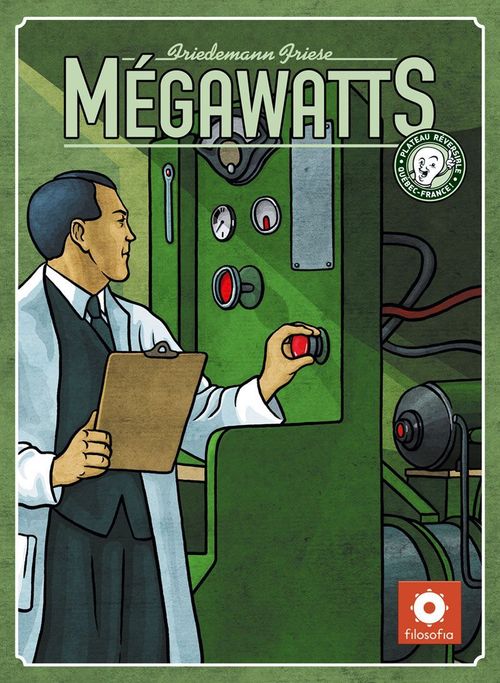
Mégawatts
Mégawatts Rulebook
Table of Contents
Table of Contents
- Components
- Power Plant Cards
- Setup
- Phases of a Round
- Phase 1: Determine Player Order
- Phase 2: Auction Power Plants
- Phase 3: Buy Resources
- Phase 4: Build
- Phase 5: Bureaucracy
- The Three Steps of the Game
- End of the Game
- Rules for Different Player Counts
- Tips for Beginners
- Important Rules (Reminders)
- Resource Table
- France Map Variant
- Acknowledgments
Components
- 1 double-sided board (country map, scoring track, resource market)
- 22 wooden houses per player, in green, yellow, red, blue, purple and natural/black
- 84 wooden resource tokens: 24 coal (brown), 24 oil (black), 24 garbage (yellow), 12 uranium (red)
- Elektro banknotes
- 5 help cards: phases / profits
- 43 power plant cards (42 power plants and 1 "Step 3" card, marked "Stufe 3")
Power Plant Cards
The number in the top-left corner is the power plant's value — this is also its starting bid when it is sold at auction (the first bid for the card shown as an example is 14).
The picture in the middle of the card represents the power plant and has no effect on play. The symbols in the bottom-left corner, together with the card's color, show which resources the plant needs to produce electricity (brown: coal, black: oil, brown/black: hybrid, see below, yellow: garbage, red: uranium, green: ecological, blue: fusion).
The number of symbols shows how many resource tokens are needed to produce electricity — for example, a plant with two garbage symbols needs 2 garbage tokens to produce; you cannot produce electricity with fewer resource tokens than required. Each power plant can store up to twice the number of resource tokens it needs to produce. In the example above, the plant can store up to 4 garbage tokens.
The number inside the house symbol shows how many cities that power plant can supply with electricity. In the example, it can supply two cities: using two garbage tokens to produce lets you power up to two cities, but you cannot use a single garbage token to power one city, and although a plant can store twice the resources it needs, it can only produce once per round.
Special Power Plants
Hybrid power plants are brown and black and run on coal and oil interchangeably. You may choose coal or oil as you like (usually whichever is cheaper). Plant No. 5 is hybrid and can produce using 2 coal, 2 oil, or 1 coal and 1 oil.
Ecological or fusion power plants need no resources to produce. They simply supply as many cities as shown by the number in the house symbol.
Setup
Place the board in the middle of the table. The map is divided into 6 zones, each containing 7 cities. Choose one zone per player, so the playing area changes from game to game. The zones chosen simply need to be adjacent to each other.
Each player takes the houses of their color and 50 Elektro. Each player then places one house on the starting space of the scoring track. This house is used to show how many cities are connected to a player's network. A second house is used to show turn order; at the start of the game, turn order is determined randomly.
The Resource Market
The large spaces at the bottom of the board form the resource market. At the start of the game, place 3 coal on each of spaces 1–8, 3 oil on each of spaces 3–8, 3 garbage on spaces 7 and 8, and 1 uranium on spaces 14 and 16. Spaces 10 and 12 stay empty at this stage. At the start of the game, the cheapest coal costs 1 Elektro, the cheapest oil costs 3 Elektro, and the cheapest garbage costs 7 Elektro. At this stage there is no uranium available for purchase. Place the remaining resources next to the board.
During the game, newly added coal, oil and garbage are placed on spaces 1–8 (up to a maximum of three tokens of each type per space); uranium is placed on spaces 1–16 (up to a maximum of one uranium token per space).
The Power Plant Market
Arrange power plant cards 03–10 in two rows, forming a 2×4 grid (the power plant market): in the top row, place cards 03–06 in ascending order — this row is the current market. In the bottom row, place cards 07–10 in ascending order — this row is the future market. Whenever a new power plant is added to the market, all the cards must be rearranged in ascending order, with the four cheapest in the current market.
Set aside the "Step 3" card and ecological power plant No. 13, remove the game-aid card, then shuffle the remaining power plant cards. Place the "Step 3" card at the bottom of the power plant deck, and place this deck near the board. Place power plant No. 13 on top of the deck. Put the game-aid card near the board.
Phases of a Round
Each round has five phases. Every player finishes all the actions they want to take in a phase before the next phase begins. Here are the five phases:
- Determine player order.
- Auction power plants: auctions continue until every player has bought at most one power plant from the market.
- Buy resources: players may buy resources from the market for their power plants.
- Build: players expand their electrical network across the map to supply cities.
- Bureaucracy: collect income, refresh the power plant market, refresh the resource market.
Phase 1: Determine Player Order
During this phase, turn order is determined. The first player is the one whose network connects the most cities (their house is furthest along the scoring track). In case of a tie, the first player among those tied is the one who owns the largest power plant. This player's marker is placed first in turn order. Turn order for the remaining players is determined the same way.
Reminder: at the start of the game, turn order is drawn at random.
Phase 2: Auction Power Plants
During this phase, each player may buy at most one power plant.
The first player begins this phase (see Phase 1). This player may choose a power plant from the current market and make an opening bid. Reminder: the value in the top-left corner of a power plant card is the lowest possible bid.
Important: only one of the four power plants in the current market may be chosen.
The next player clockwise may then bid higher or pass. Once a player passes, they cannot take part in that auction again. The last player remaining in the auction wins the power plant, paying the bank the value of their final bid.
A new power plant is drawn to replace the one just sold. It is placed in the market, which is then reordered in ascending order, with the four cheapest cards in the current market and the rest in the future market.
During the game, a player may have at most three power plants in front of them. If they acquire a fourth, they must first discard one of the three they already have. Resources on the discarded power plant may be moved onto another plant if the resource type matches; resources are lost if there is no available storage space or no remaining plant of the correct type.
If the first player buys the power plant put up for auction, the second player in turn order chooses the next power plant to put up for auction. If another player buys it instead, the first player again chooses a power plant from the current market to auction.
A player who has just chosen a power plant to auction may pass their turn — they are not obliged to bid on it. However, they may not bid on any other power plant put up for auction that round.
The last player who has not yet bought a power plant may take one from the current market by paying its minimum value (shown in the top-left corner).
Exception (for the first round): during the first round, every player must buy a power plant. Turn order, having been determined randomly at the start of the game, changes as soon as every player owns a power plant. The first player is then the one who owns the largest power plant, since no cities are connected yet (see Phase 1).
Important: if no power plant is bought during a round, the lowest-value power plant in the market is put back in the box.
Phase 3: Buy Resources
During this phase, players may buy resources for their power plants. This phase is played in reverse turn order — the last player begins (see Phase 1).
Each power plant can store up to twice the number of resource tokens it needs to produce (a coal plant only stores coal, a hybrid plant stores both coal and oil, an ecological plant stores no resources).
Each player may buy as many resources as they can store (twice the amount needed to produce with all their power plants).
Important: at any point during the game, a player may move resources from one power plant to another. The receiving power plant must be able to use those resources (for example, coal may be moved from a hybrid plant to a new coal plant).
The resources available are those on the resource market spaces. The number printed on a space shows the cost of one resource token there. You will normally buy the cheapest available resources first. Money is paid to the bank.
Phase 4: Build
During this phase, players may expand their electrical network and connect new cities to it. As before, this phase is played in reverse turn order. The last player begins building.
At the start of the game, no player is present in any city. Each player starts their network by choosing a city where no other player is present, within the zones chosen for the game. They place a house of their color on the 10-cost space of that city and pay 10 Elektro for this first connection. This same player then moves their scoring marker forward one space on the scoring track.
Every subsequent city connected must always be linked back to this starting city. The connection cost between two cities is printed on the map. A new city can be connected to a player's network by paying the connection cost printed on the map plus 10 Elektro if the city was previously empty. The player then places a house of their color on the 10-cost space of that new city. A game is divided into three steps (see the description of the steps at the end of this booklet). During Step 1, only one player may connect to each city.
A player may connect to any city where a connection space is still available. But during Step 1, only cities where no one is present are accessible. During Step 2, cities connected by at most one player become available. Finally, during Step 3, cities connected by at most two players are available. The connection cost rises to 15 for a second connection and to 20 for a third. An empty city can always be connected during Steps 2 and 3 for 10 Elektro. A player cannot connect to the same city a second time (the transition between steps is explained later in this booklet).
A player may use all the connections of cities already in their network, and all intermediate cities where they cannot settle, in order to extend across the map. If a player connects to a city that is not yet connected to their network, they place a house of their color on the lowest-value space and pay the price shown on that space plus the connection cost shown on the map. Whenever new cities are added to a player's network, this is immediately reflected on the scoring track. The number of cities connected by a player must always be visible on the scoring track. In some cases, a city's connection is already part of another connection already paid for; the cost for an already-paid connection is always 0 — see the example below.
Example: Player A can extend to Duisburg for 10 Elektro, since there is no connection cost between Essen and Duisburg. To Dortmund it costs 12 Elektro (10+2) using the cheapest route from Münster. To Aachen the cost is 21 Elektro (10+9+2), since the connection through Düsseldorf must be paid. For Player B, Duisburg is favorable: 12 Elektro (10+2+0) pays for the connection through Essen. If Step 2 has begun, Player A can connect to Düsseldorf for 17 Elektro (15+2) or to Köln for 21 Elektro (15+2+4), since two players are allowed in the same city during Step 2. However, if Player A connects to Düsseldorf and Köln at the same time, it costs 36 Elektro: Düsseldorf is connected for 17 Elektro, then Köln for 19 Elektro.
Important: if, at any point in the game, the value of a power plant in the current market is less than or equal to the number of cities connected by the leading player, it is immediately discarded. A new power plant is drawn and added to the market. This rule does not affect power plants already owned by players.
Example: A player connects their seventh city. If power plant 06 is in the current market, it is immediately discarded, but players keep their power plants 03–05. It is also possible that a newly drawn power plant must be immediately discarded.
Important: players are not required to choose their starting cities on the first round — they may do so later.
Phase 5: Bureaucracy
During this phase, players receive money, new resources are placed on the resource market, and one power plant in the power plant market is exchanged.
Each player uses their power plants to produce electricity. Starting with the leading player, each player states how many cities are connected to their network and how many of them they wish to supply with electricity. They then receive money according to this value, based on the profit table. A player who supplies no cities receives 10 Elektro; supplying 4 cities pays 45 Elektro.
The resources needed for that electricity production are then discarded.
Important: if a player only supplies a subset of their connected cities, they receive money only for the cities they supply. If a player produces more electricity than they need, the excess production is lost. Each player chooses which power plants they wish to use — they are not obliged to supply every connected city even if their production capacity allows it.
New Resources
Depending on the number of players, new resources are added to the resource market (see the resource table below). Start by placing the appropriate resources on the market's highest-numbered spaces where resources are missing (3 tokens per large space, except for uranium, of which only 1 token is placed, starting from space 16 downward). Market spaces stay empty if there are not enough resources available.
Example: In a 5-player game, the following resources were sold during the first round: 10 coal, 2 oil, 1 garbage. For 5 players, the resource table shows that the market must be completed with: 5 coal, 4 oil, 3 garbage, 2 uranium. Only 4 coal are available (the rest are already on power plants), so only those 4 coal are placed: one on space 4 and three on space 3. 2 oil are placed on space 3 and 2 on space 2. 1 garbage is placed on space 7 and 2 garbage on space 6. Uranium is placed on spaces 16 and 14. Coal is now more expensive than on the first round (3 Elektro), while oil is cheaper (2 Elektro).
New Power Plants
The highest-value power plant in the future market is placed face-down under the power plant deck and replaced by a newly drawn power plant. The power plant market is then reordered in ascending order, with the four cheapest cards in the current market and the rest in the future market. This lets the most interesting plants end up under the "Step 3" card, so that they reappear during Step 3 later in the game.
The Three Steps of the Game
A game is divided into three steps. Important: do not confuse the 3 steps of a game with the 5 phases of a round.
Step 1
The start of the game. During Step 1, only one player may connect to any given city. The cost of this first connection is shown in Phase 4. The resource table depends on this step.
Step 2
This step begins when a player connects their 7th city during Phase 4 (Build). At the end of the Phase 4 in which the first player connects their 7th city, the lowest-value power plant is removed and replaced by a newly drawn one. Step 2 allows each city to be connected by two players. Connection prices are shown in Phase 4. The resource table depends on this step.
Step 3
When the "Step 3" card ("Stufe 3") is drawn, Step 3 begins on the next phase of the game.
- If the "Step 3" card is drawn during Phase 2 (Auction Power Plants), treat it as the highest-value power plant and place it in the fourth position of the future market. At the end of Phase 2, discard the lowest-value power plant along with the "Step 3" card, and do not draw any new power plants.
- If the "Step 3" card is drawn during Phase 4 (Build) while replacing a power plant that has become too weak, remove it from the game along with that power plant, and do not draw any new power plants.
- If the "Step 3" card is drawn during Phase 5 (Bureaucracy), remove it from the game along with the lowest-value power plant, and do not draw any new power plants.
During Step 3, there are only 6 power plants in the market. All of these plants now form a single market, and any of them may be bought. There is no longer a future market in Step 3. The power plant deck is reshuffled. Step 3 allows each city to be connected by three players. The resource table depends on this step.
This step change causes the following: during Phase 5, the smallest power plant in the market is removed from the game and a new one is drawn to replace it. If the power plant deck runs out, the game continues — during Phase 5, simply remove the smallest power plant without replacing it.
End of the Game
The game ends after Phase 4 once a player manages to connect at least 17 cities. The winner is the player whose network supplies electricity to the greatest number of cities.
In case of a tie, the richer of the tied players wins.
Important: sometimes a player other than the one who connected at least 17 cities will be the winner, if that player cannot supply electricity to all of their cities.
Rules for Different Player Counts
2 Players
Play with only three zones. Each player may have 4 power plants. Step 2 begins when a player connects their 10th city. Randomly remove 8 power plants from the deck after placing the 03–10 power plant market and setting aside power plant No. 13 at the start of the game.
The game ends when a player connects 21 cities. The profit for supplying 21 cities is also 150 Elektro.
3 Players
Randomly remove 8 power plants from the deck after placing the 03–10 power plant market and setting aside power plant No. 13 at the start of the game.
4 Players
Randomly remove 4 power plants from the deck after placing the 03–10 power plant market and setting aside power plant No. 13 at the start of the game.
5 Players
The game ends after Phase 4 once a player manages to connect at least 15 cities.
6 Players
With 6 players, play in only 5 zones. Step 2 begins when a player connects 6 cities. The game ends after Phase 4 once a player manages to connect at least 14 cities.
Tips for Beginners
Is this your first game? If you are playing with beginners, we recommend playing only Step 1.
If a player makes big mistakes early in the game, they may not be able to catch up later, which can sometimes be frustrating.
The game ends as soon as a player connects their 7th city. That player then stops connecting further cities even if they could connect more. Since the other players can also connect up to 7 cities, as in a normal game, the player who supplies the most cities with electricity is the winner. In case of a tie, the richer of the tied players wins.
Important Rules (Reminders)
If, during a round (other than the first, when a purchase is mandatory), no power plant is bought, the lowest-value power plant is removed from the game and replaced, following the usual rules, by a new power plant from the deck.
Whenever a newly drawn power plant has a value less than or equal to the greatest number of cities connected by any player, it is immediately removed from the game and replaced, following the usual rules, by a new power plant from the deck. This rule does not apply to power plants already owned by players.
Resource Table
Resources to add to the market at the end of Phase 5 of each round, depending on the number of players and the current step:
| Players | Step | Coal | Oil | Garbage | Uranium |
|---|---|---|---|---|---|
| 2 | 1 | 3 | 2 | 1 | 1 |
| 2 | 2 | 4 | 2 | 2 | 1 |
| 2 | 3 | 3 | 4 | 3 | 1 |
| 3 | 1 | 4 | 2 | 1 | 1 |
| 3 | 2 |
France Map Variant
Translated from "Règles Simplifiées" by RST, a French community rules document circulated via 1jour-1jeu.com and escaleajeux.fr — the only source found describing Mégawatts' own France-board setup changes.
Nuclear power is the main source of electricity in France. This is represented in the game by larger uranium reserves in the market at the start of the game, and by faster access to at least one nuclear power plant. Paris, the capital, is the country's largest metropolis. Keep this in mind if you want to become the best electricity producer in France.
Preparation
Place extra uranium on market spaces 5 through 12 on the board.
Remove ecological power plant No. 13 from the game. Set aside nuclear power plant No. 11, as well as the "Step 3" card ("Stufe 3"). Shuffle the remaining cards into a pile near the resource market. Then place the "Step 3" card at the bottom of the pile and power plant No. 11 on top of the pile.
Acknowledgments
Hanno Balz, Sören Bendig, Christoph Breuer, Dieter Danziger, Stefan Duksch, Thorsten Dulkys, Claudia Fischer, Juliane Helmich, Gaby Keuneke, Tale Jo König, Henning Kröpke, Aaron Libling, Lia Liebling, Daniel Limpert, Bob Mathies, Tanja Maier, Maura, Andrea Meyer, Jürgen Neidhardt, Wolfgang Panning, PeKa, Tobias Pflaum, Helge Possehl, Harro Rache, Maren Rache, Thomas Renken, Tim Schmahl, Antek van Stralen, Martin Strodthoff (yellow player), Volker Tietze, Claudia Völker, Hendrik Völker, Christian Walkau, Stefan Walkau, Ulrich Walter, Michael Wurmsee, Tagungshaus Drübberholz.