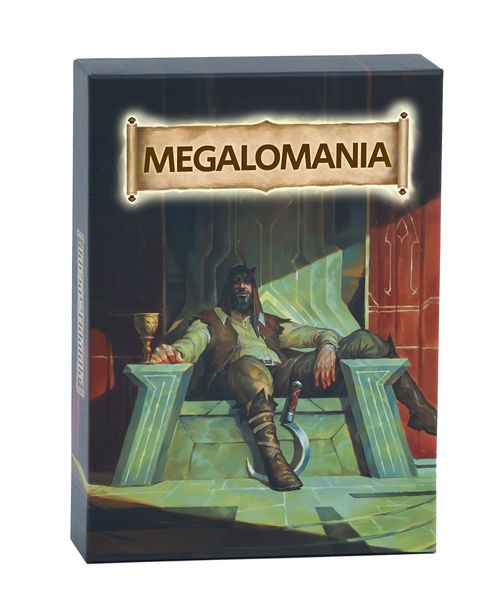
Megalomania Card Game
Megalomania Card Game Rulebook
Table of Contents
Table of Contents
Components
32 Playing cards 25 Missions 20 Scrolls 45 Cubes 1 Scoresheet 1 Rulebook 10 Power Crystals
Players and Cards
The game can be played by 2-4 players.
In the case of two players, you must use only those missions that have a number "2" marked in green on the mission card. In the case of three players, you must use only those missions that have a number "3" marked in green on the mission card. In the case of four players, all mission cards must be used.
The game can also be played in pairs. There are no extra rules when playing in pairs.
The winner is the pair that earn more points at the end of the game.
The game consists of 32 playing cards, which are divided into cards of 4 different colors. Cards in each color are divided according to the value, which is called a card rank. All card ranks have a corresponding value. See one-color cards by rank from top to bottom:
- 15 — Emperor — Disable Unique Powers
- 12 — Oracle — Change the color
- 9 — Knight — Cancel Dominant Color
- 7 — Wizard — Play the breest
- 6 — Dwarf — Lowest value takes the trick
- 4 — Explorer — Discover the Card
- 2 — Assasin — Play on any color
- 1 — Farmer — Choose who ends the next turn
Card value, Rank, Unique Power, and Card Color are marked on each card.
Playing cards have Unique Powers. (See p. 10) The game also features 25 Missions (see p. 6), 45 Cubes (see p. 14), and 20 Scrolls (see p. 15)
Setup of the game
Shuffle the decks of Missions and Scrolls and arrange them face down on the game table. Arrange the Power Crystals and Cubes near these decks. Shuffle the playing cards and place them in the center of the playing area. Take the scoresheet and hand it over to one of the players so that he can keep track of the points.
The goal of the game
The goal of the game is to complete missions, during which players earn points for each completed mission. The player who has the most points after 12 rounds is the winner.
Missions and points system
The game has 25 different missions. A mission card describes the task and the corresponding score for completing this task. According to the mission, the player may gain or lose points. The game has 2 types of missions: missions on which players gain or lose a fixed points and missions on which players gain or lose variable points. The mission card is marked with fixed and variable points, card dealing rules, tasks, and points.
A mission card shows: the Mission Logo, the Mission Point value, the different type of dealing (see the annex for the details), how many cards to deal, the task of the mission, the instruction, the number of players for this mission, and the mission number.
Example mission card: Mission Point 4, task "Take the most tricks" — players must place their cards on the table face down in sequence, on the first turn each player must play the first card from their sequence, on the second turn the second card, and the whole round continues according to this principle. Number of Players for this mission: 2, 3, 4. Mission Number: 15.
Game process
Dealing cards
The player whose birthday is closest starts the round. To start the game, the player who is tracking the scoresheet must declare the dominant color that is marked on the scoresheet. The dominant color displayed on the scoresheet changes after each round. After declaring a dominant color, the dealer must take a mission card from the top of the deck, flip it over and place it face up near the deck so that all players can see the mission task. After that, the dealer must shuffle the playing cards and deal according to the rule given on the mission. The dealing is done according to the following principle, the dealer starts dealing the cards from the player sitting to his left and deals each card clockwise.
The scoresheet lists, round by round, the dominant color for that round: round 1 black, round 2 red, round 3 yellow, round 4 blue, round 5 yellow, round 6 red, round 7 blue, round 8 black, round 9 red, round 10 yellow, round 11 black, round 12 blue, followed by a sum row.
Selection of the resources
Once the cards are dealt and the players see their cards, the resource selection phase begins. In this phase, players must select only one of the four combinations and receive the resources identified by the corresponding combination:
Combination 1: 2 Power Crystals (see page 10) Combination 2: 10 Cubes (see p. 14) Combination 3: 1 Power Crystal and 5 Cubes Combination 4: 1 Scroll (see p. 15).
The choice is made first by the player to the left of the dealer and continues clockwise. Thus, the game is ready to start. The Power Crystals and Cubes do not move to the next round. In case a player fails to spend all of the Power Crystals or Cubes taken in the given round, then these resources will be lost and the player will have to get them in the next round. The Scroll remains with the player until the end of the game, or until the player activates it.
Playing the cards
The player sitting to the left of the dealer leads the card at the beginning of the round. He can lead any card. The turn continues clockwise. In this turn, all players must play the card of the corresponding color of the leading card, if the player does not have a card of that color, then he must play a dominant color card, and if none of these conditions are met, the player can play any card.
A trick
A trick is a set of cards played in one turn.
The rule of taking a trick
The trick is taken by the player who played the highest value card of the dominant color, and if the dominant color card was not played on that turn, the card with the highest value of the corresponding color of the leading card, takes it. In case of equal values, the first card played is considered to be the higher of the two. The player who takes the trick leads the next turn.
The round ends when players have no more cards to play. The players who have completed the mission are given corresponding points, which must be recorded down in the scoresheet. After that, a new round begins. The position of dealer shifts to the player sitting to the left. The dealer flips a new mission and the process continues on the same principle. The game ends after 12 rounds.
Example 1: In the given round, the dominant color is yellow. The player "A" leads the turn; therefore, the trick is taken by player "B" because he played the highest card of the dominant color.
Example 2: In the given round, the dominant color is red. The player "A" leads the turn; therefore, player "C" takes the trick because the dominant color card was not played on the given turn and player "C" played the highest value card corresponding to the color of the leading card.
Power Crystal
All rank cards have their own unique power. To use the power of the card, you must have a Power Crystal that can be collected in the resource selection phase (see p. 8). The player can use the Power Crystal only on his own card. The Power Crystal is used after the player plays a card, in accordance with the "Playing the Cards" rule (see p...). Then, if the player wants to activate the power on this card, he has to spend one Power Crystal and place this crystal on the played card, which means that the unique power on this card is already active. The number of Power Crystals used in a single turn is not limited. See a description of the powers of the cards according to their rank:
Farmer (1)
Unique Power "Choose who leads the next turn" - In case of using the Farmer's unique power, the player can choose any player (including himself) who will lead the next turn, regardless of who takes the last trick. Not more than one Farmer's power is allowed per turn.
Example: The dominant color in the given round is yellow. Player "A" leads the turn and plays a Farmer's card. He uses a Power Crystal, after which he announces that player "C" leads the next turn. Although player "B" took the trick on this turn, according to the Farmer's power, player "C" will lead the next turn.
Assasin (2)
Unique power "Play on any color" - In case of using Assassin's unique power, no matter what was the leading card color, the player can neglect the "Playing the cards" rule and play Assassin card even if he had to play another card.
Example: The dominant color in the given round is blue. Player "C" leads the turn and plays a yellow color card. Player "B" wants to take the trick, but he has to play a yellow card that does not allow him to do so. Player "B" uses a Power Crystal and plays a dominant-colored Assassin card, which allows him to avoid the "Playing the cards" rule and not play a yellow card, so he takes the trick.
Explorer (4)
Unique Power "Discover the Card" - In case of using Explorer's power, the player randomly takes one card from the previous trick and can replace it with the card from his hand or return the taken card. The Explorer's power cannot be used on the first turn. In case if more than one player uses the Explorer's power in one turn, the player who used this power first takes the card from the previous trick first, then is the turn of the player who used that power next, and so on clockwise.
Example: On the given turn, player "B" plays the Explorer's card and uses a Power Crystal, so he must randomly take one card from the previous trick and return any card from his hand. (Can return the same card).
Dwarf (6)
Unique Power "the lowest value takes the trick" - In case of using Dwarf's unique power, the player changes the rule of taking a trick on that turn, which means that the player who played the lowest value of the dominant color card takes the trick, but if the dominant color card was not played on that turn, the player who played the lowest value of the leading color card takes the trick. Only one Dwarf's power can be used per turn.
Example: The dominant color in the given round is red. Player "C" leads the turn. Player "B" wants to take the trick, but the card that he played is not the dominant color and is not the highest value yellow card, so player "B" uses the Power Crystal and changes the rule of taking a trick, so his card is the lowest value yellow card and he takes the trick.
Wizard (7)
Unique Power "Play the lowest" - in case of using Wizard's unique power, the player changes the "Playing the cards" rule that turn, which means that after using the power, all other players must play the lowest card of the leading color, and if the player does not have a card of the leading card color, he must play the lowest card of the dominant color, and if none of these conditions are met, the player can play the lowest card of any color. Only one Wizard's power can be used per turn.
Example: Player "A" makes a turn and plays a blue card. Player "B" wants to take the trick. He uses a Power Crystal and plays a Wizard, which means that players "C" and "D" must play the lowest blue card. In this case, player "B" can no longer take the trick, because the lowest blue card of player "D" turned out to be the Knight, whose value is higher, therefore the trick was taken by player "D".
Knight (9)
Unique Power "Cancel Dominant Color" - In case of using Knight's unique power, the player changes the rule of taking a trick on that turn, which means that after using this power the played dominant color cards lose the advantage. This condition does not apply to dominant color cards played before the power was used, therefore in such a situation the dominant color cards played before the using of power, retain the advantage. Only one Knight's power can be used per turn.
Example: The dominant color in the given round is black. Player "A" leads the turn with the blue card. Player "B" wants to take the trick. He knows that there are no blue Oracle and Emperor in the hands of other players, so he uses the Power Crystal and plays Knight. Since players "C" and "D" did not have a blue card on this turn, they played the dominant color card, though, according to the Knight's power, their cards lose the dominant color advantage and player "B" takes the trick.
Oracle (12)
Unique Power "change the color" - In case of using Oracle's unique power, the player changes the color of the Oracle he played. The player cannot change the color of played card into a dominant color, however, if played Oracle card is the dominant color, the player can change it to any other color.
Example: The dominant color in the given round is blue. Player "A" leads with the yellow card. Player "D" does not want to take the trick, but he has to play a yellow Oracle, which does not allow him to do so. Player "D" uses the Power Crystal and announces that his yellow Oracle has become a black color one, therefore player "D" does not take the trick.
Emperor (15)
Unique Power "Disable Unique Powers" - After using the Emperor's power, players are not allowed to use unique powers and cubes on that turn. The powers and cubes used before, remain active. Only one Emperor's power can be used per turn.
Example: Player "A" leads the turn with a blue Emperor. He wants to take the trick, so he uses the Power Crystal and disables other players to use Cubes and Power Crystals on that turn, to increase the chances of taking the trick. Accordingly, the trick was taken by player "A".
Cube
A Cube is an element that allows a player to increase or decrease the value of cards on a given turn. In order to use this element, player must have a Cube that can be collected in the resource selection phase (see p. 8). The player can use cubes only on his own cards. This element is used after the player plays the card, according to the "Playing the cards" rule. If the player wants to increase or decrease the value of the card, he must spend and place the desired number of Cubes on that card, after which, the value of the card he played is changed (1 Cube = +/- 1 in Value). The number of Cubes used per turn is not limited.
Scroll
A Scroll is a supporting card that gives the player an advantage and helps to complete missions. The card has an instruction describing the positive effect, that a player can use in one particular round. The player can use the Scroll and activate its effect after the cards are dealt and before the resource selection phase. Only one Scroll can be used per round. The right to use the Scroll is given first to the player sitting to the left of the dealer, and if he does not use the Scroll or he simply does not have one, the right is given to the player sitting next to him and so on clockwise.
The Scroll can be collected in the resource selection phase (see p. 8). The player is not allowed to use the scroll in the round in which he collected it.
The Scroll is hidden from other players during the game, and when a player activates the Scroll, he must flip it and place it face up in front of him. Activated Scroll is discarded at the end of the round.
Winner of the game
At the end of the game, points of the players are counted according to the following principle. After 12 rounds, points of each player will be summed up according to the completed missions. Players with at least one unused Scroll gain 2 additional points. After summing up all the points, the player who has the most points is the winner. If two players have equal points, then the winner is the player who has earned fewer negative points, and if the negative points are equal, then the winner is the player who has no unused Scroll.
Annex: Detailed Explanation of Missions and Scrolls
Search for a Mission or Scroll with the relevant number on the card and see detailed description, examples, and instructions.
Missions
- The dealer deals 8 cards to each player. The mission is fixed, therefore only the players who take exactly 3 tricks gain the points.
- The dealer deals 8 cards to each player. The mission is fixed therefore only the players who take the tricks including the cards of all color lose the points.
- The dealer deals 8 cards to each player. The given mission is variable; therefore, the players gain 1 point for each blue card in their taken tricks.
- The dealer deals 8 cards to each player. The given mission is variable, therefore, the players gain 1 point for each yellow card in their taken tricks.
- The dealer deals 8 cards to each player. The given mission is fixed; therefore only the players who take 4 or more tricks gain the points.
- The dealer deals 8 cards to each player. The given mission is fixed; therefore, only the players who has no Dwarf and Wizard in their taken tricks gain the points.
- The dealer deals 8 cards to each player. The given mission is variable; therefore, the players gain 2 points for each taken trick, in which the sum of the card values is 25 or less.
- The dealer deals 8 cards to each player. The given mission is fixed; therefore, only the players who take the tricks including the cards of all color gain the points.
- The dealer deals 8 cards to each player. The given mission is variable; therefore, the players lose 1 point for each red card in their taken tricks.
- The dealer deals with 8 cards for each player. The given mission is variable; therefore, the players lose 1 point for each black card in their taken tricks.
- The dealer deals 8 cards to each player. The given mission is fixed. At the end of the round, players sum up the values of the cards of their taken tricks. Only the players with the total value of 80 or more gain the points.
- The dealer deals 7 cards to each player. The given mission is fixed, therefore only the players who take an odd number of tricks lose the points.
- The dealer deals the first 3 cards to each player and places them on the table face up, and the next 3 cards are dealt face down. Players take only 3 face-down cards in their hands. The face-up cards are played directly from the table. The mission is fixed; therefore, only the players who take exactly 1 trick gain the points.
Scroll
- In the given round the dominant color is black. Player "A" activates the Scroll and chooses the dominant color to be red; therefore, the dominant color changes in this round and becomes red.
- The dominant color in the given round is yellow. After activating the Scroll, player "B" declares the red color (he cannot declare the yellow color, because this color is dominant in the given round). Player "A" must hand over any red card to player "B", and after receiving the card, player "B" must return any card (can return the same card). After completion of the exchange, player "B" performs the same action with players "C" and "D". In this case player "D" does not have a red card, accordingly he can give any card to player "B".
- Player "A" activates the Scroll, successfully completes the mission and gains 4 points on the given mission; therefore points he gains for this mission is doubled and earns 8 points instead of 4 points.
- Player "B" activates the Scroll, because he thinks that his cards are not good enough to gain the points on the given mission, so the cards are being redealt. During the redeal, the given mission and dealer do not change.
- In the resource selection phase, player "C" chooses the Scroll and gets the scroll #5, so he must immediately take a new Scroll from the Scroll deck, and keep the scroll #5, so it remains with him until the end of the game. When counting the final points, this Scroll is considered as an unused Scroll. (See chapter "Game Winner," p. 15)
- Player "B" activates the Scroll; therefore, the resource selection phase is skipped in this round.
- Player "A" activates the Scroll. He must choose any Scroll that has already been used during the game. Player "A" choses the Scroll "Redeal the cards" that have already been activated by player "B" in the previous round, therefore player "A" activates "Redeal the cards" Scroll effect.
- Player "C" activates the Scroll; therefore, he must take 3 Scrolls from the Scroll deck and keep one, and the remaining 2 Scrolls are discarded from the game. Player "C" has an option to activate the selected Scroll in the given round or save it to for the next rounds.
- Player "D" activates the Scroll, therefore in the resource selection phase, he chooses 2 types of resources. He can choose 3 Power Crystals and 5 Cubes, or 2 Power Crystals and 10 Cubes or 1 Power Crystal and 15 Cubes. The player cannot take new Scroll on this round.