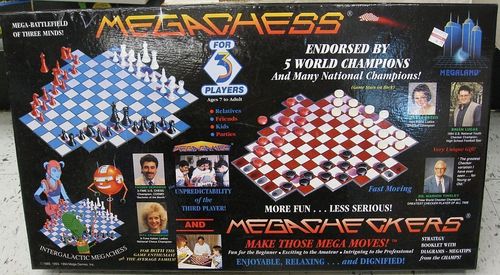
Megachess
Megachess Rulebook
Table of Contents
Table of Contents
Setup
Each team has the regular number of pieces: 1 King, 1 Queen, 2 Bishops, 2 Knights, 2 Rooks and 8 Pawns. The pieces are placed exactly according to Figure 1, with each player having a black square in his or her right corner. Notice that the Kings on each of the two staircased sides are directly facing each other across the board, as are the Queens. The Kings on these teams are always a space closer to the top of the staircase than the Queens, thereby keeping the Kings out of the open diagonal space. The player at the bottom has the option of switching the starting position of his or her King and Queen before the game starts.
White always moves first, and the players take turns moving in a clockwise fashion. All the pieces move and capture in exactly the same way as regular Chess, with the exception of the Pawn. Once you have mastered the changes, you will be ready to play.
Figure 1 shows the starting position on the Megaboard. The three teams are White, Black and Red.
The Pieces
The Pawn: The Pawn usually moves first. It can advance either one or two squares on its first move only, but only one square on all following moves. In MEGACHESS, the Pawn has more movements because of the board design and will require more concentration. It can move one square to either side or backwards, as well as forwards. It still can capture an opponent's piece which appears in the next square diagonally ahead either on its left or right, but it can capture by moving diagonally backwards as well. The Pawn can capture diagonally only by moving one square. If it should reach either opponent's back row, it can be exchanged for a Queen or any other piece the player chooses except a King. Same rule applies for all back rows even after one player has been checkmated. The "back row" consists of all the squares from Rook to Rook in the original set-up and does not include the empty squares in the six far corners. "En passant" does not apply in Megachess.
The Bishop: The Bishop moves and captures diagonally, in any direction. In one move, it can move as few or as many squares as are vacant.
The Rook: The Rook moves forward, backward or to either side in a straight line as many vacant spaces as it desires.
The Knight: The Knight is the only piece allowed to jump over other pieces, whether the others are opponents or on the same team. It still moves in an L-shape, i.e., either one square to either side plus two squares forward or backward or two squares to either side plus one square forward or backward.
The Queen: The Queen is still the most powerful and versatile piece on the board. She can move like either the Rook or the Bishop, but she may not combine the two directions in one move.
The King: The King can move only one square at a time, but he can move any direction he wants and capture an opponent's piece in an adjacent square. If an opponent moves a piece so that, on the same opponent's next move, he or she would be able to capture another player's King, that King is then "in check". Whenever this occurs, the opponent must state "Megacheck!". The King may not move into Check.
Special Moves
Castling: Castling is one special protective move that the King can take advantage of during the game, but only once. If you have not moved both the King and either Rook, and the other pieces originally between them are out of the way, then you may move the Rook to the square next to the King on the back row and then jump the King over the Rook to the next square, still on the back row. You may not Castle the King either out of Check or through a Check. Castling on the diagonal side is done the same as on the straight side. The Rook moves to the position originally occupied by either the Queen or Bishop (depending on which Rook is involved in the Castling). The King would then jump over the Rook to occupy the next square on the back row.
Checkmate
Checkmate: Checkmate occurs when a player's King has been put into Check and the player is unable to get the King out of Check by either moving him to an adjoining square that is free from Check, or by capturing the Checking piece, or by intercepting the Check by moving one of the other pieces between the King and the Checking piece. The interception methods would not work if the Checking piece were a Knight, since the Knight can jump over the interceptor, meaning the King would still be in Check. Once a player has been put into Checkmate, the checking player must say "Checkmate". There are then three options for completing the game, which the three players must have already agreed on before the game started. The three options are:
(1) The Checkmated player's pieces all remain on the board, with the two other opponents having to play around these immovable pieces.
(2) The Checkmated player's pieces are all automatically removed from the board.
(3) The Checkmated player's pieces all stay on the board, but they can be captured and removed by the other players in order to improve their positions.
The two players then continue until one has Checkmated the other, thus winning the game. The winner must then state "Megacheckmate!" or lose the game.
NOTE: If a player has Checkmated the one who last moved, the Checkmate will hold unless the third player breaks up the Checkmate by either intercepting or capturing the Checking piece. If a player has Checkmated the next player to move, the Checkmate cannot be broken up.
Stalemate
STALEMATE: Stalemate occurs when a player is unable to move any pieces or the King without putting him into Check, provided the King was not already in Check. In such a case, the game is a Draw for all three players. One player may intentionally try to Stalemate a second player in order to intentionally force a Draw, if the first player believes he or she has little chance of winning. It is up to the third player to thwart a deliberate Stalemate in order to avoid the automatic 3-way Draw.
Megacheckers
Megacheckers is printed on the flip side of the Megachess board and is included in the same rulebook.
MEGACHECKERS is played on the same board as MEGACHESS. While each player starts out with twelve pieces as in regular Checkers, they are lined up differently, as in Figure 2. Figure 2 shows the Megacheckers setup on the Megaboard, with the White, Black and Red pieces, the Back Line squares and the Black Hole squares marked.
MOVES: Each piece can move one space diagonally, either forward or backward, to an unoccupied dark square. Black moves first.
JUMPS: You may jump over and capture an opponent's piece only if the piece is in the next diagonal square forward or backward, with an empty dark square directly behind the piece captured and in the same diagonal line. If you have the opportunity to jump and capture a piece, you must do so. Same applies to several successive jumps in a straight or zigzag forward or backward direction. If a player fails to capture a piece when it was possible to do so, his or her opponent (the one who should have been jumped) may, as a penalty, remove the piece from the board who failed to make the capture. The opponent utilizing this penalty does not lose his or her regular turn. If more than one jump is possible, the player may choose the jump to make.
KINGS: If a piece reaches either opponent's back line, it becomes a King and the opponent crowns the piece with a captured piece. Same rule applies for all back lines even after the first player has been eliminated. The King can move and jump in the same manner as regular pieces. The King can also move forward, backward or sideways onto red squares; The King may and must jump over an opponent's piece on any square adjoining the red square. Successive jumps in any combination, straight or diagonally, from this position are allowed. After one player's pieces have all been captured, the remaining two players continue. The winner is the one who has captured all of the other's pieces or blocked the opponent so that he or she cannot move.
NOTE: In any series of successive jumps, a player always has the right to jump over pieces belonging to both opponents in the same move if such jumping is possible. This applies whether the jumping piece is a King or a regular piece. No penalty is exacted in this case if the jumping piece chooses to jump over only one opponent's piece or pieces.
BLACK HOLES: A piece cannot be crowned a King in a Black Hole, indicated in Figure 2. If a player forces his or her opponent to jump into a Black Hole, the opponent loses that piece. The player jumped over does not lose the piece jumped.