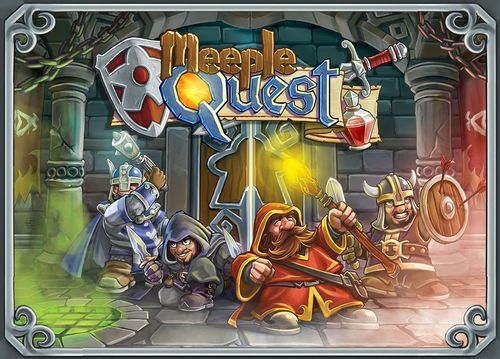
Meeple Quest
Meeple Quest Rulebook
Table of Contents
Table of Contents
- Introduction
- Game Objective
- Game Components
- The villains
- The heroes
- Combat dice
- Equipment cards
- Treasure cards
- Exploration cards
- First player token
- Representative of Evil Lord
- Villain dashboard
- Boss character cards
- Player mats
- Bonus tokens
- Magic backpack tokens
- Relic blessing tokens
- Sacred Relics tokens
- Meeple trap tokens
- Treasure chest tokens
- Summon portal tokens
- Summary cards
- Game tiles
- Teleport tokens
- Saving the Princess
- Setting up
- Game turn
- End of the game
- Solitary game
- Modular game
Introduction
This game is for 1 to 5 players and take us to dark dungeons or, who knows? you might even come across deep caverns and gloomy woods, infected with ruthless creatures. The board will be put together randomly with every turn as players explore. As brave heroes recruited by the King of Meeple Land, our mission is to clean the place and get as many treasures as we can, since these will provide us with the fame and glory that we desire so much. However, we never forget the Sacred Relics stolen by villain meeples, who are taking Meeple Land into the Darkness. In order to recover the Sacred Relics, we count on several kinds of heroes that will support us in achieving our aim with success, although only one hero can be chosen for this adventure, and if the hero dies we have the change to send another one, no worries. At the beginning it might seem a good idea to collaborate with the rest of the players and to try to create a balanced party. But, remember, there can only be one winner.
Game Objective
In order to win this game not only we must win its mechanism (an evil artificial intelligence), but also the rest of the players. For this purpose, we must achieve three Sacred Relics of any color combination except the corrupted ones (these are dark and they cannot be taken, later on the aim for this will be explained) and leave with them through the entrance of the dungeon. Nevertheless, the villain meeples could also win if they manage to corrupt Meeple Land, and they will achieve so if the Evil Level reaches the square with the eye of the Evil Lord. These can happen mainly if several heroes die or if some relics get corrupted. In order to help us recover the relics there are golden relics that are used as joker, they are very rare and of great value.
In the case we earn three relics of the same color, these will bless us and will provide us with a special bonus. If so, we will obtain the blessing token of our color.
Example: The blue player earns 3 relics, 2 oranges and 1 golden. He gets blessed by the Sacred Relics.
Game Components
The components are limited to the amount that there in the box. If a component cannot be placed, this can be ignored. This section explains their use.
The villains
They are the evil creatures of the game that are controlled by AI (artificial intelligence) call Evil Meeple Lord and sometimes by the player who represents the Evil Lord in that turn (it will be explained in more detail later on). In this game there are three kinds of villain meeples (of black color); minions, mini-bosses and the Boss of the minions.
The characteristics of these villains are the following:
- Minions: They move 3 squares, have 1 life point and throw 2 dice in melee combat. They deliver 1 power point to the hero that destroy them.
- Mini-bosses: They move 3 squares, have 2 life points and throw 3 dice in melee combat. They deliver 2 power points to the hero that destroy them.
- Boss: Check the section cards of bosses.
The heroes
The characters of the players are represented by color meeples (red, green, blue, yellow and orange).
Each player counts on 4 cards that represents his 4 heroes available in the game. When a player has an active hero in the dungeon, he must place his corresponding card in the Player Mat. These cards point out the starting life, the movement, the skills, if the hero has any, and the amount of power to start with.
- Warrior: Throws 2 extra dice in combat.
- Mage: He can re-rolls a die without having to spent a power point. Besides, when he earns power points, he gets the double of the rest of characters. As additional free action, he can spend 5 power points in order to place or move his teleport token to the square that he occupies, as long as this is empty and it is not a special tile (as the starting tile).
- Priest: Each villain meeple eliminated makes him recover 1 lost life point. He cannot have more life points that his card indicates.
- Rogue: He can leave the squares with villains without having to spend power points, and also can enter the squares with enemy meeple traps without being affected. In addition, during his movement he can move an extra square.
Combat dice
When a hero throws the dice when attacking, the results of the colors of the hero count as impacts. These impacts are usually direct (there is no defense except for some equipped treasure cards) and these impacts count as damage. Also, there must be taken into account the Combat Bonus Token that the player has, which means that the color of that token counts also has impact (this token will be explain further later on). This means that we have 33% probabilities for success as hero. The heroes are impacted by villains with their own colors and black (they have a 50% probabilities of impact).
Equipment cards
Each hero starts with his own equipment card, this card shows the face of the hero and has white border. This card usually indicates the number of dice that can be thrown in combat. Some of these cards might require spending power points in order to be fully used or to activate a special ability. On the reverse of these cards we can find the advanced version of the weapon. This side of the card has golden border.
The equipment cards are placed next to the hero card on the Player Mat. They can neither be discarded nor sold.
- Melee attack (crossed swords icon): in the same square.
- Adjacent attack (dagger icon): in the same square and also in adjacent orthogonal squares.
- Range attack (bow icon): in the same square, in diagonal squares and also up to two orthogonal squares.
Example: Stuff of Light is the Mage's advanced weapon. It attacks with one die and offers a free re-roll. By spending one power point it turns into a range attack. Besides, it is a two handed weapon with melee attack.
Treasure cards
They are similar to the equipment cards. The heroes get them by opening the chests they come across while exploring the dungeon. Also, it is possible to get one of these cards by destroying an evil summon portal. These cards are never harmful for the player and are kept hidden to the rest of the players.
- One-use object: The card indicates when to use it. Once used, it will be discarded.
- One-hand object (hand icon).
- Two-hand object (two-hands icon).
- Event icon (lightning icon): They must be shown as soon as they are taking out of the Treasure Deck and their instructions must be carried out. The event Power Up! will be shown by turning over the equipment card of the hero.
Equipping with new objects
The heroes will only be allowed to equip themselves during their turn and up to a maximum of 2 cards. It is not possible to equip with cards that have the same icon and that together add up more than two hands. The cards with potion icons cannot be equipped and must be kept in the "player hands". If the hero dies, the equipped cards are ruled out, the non equipped cards and those with a potion icon can be kept by the player. An equipped object cannot go back to the "player hands", they must be discarded in order to be replaced.
Monetary system
Some of the treasure cards have money value. As free action a player can exchange cards that are in his hands, for the value of 4 meeple coins, in order to get a relic. For this purpose 2 relics will be taken out of the Relic Reserve, having to choose one and return the other one.
Exploration cards
These cards indicate the tile that must be taken and how to organize his content (summon portals, villains, relics, treasure chests...). For the One Player Mode, the arrow shows the position as it has been explored.
For 2 or more players, the player in charge of the Evil Lord will decide how to adjust the tile.
The Exploration Deck cannot have more cards that tiles are available in the game (if there are 4 corner tiles, then there will be a maximum of 4 corner exploration cards). Check the Set Up section in order to learn how it is built. For one player only 2 tiles of each type are used. For 2 or 3 players it is recommended 3 tiles of each type so that the game is more agile.
Legend for the numbered callouts on the exploration card illustration:
- Type of tile to be placed.
- A relic token is placed facing up.
- Two villains are placed.
- A mini-boss of villains is placed.
- Forced adjustment for single player games.
The boss icon (a single black meeple) represents the villain boss of the game. There is only one exploration card with this icon.
First player token
This token is a reminder of the player who carries out his actions in the first place during the Hero Phase. At the end of each game turn, this token must be handed to the player on the left.
Representative of Evil Lord
This token is show who should throw the dice of the villains, choose the orientation of the tiles, choose target in case of a tie of malignant AI...
At the start of the game it is handed to the player on the right of the starting player and once there has been a whole turn completed (all three phases) it is given to the player on the left. In the section of game preparation this is explained in more detail.
Villain dashboard
This board allows to keep track of the progress of evilness in Meeple Land. When the level reaches the square with the eye of the evel lord, Meeple Land will fall into darkness and the players will lose the game.
It comes with two wooden black counters, the octagonal piece is initially placed in the box that shows the number of players. The cube is the counter for the life of the Villain Chief.
In addition, in this board there are three spaces to place the card of the villain chief and the exploration and treasure card decks.
Boss character cards
These cards, apart from letting the players know what kind of creatures they face, also indicates the characteristics of the Boss and his skills, which will apply only when it appears in the game. When a boss is eliminated, the hero will receive a treasure card, 5 power points and a relic, as long as its ability allows it, otherwise this will be ignored (if already in possession of three relics, the reward relic gets wasted). Remember, winning a relic means to take two Relics from the Reserve, to keep one and return the other.
The numbered parts of a boss card are:
- Name of the Boss.
- Type of attack.
- Amount of dice for attack.
- Illustration of the Boss.
- Amount of life.
- Skill of the Boss.
- Movement points.
The small skeletons are invoked by the Lich and are equivalent to normal Minions.
Player mats
The hero card and the starting equipment cards are placed on this board. A further two spaces allow to place two treasure cards that the hero has obtained during the game.
There are two bars in order to keep track of the life and power of the players by using wooden cubes. A hero will not be allowed to have more life that his cards indicates, but he will be allowed to accumulate up to 20 power points as the limit of the bar shows.
The numbered parts of a player mat are:
- Space for the hero card.
- Space for the starting equipment card.
- Space for two further equipment cards.
- Track for the power counter.
- Track for the hero's life counter.
In addition, to facilitate the preparation, the board shows the common values of life and power a hero starts with.
Bonus tokens
With these tokens the chance of impact increases when throwing the dice, not only in combat but also in any occasion that requires throwing dice (how they are handed to the players will be explained later on). For all purposes players are represented by two colors, the character card color and other components, and the bonus token you received from another player.
Magic backpack tokens
Each player has a magic backpack of relics. When a hero dies, he lays his magic backpack in the square where he died in order to identify where he left the relics obtained so far. The magic backpack token is placed on the board. There is only one backpack per player. If the active hero of the player is killed and leaves his backpack, his new hero will have to get it before he can carry on taking more relics. The limit of relics that fit in the backpack is 3. The relics inside the backpack cannot get corrupted, but one by one they can get stolen by other players.
Relic blessing tokens
Each player has a blessing token that can be used when obtaining three Sacred Relics of a same colour. There is a different type of blessing on each side of the token, and the player will choose with which of them to start as soon as he gets the three sacred relics. In the corruption phase he will be able to change the type of blessing.
Sacred Relics tokens
They represent the relics that players must get to win the game (expect the corrupt ones). There are two types, the sacred relics that are those of the colors of the players, and the golden ones that are like wildcards, and the corrupted relics, these are dark and cannot be taken and means an obstacle for the objective of the heroes.
Corrupt relics will become mini-bosses in the corruption phase if they do not get destroyed and they will return to the Reserve of Relics. They have a life point and they get impacted as villains. Destroying a corrupt relic gives 2 power points and the destroyed relic gets ruled out of the game.
The golden relics behave as wildcards, each of them are equivalent to any color, so they can be used to get the Blessing of Relics.
Meeple trap tokens
Each player has a total of 4 trap tokens of his color and there are also villains traps that can appear in the exploration cards.
The traps of the players can only be placed in empty squares where the hero is, in tiles of any type except special or initial. The trap makes any meeple (villain or hero opponent) passing through them lose a life point, but does not interrupt his movement. The heroes of the same color of the trap can cross and stay in these squares without activating the trap, the same with the villains and his traps. Rogues can remain and cross any square with a trap even though it is not of their own color. When a trap is activated, the token is discarded from the game and cannot be used again by the player to whom it belongs. The villains that are eliminated by traps offer power points to the owner.
Treasure chest tokens
These appear through exploration cards. A player can use his hero free action to open a chest. He will take a card from the treasure deck and keep it. In the case that the card contains an event, this will apply the effect immediately. The treasure token is taken away of the game board.
Summon portal tokens
On these tokens Minions will appear in the Corruption Phase. As with chests, these tokens appear throughout the game with the exploration cards. They can be destroyed by a free action of a hero, needing to spend 5 power points. In this case the player will win a treasure card.
Summary cards
They are used as a quick reference in order to know how to perform a full game turn, also indicating all kind of actions that a player can make with his character. The game turn is more detailed in these rules.
Game tiles
There are five different types of tiles apart from the starting tile that is a special one. Rooms, corridors, corners... they form the dungeon as heroes explore.
Up to a maximum of 4 meeples of any size are allowed to be in a same square (unless indicated otherwise). If there are 4 meeples, it will not be possible for any other meeple to enter the square (hero o villain). This restriction also applies to rogues.
The starting tile differs from the others because it has special corner squares with snail stairs. The villains cannot enter these squares, therefore they ignore the heroes that occupy them.
Teleport tokens
These magic portals are connected among each other. A hero can go from one to the other by spending a movement point and a power point as part of his movement. The villains also take into account these portals when calculating their shorter route toward the heroes.
All the magic portals work exactly the same although they have different colors.
Each Mage can place or move the portal of his own color by spending 5 power points. This can only be placed on an empty square, except in special tiles where the Mage is, as the starting one.
Saving the Princess
This character can appear in the dungeon at any point of the game in the dungeon. The princess is worth a golden relic and occupies the space of a meeple. The hero that is on the same square than the princess can take control of this as a free action, and he will take the card that represents it. Another hero could take her control. The villains ignore the princess. If a hero dies and is carrying the princess, this will stay on the square where the hero died. The princess comes with a character card, and exploration card (room type) and a pink wooden meeple.
Setting up
-
Each player must take the following items of his color:
- The player board
- 1 wooden meeple
- 4 hero cards
- 4 equipment cards, one for each hero
- 2 wooden cubes
- 1 magic backpack token
- 4 meeple trap tokens
- 1 teleport token
- 1 bonus token
- 1 blessing relic token
-
Preparing the Relic Reserve: Each player must take his 3 color relics, 1 golden relic and 1 corrupted one (or 2 corrupted per player for 2 players game and 3 corrupted for solitary play mode). All of them must be placed facedown and mixed. This is called the Relic Reserve.
-
Preparing the exploration deck: The exploration deck must be separated by tile type, and each of the decks are shuffled independently. According to the number of tiles, the same number of exploration cards is taken. If the Boss is included, then a room type card less is taken. Once this is done, then all cards are put together in one deck and are properly shuffled. If the Boss is included, this card is put approximately in the middle of the deck. Depending on the number of players, the number of tiles could change. Check Exploration Cards (page 6) and Solitary Play Mode (page 15).
-
Placing the starting tile: The starting point of the dungeon is the centre of the table, where the starting tile must be placed. The squares with snail stairs are starting squares where the players meeple will be placed. Once these squares have been left by the heroes, these will only be allowed to come back having got three sacred relics.
-
Revealing the type of adventure monster: The Bosses card deck must be shuffled and one of the cards is randomly taken. The chosen card is placed on the villain board and the black life counter is placed on the number that is shown on the card.
Each player hands his bonus token to the player on the left. Concerning the Evil representative Lord token, the player on the right of the starting player will get this. In the corruption phase this will also be handed to the player on the left. Consequently the player whose turn is the last one will always be the representative of the Evil Lord.
- Choosing and placing the hero: The starting player takes the meeple of his color and places it on any of the four squares with snail stairs of the starting tile. The rest of the players do the same clockwise. They can choose the same square than other players, as long as there are not more than four in the same one.
The starting player chooses a hero card and places it on the space of the player board meant for this purpose along with his corresponding equipment card. Afterwards the rest of players do the same clockwise.
Game turn
The turn consists of three main phases that take place sequentially. Once the three phases have been carried out, it can be said that a whole turn of the game has been completed.
A. Hero Phase
All players must complete this phase before carrying out the next one. Each hero has 3 actions that can be performed or skipped, as well as choosing the order in which to carry them out. It is not allowed to repeat actions. The starting player will be the first one, and then the rest of players clockwise.
- Move: The hero can move up to the maximum of squares shown in his hero card, as well as using the power stated in the card or the abilities related to the movement. Besides, the player is allowed to move an extra square by spending one power point.
- Attack: The player can attack by throwing the combat dice available for his hero, as well as using the power of the cards or abilities that affect the attack. He can attack not only villains, but also corrupted relics or other heroes.
- Free action (only one):
- Placing a meeple trap: A hero can place a trap in the square where he is if it is empty. It is not allowed to place traps in the starting tile.
- Opening a chest: A player has the option of opening a chest that is found in the same square that he occupies. This is done by taking a treasure card from the treasure card deck. Then the chest token is taken away of the game board.
- Taking a relic: A player has the option of taking a relic that is found in the same square that he occupies (if there is enough space in the magic backpack).
- Recovering the magic backpack: The hero will be able to recover his backpack and its content if he occupies the same square, or from any other place of the gameboard by spending 5 power points, plus 5 extra points for each relic inside.
- Destroying a summon portal: A player can destroy a summon portal that is found in the same square that he occupies by spending 5 power points (even if there are other meeple in the square).
- Level up: The hero will be able to improve his weapon by spending 15 power points.
- By spending 20 power points the hero can obtain a relic. He will take two relics, will choose one of them and will return the other to the relic reserve. All the corrupted relics must be returned to the reserve, so if both of them are corrupted the hero will not keep any.
Moving around the game board
Heroes and villains can only move orthogonally, not diagonally. A hero that occupies a square with villains (no enemy heroes) will have to spend one power point for each villain in order to leave the square. It is important to remember that not more than 4 meeples are allowed in one square. The movement cannot be stopped to carry out an action and then continue the movement.
Example: The warrior of the blue player cannot move diagonally, but he can do it orthogonally toward the corridor tile. He has a three square movement and he moves the maximum, but he must spend one power point in order to cross a square with a villain. He decides to spend two further power point to move two extra squares.
Exploring the dungeon
When a hero occupies an entrance/exit square, he will be able to explore a new tile as long as he still has at least one movement point left. In that case, the hero will take an exploration card and will place the tile as shown in the card. The meeple must be placed in the square of the tile as he entered. In games with more than one player, the player Representative of the Evil Lord will choose the orientation of the tile.
Figure: Entrance and / or exit square.
When a hero explores the last tile of the game, the content of the tile will be placed as indicated in the card and then the player will gain a relic (he will take two and will keep one that is not corrupted). Then another relic will be randomly placed in the middle square of the starting tile.
Fighting
A hero that shares a square with other meeples (villains or rival heroes), or these are at the reach of his type of attack, then he will be in a position to choose whether to attack this square. In that case he will roll as many dice as allowed by his equipment, abilities and any other modifier. All the results obtained of his same color and the color of his bonus token will mean impacts. These impacts turn into damage and can be divided among the different enemies within the attacked square. Besides, it is possible to re-roll the dice by spending one power point for each dice (as many times as desired). The defender, if it is a hero player, will also have the chance to spend one power point to make the attackers re-roll a dice when there is an impact against him.
For each villain eliminated, the player will obtain two power points (depending on the type of villain the amount will change). The power points will only be obtained at the end of the combat, not during. The corrupted relics that are destroyed will mean two power points for the player. The mini-bosses have 2 life points, therefore, when receiving only one damage point, they are overturned with the purpose of showing that it is only wounded, but not killed.
In the case that in the attacked squares with villains there is also another hero, the attacker can choose to ignore the left over impacts in order not to damage the hero of the other player.
Example: The Warrior has an ability of +2 dice in combat and a sword that allows him to roll a dice in melee combat. He is faced with two minions that occupy the same square. The player will roll three dice and any blue result will mean an impact. As he also has the bonus green token, any green result will also be an impact.
B. Phase of Villains
Once all players have completed the phase of heroes, all villain meeples will be activated. Firstly the minions, then the mini-bosses and finally the Boss. All movements will take place before starting the attacks. The movement is always toward the closest hero. If there is a tie, then the villains will go toward the hero with less life points. If still there is a tie, the representative of the Evil Lord will choose the direction to follow. If there is a hero trap in the way, if the distance is exactly the same the villains will sidestep the way with the trap.
Since there cannot be more than 4 meeples in the same square, if villains cannot enter they will remain in the closest adjacent square. If they can attack, they will attack the hero with less life points. In the case of tie, the representative of the Evil Lord will choose the target.
When villains attack, they hit the target when obtaining the same color of the attacked hero, the color of the hero's bonus token, as well as the black color. When there are several villain meeples in the same squares, all combat dice are rolled at the same time and all the results will impact the same victim (villain meeple do not share the damage, they enter a blinding maelstrom of the weakest). The hero can make the villain re-roll the dice by making use of power points. Nevertheless, the villains cannot re-roll the dice by themselves in order to improve their results, neither other players can spend their power points to do so).
Unless stated otherwise, minions and mini-bosses always have melee attack.
C. Phase of Corruption
This phase has to be carried out sequentially according to the following order:
- New minions appear in the summon portals. Check out all summon portals in case the level of Evilness must increase.
- Check if the Level of Evilness must increase due to the lack of exploration cards.
- The corrupted relics return to the Reserve of Relics and these are replaced by mini-bosses.
- The Sacred Relics could get corrupted.
- A hero with blessing of Relics will be able to choose the kind of blessing for the next turn.
- The tokens of the Starting Player and the Representative of Evil Lord player are handed to the players on the left.
(The source prints the detailed explanation of each corruption step as a second numbered list, in the same order.)
- If there are at least 5 summon portals, the level of Evilness will go up one position. Besides, for each summon portal a minion will appear. In the event that there are not further available minions, the player that is in charge of the representative of the evil Lord will choose in which portals they will appear. It can happen that in the square occupied by the summon portal there are already 4 meeples. In this case no minions will appear on that portal.
- When all the tiles are placed and there are not exploration cards left, then the level of Evilness will increase in one.
- The corrupted relics that are on the game board will be replaced by a mini-boss (as long as there are not 4 meeples in the square and there are mini-bosses available). The corrupted relic will be mixed again with the rest of the relics on the Reserve.
- The sacred relics that are on the game board could get corrupted. One by one and for each relic the representative of the Evil Lord will roll as many dice as players in the game (except the golden ones that cannot get corrupted, neither the ones inside a backpack). If there is at least one result of the color of the villain (black one), the relic will get corrupted. In the case of turning corrupted, this is replaced by a corrupted relic from the Reserve. If there is no corrupted relics left (all of them have been destroyed), then one of the destroyed relics will be taken (will go back into the game). Once this is done, the relic that has just got corrupted goes back into the Reserve. Remember to increase the level of Evilness in one.
- In the case that the hero of a player is blessed by the relics, he could change the type of blessing for the next turn of the game.
- Finally, the player in charge of the token of the representative of Evil Lord will handed it to player on the left, as well as the player with the Starting Player Token.
Keeping track of the Evil Lord
There is an Evil Level that is used to count the level of the corruption of Meeple Land. When a hero dies or a sacred Relic gets corrupted, the level of Evilness will level up. Besides, in the corruption phase if there are 5 or more summon portals or there are not exploration cards left, the Evil Level also will increase. In the case that the Evil Level reaches the square with the eye of the Evil Lord, then all players will loose and Meeple land will succumb into the Darkness.
Hero death
The meeple of the player is replaced by his magic backpack and his meeple is placed in any of the squares of the starting tile (squares with the snail stairs of the starting tile). The card of the death hero is discarded and all his equipment (the player can keep the treasure cards such as potions and objects not equipped). In the next turn the player will enter the dungeon with a new character (and he will have the chance to get equipped with those cards that had not used before). In order to get relics, the player will have to recover his magic backpack first.
End of the game
The game is over when any of the following happens:
- The Evil Lord Meeple wins due to the level of Evilness. In that case, none of the players will win.
- When a player has three Sacred Relics (whether of his own color, a combination of colors or using the golden relics), he will be able to leave the dungeon through any of the squares with the snail stairs of the starting tile and he will win the game.
Solitary game
The rules for playing in solitary are almost the same that for any amount of players, except that, when exploring, the tile must be placed by following the orientation of the arrow. The Reserve of Relics will include 3 corrupted relics (4 to increase the difficulty). The player, when preparing the game, must take a bonus token of any other color. The exploration card deck must have only two cards of each type, instead of 4. The game is yours and you are free to try with more if you like.
Modular game
This game can be seen as a basic set to which some parts can be added and removed parts to facilitate the game, expanding or reducing the game experience.
- Villain bosses: do not choose a Boss card. Cover the space of the villain board with the reverse of a card. Likewise, do not use the exploration card of the Boss when preparing the exploration deck.
- Magic portals: you could separate and discard the exploration cards with teleport tokens. Also the ability of the mages of placing portals could be ignored.
- Saving the Princess: do not include the exploration card with the princess when preparing the exploration deck.
- Monetary system: The treasure cards will not have monetary value. Therefore, it will not be possible to exchange cards for a relic.
- Evil meeple traps: When preparing the exploration deck, do not include those cards that contain evil meeple traps.
- The dark side: discard the treasure card Dark Medallion and the Evil token.