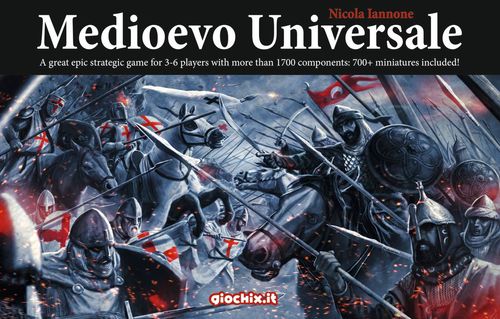
Medioevo Universale
Medioevo Universale Rulebook
Table of Contents
Table of Contents
Aim of the Game
In Medioevo Universale, players develop their kingdom on a commercial, diplomatic and military aspect while facing catastrophic events, wars and betrayals. The player who obtains the highest number of Honour Points (HP) at the end of the game is declared the winner.
Game Duration
A normal game can last 8 (short), 10 (medium) or 12 turns (long). This means the short version would last about 3 hours for a 4-player game. Players may agree to modify the game duration in the following ways:
Time Limit: a maximum time limit for the game is set. When the time runs out, the current turn is completed and then the game ends.
Honour Point (HP) limit: the number of HP needed to reach the end of game is decided. When a player reaches or surpasses this limit, the game immediately ends and the final HP are assigned.
It is possible to play with all of these ending conditions, or to choose only one or two of them. During the game, the HP total is registered on the board.
Example: players decide to play with a limit of 30 HP. During the game, the blue player has already collected 29 HP. After a successful attack and the conquest of an Inhabited Area, the blue player gains 1 HP. The game immediately ends and the final scoring is applied.
Example: players decide to end the game with a time limit of either 3 hours or 10 turns. If 10 turns are completed before the 3-hour time limit, the game ends. Alternatively, the game ends after 3 hours even if less than 10 turns were completed.
The Kingdoms
The six available factions are: the Byzantine Empire, the Mamluk Sultanate, the Kingdom of Hungary, the Holy Roman Empire, the Republic of Novgorod or the Khanate of the Golden Horde. If there are less than 6 players in the game, players must choose connected Kingdoms, as shown on the map.
For example, the Holy Roman Empire (yellow) is only connected to the Kingdom of Hungary, meanwhile the Byzantine Empire is connected to the Kingdom of Hungary, the Khanate of the Golden Horde and the Mamluk Sultanate.
If less than 6 players are in the game, players will only be able to use territories neighbouring their starting kingdom territories (within a 3-territory distance, see DEFINITIONS for "neighbouring"). To easily remember, simply place non-playing armies in territories where the board ends.
Players can initially agree on Kingdom assignation. Alternatively, Kingdoms could either be distributed randomly or selected following a turn order. If there are less than 6 players, after the first player, each following player will have to choose a connected Kingdom.
Contents
Each player set contains (in player colours):
- 20 Heavy Infantries, 10 Cavalries, 20 Light Infantries, 10 Archers, 3 Captains
- 8 Control tokens
- 9 Road tokens
- 10 Property tokens (x2 tokens I-III, x4 I-II, x2 II-III, and x2 I)
- 10 Markers
- 1 Dice Set
Other game contents are:
- 72 Empire cards, 30 Event cards
- 15 Small Standards, 10 Large Standards
- 160 Merchandise cubes in 8 colors (there is a handful of extra cubes which you can use as replacements)
- 48 Objective tokens in 6 colors
- 1 Game Board, 1 Turn Marker
- 15 Galleys, 12 Merchant Ships, 15 War Wagons, 12 Caravans
- 16 Catapults, 14 Trebuchets, 12 Bombards
- 18 Blood tokens, 17 Stop tokens
- 4 barbarian Property tokens
- 1 barbarian Dice Set
- 180 coins (30 of each type)
- 20 destruction tokens
- 40 Barbarian Infantries, 20 Barbarian Archers, 7 Barbarian Captains
- 20 Walls (Castles), 20 Fortresses*, 40 Towers*, 14 Cathedrals, 12 Cities, 17 Towns, 24 Villages
- 1 Player Screen, 1 Player Board
- 4 Battle boards (use them to place miniatures during large battles, instead of placing them on the board)
- 4 Battle board tokens (place them on the board to mark where a large battle is in progress)
- 1 Rulebook
*Tokens are included, miniatures are optional. The contents with a red flag are related to the prototype version and are not shown on this page. For full contents list please refer to the box back.
Definitions
Adjacent territories: is a term used in the game to describe territories sharing the same border (or river).
Army unit or unit: a light infantry, a heavy infantry, a cavalry, an archer or a captain.
Army or army group: 2 or more units of any type in the same territory (a group of barbarians is called horde).
Territory: a land zone delimited by borders, sea and/or rivers.
Barbarian territory: any territory not controlled by one of the players.
Neighbouring territories: two territories with no more than two territories between them.
Neighboring example. Red territories are NOT neighbouring the yellow one, meanwhile all others do.
Inhabited area: they represent the map settlements. They are portrayed on the map by an illustration of a famous building from the zone and allow players to perform different actions.
Opponent: a hostile player or also, when referring to battle, a barbarian army (unit).
Sea area: a sea zone delimited by borders (dotted lines) or coasts.
Game Turn Flow
A typical game turn starts by determining the turn order with an auction. The first player will gain several advantages that might be critical, but the following positions are important as well.
The first player determines the barbarian strength in combat for the current turn and moves their armies within some limits. Hence, players should protect their convoys and their buildings to avoid barbarian plunders.
Once the turn order has been set, catastrophic Events take place. Armies, buildings, transports and merchandise within a certain area can all suffer damage. There are many options protecting them and preventing calamity effect. Try to be ready!
In the third phase, players collect taxes and pay to maintain their units. The tax level determines both how much money can be collected and the chances of a rebellion. Citizens will revolt if too much is asked from them! On the other hand, if too little is asked, there will not be enough money for governance. Players must find a way to use special powers to influence this at their advantage. Do not forget to ask for debt if money is needed!
In the following phase, players may purchase units, buildings, technologies, Empire cards, etc. Armies, for example, are required to attack, defend, plunder, and conquer new territories, while means of transportation are required for commerce and to move troops. Technologies allow new constructions, provide new skills, and combine with other game aspects. Empire cards are needed to use technologies, bestow additional powers, and can be used as objectives as well.
After this, every player can move troops to fight opponents. Battles are resolved by rolling dice, but many factors can influence them as well. Commerce is key in receiving much more money. Players can purchase merchandise, establish a Commercial Road, and after a few turns when markets have developed, they can start to use a Great Market as well.
Finally, do not forget to make Diplomatic agreements, as well as secret agreements, with other players! These present many opportunities and can offer protection in bad times.
Setup
Place the board in the middle of the table. Put the right side face up (as the picture below). Split the cards in two different decks (Empire and Event). Shuffle and place the Empire and Event decks face down near the game board (Empire deck must show the objective side).
Each player chooses a game colour (random choice is also allowed). Then each player receives a player starting load-out:
| Component | Amount |
|---|---|
| Caravan/Merchant Ship/War Wagon/Galley | Distribute 2 levels |
| Village, player board and player screen | 1 each |
| Player Army | 1 archer |
| Dice of player colour | 1d4, 1d6, 1d8 |
| Markers, Control, Property and Road tokens | 37 |
Next, each player receives 1600 florins: two "500" coins, four "100" coins, three "50" coins, three "10" coins, three "5" coins and five "1" coins.
Follow the procedure below in this sequence:
-
Determine first Turn Order (see Turn Order Phase).
-
Players place their village on an Inhabited Area in their Kingdom.
-
Players place their army and means of transportation in their Kingdom as they prefer. Means of transportation have 3 levels (I, II, III, where higher is better). Player can take a total of 2 levels.
For example, a player can take a Galley and a Caravan of I level each (I+I=2 levels), or a Merchant ship of II level, or any other combination.
Galleys and Merchant Ships must be placed on a Harbour (icon). Note: players who start the game without Harbours may not choose ships as starting means of transportation.
-
Place 1 Barbarian Light Infantry unit in each territory with a fire icon (icon).
-
Each player receives 3 random cards from the Empire deck. Empire cards have two sides: the front side displays a character, the back an objective. The player must privately check them looking on both sides and select one card. The selected card is placed near the player's board on character side and returns the other two cards to the deck. Shuffle the Empire deck after every player has completed this operation.
-
Each player takes one free objective token (gear-shaped) of any colour from the game reserve. This token represents a starting technology point bonus in the selected colour. Place the remaining objective tokens near the board.
-
Players place 10 markers (wooden discs), 10 control tokens (cardboard star-shaped), 8 property tokens (cardboard shield-shaped) and 9 road tokens (cardboard rounded) of their colours near their player board.
-
Each player places 1 marker on the HP track on position 10 and 1 marker on the game board Turn order track on the player's turn position.
-
Finally, place the turn marker on Position 1 of HP track.
The set up is now completed and the game may begin.
Screens are useful to hide players' coins. Cards bestow special powers that can be used in game aspects such as War, Trade, or Technology. The player board summarises player technologies and tax value. Each player has a distinct dice set (1d4, 1d6, 1d8).
The War Circle is where the current turn Barbarian Armies and dice will be placed. The turn order track shows the current player order. The HP track shows the players' current HPs. Inhabited areas represent the map settlements. They are portrayed on the map by an illustration of a famous monument from the zone. Each player owns a set of 37 tokens: markers, control tokens, road tokens, and property tokens.
Game Phases
A complete game turn is divided into 7 Phases.
- Turn order
- Events
- Tax & Maintenance
- Purchase
- Combat
- Commerce
- End of turn
The turn order must be respected for the Combat and Commerce phases. In every other phase, all players can play simultaneously.
1. Turn Order Phase
Each turn, starting from the first, an auction is held to decide who will be the first player. Players bid a secret amount of florins, hiding the coins in their fist. Then all players reveal their hand's content simultaneously.
Florins: money used to trade merchandise, collect taxes, construct buildings, buy mercenary armies and technologies, bargain diplomatic pacts and betrayals. Coins come in 6 sizes: 1, 5, 10, 50, 100, and 500.
The auction winner is the first player. The other players' turn order follow their bid value. Ties for the first position are resolved by a second bid between the highest bidding players only. This second bid is added to the first one, making the total bid. If there are ties for the following positions, the previous rank between the players in a tie is inverted (or randomized if this is the first game turn). Only the auction winner (the first player) effectively pays his bid, which must be paid to the player who will play last.
2. Events Phase
The first player performs these steps, in the following order (on the first turn, only step 1 is done):
1. Barbarian dice determination: When the players move into barbarian territories without armies, they will face a barbarian horde. Likewise, in case of a rebellion, players will fight a barbarian horde.
Barbarian horde represents the miniatures that must be placed when a player army enters in any barbarian territory without army or when a rebellion happens. They are grey Light Infantries, Archers, or Captains.
The horde composition and strength change every turn: the first player rolls the 3 barbarian dice to determine the barbarian type and their battle values. The horde always consists of 1 light infantry, +1 barbarian light infantry with 1-3 result on the d4; +1 barbarian archer with 1-3 result on the d6; +1 barbarian Captain with 1-3 result on the d8;
After the roll, first player can re-roll once any dice as he wishes. The results are then final.
Barbarian dice roll example. The first player rolls the Barbarian dice and scores: 3 (1d4), 5 (1d6), and 1 (1d8). 3 = +1 light infantry; 5 = nothing; 1 = +1 Captain. The Barbarian Horde consists of 2 light infantries and 1 Captain. The player chooses to re-roll the d8 scoring 4 this time. This means the Barbarian Horde for this turn is only composed of 2 light infantries.
When the horde is finally determined, the first player places the corresponding miniatures and the rolled dice on the War circle located the board over the HP track, in order to reflect the current horde composition.
The War circle is located on top-right corner of the board.
The same dice results will be also used in battle as the barbarians scores (see 5. COMBAT PHASE).
2. Event card check (only from second game turn): The first player draws the event card on the top of the deck.
An Event card displays in (light and dark) red where the event takes place. The card lists 3 possible effects (icons on the left) of which only 2, chosen by the 1st player, will apply. Note: if a "Grail" symbol is depicted on the card, please ignore it. It is for prototype game.
The first player chooses 2 of the 3 icons depicted on the card and applies their effect in the red territories specified on the card and the adjacent sea zones. The icons mean:
Movement. Every player with at least 1 mean of transportation in an Event card red territory must roll 1d6. On a 3-6 result, nothing happens. Otherwise, the player must select 1-2 (die result) mean of transportations located within the red territories and lower their MP to 0. Place a stop token next to the affected miniatures to reflect the penalty. Remove them at turn end.
Armies. Every player with at least 1 army unit in an Event card red territory must roll 1d6. On a 5-6 result, nothing happens. Otherwise, the player must immediately distribute 1-4 damage points (die result) to 1 or more units located within the red territories. Any killed unit is then removed.
Buildings. Every player with at least 1 building in an Event card's red territory must roll 1d6. On a roll of 4-6, nothing happens. Otherwise, the player must distribute 1-3 (die result) damage points to 1 or more of his buildings located within the red territories. Place corresponding destruction tokens next to the affected miniatures to reflect the destruction. Any destroyed building is then removed.
Merchandise. Every player with at least 1 cube on a mean of transportation in an Event card red territory (or adjacent sea zones) must roll 1d6. On a roll of 3-6, nothing happens. Otherwise the player loses 1-2 (die result) merchandise (cubes) taken from a selected commercial transport located within the red territories.
Event example. Consider the Event card on the previous page. The first player chooses to apply the Event effects on Armies and Movement. Only the Yellow player has armies in a territory in the red area, meanwhile both White and Blue players have units with MP available. The Yellow player rolls a 4 for the Armies effect on 1d6, and thus applies 4 damage points to Yellow army units within the red area. The Yellow player then removes 2 Heavy Infantries by applying 2 damage points to each. There are no further army damage rolls, because no other player has army units in the red area. The White and Blue players then roll for the Event effects on Movement and they respectively roll 5 (nothing happens) and 1. The Blue player then places 1 stop token next to a Blue Caravan, thus reducing its MP to zero.
3. Barbarian supply (only from second game turn): The first player gains 3 barbarian points that can be spent to add barbarian units and/or move barbarian hordes. For each point spent, the player can place 1 barbarian unit on the board or move a barbarian horde within one territory to an adjacent territory.
- When adding barbarian units, the player may add 1 unit in a territory with at least one barbarian unit or in a territory with the fire icon that is not under a player's control. If every territory containing a fire icon is controlled by a player, then the first player can place new barbarian units in any not controlled empty territory outside the players' starting Kingdoms ("empty" means without armies, siege engines, means of transportation, or buildings). The first player may always add light infantries to a barbarian horde, but may only add an archer if the horde already contains 2 or more units; a Captain may only be added if the horde contains 4 or more units.
- If the player moves barbarians, all the barbarian units within a territory must move to an adjacent territory/sea zone. Hence, only 1 barbarian point is spent to move any number of units to and from one territory. If a barbarian horde is moved into a sea zone, place a barbarian galley in it (use a barbarian Property token to mark this galley as barbarian). The barbarian galley is removed when armies move into a land territory, thus leaving the galley empty (see COMBAT PHASE, under MOVEMENT paragraph).
Note that the first player cannot move: A) Barbarian units that are in the same territory as another player's units. B) Barbarian armies that are in a territory under the first player's control.
For example, the first player adds 1 Barbarian Light Infantry to Trebisonda and then moves the horde consisting of the 2 infantries by 2 territories to attack the Yellow player.
4. Rebellion check (only from second game turn): The first player checks the top of the Event deck. On the back of the top card there is a number representing the tolerated tax level in the current turn. Every player with a higher tax level than the tolerated one gets 1 rebellion per difference between the player's tax level and the tolerated tax level. Players must then place in their territories a number of barbarian hordes equal to the difference between both levels.
Tolerated tax level example. The first player draws the current Event card, completes the Event card effects, and checks the number on the top Event card of the deck (i.e. the next turn Event card). This represents the maximum amount of tolerated tax, in this case 30 florins.
First, players suffering a rebellion must check if they already had at least one rebel territory (a territory occupied by barbarian armies) within their starting Kingdom territories: if so, they lose 1 HP for every new rebellion received this turn. Then for every new rebellion, the players must place one barbarian horde in their home territory containing the least of their army units (starting with territories without any units). In case of ties between territories, the victim players choose.
Rebellion HP penalty example. The Green player has a tax level of 50 florins. The tolerated level for the current round is 30. Hence, Green suffers 2 new rebellions. Green already had 2 rebel territories, so Green receives a -2 HP penalty.
The current barbarian horde composition was determined in step 1 for this turn. It is set up on the War Circle on the board.
3. Tax & Maintenance Phase
Players choose their tax level by placing a disc marker on the tax track of the player's board in the selected space (10-20-30-40-50).
Tax level example. The Green player chooses a tax level of 30 florins and places the green marker on the third space.
Then, players calculate their income as follows:
-
An amount of florins equal to their tax level for each of their controlled territory. Every civilian building (see 4. PURCHASE PHASE section) counts an additional territory: +1 territory for a Village, +2 territories for a Town, +3 territories for a City.
A territory is considered controlled by a player if it is part of the player's starting kingdom, if it contains a player's army, or if it contains a control token. No barbarian unit and no other players' armies may be present (unless there is a pact that prescribes so).
-
X additional florins per city in their territories. A city provides 20 florins multiplied for the Great Market value of the territory (see GREAT MARKET paragraph).
Then, players pay their expenses as follows:
-
20 florins per army unit (light infantry, heavy infantry, archer, cavalry, captain), means of transportation (war wagon, caravan, galley, merchant ship), and siege engine (catapult, trebuchet, bombard) owned, regardless of the type and level, as a maintenance.
Maintenance example. The Yellow player owns 2 light infantries, 1 heavy infantry, 1 archer, 1 cavalry, 1 captain, 1 bombard, 2 war wagons, and 1 galley. The Yellow player's expenses are thus 200 florins.
A player can freely remove any unit with a maintenance cost, in order to avoid paying for it. Removed elements return to the reserve (game or player).
Note: Removal is mandatory, if players do not have sufficient funds to pay the maintenance costs and if they cannot ask for a loan (see D. DEBTS section). When players do not have sufficient funds to pay the interest on their debts and cannot ask for a new loan, they become bankrupt (see D. DEBTS, Bankruptcy).
4. Purchase Phase
In this phase, players may buy Technologies, Buildings, Means of transportation, Armies, Siege engines, and Empire cards. They can also upgrade Buildings, Means of transportation, Siege engines or Captains already in play. It is also possible to repair damaged Buildings.
Players can do this phase simultaneously. If an element in game reserve is not available for all, players must follow the order turn for its assignment.
Technology
It can be acquired by paying 100 florins per technology level. Example: 400 florins for a 4th level technology.
- To purchase a technology on a certain branch, a player must already own the previous technology level on that branch.
- It is possible to purchase a maximum of 1 technology in each branch per turn.
- Players must place (or move) their marker on the player board to show the technology owned.
- Owning a technology enables players to do a specific additional action.
- Every technology action has an activation cost of a specific colour (technology points). Players can produce technology points by activating their Empire cards or by flipping their objective tokens of the right colour (see EMPIRE CARDS section).
Example: when activating the Commerce technology, a player is able to sell merchandise at a higher price in a spending a technology point for each cube.
Example: when activating the Masonry technology, a player is able to design civilian buildings (1 technology point for a Village, 2 for a Town, or 3 for a City).
There are 6 technology branches available (blue, yellow, orange, red, green and purple), each with 4 technology levels (I to IV):
Blue — Carpentry
- I. Carpentry: allows to design means of transportation of one level per 1 blue technology point.
- II. Logistics: converts sea movements (one per 1 blue technology point) to land movements, or vice versa.
- III. Machinery: allows the units which activated a Siege Engine to combat normally.
- IV. Cartography: adds 1 MP per 2 blue technology points to a unit, means of transportation or siege machine.
Yellow — Commerce
- I. Commerce: +25/50/100 florins when selling in a Village/Town/City by spending 1 yellow technology point/cube.
- II. Market: improves deals by +/- 50 florins per yellow technology point when selling/buying one resource type.
- III. Control: transfers one cube per yellow technology point between two neighbouring areas. This requires a caravan or a merchant ship.
- IV. Guilds: completes 1 stage per 2 yellow technology points of the player's Commercial Road.
Orange — Edict
- I. Edict: allows to move through one barbarian territory per 1 orange technology point without experiencing barbarian resistance.
- II. Law: 1 orange technology point — rebellions can be placed in a territory adjacent to the player's initial kingdom.
- III. Nation: allows the player to move one barbarian unit per 1 orange technology point by one movement.
- IV. Influence: converts one barbarian unit per 2 orange technology points from an adjacent territory to player's army unit.
Red — Military Art
- I. Military Art: allows to hire a captain of one level per 1 red technology point.
- II. Promotion: for current turn, consider 1 unit per 1 red technology point as of a different kind for combat purposes.
- III. Tactics: choose how to assign 1 damage point which you caused per 1 red technology point.
- IV. Strategy: causes 1 damage per 2 red technology points as if made by archer power.
Green — Masonry
- I. Masonry: allows to design civilian buildings of one level per 1 green technology point.
- II. Architecture: allows to design military buildings of one level per 1 green technology point.
- III. Mathematics: allows to design Siege Engines of one level per 1 green technology point.
- IV. Engineering: increases the level of a building or a Siege Engine for free by 1 level per 2 green technology points.
Purple — Religion
- I. Religion: allows to design one cathedral per 1 purple technology point.
- II. Monasticism: convert one technology point into another color.
- III. Proselytism: allows the use of 1 neighbouring player's Empire card per 1 purple technology point.
- IV. Temporal power: allows the use of one neighbouring player's technology per 2 purple technology points.
Income: Tax Level x (1/Controlled Territory + 1/Village + 2/Town + 3/City). City bonus: 20 x Great Market value.
Expenses: Maintenance: 20 x (Armies + Means of Transportation + Siege Engines). Debt Interest Rate: 10%.
Buildings
Players can place buildings on the board only if they meet the prerequisite criteria and have enough funds to pay for the cost, as shown on the chart below:
| Type | Lvl | SP | Cost | Prerequisite |
|---|---|---|---|---|
| Village | I | 2 | 100 florins | Inhabited Area, Design with Masonry |
| ->Town | II | 4 | 200 florins | Inhabited Area, Design with Masonry |
| ->City | III | 6 | 300 florins | Inhabited Area, Design with Masonry |
| Tower | I | 3 | 100 florins | Design with Architecture |
| ->Fort | II | 6 | 200 florins |
It is required that every building be designed first. This is done through specific technology activation: Masonry, Architecture, and Religion are respectively required for civilian (Village, Town, City), military (Tower, Fort, Castle) and religious (Cathedral) buildings.
Only then must the player pay the construction cost in florins. Once paid, the player takes the building miniature from the reserve and places it, on the board, in a territory under his control. Civilian buildings require a territory with an Inhabited Area, but military and religious buildings can be placed anywhere.
The Inhabited Areas are represented on the board by a building illustration and their historical place name. They indicate the possibility to build a settlement, to conduct trade, and to place reinforcements. If near the Area name is the harbour icon, the Area has a harbour.
Inhabited area example. The "B" territories contain Inhabited Areas, while "A" territories do not.
Towns and Cities are Village improvements, just as Forts and Castles are Tower improvements. It is possible to upgrade a building into one of its improvements, by fulfilling the requirements and paying the difference in price.
Building upgrading example. A player wants to upgrade a Tower into a Castle. First, the player must plan the new Castle by activating Architecture technology and spending 2 green technology points (2 instead of 3, because it is an upgrade from a Tower which has already required 1) and only then can he build it by paying 200 florins for the construction costs (200 florins instead of 300 because it is an upgrade from a Tower that has already cost 100 florins). Finally he replaces the Tower miniature with the Castle miniature. The tower miniature is then returned to the game reserve.
- It is not possible to have more than one building of the same category on the same territory: only 1 civilian, 1 military and/or 1 religious building.
- Siege weapons or events can damage buildings: when that happens place 1 destruction token for each damage point taken near the building miniature. When the number of the destruction tokens equals its Structure Points (SP), remove the building miniature and put it back on game reserve.
- A player can repair a building by removing the destruction token from there. He has to pay 50 florins for each token removed: Place the removed tokens in the game reserve. A player can only repair a building which is in a territory under his control.
Means of Transportation
They available means of transportations are the Galley, the War Wagon, the Merchant Ship, and the Caravan. Increasing their level (I, II, or III) improves the mean of transportation features.
The Carpentry technology activation is required. Hence, players must activate the Carpentry technology with 1 blue technology point/level to be able to plan the mean of transportation. Then, they have to pay 100 florins per level for its construction cost.
Players can upgrade a mean of transportation to a higher level by paying the difference between the levels in both technology points and florins.
Construction example: To build a level-II Galley, the player first activates the Carpentry technology (2 blue technology points) to plan it. Then, the player pays 200 florins to build it and places the miniature in the player's harbour.
Upgrade example: A player wants to upgrade a Galley from level-II to level-III. The player first activates the Carpentry technology with 1 blue technology point (the plan of a level-III Galley requires 3 blue technology points, while the level-II requires 2, so the difference for the upgrade is 1). Then, the player pays 100 florins (a level-III Galley costs 300 florins, while a level-II costs 200 florins, so the difference is 300-200=100 florins). Finally, the player replaces the Galley property token of level-II with a level-III property token.
Caravans can be built/upgraded in any controlled inhabited area. War Wagons can be built/upgraded in any controlled inhabited area or in a controlled territory with a military building. Galleys and Merchant Ships can be built/upgraded in any controlled inhabited area with a harbour.
Players must place their property token (shield-shaped token with "I", "II", or "III") over the mean of transportation to indicate both its owner and its level. If a player does not have any token left, no more means of transportation can be produced.
Armies
They are represented by:
| Type | Cost (florins) |
|---|---|
| Light infantry | 20 |
| Archers/Heavy Infantry | 50 |
| Cavalry | 100 |
| Captain | 100/level |
Captain must be hired and then paid. Hiring requires Military Arts technology and 1 red technology point/Captain level. It is possible to upgrade a Captain by paying the difference in cost. Armies must be placed/upgraded in any controlled Inhabited area or in a territory with a military building under the player's control.
There is a limit to the number of army units which a player can buy per turn: it is equal to 3 + [sum of player-controlled civilian building levels] per purchase phase.
Army unit limitation example: The Blue player controls 1 inhabited area (without buildings), 1 village and 1 city. The Blue army unit limit is equal to 3 + 4 (0 for the no-building area, 1 for the village and 3 for the city) = 7 army units per turn.
The Captain level is represented by an element on the miniature itself. At level I, the miniature carries a spear; at level II, it carries a small standard; at level III, it carries a large standard. Players substitute the various elements when required.
Siege Engines
They can be of level I, II or III. Three different miniatures represent these three levels: Catapult (level I), Trebuchet (level II) and Bombard (level III).
The Mathematics technology activation is required. Hence, a player must activate the Mathematics technology with 1 green technology point/level to be able to plan a siege engine. Then, the player pays for its construction cost: 100 florins per level (I, II, or III). Players can upgrade a siege engine to a higher level by paying the difference between the levels in both technology points and florins.
Upgrade example. A player wants to upgrade a Catapult to a Bombard. The player first activates the Mathematics technology with 2 green technology points (the plan of a III level Siege engine requires 3, meanwhile the level-I requires 1, so the difference for the upgrade is 2). Then, the player has to pay 200 florins (a Bombard costs 300 florins, while a Catapult costs 100 florins, so the difference is 300-100=200 florins). Finally, the player replaces the Catapult with a Bombard miniature, and places the Catapult in the game reserve.
Siege engines can be placed/upgraded in any controlled Inhabited area or in a territory with a military building.
Players must place a property token (shield-shaped token) over the siege engine (or next to it, for the Bombard) to indicate ownership (use tokens with the corresponding level number). If a player does not have any tokens left, he cannot own more siege engines.
Empire Cards
Check the CARDS section at the end of the rulebook for their detailed description.
Empire cards have two sides: the character side and the objective side. The front side depicts a character with special abilities like combat, spying, tax collection, diplomacy, commerce, etc. Empire cards bestow special abilities or technology points to the players. The reverse side describes a game objective; achieving it will bring precious HPs to the player. Every Empire card is unique.
How to Buy an Empire Card
Every player starts the game with 1 Empire card (see SET UP section). In the purchase phase, it is possible to buy 1 additional card. Players can only purchase 1 Empire card per turn.
An Empire card costs 100 florins plus 50 additional florins for every Empire card already owned.
Empire card example: A player who already has 3 Empire cards will pay 250 florins for a new (fourth) card.
When purchasing a card, a player draws 2 cards + 2 cards for every cathedral in the player's controlled territories. The player then selects 1 card and places the rest face down, at the bottom of the deck.
During the game, the players' Empire cards are placed character-side up, near the player board. Obviously, players can check at any moment also the objective side, but should not show it to other players.
How to Use an Empire Card
A player may use an Empire card at any moment during the turn, as an instantaneous action. Empire cards can be used in three alternative ways:
A) Character Ability: Rotate the card by 90 degrees and use the character ability (card text). The rotated card is not available anymore for the rest of the turn, but it will be available again in the following turn.
Character Ability usage example: Green is in combat and owns the Warlord card, which reads "+2 to attack value (1 combat round only)". By rotating the card by 90 degrees, Green gains a +2 attack value bonus in a battle (but no technology point).
B) Technology Point (TP): Rotate the card by 90 degrees and use the TP depicted in its bottom-right corner. The rotated card is not available anymore for the rest of the turn, but it will be available again in the following turn. The "/" symbol means the card generates either symbol, not both.
- TP may be used to get a technology of the corresponding colour.
- All TPs must be used within the actual phase of the current turn; any unused TP will be lost.
Note: Cards without TP depicted in the bottom-right corner cannot be used in this way.
Technology Point usage example: A player owns a Scientist card and a Warlord card. By rotating the Scientist by 90 degrees, the player gains 1 green technology point. By rotating the Warlord, the player gains 1 red or 1 blue technology point. With 100 florins, the green TP (from Masonry) is used to place a new Village in a controlled inhabited area, while the red TP (from Military Art), along with another 100 florins, is used to place a level-I Captain in a controlled territory with a Tower.
C) Objective: When meeting the requirements written on the back of an Empire card, the player may show the card before placing it at the bottom of the deck. The player then gains 1 gear-shaped objective token (of) the same colour as the gear symbol depicted on the Empire card. If there are two coloured symbols, the player chooses which one. If there is no gear symbol on the card, the player chooses an objective token of any colour.
Important: Players receive a coloured objective token only if it is available in the game reserve.
Objective tokens can be used as technology points during the game and be converted in HPs at the end. When using the token to obtain Technology Points, flip it to the other side to show it is not available for the rest of the current turn.
Objective usage example: Blue owns a card whose objective reads "Control at least 5 military buildings in adjacent territories." Blue builds a castle next to 4 adjacent towers, thus achieving the described objective on the above card. Blue then shows the card to the other players, discards it, and gains 1 red objective token from the game reserve.
5. Combat Phase
The first player either selects one or more units and makes a full movement into a single territory, or decides to pass. If a combat situation arises, it is immediately resolved. Then, the second player proceeds and so on, until all players are done for the round.
Full movement: units move until all their Movement Points (MPs) are exhausted. MPs can be exhausted for 3 reasons: because the unit(s) used all MPs available, because the player chose to stop there (thus exhausting the MPs) for a strategic reason, or because the units made contact with an opponent and battle ensues.
Note: a player can add units or remove units to/from the moving group during the itinerary. Added units must be found in a crossed territory and must have MP available to move. Removed units remain exhausted in the territory where they are dropped.
After the initial round, a new one may begin. Again, the first player either performs one full movement or passes, and the other players proceed subsequently. This continues for as many Combat rounds as necessary, until all players either pass or all possible movements are completed. To mark which unit group already moved, a stop token is placed next to it.
Combat round: The time period in which every player performs a full movement or passes. A battle immediately follows the Movement if units meet an opponent in the same territory (or sea zone). Battle lasts as long as two or more opponents are in the same territory/sea zone.
Movement
Players can move their units that have available MPs (war wagons, galleys, and siege engines). Means of transportation have a Capacity value and allow the player to move armies with them; war wagons for land movement and galleys for sea movement. To allow this, the war wagon/galley must be in the same territory as the army group, while the galley must be in the same sea zone.
-
Moving from 1 territory (or sea area) to another costs 1 Movement Point (MP). Moving from a sea zone to a land territory (anchoring) or from a land territory to a sea zone (setting sail) is a normal movement and costs 1 MP.
-
A unit with 0 MP cannot move unless its movement has no cost. Spent Movement Points are recovered at game turn end.
-
Anchoring/Raise anchor: when a ship anchors from a sea area to an adjacent territory, its miniature is placed into the territory. Conversely, when an anchored ship takes to the sea, the miniature moves into an adjacent sea zone. A galley must be anchored within the same territory as the army units in order to pick them up. Similarly, an anchored galley carrying units can only unload them into the same territory. Loading or unloading has no MP cost. A ship must be anchored to load/unload units. The same applies to loading/unloading merchandise (i.e. cubes).
-
Any mean of transportation may also move alone, without an army.
-
All land movements from a territory containing a castle to adjacent territories (not vice-versa) are free (no MP spent), but only for the player controlling the castle territory (this is the one of the rare cases where armies may move without a means of transportation).
In the game, War wagons work like the galleys even though they did not load troops in the Middle Ages, but simply carried the supplies. Hence, these convoys enable armies to spend MPs.
The Green player army group in the castle territory can freely move against the blue armies, even without a war wagon to supply it, as this movement is free (0 MP).
Note: even if the two territories composing the Dardanelles strait are separated by the sea, army units my move by land from one to the other without the help of naval transports. This rule works only for this specific strait.
Some cases immediately reduce available MPs to zero:
- If a player's army moves into a territory where there are no army units and that is not under another player's control, a barbarian horde is immediately placed there (unless a special ability prevents this). The army movement ends immediately and the remaining MPs are lost (unless a special ability avoids this as well) and battle begins.
- If player's army moves into a territory containing an opponent army, all movements stop immediately and the remaining MPs are lost (unless a special ability prevents it) and battle begins.
- If player's army moves into a territory controlled by an opponent but without army units, all movements stop immediately and the remaining MPs are lost (unless a special ability prevents it), but no battle begins and the player now controls the territory.
The number of available MPs and the carrying/supply capacity depends on the transport type and its level, as is indicated in the next chart:
| Military transport | Level | Capacity | MPs |
|---|---|---|---|
| War wagon/Galley | I | 3 | 6 |
| War wagon/Galley | II | 6 | 7 |
| War wagon/Galley | III | 9 | 8 |
| Siege engine (any type) | any | 0 | 4 |
War wagons can carry units only. Each army unit requires 1 mean of transportation capacity unit.
For example, a level-II war wagon can supply up to 6 Army units. A level-III galley can load up to 9 army units.
A galley can carry war wagons and/or siege engines: they require 1 capacity unit.
For example, if 1 war wagon, 1 catapult and 3 army units are loaded on a level-II galley, they occupy 5 of the 6 available spaces on the galley.
Movement example: Using 1 MP, the Blue player moves the level-I war wagon and the 3 units to Constantinople, where a galley is anchored. There, the 3 Armies are loaded on the galley (automatic, no MP cost), and then the galley moves at sea. The war wagon still has 5 MPs.
Movement example: The Blue player moves the level-I war wagon and 3 units into the adjacent territory. The movement ends immediately, as there are Yellow armies present.
Battle
When two opposing armies meet in a territory, a battle begins. Battle consists of one or more battle rounds with dice rolls:
-
Every battle round starts with the artillery attack (siege engines). Players assign which army units will serve as siege engine crews. These will not participate to other combat phases. Artillery damage must be resolved before going to step 2 (Cf. SIEGE ENGINES).
-
Then players determine whether captains and archers powers are active (Cf. CAPTAIN and ARCHERS).
-
If one side has active archers (or a captain acting as an active archer), they attack now. Archer damage must be resolved before going to step 3 (Cf. ARCHER).
-
Now, the melee starts. Before rolling dice, powers of remaining army units must be assessed. Thus, players check which of their respective light infantries, heavy infantries, and cavalries will be able to provide their powers for this battle round. These powers will remain active even if the providing unit is removed from play before the end of the round.
-
The active player attacks and first rolls all 3 dice (d4, d6, and d8). The attacker may then choose how many dice are to be re-rolled, but once each. The highest result from the three dice is the attack value.
Critical roll: if two or more dice yielded the same result, their result is multiplied and becomes the attack value, if it is higher than the best single die result.
Critical roll examples: The final rolls are 3, 3, and 3. The attack value is 27. With 5, 5, and 4, the attack value is 25. With 2, 2, and 5, the attack value is 5, not 2x2=4, as 4 is lower than 5.
Casualty value: regardless of which die generated it, the lowest die-roll becomes the casualty value. This represents the losses to one's own army, whether victorious or not.
If the battle involves a player and a barbarian horde, the barbarian dice result are on the War Circle (those were determined in the Event Phase).
If any opponent army units remain after previous battle round, the attacker may choose to: initiate a new battle round, flee, or surrender (see FLEE and SURRENDER paragraphs).
After battle results, if there are still opposing armies, the attacker may choose to start another battle, to flee or to surrender (see FLEE and SURRENDER paragraphs).
Battle example. Blue plays first, attacks, and rolls: 3 (d8), 5 (d6) and 1 (d4). Blue then re-rolls the d8 and the d4. The final results are respectively 5, 5 and 1. The attack value is 25 (5 x 5 = 25) and the casualty value is 1.
The yellow player rolls: 4 (d8), 2 (d6) and 1 (d4). Yellow then re-rolls the d8 and the d6. The final results are respectively 7, 4 and 2. Yellow plays fourth in a 4-player game and has a turn order penalty of -3. Thus, the attack value is 4 (7-3) and the casualty value is 2. The battle results in Blue having the highest attack value and being the winner! The battle score is 25-4=21 points of damage, but since there is only 1 blue army, the points of damage cannot be higher than 1. Hence, Blue inflicts only one point of damage to the yellow unit. However, the battle score being above 20, Blue has a massive superiority and can reduce damage to the blue unit or inflict 1 damage point more. Then, as both players receive damage from their own casualty values, Blue decides to use the massive superiority advantage to reduce the damage to the blue unit from 1 to 0. Meanwhile, the yellow unit receives 2 more hits for a total of 3 points of damage.
Armies
Every army unit type has a specific power. Its availability depends on the opponent's troops. If an army is the only one with a certain unit type, then the unit power can be used.
The order is important. After siege engine attacks, check for the archer power availability first. Once the archer phase has been completed, the check the power availability for the other units: light infantries, heavy infantries, and cavalries. Captains are considered at the same time as the unit type they emulate.
Archer
Power: If only one army contains archer units, its archers shoot and inflict their damage before the melee, possibly eliminating enemy units without a fight. For each archer unit, roll 1d8. For every result of 1-3, the arrows cause 1 point of damage to the opponent's army. This damage must be applied before proceeding with the battle and any other unit type's power assessment. If the target is a barbarian horde, apply the damage first to light infantries, then to archers, and finally to captains.
Damage: If an archer unit receives 1 point of damage, it is removed and placed in the player's reserve.
Light Infantry
Power: If only one army contains light infantries, for every light infantry unit being sacrificed (i.e. being removed from the board and placed in the player's reserve) before rolling own dice, the attack value receives a +4 bonus.
Damage: if a light infantry unit receives 1 point of damage, it is removed and placed in the player's reserve.
Light Infantry power example. Blue is the first player and is thus immune to the turn order penalty. Blue has at least 1 light infantry unit, while Yellow has none. Hence, the light infantry power can be used: Blue sacrifices 1 light infantry unit and gains +4 to the attack value. Next, Blue rolls 7, 5, and 1; and chooses not to re-roll any die. Hence, the casualty value is 1, the initial attack value is 7, but the final attack value becomes 11 (7+4).
Heavy Infantry
Power: If only one army contains heavy infantry units, each heavy infantry unit removes 1 from the casualty value (i.e. gives a -1 bonus) down to a minimum casualty value of 0.
Damage: If a heavy infantry unit receives 1 damage point, it is removed and replaced with a light infantry taken from the player's reserve. If light infantry is not available in player reserve, simply remove heavy infantry without any replacement.
Cavalry
Power: If only one army contains cavalry units, after the battle score rolls, every cavalry unit on the winner's side, or if it was a tie, inflicts 2 additional points of damage to the opponent.
Damage: If a cavalry unit receives 1 point of damage, it is removed and replaced with a heavy infantry unit taken from the player's reserve (if available). If heavy infantry is not available in player reserve, replace the calvary with a light infantry. If also light infantry is not available, simply remove calvary without any replacement.
Cavalry power example: The yellow player has a cavalry unit, while the blue player has none. So the cavalry ability can be used. Both players have a heavy infantry, so their ability cannot be used.
After rolls, re-rolls, and the turn order penalty, the results for Yellow are an attack value of 5 and a casualty value of 1. For Blue, the attack and casualty values are 4 and 1, respectively. Yellow is the winner and causes 1 point of damage to Blue (5-4=1) + 2 points of damage for the cavalry ability. Blue removes one heavy infantry (2 points of damage) and converts the other one into a light infantry (1 point of damage). Then the casualty value is applied: 1 for both players. Yellow converts the heavy infantry into a light infantry, while the last blue unit is removed.
Battle example: Blue has the only archer, since Yellow has none. Thus, the blue archer ability can be used. Before the battle attack rolls, Blue rolls 1d8 for the archer and scores 1, so the archer inflicts 1 point of damage to the yellow cavalry. Hence, Yellow removes the cavalry unit and replaces it with a heavy infantry unit.
Then, the melee begins. No player has light infantry units, and both have heavy infantry, so neither power can be used. However, because Blue has the only cavalry left now, its power can be used.
Both players roll, re-roll and apply the turn order penalty, yielding attack and casualty values of respectively 9 and 1 for Yellow, and 7 and 1 for Blue. Yellow wins and the battle score is: 9-7=2, but there is only 1 yellow unit, so the 2 points of damage are reduced to 1. Blue then removes the archer.
Next, the casualty value is applied: Since both players have heavy infantry units, their power cannot be applied, so both player must assign 1 damage point and both replace their heavy infantry with a light infantry.
Captains
Power: A captain unit can use as many army unit powers (archer, light infantry, heavy infantry, or cavalry power) as its number of levels. Alternatively, a captain can allow one unit type to use its power, even if the same unit type is present in the opposing army. Similarly, a captain can cancel the power of an opposing army unit. When both armies are led by captains of the same level, they cancel each other out. Otherwise, the highest-level captain may only use a number of powers equal to the difference in levels between both captains.
Damage: If a captain unit receives 1 point of damage, it is removed and placed in the player's reserve.
Captain power example: Yellow has a captain, but Blue does not. Before the melee starts, Yellow must choose which captain power will be used. The captain could allow the yellow cavalry unit to use its ability in the presence of a blue cavalry unit, or the captain could cancel the blue heavy infantry ability, or the captain could gain archer or light infantry power. Yellow chooses to gain the archer power, and then rolls a 2, causing 1 point of damage point to the blue army, which loses a light infantry. Now, the melee starts...
Siege Engines
There are 3 siege engine levels: Catapult (1st level), Trebuchet (2nd level) and Bombard (3rd level). Siege engines have 4 MPs per turn, but have no carrying capacity.
In a battle involving siege engines, the players assign army units to operate the siege engine. In order to attack, a siege engine must have a crew consisting of at least 1 army unit. Assigned army units do not participate to the other phases of the battle round. No more than 3 units can operate the same siege engine. The attacker must declare if the siege engines will target army units or buildings before rolling the dice.
Every siege engine gets one roll per unit assigned to it. Siege engines hit on 1-3 roll with a 1d8.
For example, with a 3-unit crew, there will be 3 rolls; with 2 units, 2 rolls.
Hits from siege engines inflict the following damage: Catapult: 2 points to army units, but none to buildings. Trebuchet: 3 points to army units or 1 point to a building. Bombard: 4 points to army units or 2 points to a building.
The siege engine and its resulting damage must be resolved before starting the archer/captain step, which, in battle round, must be resolved before the melee.
If the target is a barbarian horde, apply the first damage to light infantries, then to archers, and finally to captains.
Army units used to activate siege engines cannot use their abilities and are not involved in the melee, but residual points of damage from the battle score or the casualty value will be applied to them once all the other units have been removed.
Every battle round, players can reassign units to and from siege engine operation.
When barbarians conquer a territory in which there are siege engines, the latter are removed. When another player conquers a territory containing siege engines, the conquering player may either keep the siege engines or remove them and gain the 50% of their florins value (Cf. PLUNDER paragraph).
Note that during the melee, the losing army must assign the resulting damage to its melee units. When all melee units have been eliminated, if there still is damage to be applied, only then are siege engine crews affected.
Siege engine example: Blue has a catapult, and assigns a cavalry and a light infantry to activate it, leaving only 1 light infantry for combat. Blue shoots twice and rolls 1 and 5. The first shot hits (2 points of damage), the second one misses. The yellow player removes 2 light infantries (2 points of damage).
Now, the melee begins between the yellow cavalry and the blue light infantry. Battle rolls yield attack and casualty values of respectively 6 and 1, for both players. It is a tie, but Yellow uses the cavalry power to inflict 2 points of damage. Blue removes the light infantry (1 point of damage) and must remove also 1 light infantry from the catapult crew because of the residual point of damage. Then, both players apply 1 point of damage from the casualty value. Both blue and yellow cavalries become heavy infantries.
Naval Battle
Naval battle occurs when enemy galleys, whether opponents or barbarians, share the same sea zone. Naval battle follows the same rules as land battle – including the turn order penalty – as army units aboard the galleys will fight. Some modifications must be applied though:
- Add the galley levels for each faction. Subtract the lowest from the highest: the result is the attack bonus for the faction with the highest level.
- Each galley holds a slot number for Siege engines equal to his level. These slots can be used to fire with an equal number of Siege engine levels following normal rules.
For example, a II level galley can use two Catapults or a Trebuchet. A III level galley can use a Catapult and a Trebuchet or a Bombard.
- Only archer and light infantry powers are applicable, when they are available (and Captain power to act as archer and light infantry).
- Cavalries and heavy infantries are immediately removed when hit, just like archers and light infantries.
When a galley loses all its army units (destroyed), a 1d8 is rolled. On a 1-3 result, the galley sinks and must be removed.
Note that an anchored galley cannot join a naval battle. It is considered on land, not in the sea zone (an anchored galley can join a land battle as a war wagon and the naval battle modifications above are ignored).
Naval battle example. Yellow has 3 level-I galleys (3 x I =3), while Blue has 2 level-II galleys (2 x II = 4): Blue's attack value gets a +1 bonus.
Military Buildings
Battle Protection
Military buildings protect their owner when fighting in the same territory. The building type determines the damage reduction:
Tower: -1 point of damage; Fort: -2 points of damage; Castle: -3 points of damage.
Before each battle round, the building owner chooses whether the troops will be shielded against siege engines, archers, or melee army units. Only one type of protection is allowed per battle round. Damage caused to buildings cannot be reduced.
Military building example: Yellow controls a tower, and chooses to gain protection from archers. Blue has 1 archer and Yellow has none. Blue rolls for the archer attack and scores 2. The archer hits and should inflict 1 point of damage, but the tower reduces the damage by 1 point, so there is no damage at all from the archer. Then battle follows as usual.
Military Building Control
When constructing new buildings, players gain star-shaped control tokens. A player can use these tokens to take/keep control of the adjacent territories by control extension, without conquering them with an army.
Control tokens must be placed immediately or they will be wasted and returned to the reserve.
A tower provides 1 control token; a fort, 2 tokens; and a castle, 3 tokens.
These tokens can only be placed:
- In a territory adjacent to the building;
- In a territory not controlled by an opponent;
- In a territory without opponent's armies (player or barbarian).
If there is no room for some tokens, these will be wasted and put back to the reserve. The number of tokens is limited for each player. If no token is available, then players cannot use any.
- When a building is upgraded, players gain the additional tokens provided by the improvement (the difference from building levels). These tokens must be placed immediately as usual.
- If a player conquers a territory with a control token from another player, the control token is removed and returned to player reserve. Note: the latter player does not have to put a control token back in the territory if it gets reconquered or becomes a barbarian territory.
- If a player conquers a territory with a military building and decides to keep the building, the player must substitute the previous owner's control tokens in adjacent territories with the conquering player's own tokens. Note: this is only possible if the original tokens cannot be ascribed to a military building belonging to the original owner in some other adjacent territory. If so, the original tokens remain in place.
Building control example: Yellow builds a tower in a territory that was just conquered the turn before. Yellow receives immediately 1 control token, and places the token in an adjacent territory to gain control of it.
Buildings control change example: If Red conquers the tower with the arrow, Red cannot change the adjacent yellow control token with a red token; there is another yellow tower, to which the yellow token can be ascribed.
Building Destruction
Siege weapons and events can damage – and even destroy – a building. For every point of damage received, the building gets one damage token. When the damage tokens equal (or more) the building Structure Points (SP), the building is destroyed: remove it and place it in the game reserve. Remove also all control tokens ascribed to the building.
When barbarians conquer a territory, its buildings are removed (plundered). When a player conquers a territory, its building may be kept or removed (plundered), thus bringing 50% of their florin value to the conqueror.
Fleeing
The attacker can choose to flee a battle, but has to declare this before the dice rolls. Then, the player's army fights using half its normal attack value (rounded up, calculate it after any modification), while the casualty value gets increased by the same amount as the movement points spent fleeing away. After this, the army can move normally (obviously, it needs sufficient MPs to move).
Fleeing example. The blue heavy infantry wants to flee the battle in the picture above, spending 1 movement point to join the other blue units. First, battle begins. Yellow's attack and casualty values are 4 and 1, while Blue's are 7 and 1 respectively. Blue's attack value gets halved and rounded up to 4 because of the flight, while Blue's casualty value increases by 1 (for the 1 movement away) to 2.
It is a tie. Only casualty values are applied. Blue uses the heavy infantry power to reduce the casualty value down to 1, and replaces the heavy infantry with a light infantry. Yellow removes 1 light infantry. Now, the war wagon and the blue light infantry can move into the adjacent territory.
Surrender
In a battle between players, one player can surrender or offer the other a chance to surrender. Both parties must agree. The looser is able to take all his army units involved in the battle and place them near his board. Battle immediately ends. From the following turn, the player who surrendered can place his units (or choose which ones) in a military building or in an inhabited area under his control. Note: these units count on maximum amount of purchasable units per turn.
Capture
A player can try to capture opponent armies instead of destroying them. In order to do that, a player must announce this intention before the battle round starts. If the army unit ratio between the capturing player and the opponent is at least 3:1 in favour of the capturing player, a normal fight happens.
If this ratio is lower (2:1, 3:2, etc.) the capturing player's attack value (after any modification) is reduced by 50% as a penalty (rounded up).
If the capturing player wins the battle, any army unit destruction due to the attack value gets converted into prisoners. The casualty value gets to be applied normally, but only to the capturing player's troops.
Prisoners are spoils of war. Players keep their prisoners near their player board until their owner pays their ransom. At the end of the game, if another player holds some your prisoners, you will lose HP.
Note: if all capturing troops are destroyed by casualty value, captured units get released immediately and win the battle. If the capturing player looses the battle round, complete the battle round normally.
Capture example: Blue attacks Yellow, and announces the intention to capture the opponent. The ratio between both armies is lower than 3:1, so there is a 50% penalty to Blue's attack value.
Blue's rolls yield 7 as the attack value and 1 as the casualty value, meanwhile Yellow's rolls yield 3 and 2, respectively. Blue rotates the Warlord Empire card and gains +2 to the attack value, which becomes 9. Then Blue applies the capture penalty, thus reducing the attack value to 4 (9 * 50% = 4.5 = 5). Blue wins and takes the yellow unit as prisoner instead of killing it.
Finally, Blue applies the casualty value, and the blue cavalry becomes a heavy infantry.
Multi-Battle
If there are three or more opponents in the same territory (for example, two or more players, and maybe a barbarian horde), the active player chooses who attacks. The active player can also engage in battle against several opponents, but one at a time.
Note: Starting a battle against any barbarian horde is mandatory (it is the first thing to do in this case), while doing so against other players is determined by Diplomatic pacts and/or the active player's discretion.
War Without Winners
It is possible that a battle destroys every army within a territory. In these rare cases, there is no winner. If the territory is part of a player's kingdom (i.e. coloured), it returns under the original player's control. In any other case, it reverts to being a barbarian territory.
Conquest of a Territory/Plunder
When any attacker army unit survives, while all opposing armies are either destroyed, or have surrendered, the territory is conquered. The player must then choose to either keep or plunder (all or some of) the assets in the conquered territory. The assets in question are buildings, siege engines, means of transportation, and merchandise cubes (also from the Great Market).
If the assets are kept, the player renounces the right to plunder them. Then, their ownership changes and the property tokens are replaced accordingly.
If the assets are plundered, they are destroyed. Players remove them from the board and place them in the reserve. For most of them, the plunderer receives 50% of their cost in florins, note that the Great Market resource cubes, are plundered for 50 florins each (Cf. GREAT MARKET paragraph).
- If the conquering players do not have available property tokens, means of transportation and/or siege engines cannot be kept and must be plundered.
- In the rare occurrence where a neutral element is in the conquered territory (for example, a third-party caravan not involved in the battle), that element can remain there. Its situation will be determined by the inter-player relationship in the following turn.
Conquest example: Blue conquers a territory with a level-II caravan, a village, and a cathedral. Blue chooses to destroy the cathedral and the village, keeping the caravan. Blue takes 200 florins from the reserve because the buildings' value is 400 florins (100+300=400). Then, Blue replaces the property token on the caravan with a blue second level token.
Control of a Territory
Players control territories on the map, whether they started with them or because they conquered them. These territories represent the "Kingdom".
Starting territories (in colour), the players' homeland, remain under player control even without an armed presence as long as they are not invaded by an opponent.
Territories outside of the players' homeland do not. When players leave them without army units, they immediately lose control of the territory. To avoid this, players need to either keep an army or place a control token in the territory (Cf. MILITARY BUILDING CONTROL paragraph).
A control token remains in place until a battle starts inside the territory, or is invaded by barbarians or by a player opponent.
Example of territory control: Yellow can leave the homeland territories and the external territory with the control token (blue arrows) without army units and still retain control over them. On the other hand, the territory with the red arrow requires an army unit to keep control of it, as it neither is Yellow's homeland nor does it contain any control token.
Empire Cards
At any moment, players may use one or more of their Empire cards near their board to influence battle. Cards affecting dice results must be used before damage points application (Cf. EMPIRE CARDS section).
Use of Technologies
At any moment, players may use one or more of their technologies to influence battle (see TECHNOLOGY section).
Element Removal
At any moment during their turn, players can remove some of their elements (army units, means of transportation and siege engines) from the board and put them back on the game reserve (or player reserve for army units). Elements removed must not be involved in a battle.
Player Elimination?
War cannot eliminate players from the game. In the rare case where all territories and army units are lost, players remain in play by using money, taking debts, making diplomatic pacts, etc. In addition, players without any army units and without control over any territory gain 200 florins per turn in Phase 3: TAX & MAINTENANCE.
Important: Players continue to be the official owners of their starting Kingdom territories, even if these are under another player's control. So, if, for any reason, a territory from a starting Kingdom gets cleared of armies and control tokens, it will immediately return under the control of its original rightful owner.
6. Commerce Phase
In this phase, every commercial transports can perform these actions: they can move, buy and sell.
Move
Players can move their commercial transports as they wish. Commercial transports movement points and carrying capacity are defined in this chart:
| Transport | Level | Merchandise carrying capacity | MP |
|---|---|---|---|
| Caravan/Merchant ship | I | 2 | 6 |
| Caravan/Merchant ship | II | 4 | 7 |
| Caravan/Merchant ship | III | 6 | 8 |
A transport spends 1 MP when it moves 1 territory, or when it either buys or sells merchandise.
Transports can enter into foreign territories that are free of army units. They also enter barbarian territories without causing a barbarian horde placement.
If they enter a territory containing a foreign army, there are two possibilities:
- The army is hostile. Player armies can be hostile because the player controlling them is hostile. Barbarian armies are always hostile. In this case the transport is immediately plundered.
- Armies are not hostile. This is possible only for player armies. In this case nothing happens and the transport can continue with its actions.
Movement example A. The player buys 1 green cube in Caffa for 100 florins and place it on the level-1 caravan. The buying action costs 1 MP independently from the number of cubes purchased.
Then, the player moves the caravan from Caffa to Saraj, spending 3 MP, so the player sells the green cube (1 MP) and buys 1 orange cube (1 MP). The caravan must stop there (1+3+1+1=6 MP spent in total).
Movement example B: In this case, the player stops before entering in Saraj, because there are hostile armies.
Buy/Sell
There are 8 types of merchandise (cubes), each of a different colour. Every inhabited area produces one of these merchandise and the type produced is shown near the territory name.
Each cube colour represents a different type of merchandise:
- Black: weapons
- White: salt
- Brown: furs
- Yellow: grain
- Green: slaves
- Orange: spices
- Blue: clothes
- Purple: wine
It is not possible to buy or sell when:
- There are players' armies at war in the territory/inhabited area where the transport wants to trade.
- The inhabited area, where the transport wants to trade is owned by another player and there is no specific Diplomatic Commercial pact between both players (see DIPLOMATIC section).
In order to buy a certain type of merchandise, players have a transport in an inhabited area where the merchandise is produced. Players must spend 1 MP to perform the buying action.
In every inhabited area, it is only possible to buy merchandise of 1 type, the one depicted on the board near the inhabited area illustration. Players can buy 1 or more cubes from the game reserve by paying them 100 florins each. Every transport has a carrying capacity. It is not possible to buy cubes that cannot be carried on a transport.
In order to sell, players must carry the merchandise to an inhabited area. Then, they must spend 1 additional MP to perform the selling action, transferring 1 or more cubes from the mean of transportation to the game reserve, in order to gain 100 florins per cube sold.
It is only possible to sell cubes of a different colour than those already present, whether real or depicted. Technologies and Empire cards can modify the purchasing prices of merchandise. Bonuses from the Great Market or the Commercial Road, as well as from some Empire cards also modify the selling prices.
Buying example. Blue moves a caravan to Rome and spends 1 additional MP to purchase 2 yellow cubes for 200 florins.
Cube Placement
Every time a commercial transport sells cubes in an inhabited area or port OR moves out from an inhabited area, the transport owner takes a cube from the game reserve and puts it in the territory near the depicted cube. The cube must be the same colour as one of those on the transport.
Note: If a cube of the same colour is already present (real or depicted), ignore this rule.
Great Market Bonus
When an inhabited area has 1 or more cubes placed there, it becomes a Great Market. The Great market value is equal to the number of resource cubes present. Players selling in great markets add 20 florins for every actual resource cube present (real, not depicted!) to the price of selling. It is not possible to sell a resource already present in a Great Market.
Note: It is not possible to gain both the Great Market bonus and the Commercial Road bonus in the same trade (unless a special power allows it).
Selling example. The player bought 1 green cube in Caffa for 100 florins. It cannot be sold in Saraj, as there is one already there, but it could be sold in Trebisonda. Having spent 1 MP to buy the cube in Caffa, the player then moves up to Trebisonda spending 5 MP. Note that no cube needs to be added in Saraj when the player moves out from there, because the caravan only carries 1 green cube and a green cube is already there.
In the next turn, the player sells the green cube in Trebisonda, spending 1 MP. The income is 100 florins + the Great Market bonus: 20 (for the red cube) + 20 (for the yellow cube), for a total of 140 florins. After the sale, the player must take 1 green cube from the reserve and put it in Trebisonda.
Commercial Road Bonus
When players buy merchandise in an inhabited area, they may open a commercial road from there to any other inhabited area of the board. A commercial road may include 4, 6, or 8 stages in inhabited areas along the route from origin to destination.
Players, which choose this option, must place one of their "road tokens" (representing one stage each) on every inhabited area that is part of the Commercial Road, excluding the final stage. Tokens must be placed on the unaccomplished side ("X" side). Then, players must place the "road destination" token in the final stage and the little "on road" token on the transport that will link the commercial road.
Note: the inhabited area where the player is buying resources is not a stage of the commercial road.
Once created, a commercial road cannot be changed (unless a special power allows it) and the players gain its benefit only if they sell their merchandise at the road destination.
Tokens. A-B: green player road token (A: accomplished side; B: unaccomplished side). C: road destination token
When a commercial transport arrives to a commercial road stage, flip the road-token on the accomplished side (without the "X"). When the commercial transport arrives to the final destination, the player may sell and earn trade points:
A 4-stage commercial road yields 2 trade points; a 6-stage one: 4 trade points; and an 8-stage one: 6 trade points.
Trade points must be immediately converted into bonus florins and/or HPs. Every trade point yields: 1 HP OR +50 florins to the selling price of each cube sold.
Important notes:
- When cubes are sold from the mean of transportation completing the commercial road, remove all road tokens, as they become available again for the player to use.
- If players sell merchandise before they complete every commercial road stage or in a different inhabited area from the destination one, the commercial road is immediately removed. This can also be done voluntarily and obviously does not provide the Commercial Road bonuses.
- Players may have only one active commercial road at a time and may only complete it with only one of their commercial transports, by placing the token "on the road" on the transport in question.
- It is not possible to gain both the Great Market bonus and the Commercial Road bonus in the same trade (unless a special power allows it).
Commercial road example: Blue wants to make this 4-stage commercial road, so Blue places a road token on Caffa, Saraj, Trebisonda and the destination token in Antakya. Blue made a diplomatic agreement with Yellow to ensure the caravan will be not stolen. Blue then uses the Edict technology to move the caravan in Trebisonda without being attacked by the barbarian army.
Finally in Antakya, Blue is able to sell a green cube gaining 2 trade points, which can been converted in 2 HP.
7. End of Turn
The turn ends. Follow this procedure:
- Remove any stop token from the board.
- Each player reactivates the used Empire cards putting them straight and the objective tokens flipping them on colored side.
If the turn done wasn't the last turn, a new turn and a new Phase 1 begins by moving the turn marker on scoreboard on the following turn number.
Other Elements
A. Empire Cards
The Empire cards have two sides: the character side and the objective side. The front side depicts a character with special abilities like combat, spying, tax collection, diplomacy, commerce, etc. Empire cards bestow special abilities or technology points to the players. The reverse side describes a game objective; achieving it will bring precious HPs to the player.
For further information about Empire cards, please check the PURCHASE, Empire Cards section.
B. Technology
There are six technology branches that can be brought to 4 levels during the game:
- Transportation (blue)
- Commerce (yellow)
- Legislation (orange)
- Combat (red)
- Construction (green)
- Religion (purple)
Buy a Technology
Players advance technologically by paying 100, 200, 300, or 400 florins respectively for a 1st, 2nd, 3rd, or 4th level technology.
- Within a particular branch, lower-level technologies are prerequisites for higher-level ones, i.e. players must own the previous technology levels in order to progress in a given branch.
- It is only possible to purchase 1 technology in each branch every turn.
When a first technology level is acquired, players place their markers on the corresponding space. When players advance to the second level, they move their markers to the second level, and so forth.
Technology acquisition example: Green purchases the 1st level in three technology branches: blue (Carpentry), yellow (Commerce) and orange (Edict). Green spends 100 florins for each technology level, for a total of 300 florins.
Green must wait at least until next turn to reach the next level in these branches. In the following turn, Green purchases the 2nd level technology in the blue branch (Logistics) for 200 florins. Then, Green moves the marker from the first to the second row in the blue technology branch, indicating ownership of both blue technology levels (I and II).
Technology Usage
Every technology bestows a special power to the players (6 branches x 4 levels = 24 powers). In order to activate and use one of these powers, players need to acquire the technological advance and generate its required technology points (TP).
Players can generate the TPs by activating their cards (rotating them by 90 degrees) or by flipping their objective tokens on the grey side.
Players can also spend 100 florins for each TP they were lacking to use the technology.
Technology use example. Blue wants to sell 1 cube in Alexandria, where is a Town. Rotating the Crossbowman card will generate a green or yellow technology point, Blue uses the yellow one, which is required for the Commerce technology. This increases the amount from selling the cube by +50 florins. Blue must use the remaining green technology point in this turn phase or it will be wasted.
C. Diplomacy
A player may perform diplomatic actions that involve another or several other players. Diplomatic actions can be unilateral, consensual, or can require an agreement of 2 or more players. Diplomatic actions and pacts can include money payments and/or prisoners exchange.
Declaration of war (unilateral): Once war is declared, a player may attack an opponent in the following turns. Whenever players move army units into another player's territory or plunder another player's property without having declared war in a previous turns, they immediately lose 3 HPs and war starts at once. When a player declares war to another, all diplomatic pacts between both players are broken and the resulting penalties are applied to the aggressor (Cf. PACT RUPTURE Section).
Armistice (consensual): Suspension of all fights between warring players for the current turn.
Peace (consensual): Cancellation a previous state of war.
Diplomatic Pact (agreement). A diplomatic pact is any agreement between two or more players. Pacts must be put into writing. Use game bloc notes (or also a message application on smart phone).
Important: Pacts are not implicit; if something is unclear or missing, then players follow standard game rules.
Note: If no end (i.e. number of turns) is specified, the agreement will last for the whole game.
There are several kinds of diplomatic pact:
Commercial: Allows a player to trade in another player's territories.
Passage: Allows a player to move military units (army units, galleys, siege engines and war wagons) into another player's territories.
Military Control: Allows a player to place newly bought military units (army units, galleys, siege engines and war wagons) into another player's territories, as if they were the player's own territories.
Civilian Control: Allows a player to place newly bought merchant ships and caravans into another player's territories, as if they were the player's own territories.
Non-belligerence: Avoids war status between 2 or more players.
Defensive Alliance: If a player is attacked by any player, the allied player(s) will provide at least X army units and their required war wagon(s)/galley(s) in support. This support will last until the war or the pact ends; whichever comes first. The attacked player can direct the supporting army units. The owning player must follow the directions or be considered as breaking the alliance, unless these directions imply breaking another pact or suffering HP loss. Note: A defensive alliance could bring a player to be at war with another ally, if both allies declare war to each other. In this case, the player must choose which pact will be broken and suffer the relative penalties.
Offensive Alliance: As above, but the supporting units are used to attack another player.
The attacking player can instruct the allied player(s) how to move the allied units. Allies must follow these directions unless they imply the rupture of another pact of an HP loss. If an ally does not follow the directives, the attacking player can claim the offensive alliance to have been broken.
Pact Rupture
A treaty ends when one of the signatories breaks the agreement or does not respect it. Unilaterally breaking or not respecting a diplomatic pact costs 2 HPs to the player who broke it. If there are any doubts or controversy whether a pact has been respected or not, the pact will be made public and every player will publicly vote stating "respect" or "rupture". The higher result will be applied. In case of a tie, nothing happens.
Pact End
A diplomatic pact expires at the end of its specified duration or when all involved players agree. A pact can then be cancelled at any moment.
Diplomatic Pact Examples:
"Passage. I am allowed to pass through your territories with my armies. This pact ends at the end of turn 3";
"Commercial Pact. I can commerce with your cities. I will give you 50 florins for every trade. This pact ends at the end of turn 4";
"Passage and Non-belligerence. I can pass through your territories. We are in non-belligerent status. I will pay you 100 florins at once. This pact ends at the end of turn 5";
"Defensive Alliance. In case I am attacked, you commit to help me with at least 6 army units. This pact lasts the whole game";
"Offensive Alliance. If I attack the Blue or Yellow player, you commit to help me with at least 8 army units. This pact ends at the end of turn 7. This pact is secret".
Pact rupture example: In case of attack, the blue player must support the yellow player with at least 5 armies. The pact lasts up to the end of turn 6. On turn 4, the yellow player is attacked! The blue player should intervene, but moves 5 supporting armies to a territory nearby instead of attacking the enemy army as demanded by the yellow player.
The yellow player claims "a pact rupture" showing the pact to everyone. The blue player replies that not attacking did not cause any prejudice to the yellow player and refutes the rupture accusation. As there is a controversy, all players vote and "pact rupture" wins, so the blue player loses 2 HP.
D. Debts
At any time during the turn, but only once per turn, players may take on debt and receive 500 florins from the game reserve. Any time players take out such a loan, they mark it on game board with a disc token.
The following turn, in the TAXES & MAINTENANCE phase, players start paying interests on their loans at a 10% rate. In other words, a player must pay 50 florins per loan per turn. At any time, but only once per turn, players may pay off debt by paying 500 florins back to the game reserve; they immediately move their debt token one step back (to the left).
- Both loans and repayments are of exactly 500 florins per turn. The maximum allowed debt is 2500 florins.
- In the final score, when calculating the richest player, both debts and interests are taken into account; so, if a player possesses 1000 florins and has one unpaid loan, the player's actual treasury is 450 florins.
Debt example: Blue player takes a loan, places the debt marker on the first debt space, and receives 500 florins from the game reserve. Blue cannot take further debt for the remainder of the turn. The following turn, Blue pays 50 florins in interests and then takes another loan. Blue then moves the debt marker on the second space and receives an additional 500 florins from the game reserve. Next turn, Blue will have to pay 100 florins in interests.
Player Bankruptcy
Players who do not have enough money to pay the interests on their debt (Cf. Section 3: TAXES & MAINTENANCE) and cannot ask for a new loan, become bankrupt and have to find a way to pay the interest on their loans or will be eliminated from the game.
In bankruptcy, player can plunder their buildings and/or their means of transportation, receiving 50% of the value in florins. If they still need money, they can place rebellions in their territories, following the standard rules (Cf. Section 2: EVENTS; Rebellion Check). They receive 100 florins for each rebellion.
Note: In bankruptcy, players can raise by plunder and rebellion also more money than the due loan interest.
Players who cannot pay the interests on their debt for two consecutive times are eliminated from the game. Their cards and tokens all return to the game reserve.
E. Barbarian
Barbarian Movement/Set Up
Barbarian armies are both set up and moved by the 1st player during the Event Phase. The 1st player can only move:
- Barbarian armies in a territory without any players' army units.
- Barbarian armies that are not in one of the 1st player's territories.
When a barbarian army crosses the seas, a galley immediately joins it. Use a barbarian property token to mark this. The galley is then removed when all barbarian army units leave it.
Barbarian Resistance
When a player's army unit enters in a neutral territory, a new barbarian horde appears in it. The barbarian horde composition changes every turn and it is determined by the 1st player rolling the dice in the Event Phase. The current horde composition is displayed on the board in the War Circle, so players can easily check it.
Barbarian Battle
The barbarian dice rolls are already set. This means that barbarian dice rolls will remain the same for the current turn. Whenever battle occurs, the player fighting the barbarians manages them: rolling additional barbarian dice for the archer attack, removing casualties, etc. To check whether barbarian army units can use their power, follow these rules:
- Archer power must be always applied when available.
- Captain must use the archer power, when available.
- Light infantry power (+4 to attack value) if available must only be applied when barbarian army units are fewer than player units and there are at least 2 barbarian light infantries. If there are 2 or 3 light infantries, barbarians sacrifice 1 light infantry; if there are 4+ light infantries, barbarians sacrifice 2 light infantries.
Barbarian Plunder
If a barbarian army conquers a territory, or if the barbarians are the only units there, the territory is plundered: immediately remove any means of transportation, siege engine, building and great market resource cubes.
Barbarian battle example: For the current turn, barbarian hordes consist in 2 light infantries. The barbarian dice are 7, 2 (1d4 has scored 2, 1d6 scored 4, and 1d8 scored 7).
The blue player enters in a barbarian territory with 1 cavalry and 1 light infantry. 2 barbarian light infantries appear and battle ensues.
The player's dice are rolled and result in 8 (attack value) and 1 (casualty value), meanwhile the barbarian dice were already set at 7 and 2, respectively. The player wins the battle and destroys both barbarian armies (1 hit from the battle score plus 2 damage points from the cavalry power), but receives 1 point of damage for the casualty value.
In the same turn, the yellow player enters into another territory with 1 cavalry and 2 heavy infantries. As for the blue player, 2 barbarian light infantries appear. In this case, the barbarian horde can activate the light infantry power, since there are less barbarian units than player units (2 versus 3), and there are 2 barbarian light infantries. So, one barbarian light infantry is sacrificed. Battle ensues and the yellow battle scores are 8 and 2, while the barbarian ones are still the same 7 and 2. However, with the sacrifice, the barbarian attack value becomes 11. The barbarians win inflicting 1 damage point to the player.
The remaining barbarian army is removed due to the casualty value (2). But the yellow player does not suffer any additional damage points for the casualty value, as there are 2 heavy infantries that absorb 2 damage points.
Victory
During the game, players gain Honour Points (HP) in many ways:
| Action | HP |
|---|---|
| Conquest of territory with an inhabited area | 1 |
| — for every building level there | +1 |
| — if Rome or Jerusalem (first conquest only) | +2 |
Players conquering a territory with an inhabited area gain 1 HP. Conquest means the players remain with at least 1 army after their opponent's army has been destroyed, has fled, or has surrendered. If there were buildings, there is a bonus of +1 HP per building level. For this purpose, a cathedral count as a third level building.
For example if a player conquering a territory with a city and a castle will gain 7 HP (1+3+3).
- A territory being conquered twice in the same turn is not worth any HP.
- Re-taking a homeland territory (starting kingdom) is not worth any HP.
- The first player to conquer either Rome or Jerusalem gains +2 HP.
| Action | HP |
|---|---|
| Build a City | 1 |
| Build a Castle | 1 |
| Build a Cathedral | 1 |
| Diplomatic pact broken | -2 |
If a player breaks a diplomatic pact, the player loses 2 HP. If multiple pacts were broken in the same action, the player loses 2 HP for every broken pact.
| Action | HP |
|---|---|
| Suppress a rebellion | 1 |
Players suppressing a rebellion in one of their starting kingdom territories, gain 1 HP when they re-conquer the territory. Only for starting territories!
| Action | HP |
|---|---|
| Defeat a great army (5+ units) | 1 |
If a player destroys (or capture) all the units in a big army (5 or more units; player or barbarian), the player gains 1 HP if it happens within a single battle.
| Action | HP |
|---|---|
| Complete a commercial road | variable |
When a player completes a commercial road, the player gains trade points, which can also be converted in HP (Cf. COMMERCIAL ROAD paragraph in 6. COMMERCE section).
| Action | HP |
|---|---|
| Loose a battle with barbarians | -1 |
If a player's units are destroyed by a barbarian horde or if the player flees, the player looses 1 HP.
| Action | HP |
|---|---|
| Attack without declaration | -3 |
If a player attacks another player without a declaration of war, the player loses 3 HP. There are some example of attack:
- Attack the army of another player.
- Move an army inside a territory under the control of an another player without a Diplomatic pact, which allows it.
- Plunder or keep a means of transport or siege engine under the control of an another player.
| Action | HP |
|---|---|
| Every new rebellion if there is already one | -1 |
Every new uprising in a player's territory when there already was at least one rebellion in the player's starting kingdom causes 1 HP loss to the player.
When players gain or lose HP, they move their HP token on the scoreboard accordingly. If an HP token reaches 49 HP, another token gets placed atop the first one, and they resume moving from the bottom of the scoreboard.
Negative HPs are possible: if a player goes under 0, place a merchandise cube atop the player's HP marker and continue moving it on the scoreboard.
Once the conditions established at the beginning of the game are reached, the game ends and final HPs are calculated. Players must draw an Event card and check the Tax value at the top of the following card and then proceed with a rebellion check, as in a standard Event Phase. New rebellion HP penalties must be applied.
Then, add HPs as shown below (if there is a tie in a condition, every player in the tie gains 1 HP):
| Condition | HP |
|---|---|
| Player with the most coins | +3 |
Players count their money, then subtract their debts and the interest due. The player with the most money gains 3 HPs.
| Condition | HP |
|---|---|
| Player with the highest Great Market value | +3 |
Check which inhabited area has most cubes, excluding areas under barbarian control or contested between 2 or more opponents. The player who controls it, gains 3 HPs.
| Condition | HP |
|---|---|
| Player with the highest technology level | +3 |
Players check their highest technology level (from I to IV). The player with the highest level wins. If 2 or more players have the same score, they have to check how many their technologies reached that level. The player with most technologies of that level wins. The winner gains 3 HPs.
| Condition | HP |
|---|---|
| Player who controls Rome | +3 |
| Player who controls Jerusalem | +3 |
The player who controls Jerusalem, if different from the player who owns the Mamluk Sultanate, gains 3 HPs.
| Condition | HP |
|---|---|
| Player with the most Cathedrals | +3 |
| Player with the most Cities | +3 |
| Player with the most Castles | +3 |
| Player with the most territories | +3 |
| Player for each monopoly | +3 |
If any one player controls all territories where the same type of merchandise is produced, the player gains 3 HP. Consider only territories inside the played map. Check for monopolies in all 8 types of merchandise.
| Condition | HP |
|---|---|
| 1-3 units are prisoners | -3 |
| 4-6 units are prisoners | -6 |
| 7+ units are prisoners | -9 |
Players with prisoners lose the corresponding HPs for the given numbers.
| Condition | HP |
|---|---|
| Player with debts of 500/1000 florins | -2/-4 |
| Player with debts of 1500/2000/2500 florins | -6/-9/-15 |
Players with debts lose the corresponding HPs for the given amount of florins.
Finally, player count their objective tokens and, depending on the amount, they receive the following HPs:
| Objective tokens | HP | Objective tokens | HP |
|---|---|---|---|
| 1 | 0 HP | 5 | 8 HP |
| 2 | 1 HP | 6 | 11 HP |
| 3 | 3 HP | 7 | 15 HP |
| 4 | 5 HP | 8+ | 20 HP |
After processing all the above conditions, the player with most HP wins. In case of a tie, the richest player in the tie wins the game. In case of further tie, the one in the second tie who played first in the last turn wins the game.
Game Variants
Starting Auction
As starting kingdoms are asymmetrical, a skilled player could prefer playing one kingdom instead of another. In this case, we suggest a starting auction with HPs. Proceed by this way:
Players write down their preferred kingdom and how many HP they want to bid for it, within a range from 0 to 10 HPs. When all are done, bids are shown; the players who bid the highest amount take their kingdom and lose the HPs, moving their HP marker on the scoreboard accordingly. The remaining and/or tying players then repeat the procedure. After the first bid, players can change their kingdom preference and their bid. After the second round, the remaining kingdoms are assigned randomly. When the procedure has been completed, move all players HP markers in step to have so the lowest is at position "10 HP".
Terrain Type
| Plains | Forest | Hills | Mountains | Desert |
|---|
Movement. Apply the MP costs below when a unit moves inside a territory:
- Plains: 1 MP
- Desert: 2 MP
- Forest: 2 MP
- Hills: 2 MP
- Mountain: 3 MP
- Crossing a river: +1 MP
Maintenance. In any territory containing an inhabited area, the maintenance cost is 10 florins/unit. Where there is no inhabited area, the maintenance cost is:
- Plains/Forest/Hills: 20 florins/unit
- Mountain: 30 florins/unit
- Desert: 40 florins/unit
Blood Tokens
Players gain 1 blood token every time opponents plunder something they own (caravan, building, etc.) or conquer one of their starting kingdom territories. Players then gain +1 to a single attack value for each blood token spent. Spent tokens are returned to the game reserve.
Teams
Players form teams at the beginning of the game, as they see fit. Teams last for the whole game. Teammates gain a final game value equal to the sum of their HP. Thanks to this variant it is possible to balance games where there are both expert and beginner players. It is also possible to develop compelling group strategies.
Deployment
During the Purchase Phase, any player can call for the "Deployment" procedure, if he requires so.
If anyone makes this request, all elements purchased in the Phase must be placed behind the player screen.
At the end of the phase, in turn order, each player will place all units purchased on the board.
Description of Card Powers
All card powers are instantaneous. This means the power can be activated at any moment during play and it lasts only for an instant. Sometimes, power effects can last longer, until the end of the turn, but never more.
Bishop
- Fighting is forbidden in a selected territory for this turn. If a battle was already in progress (at least one die was rolled), it immediately stops once the current round is completed. This applies for player vs. player and player vs. barbarian conflicts. It is not possible to use this power on the same territory for two consecutive turns.
- Trading is forbidden in a selected territory for this turn. If a trade was in progress, stop it. It is not possible to use this power on the same territory for two consecutive turns.
- Moving is forbidden in a selected territory for this turn. Any unit already in the target territory cannot move. All units entering the territory must stop there. If a player movement was in progress from this territory, cancel it. It is not possible to use this power on the same territory for two consecutive turns.
Warlord
- An opponent needs at least a 1:1 ratio for any given army unit type to prevent army unit power usage. For example: Blue attacks with 3 archers and Red has 1 archer. The archer power is unavailable because both sides have archers. Blue activates the Warlord card. Now, Blue's archers may shoot because they outnumber Red's archers, 3 to 1.
- Player gains +2 to the attack value, gives +2 to another player's attack value, or gives +2 to a barbarian attack value. This lasts 1 single battle round. The power must be declared before assigning points of damage.
- When entering a territory controlled by another player, half of the player's army units (rounded up) retain their MPs and can keep on moving, but the other half must stop there at 0 MP as usual.
Crossbowman
- Consider up to 3 different player units with additional archer power (Roll 1d6; 1-2 = 1 unit, 3-4 = 2 units, 5-6 = 3 units). This only lasts for the current battle round. This archer power is additional to the original unit power, so an archer could be shooting twice.
- For every pair of owned archers in the fight, the player gets -1 to their die roll. The maximum allowed is -3. For example, if the player has 5 archers shooting, the bonus is -2, so a die roll of 5 gets lowered to 3 and becomes a hit!
- The player can re-roll the archers dice from the current battle round. The archer re-roll request must be done before the ensuing battle dice rolls.
Scientist
- The number of armies operating a siege engine count as double. This lasts for the current battle and can exceed the siege engine limit (3 shots). For example, Blue assigns 2 light infantries to operate a catapult. Normally, this would allow two attack rolls. After activating the Scientist card effect, Blue can now roll 4 times for the catapult.
- One player's caravan can be considered at the same time as a war wagon of same level and vice-versa. This power lasts for the current turn.
- A military building protects from a second attack type. The player can apply building damage reduction to 2 of the following attack types: siege engines, archers, or melee. This power lasts for the current turn.
Infiltrator
- By paying 100 florins, the player can cancel the re-activation of a total of 1-3 Empire cards from one or several players (Roll 1d6; 1-2 = 1 card, 3-4 = 2 cards, 5-6 = 3 cards).
- By paying 100 florins before the first battle dice rolls, the player may select an enemy army unit that will switch sides. For example, a barbarian unit fighting the player's army will be replaced by a player unit of the same type. Captains, however, are immune.
- By paying 100 florins, the player causes a rebellion in a neighbouring territory and places a barbarian horde in it. The horde composition reflects the one in the War Circle. Any combat must be resolved immediately.
Spy
- Before any dice roll, the player can attempt to sabotage an enemy war wagon or siege engine involved in a his battle. If the player rolls 1-3 with a 1d8, the sabotage is successful and the targeted war wagon/siege engine looses 1 level. Level I war wagon/siege engines successfully sabotaged must be removed. On a roll of 7 or 8, the sabotage fails and one of the player's fighting units must be removed from play.
- Before any dice roll, the player can attempt to ambush an opponent army unit involved in a his battle. If the player rolls 1-3 with a 1d8, the ambush is successful and an enemy unit is removed. On a roll of 7 or 8, the ambush fails and one of the player's fighting units must be removed.
- Before any dice roll, the player can attempt to trap an opponent army unit involved in a his battle. If the player rolls 1-3 with a 1d8, the trap is successful and a target opponent army will be considered out of battle, but will still able to take points of damage. On a roll of 7 or 8, the trap fails and one of the player's fighting units must be removed.
Merchant
- The player can sell 1 cube per turn in any barbarian territory, whether inhabited or not, as long as there are no barbarian units. The selling price is 100 florins per cube colour minus one on the player's caravan or merchant ship. This power is limited to 1 cube per turn. For example, if the player's caravan carries 4 cubes of 4 different colours, the player can sell 1 cube for 300 florins. However, if all cubes were the same colour, they would be worthless.
- The player can sell cubes anywhere outside the player's controlled territories despite any interdiction. The selling price is 50 florins per cube. For example, the player can sell cubes in an inhabited area where there is already a cube of the same colour, or in a territory without any inhabited area, or even in a territory where a Bishop card has forbidden it.
- The player can buy 1 cube in any inhabited area where it was unavailable by spending 150 florins.
Tax Collector
22-23. The player immediately gains from the reserve 10 florins (or 20 florins for card 23) for every cube carried by the other players' means of transportation within the player's controlled territories.
Militia
- When either a rebellion starts or when an enemy moves an army unit into one of the player's controlled territories, the player can place from his reserve one free army unit of any kind, captains included (level I), in the threatened territory.
- When either a rebellion starts or when an enemy moves an army unit into one of the player's controlled territories, the player immediately gains 3 MPs that can be applied to any army unit(s) or to means of transportation (and their contents) in order to defend the threatened territory. MPs are only applied if the units can reach their destination. War wagons are not required for this movement, but can accompany the armies.
- When either a rebellion starts or when an enemy moves an army unit into one of the player's controlled territories, the threatened territory is considered having a tower or, if a military building is already there, that building gains 1 additional point of damage reduction. This power last for the current turn only.
Surgeon
- The player ignores the first point of damage for one unit.
- The player can re-purchase losses from this battle round at half price, but only in the phase 4 of the following turn. No further technology points are required for Captains.
- In the current combat round, army losses from archers and siege engines are removed only at the end of battle round, so they can be still used in the melee.
Vendor
- The player keeps the road tokens from a destroyed caravan (or merchant ship) on the board for the current turn. Thus a new caravan can be assigned to the initial commercial road. Completed road tokens keep their status.
- The player's road tokens (completed or not) can be reorganised as desired.
Architect
32-33. In the Purchase Phase, the player can buy 1 building with 50 florins of discount (Card 32) or at half-price (Card 33).
Templar
- The player places 1 free army unit (not a captain) from his reserve in any territory outside the player's starting kingdom. A barbarian horde is placed in the same territory, if barbarian resistance must be applied. Any ensuing combat must be resolved immediately.
- As the card 34, but the player can add only the army unit to a fight.
Magnate
- The player can place up to 300 florins on the card, if the card is empty, OR take the coins on the card + a 50% bonus from the game reserve. Note: the card power must be activated for any of these two actions.
- When activated in phase 3, the player then receives half of the all interests paid by the other players in that phase.
- The player's interest payment is 50 florins lower (to a minimum of 0).
Jailer
- Instead of destroying one enemy army unit, the player keeps it as a prisoner.
- The required ratio for capturing prisoners is reduced to 2:1 (see CAPTURE paragraph).
- When the player attempts to capture prisoners, the penalty for missing the 3:1 ratio is reduced by 2 points (see CAPTURE paragraph). The penalty can be also zero.
Plague Doctor
42-43. Protect one territory (card 43) or 1-3 territories (card 42) from an Event card effects. This card can be activated after the Event card draw. For card 42 roll 1d6: with 5-6 result the player can protect 3 territories, with 3-4 result 2 territories, and with 1-2 result only 1 territory.
Bard
44-45. Reactivate, for free (card 44) or for 50 florins (card 45), any Empire card that has already been activated this turn (i.e. undo the rotation). It can be another player's card.
Assassin
46-47. Lower any single die roll by 1 (card 46) or by 2 (card 47). The minimum result is 1. It can be another player's die roll. Battle die roll change must be made before the damage assignment. This power can activate a critical roll. Battle example: Blue rolls 5, 4, and 2. Blue then uses this card to lower the 5 to a 4, and now scores 4, 4, and 2, thus bringing the attack value to 16.
Joker
48-49. Negate any one Empire card effects for 50 florins (card 48) or for free (card 49). The targeted Empire card gets rotated, but has no power nor technology points. The Joker cards must be activated immediately after the rotation, before any effects have taken place.
Diplomat
50-51. Protect 1-3 elements (card 50) or 1 element (card 51) from either barbarian or player plunder. (Roll 1d6; 1-2 = 1 element, 3-4 = 2 elements, 5-6 = 3 elements) Protected game elements are: means of transportation, siege engines, great market cubes and buildings. For the current turn hostile players or Barbarians cannot destroy the elements within.
Gunner
- All the player's siege engines are considered as having an additional unit operating them for one battle this turn. Example: a lone siege engine would be considered as having a crew of 1, meanwhile siege engine with 3 operating Light Infantries would be considered as having a crew of 4.
- A siege engine can move beyond its normal MPs, as long as it remains with an army group. For example, a catapult, with an army group that has 8 MPs, will move to the same destination as the army group even if it has less than 8 MPs.
- A single siege engine may be used as a war wagon with 1-3 capacity. (Roll 1d6; 1-2 = capacity 1, 3-4 = capacity 2, 5-6 = capacity 3) This power lasts for the current turn.
Ranger
55-56. One mean of transportation (card 55) or a group of means of transportation which are in the same territory (card 56), along with the accompanying army units, can move unnoticed through 1 or more territories without any reaction from opponents (barbarian or players). Opponents simply ignore the moving unit stack. This power lasts only for the current turn.
Pirate
- This card gives 2 technology points of any colour.
- This card gives 2 technology points of any colour, but both are the same colour.
Princess
- This card enables another Empire card to provide both its power AND its technology point. They are provided at the same moment. The target card can be another player's card.
- This card enables another Empire card to double the technology point. Target card can be another player's card.
Savior
- Only during the Event Phase, the player draws up to 3 Event cards and selects which one will be the current Event card, even if another card had already been drawn.
- When selecting an Empire card, the player can repeat the procedure. The player discards the drawn cards, and draws them again.
Cameleer
- The player can move a cube from an inhabited area to a neighbouring one without a cube of the same colour.
- The player's caravan or merchant ship which is completing the commercial road can also score Great Market bonus, if available.
Marauder
- The player pays 100 florins and places a barbarian horde into one of the player's own controlled territories containing a least one army unit. The barbarians are considered as the player's units. The horde composition is the one in the War Circle on the board. Remove the barbarian horde at the end of the turn.
- Player can assign up to 3 army units to a barbarian horde. The units can be taken from any of the player's territories. They will fight as any barbarian units would. At the end of the turn, if they survived, these units return to their original location.
Heroine
67-68. An army unit becomes a captain (level I) in a leaderless army (card 67) or a captain gets upgraded one level higher, level-III being the maximum (card 68). Other players can benefit from the card. The effects disappear at the end of the combat.
Sheriff
- Upgrade for free one civilian building by one level if there is a higher-level military building in the same territory. Replace the old miniature with the new one. For example, a fort (level-II) and a village (level-I) share the same territory. The village gets upgraded to a town (level-II). If there had been a town, it could not have been upgraded to a city (level-III) unless there had been a castle (level-III).
- Similar to card 69: a military building gets upgraded by one level for free if it is in the same territory as a higher-level civilian building.
Mystic
- The player gains florins by spending technology points. For each technology point of any colour being spent, the player receives 20 florins.
- Similar to card 71: For every 4 technology points of different colours being spent, the player receives 100 florins.
Description of Technologies
All technologies powers are instantaneous. They can be activated at any time during play and usually their power last only for an instant or 1 turn. Technology effects cannot be applied to another player.
Carpentry (I)
Make the project of a mean of transportation 1 level/technology point. The project is the prerequisite which allows the player to pay the transport cost (100 florins/level) and to place it in any inhabited area under the player's control. Galleys and merchant ships require a harbour (icon). Existing means of transportation, if it is in an inhabited areas under the player's control, can be upgraded by paying the difference in technology points and florins.
Building example: Blue player has Carpentry and wants to purchase a caravan of level II. Blue produces a technology point with an Empire card, pays 100 florins to buy the missing technology point, and then pays another 200 florins. Blue then places the miniature on the board in an inhabited area.
Upgrading example: Yellow has Carpentry and wants to upgrade a galley from level I to level II. Yellow produces a technology point with an Empire card and pays 100 florins. Yellow then replaces the galley level-I property marker with a new one of level II.
Logistics (II)
Allows converting sea/land movements as land movements, or vice-versa. A land transport (caravan/war wagon/siege engine) can move through sea zones and a naval transport (merchant ship/galley) can move overland. However, all transports must end their movement in its proper territory type; land transports in a territory and naval transports at sea. For example, White wants to move a caravan from Rome to Panormos, but there is a sea crossing. With Logistics, White can pay a technology point and the caravan can now move to Panormos, crossing the sea without a merchant ship.
Machinery (III)
Allows army units operating siege engines to fight as well. The effect lasts from the current combat until the end of the turn.
For example, Yellow assigns 3 light infantries to operate a catapult, leaving only 1 heavy infantry for combat. With Machinery, Yellow pays a technology point and now the catapult will get 3 shots while all four army units will fight in the melee.
Cartography (IV)
Allows a unit not involved in a battle to gain 1 additional movement for each 2 technology points paid. It is also possible to apply this power to siege engines or means of transportations with units inside their capacity.
For example, Blue, who has Cartography, moves a war wagon and several army units into an adjacent barbarian territory. A barbarian horde appears and battle follows. Blue wins the fight and then pays 2 technology points to gain 1 additional MP.
For example, Yellow, the last in player order, who is at war with Green, invades a green-controlled territory. Blue, who is allied to Green, pays 2 technology points and moves a Cavalry unit into the same green-controlled territory in order to fight against Yellow.
Commerce (I)
Allows one sale to increase the value of every resource cube by 25, 50, or 100 florins, depending on whether the sale takes place in a village, a town, or a city, respectively. It requires 1 technology point for each cube sold.
For example, Green is selling 2 black merchandise (weapons) in Rome, which is currently a village. The normal price would be 100 florins/cube. With Commerce, Green spends 2 technology points, so the cube value increases to 125 florins, for a total sale price of 250 florins.
Market (II)
Allows the price for one trade to increase or decrease by 50 florins for each technology point spent. It is not possible to lower the total price down to nothing (0 florin).
For example, Red wants to buy 2 yellow merchandise (grains) in Rome. The normal price would be 200 florins (100 each). With Market, Red spends 3 technology points, so the price drops to 50 florins in total (200-150=50). Even if Red had another technology point available, it would not have been possible to use it, because Red cannot get the grain for free.
Control (III)
Allows the player to move 1 cube/technology point between two neighbouring inhabited areas, thus changing the great market values. At least one of the two areas must be under the player's control. A player's caravan (or merchant ship) is required in the source or the target area.
For example, White controls Rome. The neighbouring city of Panormos is a great market with 4 cubes. White, who has a merchant ship in Panormos, spends 2 technology points to move 2 cubes from Panormos to Rome. Now White can sell in Rome at a greater profit.
Guilds (IV)
Allows the player to consider 1 stage/2 technology points of his commercial road as completed. The final destination cannot be completed by this power, but must always be reached by the caravan/merchant ship. The player must always place a valid commercial road.
For example, Black has already completed the first 3 stages of a 6-stage commercial road, and moves a caravan to its final destination. Then, with Guilds, Black spends 4 technology points to consider the two missing previous stages as completed. Black has now completed the 6-stage commercial road and can sell the caravan merchandise at a much higher profit.
Edict (I)
Allows the player to move a group of means of transportation and/or siege engines through barbarian territories without provoking any hostility (check Barbarian Resistance paragraph). Each territory requires 1 technology point when crossed. However, this power does not allow the player to end movement in a barbarian territory nor can it be used if barbarian troops are already present.
For example, Yellow moves a war wagon with 3 army units into a barbarian territory. With Edict, Yellow spends 1 technology point, so nothing happens. But when Yellow moves again into another adjacent barbarian territory, a horde then appears and fighting ensues.
Law (II)
When the player suffers a rebellion, it allows locating it into any barbarian territory, free of army units and adjacent to the player's starting kingdom territories. It requires 1 technology point for each rebellion placed this way.
For example, White suffers a rebellion during the Event phase. With Law, White spends 1 technology point and places the horde into a barbarian territory without any army units adjacent to the player's kingdom.
Nation (III)
Allows the player to move 1 barbarian unit by 1 movement for each technology point spent.
For example, Red attacks an adjacent barbarian territory with a horde consisting of: 1 light infantry, 1 archer and 1 captain. With Nation, Red spends 3 technology points to move these 3 barbarian units into an adjacent territory, which is controlled by another player, and thus conquers the territory!
Influence (IV)
Allows converting 1 barbarian unit/2 technology points from an adjacent territory into player's units of same type. This is possible only if the equivalent unit is available in the player's reserve.
For example, Yellow fights against a barbarian horde, consisting of 1 Captain and 1 light infantry, in a territory adjacent to the player's Kingdom. With Influence, paying 4 technology points will replace both barbarian miniatures with equivalent ones belonging to Yellow.
Military Art (I)
Allows the player to enlist a captain of 1 level/1 technology point. After paying the cost in florins, the player places the captain in an inhabited area or a territory with a military building. In both cases, the territory must be under the player's control. It is also possible to upgrade a captain by paying the difference in technology points and coins, but, again, only in an inhabited area or a territory with a military building, under the player's control.
For example, Blue pays 200 florins and spends 2 technology points for a level-II captain. The captain is then placed in an inhabited area (or any territory with a military building) under Blue's control.
Promotion (II)
Allows the player to modify the type of 1 fighting unit/1 technology point for the current turn.
For example, White is in a combat against 1 barbarian light infantry and 1 barbarian captain. White only has 1 light infantry. With Promotion, White spends 2 technology points to consider the white light infantry as a cavalry and the barbarian captain as a light infantry.
Tactics (III)
Allows the player to assign 1 point of damage/1 technology point (caused by the player in a combat) to a specific target. This technology must be activated before the damage assignment.
For example, Brown wins a combat against Yellow and causes 2 points of damage. With Tactics, Brown spends 2 technology points to direct both points of damage against Yellow's heavy infantry, thus destroying the unit.
Strategy (IV)
Allows the player to cause damage to the opponent, as if it were made by archer power. It costs 2 technology points per point of damage caused. No die roll is required. This can be used in combination with Tactics to specifically assign the damage caused.
For example, Red's light infantry is facing 2 barbarian infantries. With Strategy, Red spends 4 technology points to kill both barbarian units. No combat is required.
Masonry (I)
Make the project of a civilian building of 1 level/1 technology point. The project is the prerequisite which allows the player to pay its cost (100 florins/level) and to place it in any inhabited area under the player's control. Existing building, if it is in a territory under the player's control, can be upgraded by paying the difference in technology points and florins.
For example, White upgrades a village to a city by spending 2 technology points and paying 200 florins.
Architecture (II)
Make the project of a military building of 1 level/1 technology point. The project is the prerequisite which allows the player to pay its cost (100 florins/level) and to place it in any territory under the player's control. Existing building, if it is in a territory under the player's control, can be upgraded by paying the difference in technology points and florins.
For example, Blue upgrades a tower to a castle by spending 2 technology points and paying 200 florins.
Mathematics (III)
Make the project of a siege engine of 1 level/1 technology point. The project is the prerequisite which allows the player to pay its cost (100 florins/level) and to place it in any inhabited area (or in a territory with a military building) under the player's control. Existing siege engine, if it is in an inhabited area or in a territory with a military building under the player's control, can be upgraded by paying the difference in technology points and florins.
For example, Yellow buys a catapult by spending 1 technology point and paying 100 florins. The siege engine is then placed in a territory under Yellow's control where there is a tower.
Engineering (IV)
Allows the player to increase for free the level of a building or a siege engine by 1/2 technology points. This can only be done if the territory where the building and/or the siege engine is under the player's control. Increasing the siege engine level can only be done in an inhabited area or in a territory with a military building.
For example, with Engineering, Green spends 2 technology points to replace a catapult with a trebuchet.
Religion (I)
Make the project of a cathedral for 1 technology point. The project is the prerequisite which allows the player to pay its cost (300 florins) and to place it in any inhabited area under the player's control.
For example, Black spends 300 florins and 1 technology point to place a cathedral in an inhabited area of a territory under Black's control.
Monasticism (II)
Allows the player to convert 1 technology point in a technology point of different colour.
For example, Red has Monasticism and uses 3 purple technology points as 1 green, 1 yellow and 1 blue technology point.
Proselytism (III)
Allows the player to use an opponent's Empire card. The player can use its technology points or its power, but cannot use its objective. The player must have a territory neighbouring the opponent's controlled territory. It costs 1 technology point per card used. This does not cause the card inactivation (the card remains straight). The player must meet any card requirement and the same player cannot use the same card more than once per turn with this power.
For example, with Proselytism, Blue spends 1 technology point to use the opponent's card Warlord, and immediately gaining +2 to the combat value.
Temporal Power (IV)
Allows the player to use an opponent's technology. The player must have a territory neighbouring the opponent's controlled territory. It costs 2 technology points per technology used. The player must meet any technology requirement.
For example, Blue has Temporal Power, but not Military Arts. Blue spends 2 technology points and uses the Military Arts technology from a neighbouring opponent. Blue then pays 100 florins and spends 1 technology point to place a blue level-I Captain on the board.