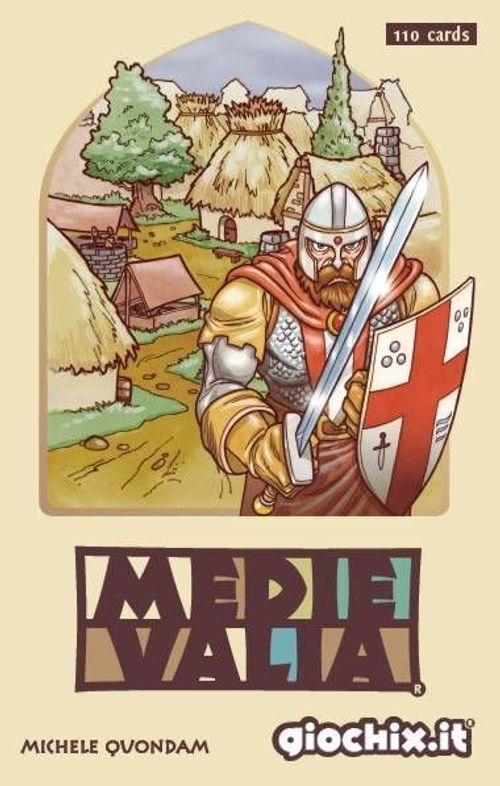
Medievalia (2007)
Medievalia (2007) Rulebook
Table of Contents
Table of Contents
Box Contents
- 4 City cards
- 2 Memo cards
- 17 Building cards: 2 Bank, School, Church, Stable, Blacksmith, Carpenter, Workshop, and 1 Tower, Fortress, and Castle.
- 38 Territory cards: 12 Field, 12 Farm, 7 Forest, 7 Mine.
- 20 Military cards: 8 Soldier, 3 Priest, 3 Bowman, 3 Knight and 3 Infantry.
- 29 Character cards: 20 Worker, 3 Merchant, 3 Artist and 3 Bureaucrat.
- Rulebook
Card Layout
- Military value: composed of attack and defence points (shown as attack/defence).
- Cost symbol: shows the resources you have to pay for playing the card.
- Production symbol: (food, energy, gold, or workforce) shows the card's resource production.
- Power symbol: on Character cards, shows the Special Power of the card.
- Building Memo: shows the Building Symbol on Building and Character cards.
Game Preparation
- Divide the game cards into 3 decks: a Territory deck, a Military deck, and a Character deck. Place the first card under each deck to remind players which deck is which.
- Each player takes a City card (blue back) and places it in front of himself.
- Divide the Building cards into three roughly equal decks.
- Put the School, Workshop, and Bank buildings face up on the 3 little decks.
- The first player takes 8 cards, one by one, as he wants from the 3 different decks. He can look at the cards while he is drawing them. The other player then does the same.
Turn Sequence
A game turn consists of:
- Turn start and card draw
- Re-activation
- Player Actions
- External Movement and War
- End of turn
1. Turn Start and Card Draw
The player starts his turn by drawing 1 card from one of the three decks.
2. Re-activation
The player re-activates all his cards used during his previous turn, unrotating them (in order to use a card it has to be rotated by 90°).
3. Player Actions
The player can play and activate cards (territories, buildings, military units and characters) and move inside his Fief.
How Cards Are Played and Used
To add a card to the table, the player must pay its cost. The cost is indicated by symbols located at the bottom of each card. To pay the cost, the player uses (activates) the cards that he has already played on the table. Once a card on the table is used, it produces the resource indicated by the production symbol on the top right of the card. Once used, the card is rotated by 90° in order to distinguish it from the unused cards.
Example: a Field costs 1 workforce, as shown by the cost symbol. Rotating a City card on the board, the player produces 1 workforce, as shown by the production symbol.
All the cards on the table can be used, including any just placed on the board, once per turn. The played card has to be placed in front of the player inside the player's game area, called the Fief.
A player's Fief is made up of his City, territories, buildings and characters placed in front of the player. Between two players' Fiefs there is an intermediate Fief that is not economically usable. This means that this Fief does not produce any resources. Character cards in an intermediate Fief or an enemy Fief cannot produce resources.
Territories
Territories require a workforce to be played, and produce the resources needed to play all the other cards. There are 4 different kinds of territories: fields (food production), forests (energy production), farms (food production) and mines (gold production).
Resource symbols: Corn = Food, Lightning = Energy, Man = Workforce, Money = Gold.
Territories can increase their production by adding 1 or more cards that produce workforces. For example, a field alone produces only 1 food resource, while with a farmer it produces 2 food resources, and with two farmers it produces 3 food resources (this is indicated by two small symbols at the bottom-right of the card).
These are the rules that apply to increased production:
- Associated cards always produce the resource of the territory and not the resources of the single card.
- Once a territory produces resources, it is rotated to show that it has been used this turn. All cards in the territory are turned together with the territory.
- The characters used in conjunction with a territory can be moved from it in the following game turn, on the condition that the cards have not been rotated.
- A territory with an associated character is defined as guarded.
Limits: each Fief contains the player's City and up to 4 territories. If the player wishes, he can, during his game turn, remove some of his territories. In order to do so, the player has to pay 1 workforce for each territory card removed.
With City, 2 Fields, 1 Mine, 1 Forest (total: 5 cards), a player cannot play more territory cards without first removing some.
Buildings
Buildings must be purchased from the 3 decks in the middle of the table, paying their cost in resources. A player can purchase more than one building during his turn if he has enough resources to do so. The buildings can be military or civilian.
Note: buildings cannot be placed on their own, they always have to be placed on an unused territory (or the unused City). Therefore, a player who used all his territories and the City to obtain the resources to buy a building cannot purchase it because he cannot place it!
Limits: it is possible to place a maximum of 2 buildings on each territory/City. Once a building has been placed on a City/territory, it cannot be moved.
How to buy a Building:
- Buildings must be purchased from the decks in the middle of the table, paying their cost in resources.
- Purchased buildings must be placed with an unused territory or the City and cannot be moved once placed.
- After purchasing, the player must turn the card underneath face up.
Military Buildings
Military buildings are used to protect the Fief's territories. They have a military value of 1/4, 1/5 and 2/6, for Tower, Fortress and Castle respectively. The military building is considered to be a character guarding a territory, but cannot be moved once placed.
Civilian Buildings
Civilian buildings produce 1 additional resource and allow military cards and character cards to be played (for example, the Priest card can be played if the player has a Church building).
If the player wants to play a special character, but does not have the corresponding building, it costs two gold resources in addition to the standard card cost. It is not necessary to rotate the building cards in order to play the associated character (the building just needs to be in the Fief).
Each civilian building has a symbol that identifies the building and the related character cards (Building Memo):
- Church: Priest
- Carpenter: Bowman
- Stable: Knight
- Blacksmith: Infantry
- Bank: Merchant
- Workshop: Artist
- School: Bureaucrat
Civilian buildings provide a defensive bonus during war of +0/1. This bonus is applicable when:
- there is a character in the same territory as the building (the +0/1 goes to the character).
- the building is placed in the City (the +0/1 goes to the City).
- there is a military building in the same territory as the building (the +0/1 goes to the military building).
If the defensive bonus can be applied to more than one card, the player decides each turn how it will be applied.
Military and Character Cards
During the Player Actions phase, players can play military and character cards. Both kinds of cards have to be played inside the player's Fief by paying the related cost. The played cards can remain in the Fief or move to another one.
Both kinds of cards have a Military Strength, defined as an attack value and a defence value, which can be used during war.
Most of the military and character cards have a Special Power. These are listed at the end of the rulebook.
Internal Movement
All unused military and character cards can be moved freely within the Fief. It is thus possible to move a character to a territory, or move a character from an unused territory and place it freely in the Fief. This internal movement does not cause the activation and rotation of the cards. When a character card is placed in a territory (field, farm, forest, mine or City), that territory is considered guarded.
4. External Movement and War
During this phase and once during their game turn, players can move the military and character cards from a Fief to an adjacent Fief. This kind of movement does not trigger the use of the card and its rotation.
War
After external movement, the player who is performing the turn can declare war. In order to attack an enemy, the player must have some troops in a Fief containing an opposing player's cards, or a Bowman to use from distance. Any card with an attack/defence value is considered a troop.
Some considerations:
- If there are troops of two different factions in the same Fief, combat can take place. The decision to attack is not mandatory, but a choice.
- War can happen within an intermediate Fief or within a player's Fief. In both cases, combat is resolved by comparing the offensive value of their cards with the defensive value of the opposing cards. If the offensive value exceeds or equals the defensive value, the combat is successful and the enemy cards are destroyed. In battle, both sides give and receive damage simultaneously, so it could happen that both sides are eliminated.
- The City and military buildings can fight like other character cards. However, they can only do so if directly attacked: they are not allowed to initiate combat.
Combat Sequence in a Player's Fief
- The player who is performing the turn (the "Attacker") deploys his available troops as he wishes. He cannot use activated or guarding troops. More than one troop can be grouped to form an Army. Attack and defence values of an Army are the sum of the values of the cards composing it. Each Army can attack a single target.
- The player who is under attack (the "Defender") deploys his available troops in defence and decides how to engage the enemy troops. He cannot use activated or guarding cards.
An Attacker or Defender that is not in its own Fief must use all available troops during the battle.
- Any attacking troop/army not engaged by a defending troop/army can attack any target of its choice: a territory, the City, or a defending troop/army whether involved in the battle or not (activated defending cards can also be targeted). If the target has an attack/defence value, then normal combat will take place between the cards.
- Damage Points: the battle results are calculated by comparing the attack values with the defence values. If an army is present, its owner decides the order of damage allocation amongst the cards in the Army. If the first card chosen is destroyed, and there is still damage to be allocated, then the damage will be done to the second card and so on, until all the damage has been allocated.
- Special healing and damage: the powers of the Bowman and the Priest are applied (see the end of the rulebook). The excess damage points always have to be healed: if a Soldier 2/2 receives 3 damage and goes to -1, he will need at least two Priests.
- End of combat: final damage points are calculated and the destroyed/killed cards are discarded. The war ends for this turn. All characters and buildings are returned to full health at the end of the turn. A player can perform more than one combat if he attacks on different fronts with different troops.
Some considerations:
- When a territory is guarded, the troop that protects it must be destroyed first, and then there must be 1 additional attack point left to destroy the territory in the same turn.
- If a territory possesses a military building, the territory is considered guarded by a troop possessing the same attack/defence value as the military building.
- An unguarded territory, with or without civilian buildings on it, can be destroyed by any troop with at least 1 attack point.
- If there are enemy troops inside your Fief, you can always choose to move your troops out of the Fief, thus avoiding battle (you are not blocked by enemy troops inside your Fief).
Combat in an Intermediate Fief
When a battle takes place in the intermediate Fief, all the troops (attacker's and defender's) are involved in the battle, even if they have been already used. The process is very simple: the players treat the troops as if they are two big armies (each composed of all the troops of the player). All the cards are counted, both used and unused.
- It is not possible to move your troops through an Intermediate Fief occupied by unused hostile troops.
- During your turn, you can always move away from an Intermediate Fief occupied by enemy troops into your Fief or an ally's Fief (see Allied Game).
5. End of Turn
The game turn ends and the next player clockwise will start.
Combat Examples
Example 1: Single Troop Attacking
Player A moves a troop to the intermediate Fief. On the next turn he moves the troop to Player B's Fief.
The Defender chooses how to deploy his troops: he can use the available Farmer on defence, or let the attacking player choose an objective in the Fief. In the first case:
- Soldier (2 attack / 2 defence) against Farmer (1 attack / 1 defence).
- Soldier survives: he takes 1 damage point with 2 points on defence, so he survives.
- Farmer dies: he takes 2 damage points with only 1 point on defence, so he dies.
Example 2: Army Attacking
Two troops are coming and form an Army. The Defender has 5 troops in the Fief: a Farmer and a Priest are already used, a Soldier and a Farmer are available, and a Farmer is guarding.
The Defender chooses how to deploy his 2 available troops: he can use both against the Army, or just one, or not deploy them and let the attacking player choose 1 objective in the Fief. In the first case:
- Army 1 (attacker): 6 damage points (4+2), 4 defence points (2+2).
- Army 2 (defender): 3 damage points (1+2), 3 defence points (1+2).
- One dies: one of two troops takes 3 damage points and dies, absorbing 2 damage points [sic: "adsorbing" in the printed caption]. The remaining 1 damage point goes on the other troop, which survives.
- Both die: Soldier and Farmer have together 3 defence points. With 6 damage points both are destroyed.
Example 3: Separated Troops Attacking
Three troops are coming and attack separately. The Defender decides to use his 2 troops separately. The 3 attacking troops and 2 defending troops are paired as follows, and an attacking troop without an opponent can choose another objective (for example a forest and a building over it).
- Pairing 1: Soldier (2 damage, 2 defence) against Soldier (2 damage, 2 defence). Captions: left card "SOLDIER DIES"; right card "SOLDIER MUORE" [sic: transcribed as printed in the caption].
- Pairing 2: Soldier (2 damage, 2 defence) against Farmer (1 damage, 1 defence). Captions: left card "SOLDIER SURVIVES"; right card "FARMER DIES".
- Pairing 3: Knight (4 damage, 2 defence) against a Building and Forest (0 damage, 0 defence, with the +0/1 bonus marked by an asterisk). Captions: left card "KNIGHT SURVIVES"; right card "BUILDING AND FOREST DESTROYED".
- +0/1 is a bonus that works only if a character, City, or military Building card is guarding it.
General Rules for Resources
- At any time (even if it is not your turn), you can change 3 resources of the same type for a different type. For example, you can produce 3 food and then convert them into 1 gold, energy or workforce.
- At any time (even if it is not your turn), you can discard a card from your hand in exchange for a resource of your choice.
- It is possible during your turn to produce 4 resources (of your choice) to take one extra card from the deck.
- If a player produces more resources than necessary, he cannot store the excess resources and use them to purchase/play another card.
The rulebook's icon panel summarises these rules as: "3 identical resources → 1 different resource"; "discard 1 card → 1 bonus resource"; "any 4 resources → take 1 card"; "1 production = 1 card."
End of the Game
The game ends for a Prestige Victory, a Military Victory, or for lack of cards.
Prestige Victory
Every building placed inside a Fief counts as 1 victory point (VP), with the exception of the castle, which counts as 2 victory points. If there are duplicate buildings in the same Fief, they still count as only 1 victory point (the duplicate provides 0 victory points). The player who reaches 7 VP first is the winner. In an allied game, the allied players need a total of 11 VP.
| Item | Victory Points (VP) |
|---|---|
| Single Building | 1 VP |
| Duplicate Building | 0 VP |
| Castle | 2 VP |
| Victory | 7 VP |
| Allied Victory | 11 VP |
Military Victory (or by Siege)
If a player or an alliance of players destroys all enemy Cities, they win a military victory. This can be obtained by directly attacking the City and destroying it in a normal battle, or during a siege.
Siege. A player is considered under siege if, at the beginning of his turn, both the following conditions are met:
- There are enemy troops in his Fief;
- All the player's territories are destroyed or any of his territories is unguarded.
If both siege conditions are met for 3 consecutive turns, the player will be defeated at the beginning of his turn and is eliminated. In an allied game, troops of the allied players can break the siege.
Lack of Cards
The game ends immediately when the last building card is purchased, or when at least two decks are empty. In such case the player or the alliance with more VP wins the game.
In case of a tie, the total gold resources that the players can produce (without taking into account bonus from special Powers) are considered. In case of a further tie, the winner is the player/alliance with the highest number of cards in hand. After that, a tie happens.
Allied Game
The following additional rules apply to an alliance game:
- Allied players sit opposite each other.
- Buildings are not common property and cards cannot be exchanged between the players.
- If a player is defeated, his cards are removed from the game.
- When allies attack the same enemy, they always fight separate battles.
- No movement may be performed out of turn.
- Resources can be produced out of turn. This costs 1 extra resource (any kind) for each game turn in which resources are transferred to own ally.
- Special powers cannot be used out of turn to help an ally, with the sole exception of the Priest and Bowman powers, if they have not already been used.
Special Powers of Military and Character Cards
Cards with special powers: Priest, Bowman, Knight, Infantry, Merchant, Artist, Bureaucrat.
- Priest: when activated, he reduces by 1 point the total damage inflicted on a character in the same or adjacent Fief. A Priest cannot cure himself to avoid being killed.
- Bowman: when activated, he causes 1 damage point on an enemy character in the same or adjacent Fief. The damage point can only be inflicted on a character, not on a territory or a building. The player can freely choose the target, even if it is in an army. Note that military buildings and the City protect the character cards from Bowman.
- Infantry: if an Infantry unit is in an army, it can provide a bonus of +0/1 to one other character in the same army. You do not have to turn the card in order to use this special power.
- Knight: the Knight can move twice per game turn. You don't have to turn the card in order to use this Special Power. Note that Knights can reach an enemy's Fief in just one turn because of their doubled movement.
- Merchant: when activated, he can transform one type of resource into another type of resource. If the starting resource is gold, the transformation produces two resources instead of one.
- Bureaucrat: when activated, he reduces the cost of a building by any 2 resources. Two Bureaucrats reduce the cost of a building by any 4 resources, three by any 6 resources. This means that, in some cases, use of multiple Bureaucrats will result in a free building.
- Artist: when activated, he doubles the production of a single card or group of linked cards (up to a maximum of three cards). If there are more than three cards in the linked group, the player chooses which ones to double. Additional Artists can combine their special powers: with 1 Artist 1 resource becomes 2 resources, with two Artists 1 resource becomes 4 resources, and with 3 Artists 1 resource becomes 8 resources.
Note on Using Special Powers
The use of the special power of a character card causes the use/rotation of the card itself (the only exceptions are the Knight and the Infantry). Therefore:
- Character cards that have a production capacity and a special power (Priest, Merchant, Bureaucrat, Artist) can only be used for one purpose during a turn.
- The special power of a card can be used whether the card is in a City or a territory. In such cases, the cards connected to the character are used.
- The special power of a character card can be used even if it is in an army. Knights and Infantry do that without restriction. The army must not be involved directly in a battle, and all the army cards are turned when the special power is used.
- The special powers of Artist, Bureaucrat and Merchant cannot be used when the character card is in an Intermediate or Enemy Fief.
- The only powers that can be used out of turn are the powers of the Priest and Bowman. This is possible if the player is attacked (or if an ally is attacked) or if the ally attacks.
Limits to Characters
- Players have to maintain characters placed on the table by using food resources. Each available food resource maintains two characters.
- It is not possible to use the Artist to double the food production in order to maintain more characters.
- Food producing cards used to maintain characters are not used/rotated.
- It is not important if the character cards are in the player, intermediate or enemy Fief; they always have to be sustained.
- At any moment during his turn, a player can discard characters from the table, unless they have already been used/rotated.
- The maintenance requirement is valid throughout the turn and it has always to be taken into account. If a player cannot maintain all his characters at any point during his turn, he must remove the excess characters immediately.
Example: 3 food resources are on the board (1 from a building, 2 from two fields). So a player can have at most 6 characters in play (2 for each food).
More Information
Visit the publisher's website www.giochix.it to read the FAQ to the rules, see the tutorial in Flash format, and write in the forum dedicated to Medievalia.