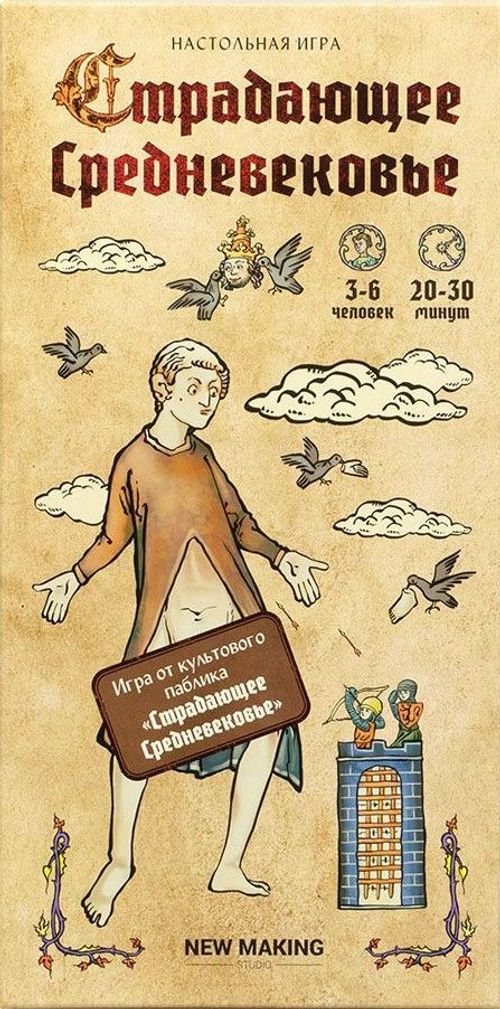
Страдающее средневековье (Medieval Suffering)
Страдающее Средневековье (Medieval Suffering) Rulebook
Table of Contents
Table of Contents
Components
- 90 suffering cards (страдающих карт)
- 6 Epidemic Breeding Ground tokens (жетонов Рассадника Эпидемий)
- 14 player boards (планшетов)
- 18 Crusade Points tokens (жетонов Очков Крестового Похода)
- 3 Relic cards (карты Реликвии)
- 5 Epidemic dice (кубиков Эпидемий)
Setup
- Place the deck in the centre of the table and lay 3 cards face up in front of it. This place is called the crossroads (перекрёсток).
- Lay out the Relic cards next to the deck.
- Place as many Crusade Points tokens as are needed for your number of players:
- 3 players — 16 points
- 4 players — 20 points
- 5 players — 23 points
- 6 players — 25 points
- Each player chooses the left or the right half of their player board to determine the name of their great city.
- The first player to move is the one who founded the city with the most absurd name. Or the one who suffered the most that day. Or simply draw lots.
Game Flow
Players take turns. Each turn consists of the following stages:
- I) Drawing cards.
- II) Playing cards.
- III) Epidemic (if there is one in your city).
I. Drawing Cards
- Take the top card from the deck.
- Take one of the three cards lying face up at the crossroads.
- Take the top card from the deck and place it at the crossroads.
It is very important that during the game the crossroads always keeps 3 cards.
II. Playing Cards
Cards in the deck come in two types:
- Residents (Жители).
- Epidemic (Эпидемия).
- Play all the cards from your hand one by one, placing them in your own city or in another player's city. Cards may be played in any order.
- It is forbidden to discard a card to the discard pile simply because you do not like it.
- All cards must be placed in cities or used.
- Once you have placed a card in a city, immediately resolve its instant effect, before placing the next card.
Residents belong to three estates (сословия). Place each resident card in the row of the estate to which it belongs.
How a Resident Card Is Laid Out
- Estate colour dots: Courtiers (Придворные) — red; Priests (Священники) — dark blue; Commoners (Простолюдины) — green.
- ПО (Victory Points, Победные Очки) — the number in the flag at the top-left of the card. Their total determines the winner at the end of the game.
- Crusade Points — the cross icon at the top-right of the card. If the character has this icon, it counts as a Crusader (Крестоносец). If the character has no such icon, it counts as a peaceful resident (мирный житель).
- Instant effect — the arrow icon. It activates as soon as the card is laid on the table from the hand.
- Immunity (Иммунитет) — the number at the bottom of the card. The lower this value, the sooner the character dies during an Epidemic.
Example: the card Minstrel (Менестрель) is a Courtier with 1 Victory Point, 2 Crusade Points (so it is a Crusader) and Immunity 45. Its instant effect: it steals 3 Crusade Points from another city.
Estates and Rows
- Courtiers (Придворные) — knights, noble maidens and all who serve them. Place characters with a red flag in the top row.
- Priests (Священники) — everyone who prays day and night for the well-being of your city. Place characters with a blue flag in the middle row.
- Commoners (Простолюдины) — executioners, peasants, guards, loose women and everyone who was unlucky enough to end up on the margins of medieval life. Place characters with a green flag in the bottom row.
- Those who by chance may end up in any estate have a grey flag. Place characters with a grey flag wherever you wish.
Epidemics and Ending the Turn
- Epidemic cards are placed next to the city in which you want to start an Epidemic (more about Epidemics on page 4).
- Your turn ends when you have played all the cards that were in your hand. No cards may remain in your hand at the end of the turn!
- If an Epidemic is raging in a city, discard the residents who must die, and pass the Epidemic card to the next player clockwise. The turn passes to the next player clockwise.
III. Epidemic
If you have drawn an Epidemic card from the deck into your hand and intend to play it, do the following:
- Place the Epidemic card in front of any city and place on it a die showing the number drawn on the card. This is the number of residents who must die.
- Place the Epidemic Breeding Ground token (фишка Рассадник Эпидемии) next to the infected city.
How Does an Epidemic Work?
At the end of the turn of the player in whose city an Epidemic is raging, people begin to die. By default, the first residents to die are those with the lowest Immunity value. But some Epidemics work differently.
For example, Leprosy (Лепра) first kills Priests (Священники). This means that first the disease kills all residents of the Priests estate, and only then begins killing the other residents by the usual rules.
The number on the Epidemic die sets the current number of residents dying each turn. Then the Epidemic card passes to the next player. The Breeding Ground token stays in the city where the Epidemic started.
If an Epidemic returns to a city with a Breeding Ground token, turn the die to the next face. Now the Epidemic will kill one more resident.
How to Stop an Epidemic?
An Epidemic is discarded in two cases:
- When a Plague Doctor (Чумной доктор) comes into the infected city from the hand. (Important: if the Plague Doctor came into the city before the Epidemic, they cannot cure it.)
- When all residents in the infected city die.
In the city of TrupoPolis (ТрупоПолис) live remarkable people. Let's find out in what order they will die from the different Epidemics!
The city board shows two columns, Trupo (Трупо) and Polis (Полис), with these residents:
- Trupo: Knight (Рыцарь, Courtier), Preacher (Проповедник, Priest), Witch (Ведьма, Commoner), Coachman (Возничий, Commoner).
- Polis: Lady (Леди, Courtier), Plague Doctor (Чумной доктор, Priest), Loose Woman (Распутная девка, Commoner), Executioner (Палач, Commoner).
Malaria (Малярия) first kills Courtiers. This means that first all the Courtiers in the city die out, and then residents with the lowest immunity from the other estates begin to die.
- First turn: the Lady dies (she is the Courtier with the lowest immunity).
- Second turn: the Knight dies (he is the only remaining Courtier), and the Preacher dies (among the remaining characters he has the lowest immunity).
- Third turn: the Coachman, the Executioner and the Loose Woman die.
Leprosy (Лепра) first kills Priests. This means that first all the Priests in the city die out, and then residents with the lowest immunity from the other estates begin to die.
- First turn: the Preacher dies (the Priest with the lowest immunity).
- Second turn: the Plague Doctor and the Lady die (among the remaining characters she has the lowest immunity).
- Third turn: the Coachman, the Executioner and the Knight die.
Black Pox (Чёрная оспа) first kills residents with the highest immunity.
- First turn: the Witch dies (she has the highest immunity).
- Second turn: the Plague Doctor and the Loose Woman die.
- Third turn: the Knight, the Executioner and the Coachman die.
Bubonic Plague (Бубонная чума) kills two residents at once in the first turn.
- First turn: the Lady and the Preacher die.
- Second turn: the Coachman, the Executioner and the Knight die.
- Third turn: the Loose Woman, the Plague Doctor and the Witch die. (A fourth resident could otherwise have died, but no residents are left in the city.)
An Infant (Младенец) always dies first, regardless of the type of Epidemic!
The Crusade
Crusades held a special place in the lives of medieval warriors. City residents who could bear arms had to answer the call and set out on a military campaign toward eternal glory and riches. In our game, the bravest warriors will obtain one of the sacred Relics (Реликвии). Usually, Crusaders (Крестоносцы) set out on the Crusade.
Crusaders are city residents who have a symbol with a number in the top-right corner. They live in the city by the normal rules until the order to begin a Crusade.
Each time a resident with the effect "Sends to the Crusade" (отправляет в Крестовый Поход), for example the Preacher or the Bishop, is played, the Crusaders leave the city and set out on a holy war.
How Does It Happen?
- The Crusader cards are discarded from the city. The sum of Crusade Points of all Crusaders of this city is counted.
- The player takes the required number of Crusade Points tokens. (If the total came out negative, the player must return points to the Holy Land. If there is nothing to give back, nothing happens.)
Capture of the Holy Land
When the Crusade Points on the table run out, the Holy Land is considered captured. The player with the most Crusade Points receives a Relic card. This card gives its holder additional Victory Points when counted at the end of the game. This card cannot be stolen or destroyed; it stays with the player until the end of the game.
The Relic card example shown in the rulebook is the Ark of the Covenant (Ковчег Завета), worth 7 Victory Points.
Then all Crusade Points return to the Holy Land. A new campaign may begin under the same rules. There are 3 Crusades in each game. One player may hold several Relics.
Tie-Breaks for a Relic
- If Crusade Points are tied, the Relic goes to the player who has fewer Relics.
- If no one has a Relic (or each player has one), the Relic goes to the player who has more residents of the Priests estate in their city.
- If the number of Priests is also tied, the Relic goes to the player who currently has fewer Victory Points.
Conversion into Crusaders
In some cases peaceful residents may become Crusaders against their will. If some effect sends a peaceful resident to the Crusade, their Victory Points become Crusade Points.
For example, the Recruiter sends the Peasant and the Jester to the Crusade. The city's ruler discards both cards and takes 4 Crusade Points for themselves.
End of the Game
The game ends if:
a) By the end of someone's turn, there are 10 residents in any player's city. b) The deck is exhausted (the discard pile is not shuffled back into the deck).
Counting of Victory Points begins in each city. The player with the most points wins (negative points are subtracted from the total).
- If points are tied, check who holds a Relic.
- If Relics are tied, compare the Crusade Points.
- If Crusade Points are tied, compare the number of residents.
- If the number of residents is also tied, the player who suffered the most during the game wins.
Keywords
- This city — the city in which you play the card.
- Neighbouring city — the city to the left or to the right of the city in which you play the card.
- Crossroads (Перекрёсток) — the three open cards in the centre of the table.
- Estate (Сословие) — a group of residents placed in one row (Courtiers — top row, Priests — middle row, Commoners — bottom row).
- Resident (Житель) — any character in a city.
- Crusader (Крестоносец) — a character able to leave for the Crusade.
- Peaceful resident (Мирный житель) — any character except a Crusader.
- Immunity (Иммунитет) — the number on a resident card that determines the order of their death from an Epidemic (the lower it is, the sooner the resident dies).
- Settle (Поселить) — place a resident from the hand into a city. The instant effect activates at this moment.
- Instant effect (Мгновенное свойство) — an effect that activates only when a resident is placed into a city from the hand.
- Lure (Переманить) — move a resident into the city of the character that used this effect.
The Golden Rules of the Middle Ages
- At the start of a turn, always take two cards, and only then place them in cities.
- The order of the cards is very important, because instant effects activate immediately, as soon as the card appears in a city. (For example, if in one turn you first settle the Plague Doctor into a city and then immediately Black Pox, the Plague Doctor will no longer be able to cure it.)
- Epidemics kill residents only at the end of your turn. You still have a chance to be saved.
- The number of residents needed to end the game is counted only at the end of each turn. If within one turn you gather 10 or more residents, but an Epidemic or a character's effect makes you lose them, the game continues.
- If during your turn another player has gathered 10 characters in a city, your turn will be the last in the game.
- Whoever placed a card decides how its effect is carried out (chooses which character will be killed, moved, etc.), even in another player's city.
- When all cities go on the Crusade, this happens simultaneously, and the Crusade Points must be enough for everyone. Add the points from the reserve, or memorise the final number of points of each player to determine who gets the Relic. A situation in which someone does not have enough points must not occur.
- If a card's effect contradicts the rules of the game, the card's effect takes priority.
Card Descriptions
Warhorse (Боевой конь)
What use is a Warhorse if it has no rider?
If only the Warhorse is sent to the Crusade from your city, you do not receive Crusade Points.
The card itself reads: does not receive Crusade Points if it goes on the Crusade alone.
Witch (Ведьма)
Despite her negative influence on the city, rulers find it hard to resist inviting the Witch to them.
If you settled the Witch in your own city, take two cards and play them before the end of your turn. If you settled the Witch in another player's city, that city's ruler takes two cards and immediately plays them, applying all their effects by the usual rules. After this you may continue your turn.
The card itself reads: the ruler of this city takes two cards from the deck.
Coachman (Возничий)
The main thing is to enjoy the work.
Place the Coachman in any city. Swap places of one resident each from the cities neighbouring the Coachman's city. They must be from the same estate. If one of the cities has no suitable resident to exchange, nothing happens.
The card itself reads: swap one resident each from the neighbouring cities to the left and right of the Coachman.
Bishop (Епископ)
Brothers and sisters, the time has come to shed blood for the righteous cause and for a couple of sacks of gold.
All cities go on the Crusade simultaneously. The Crusade Points must be enough for everyone. If needed, use the reserve tokens or count in your head (if, of course, they taught you arithmetic in the Middle Ages).
The card itself reads: Crusaders from all cities are sent on the Crusade.
Heretic: Natural Scientist (Еретик (Естествоиспытатель))
Medieval natural scientists always dreamed of flight. Put a man in a barrel and send him to the heavens from the largest catapult. If the poor soul was infectious, you'll even be thanked.
The card itself reads: move any resident from this city to another city. An Epidemic leaves with them.
Heretic: Necromancer (Еретик (Некромант))
Medieval necromancers loved two things: raising people from the dead and wearing lucky trousers made of human skin.
You may take one resident from the top 5 cards of the discard pile and use them as if they had come to you from the deck.
The card itself reads: discard a card from your hand and take any resident from the top 5 cards of the discard pile into your hand.
Heretic: Alchemist (Еретик (Алхимик))
In pursuit of the philosopher's stone, ancient alchemists went in for monstrous experiments!
If a resident brought negative Victory Points, then the Crusade Points you receive will be negative as well, and they must be subtracted from your supply. However, if the supply is empty, nothing happens.
The card itself reads: discard any resident from a city and take as many Crusade Points as the resident's Victory Points.
Inquisitor (Инквизитор)
The flame destroys only sinners. The problem is that everyone is a sinner.
Place the Inquisitor in any city and kill any resident of that city. If you killed a Heretic (even in another city), take one more card into your hand.
The card itself reads: kill any resident in this city. Draw a card if the Inquisitor burned a Heretic.
Kolya (Коля)
There are ordinary residents of medieval cities. And there is Kolya, before whom no one can hold out.
The card itself reads: lures one woman from each neighbouring city.
Cat (Кот)
The brave kitty is ready to sacrifice itself for its master.
The Cat's effect may be used on any turn. If you want to save one of your residents from an Epidemic, the Cat may die in their place. You may keep the Cat in your city until the moment comes to save a truly valuable resident.
The card itself reads: can save one resident from an Epidemic and go to the discard pile instead of them.
Peasant (Крестьянин)
The life of medieval Peasants was full of suffering.
If you have several Peasants, they die from an Epidemic simultaneously. If an Epidemic must kill several residents, count all the dead Peasants as one resident.
The card itself reads: gets +1 Victory Point for each other Peasant in the city. All Peasants in the city die from the Epidemic at once.
Lady (Леди)
A Knight will set out to perform deeds in the name of a fair lady. He will dedicate all his victories and conquests to her.
The card itself reads: sends a Knight from a neighbouring city on the Crusade. His Crusade Points go to the Lady.
Lord (Лорд)
The life of a Lord is worth the life of any person in the Kingdom.
If you have no card in your hand that can be discarded, you cannot place the Lord in your city. Remember that the order in which cards are played matters.
The card itself reads: discard a card from your hand to place the Lord in your city. The Lord may be settled in another player's city for free.
Minstrel (Менестрель)
It does not matter who performed the deed. What matters is who told about it.
The Minstrel takes 3 Crusade Points from any city. If the city has fewer than 3 Crusade Points, the Minstrel takes everything it has. The stolen Crusade Points go to the city in which the Minstrel was settled.
The card itself reads: steals 3 Crusade Points from another city.
Infant (Младенец)
In the Middle Ages, suffering began with birth itself. And the start of a new life was always, in a way, a finale.
When an Infant appears in a city where there is a Lady or a Loose Woman, choose and discard one of those women. If there are none, the Infant simply appears in the city.
If you have an Infant in your city, and this turn someone must die from Malaria or any other Epidemic, boldly discard the Infant.
The card itself reads: kills a Lady or a Loose Woman in this city. Dies first from any disease.
Monk (Монах)
The bigger the monastery, the more quarrels and idle chatter it holds.
Yes, their points can drop to negative values.
The card itself reads: loses 2 Victory Points for each other Monk in the city.
Squire (Оруженосец)
The Squire is ready to do anything for his liege lord.
Each time an Epidemic or another character tries to kill the Knight, the owner of the city may say that the Squire dies instead of the Knight. The Squire may block the Lady's effect and go on the Crusade instead of the Knight. However, the Crusade Points that would go to the Lady still have to be handed over to the Squire. (Translator's note: this sentence is a literal rendering of the Russian; the exact intended recipient is as printed.) If the Squire goes on the Crusade simultaneously with the Knight, his effect does not work.
The card itself reads: when the Knight must die or go on the Crusade alone, the Squire may do so instead of him.
Executioner (Палач)
In the Middle Ages there was little entertainment, and a public execution is devilishly fun.
The player who played the Executioner decides which Courtier dies and which Commoners settle in the city. If there is no Courtier in the city, the Executioner's effect does not activate. If there is no Commoner in a neighbouring city, the effect still activates, but no one comes to the execution.
The card itself reads: kills a Courtier in this city and lures one Commoner from each neighbouring city.
Leper (Прокажённый)
This fellow is no longer afraid of either Leprosy or the Bubonic Plague. The worst of his life is already behind him.
The card itself reads: does not die from Epidemics.
Preacher (Проповедник)
A good sermon always inspires people to dubious adventures.
This effect does not extend to other cities, unlike the Bishop's.
The card itself reads: all Crusaders in this city are sent on the Crusade.
Brigand (Разбойник)
He is not the best resident of the Middle Ages, but he too can be useful.
If there are no Courtiers in other cities, the effect does not activate.
The card itself reads: can be settled only in your own city. Kills a Courtier in another city.
Loose Woman (Распутная девка)
«Possessed by a loose woman as if by a demon!..»
Choose a Monk in another city and move him to the city in which the Loose Woman was settled. If there are no Monks in other cities, the Loose Woman's effect does not activate.
The card itself reads: lures a Monk from another city.
Recruiter (Рекрутёр)
If a resident can stand on their feet, they are fit for military service.
The Recruiter is not obliged to use this effect. He does not leave together with those he sent. If a peaceful resident whom the Recruiter sent on the campaign has negative Victory Points, they will receive negative Crusade Points. If you place the Recruiter in another player's city, you decide who goes on the campaign, but the Crusade Points go to the ruler of the city in which the Recruiter was settled.
The card itself reads: you may immediately send up to two peaceful residents to the Crusade. Their Victory Points count as Crusade Points.
Knight (Рыцарь)
The life of a Knight is worth the life of any person in the Kingdom.
If you have no card in your hand that can be discarded, you cannot place the Knight in your city. Remember that the order in which cards are used matters.
The card itself reads: discard a card from your hand to place the Knight in your city. The Knight may be settled in another player's city for free.
Guard (Стражник)
A dangerous criminal is under the reliable guard of a bored guard.
When the Guard enters the game, take the top card from the deck, show it to everyone and place it under the Guard. This card is inactive for as long as the Guard stands on it. This character cannot go on the Crusade, be moved or killed, and its Victory Points are not added up with the other residents of the city. When the Guard dies or leaves this city, the "Criminal" (Преступник) is freed, as if it had just been placed in this city from the hand, and goes to its estate. Its instant effect (arrow) activates.
The card itself reads: place the top card of the deck under the Guard. When the Guard disappears, the instant effect of this card is activated.
Trader (Торговка)
Competition harmed business even in the Middle Ages.
Two Traders give zero points.
The card itself reads: does not bring Victory Points if there is more than one Trader in the city.
Innkeeper (Трактирщик)
There is something wrong with this swill.
Take the top card from the deck and place it in the same city into which you settled the Innkeeper. Its instant effect (arrow) does not activate, because whoever follows the Innkeeper is dead drunk.
If the top card turns out to be an Epidemic, you likewise place it in your own city. Sour beer is an excellent carrier of plague.
The card itself reads: place the top card of the deck into this city. The instant effect of the new card does not activate.
Fanatic (Фанатик)
He gathers a militia and hides fanatical Crusaders in the cellars of your castle, so that they can rise up for you at the right moment. So do not be angry with the Fanatic.
The card itself reads: lures into this city one Commoner Crusader from a neighbouring city.
Plague Doctor (Чумной доктор)
Bloodletting, cauterisation, leeches, quarantine. Healthy. Next!
Discard the Epidemic card from the city into which the Plague Doctor has been brought. If there is no Epidemic in this city, the Plague Doctor's effect does not activate, but it counts as used.
It is important to remember that the Plague Doctor's effect works only once! A Plague Doctor who has already used his instant effect (arrow) does not protect the city from future Epidemics in any way.
The card itself reads: cures an Epidemic in this city.
Jester (Шут)
Jesters are best at parodies.
The Jester copies and immediately uses the instant effect (arrow) of a character at the Crossroads. If the characters at the Crossroads have no instant effects, the Jester's effect does not activate. If an instant effect is present, the Jester must apply it, even if this changes nothing in the game or is disadvantageous to the Jester's owner.
The card itself reads: copies the instant effect (arrow) of a character at the Crossroads.
Enjoy the suffering!