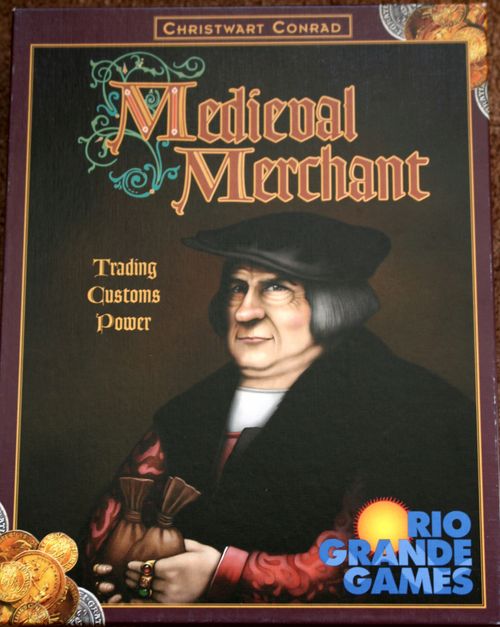
Medieval Merchant
Medieval Merchant Rulebook
Table of Contents
Table of Contents
Component List
The game board is a map of central Europe divided into 10 regions. The map has 25 cities and 20 towns connected by potential trade routes.
The regions are separated by dashed lines and colored differently. There are no special requirements for expanding trade across region boundaries.
The cities are shown on the map as large circles with numbers in their centers. Players open cities for trade by placing the round city markers on cities with matching numbers.
The towns are shown as small buildings without numbers, but located at intersections along the trade routes. Passage through a town is controlled by the player who has opened a branch office there.
The trade routes connect the cities and towns. The number on a trade route is the amount it costs to open a new branch in one of the cities or towns from the other city or town.
The scoring track displays the players' influence points.
Components:
- 1 Game Board (10 regions with 25 cities and 20 towns connected by potential trade routes)
- 270 Buildings (45 of each player color: red, green, blue, grey, brown, and natural/light brown)
- 12 Escort Letters
- 25 City Markers. Players place them on cities to indicate they are open for trade. They are removed when the city is dominated or filled with branches.
- Play Money (30 each of 1, 2, 5, 10, and 20 guilders)
- 6 Hundred Markers
- 1 Town Availability Track. The town track shows how many towns have been used and, thus, how many remain available.
Setup
If you are playing Medieval Merchant for the first time you may want to use the setup shown on the "Introductory Game Setup Rules." After setting up using the introductory rules, skip to "Playing the game" below.
Preparation
- Place the game board in the center of the table.
- Place the town track next to the board and place one of the houses on the "20" to indicate that all towns are available.
- Each player selects a color, takes the buildings of that color, and places one on the "1" space of the scoring track.
- Each player takes 2 escort letters. Return unused buildings and escort letters to the box.
- Each player receives starting capital as shown below. A player's cash is kept secret from other players.
| Number of players | Starting capital |
|---|---|
| 2 | 15 Guilders |
| 3 | 20 Guilders |
| 4 | 25 Guilders |
| 5 | 30 Guilders |
| 6 | 35 Guilders |
- Choose a player to manage the bank.
- If you are playing with 2 players, see the special "Medieval Merchant for Two" below.
- Return the blank city marker to the box.
- When playing with 2, 3, 4 or 6 players, place a city marker worth 2 on Wittenberg. With 5 players all city markers are distributed as described below.
- Distribute the city markers to the players: first, take the markers with the values 5 to 8, shuffle them, and "deal" an equal number of them to each player face down. Shuffle any remaining with the city markers valued 2 to 4 and "deal" these to the players face down. Each player should now have an equal number of city markers. The markers should be kept secret from fellow players.
- The players choose a starting player.
- The starting player examines his city markers and selects a town as his "home" town. He places one of his buildings on the town to claim it and moves the marker on the town track to indicate the reduction in available towns. The other players follow in clockwise order, choosing their "home" towns and moving the town track marker.
Playing the Game
Starting with the starting player and moving clockwise around the table, each player takes the following actions on each turn:
- Open a city for trade (not used in introductory game)
- Add branches or receive income
- Receive basic income
- Open a new branch
- Assign influence points
1. Open a City for Trade
At the beginning of his turn a player must open a city for trade. The player chooses one of his city markers and places it on any available city that has the same number as the marker. The player may not open a city that has already been opened. The number indicates how many branches may be placed in the city. This action is bypassed when a player no longer has city markers.
2. Add Branches or Receive Income
The player checks each city where he has one or more branches. If the city still has the city marker on it, the player may either add a branch or receive income. If the city marker has been taken, the player may no longer receive income, but may be able to add a branch.
Each city is treated separately and may be considered in any order the player chooses. A player may only receive income from cities; towns do not produce income.
To add a branch to a city, there must be a free space available in the city. A player may only add one branch per city per turn. This action cannot occur in the first round as no player will have a branch in a city before their turn. In the introductory game this action is possible in the first round.
There are two situations for adding a branch:
A. If the city still has a city marker, the player takes a building from his supply and places it temporarily on the number in the center of the city marker to indicate that the placement is free.
B. If the city marker has been taken, but there is space for another branch, the player may pay to add a branch. The player takes a building from his supply and places it on the next free space in clockwise order in the outside ring of the city. The cost of the placement depends on the number of players in the game as shown below:
| Number of players | Cost |
|---|---|
| 2 | 1 Guilder |
| 3 | 2 Guilders |
| 4 | 3 Guilders |
| 5 | 4 Guilders |
| 6 | 5 Guilders |
To receive income from a city, the following conditions must be fulfilled: the player
- has already placed a branch in this city
- has not built a branch in this city this turn
- the city marker is still on the city
The income a player receives from a city depends on the number of players in the game and the number of available spaces in the city:
| Number of Players | Income per free city space |
|---|---|
| 2 | 1 Guilder |
| 3 | 2 Guilders |
| 4 | 3 Guilders |
| 5 | 4 Guilders |
| 6 | 5 Guilders |
Example with 4 players: Andreas has two branches in Gent (with a branch limit of 7), Bernd and Christiane each have one, Doris has none, and there are still 3 free spaces. Thus, Andreas has an income available in Gent of 3 x 3 = 9 guilders.
The number of branches a player has in a city has no bearing on the income - the income is based solely on the table above.
3. Receive Basic Income
In the first round, this action is bypassed as the player's starting capital includes the first round income. In subsequent rounds, players receive basic income based on the number of players as shown below:
| Number of players | Basic income |
|---|---|
| 2 | 2 Guilders |
| 3 | 4 Guilders |
| 4 | 6 Guilders |
| 5 | 8 Guilders |
| 6 | 10 Guilders |
4. Open a New Branch
A player may only open one new branch per turn.
A. A player may open a branch in a city if:
- the player has no branches in the city already, and
- there is a direct trade route between the city and a city or town where the player has a branch already, and
- there is an available space in the city, and
- a city marker has already been placed in the city.
The player pays the bank the amount indicated by the number on the trade route he used to reach the new city. The player takes a building from his supply and places it on the number in the center of the city. Players receive no influence for opening a branch in a city. A player may place a new branch in a city whose marker has already been removed if there is space. As before, the cost is the number on the trade route. There is no extra cost due to the fact that the marker has been removed.
B. A player may open a branch in a town if:
- no player has branches in the town already, and
- there is a direct trade route between the town and a city or town where the player has a branch already.
The player pays the bank the amount indicated by the number on the trade route he used to reach the new town. The player takes a building from his supply and places it on the town.
Only 1 branch may be built in each town.
The player adds one to his influence score by moving his influence marker one space. The player moves the town track marker down one space to reflect the loss of availability of the town.
5. Assign Influence Points
The player moves any buildings he has placed in the center of a city to the next free space in clockwise order in the ring around the number. If it is the first branch in a city, place it on the space with the arrow.
When placing buildings after the first, they must be placed in clockwise order to keep track of the order they were placed. This may be important for scoring influence.
The player now checks to see if he has the absolute majority of branches which can be built in a city or if he has just built the last possible branch in the city.
A. The player has the absolute majority in a city; i.e. more than half of the possible branches in the city. The player removes the city marker from the board, moving the buildings to respective positions on the city. The player places the city marker face up before him on the table. If he still has unplayed city markers, he should be careful to keep them separate. The player then moves his influence marker on the scoring track. He moves it forward a number of spaces equal to the number on the city marker just removed.
Example: Andreas has 3 branches and Doris has 2 in Lübeck (with a 7 value). Andreas adds a branch in the next remaining spaces and now has four, which is an absolute majority of the possible branches in Lübeck. Thus, he removes the city marker from the board and receives 7 influence points.
B. The player did not achieve the absolute majority, but did place the last possible branch in the city. The players count to see which player has the most branches in the city. This player removes the city marker as above, placing it face up before him. He moves his influence marker a number of spaces equal to half the number, rounded down, on the city marker just removed.
If two or more players tie for most branches in the city, the player who first opened a branch there (among those tied, check clockwise order from the arrow), receives the city marker and the points of influence (one half the number on the city).
C. If the player did not achieve the absolute majority and the city was not filled, no influence points are assigned.
The player has now completed all possible actions and his turn ends. Play passes to the next player in clockwise order, who takes his turn.
Escort Letters
Each player has two escort letters. An escort letter allows a player to "double" the actions described below. Only one may be used in a turn and none may be used in the first round.
A. Add two branches
If a player decides to add a branch in a city, he can use an escort letter, to place an additional branch there immediately. The player places two buildings in the center of the city.
B. Double income
A player may use an escort letter to increase his income. He does this by choosing to take income from all cities he can; he may not choose to add branches to any of them. He then adds his city income to his basic income and multiplies by 2. If this "doubled" income is greater than 48, he collects the "doubled" amount. If not, he collects 48 guilders.
The player receives this income instead of his normal income.
C. Open 2 new branches
A player may use an escort letter to open a second new branch on a turn. The second branch can be reached from the new branch built this turn or from a branch built in a previous turn. The branch may be in a city or town, but must follow the normal rules for building a new branch. It cannot be used to add a branch where the player already has one.
Game End and Scoring
The game ends immediately when
- A. A new branch is opened in the last available town, i.e. the town track marker reaches zero, or
- B. all cities have been opened and the city markers have been removed from every city, or
- C. an entire round is played with no player adding a new branch.
If a city still has a city marker on it when the game ends, no points are awarded for that city.
Players now receive the following additional points:
- Each player receives 2 influence points for each region where he has at least one branch in a city or a town.
- Each player receives points for the cash that he has. He receives 1 influence point for each full 20 guilders.
Move the influence markers on the scoring track for these additional points. If a player exceeds 100 influence points, he takes one of the "hundred markers" and marks with its influence marker his points above 100.
The player with the most influence points is the winner. If one or more players tie with the most, the player, of those tied for first, who has taken the most city markers is the winner. If there is still a tie, the player, of those tied for first, with the highest sum of numbers on the city markers he took is the winner.
Medieval Merchant for Two
Preparation
When playing with two, part of the board is not used. Before beginning the game, set aside four city markers with value 2 and one each of those with value 3, 4, and 5. Place these markers face down on seven cities in the southeast corner of the map: Erfurt (5), Leipzig (3), Wittenberg (2), Regensburg (2), München (2), Linz (2) and Wien (4).
Place the blank city marker on the town between Regensburg and München. The distribution of the remaining city markers and the remaining game preparations are the same as in the game with 3 to 6 players.
After the players select their "home" town, set the town track marker to 16 to reflect the two "home" towns and the two unavailable towns.
The game is now played according to the normal rules.
The cities, which are covered with face down city markers are not part of the game. The trade routes to these cities cannot be used. Thus, no branch may be opened in the town between Erfurt and Regensburg and in the town between Regensburg and München. The trade route (56) from Braunschweig to Nürnberg is accessible.
Tactical Notes and Playing Tips
Usually, the most influence points come from the city markers players remove from the map. Usually, a city marker goes to the player who first opened a branch in the city. Therefore, a good strategy is to select a "home" town that is close to cities whose values match the city markers you begin the game with.
If possible, select a "home" town near a city of high value that matches one of your city markers. This can often give you the opportunity for a few rounds of income from the city before other players open branches there.
The cities Köln, Straßburg and Braunschweig represent key positions on the map. From these three cities most of the others can be reached. Therefore, it is often a good strategy to open branches in these important cities.
Correct application of the escort letters is crucial to a successful game. Be careful not to use them for trivial actions.
In the early phases of the game, using an escort letter to open an extra branch in a high value city can give a player an important advantage. This can provide a player with both income and access to the cities and towns beyond the high value city.
Remember that escort letters can be used to double the addition of branches where players already have them. This can allow another player to "steal" a city that you have started if you do not have an escort letter when he uses his. This suggests that you may want to keep one of your letters to counter such an action in mid-game.
It may be worthwhile to add or open a branch in a city that has had it's city marker removed, but has space left. By opening the branch, a player gains access to the cities and towns beyond it. By placing the last branch in a city, you block other players from the city and the access it gives. This can force them into costly detours or keep them from reaching parts of the board.
It can be very useful to open a branch in a town to block other players from access to the city beyond. Also, the route between the towns and between a town and a city are much less expensive than those between cities. Thus, a player may be able to save considerable money by using an escort letter to add 2 new branches. The first would be to the town between the city you are at and the one you want to reach. The second would take you to the city. Other players will then have to spend the higher amount to go between the two cities.
One of the most difficult decisions will be whether to add a branch or take income. Opening new branches is expensive and requires money. Failing to add branches can lose you a city. As there are no easy answers, players will often agonize over the decision and, possibly, change their minds often during a turn. When players are still learning the game, it is probably best to allow some flexibility in move changes - as long as they occur before the end of the player's turn.
Examples for 4 players: Christiane adds a branch to Straßburg (5) in her turn, filling the last free space. Since the city marker for Straßburg has already been removed, Christiane must pay 3 guilders for the branch. Because she took the last branch, Andreas can no longer add a new branch in Straßburg. To reach the south from Köln, he must detour to Metz (4) and thence to Konstanz (2).
Bernd's two branches in the towns between Straßburg and Trier (3), or München (2) block the inexpensive routes from Christiane. To reach Trier he must take the expensive route (30). The way to München leads now across Augsburg (4) and Nürnberg (6).
Rule Summary
- Open a city for trade
- Add branches or receive income
- Receive basic income
- Open a new branch
- Assign influence points
| Number of Players | Starting capital | Cost of adding a branch in a city, whose city marker has been removed | Income per free space in a city | Basic income |
|---|---|---|---|---|
| 2 | 15 Guilders | 1 Guilder | 1 Guilder | 2 Guilders |
| 3 | 20 Guilders | 2 Guilders | 2 Guilders | 4 Guilders |
| 4 | 25 Guilders | 3 Guilders | 3 Guilders | 6 Guilders |
| 5 | 30 Guilders | 4 Guilders | 4 Guilders | 8 Guilders |
| 6 | 35 Guilders | 5 Guilders | 5 Guilders |
If you have comments, questions, or suggestions, please contact Rio Grande Games, PO Box 45715, Rio Rancho, NM 87174 or [email protected] or visit our web site at www.riograndegames.com.
The Author: Christwart Conrad. "Medieval Merchant" is the third board game Christwart Conrad has had published.
Graphics: Franz Vohwinkel
English translation, editing and development: Jay Tummelson
© 1998 Simba Toys, Goldsieber Spiele, Werkstr. 1, D-90765 Fürth. All Rights Reserved. Made in Germany.