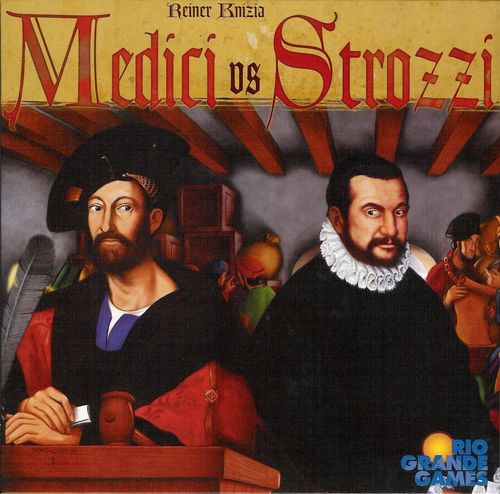
Medici vs Strozzi
Medici vs Strozzi Rulebook
Table of Contents
Table of Contents
Game Material
- 3 harbours
- 6 merchant ships
- 26 goods tiles
- 8 marker stones for the monopolies
- 48 coins (12x1, 6x5, 12x10, 18x50)
- 1 linen bag
- 1 rulebook
Preparation
- The three harbours are placed between the players. Each harbour shows two or three monopoly rows for different goods.
- A marker stone is placed on the middle space of each monopoly row.
- Each player takes the three ships of one colour: blue for the Medici, red for the Strozzi. The three ships have cargo holds for 3, 4, or 5 goods tiles.
- Each player receives coins to a total value of 300. The remaining coins are placed next to the playing area as the bank.
- The goods tiles go into the bag and are thoroughly mixed. There are four different kinds of goods. Of each kind of goods there are six tiles, with the values 0, 1, 2, 3 and twice 4. In addition there are two gold goods tiles with the value 5.
Overview
Three rounds are played. In each round the players buy goods and load them onto their ships in the harbours. After each round they receive money for the ships with the most valuable cargo and for monopolies in the four kinds of goods.
Course of a Game Round
In the first round the Medici player takes the first turn: he draws a goods tile from the bag and places it face up on the table. Now he may decide whether he wants to draw and reveal a second tile as well. After that he may even draw and reveal a third tile.
Then the player sets a price which applies to all of the tiles together that he has just revealed. His fellow player must now decide whether he wants to buy the goods tiles at this price or not. If his fellow player does not want to buy the tiles, the player must buy them himself for the price he set. The player who buys the goods tiles pays the amount to the bank and loads them onto one of his ships. As soon as a ship is loaded with one or more goods tiles, the player must assign it to a harbour. Each player must assign his three ships to three different harbours. Once a ship has been assigned to a harbour, it may not move to another harbour in the same round.
Then the player who bought the tiles takes the next turn: he draws new tiles, sets a price, and so on.
The game round ends when one player has fully loaded his three ships, or when one player draws the last goods tile out of the bag.
Attention
- A player may not draw more tiles from the bag than he can still fit onto one of his ships.
- If one of the players buys several tiles at once, he must load them all onto the same ship.
- Instead of loading the tiles just bought onto a ship, the player may discard them.
- The player may also set the price at 0. His fellow player can then take the tiles for free and load them or discard them.
- If a player does not have enough money, he may take out loans from the bank. These loans should be noted down. They cost no interest and must be repaid at the end of the game. The players therefore have an unlimited supply of money available. In this way a player who has an early lead cannot so easily outbid a fellow player who is temporarily short of cash.
Example: The Medici player draws two tiles, reveals them and sets the price at 7. The Strozzi player declines the offer at this price. Therefore the Medici player must pay 7 to the bank. He loads both tiles onto one of his ships and assigns it to a harbour — if he has not already loaded it and assigned it to a harbour with an earlier purchase.
Scoring a Round
At the end of the round both players compare the total value of the goods tiles on their ships that they have each assigned to the same harbour. The player with the highest sum is paid coins to the value of 20. In case of a tie neither player receives the money.
Then the marker stones for the monopolies are moved. For each goods tile that is on his ship in that harbour and whose kind of goods matches that of the monopoly, each player may move the marker stone one space in his direction. For the goods tile with the value 0 the marker stone may be moved two spaces. Gold goods tiles, and tiles of kinds of goods for which there is no monopoly row in that harbour, have no influence on the positions of the marker stones.
After all the marker stones for the monopolies have been adjusted accordingly, each player receives coins to the value of 10 for each marker stone that stands on his side of the harbour. The players receive no money for the goods tiles themselves. If the marker stone for the monopoly stands on one of the spaces for the bonus payment of 10 or 20, the player concerned is paid this bonus in addition.
Example: The Medici player wins the comparison of the ships in two harbours and is paid coins to the value of 40. In the middle harbour there is a tie. Four of the marker stones for the monopolies stand on the Medici player's side of the harbour. For these he receives a further 40. Three of the stones stand on the Strozzi player's side, and one of them stands on the bonus space 20. The Strozzi player is paid 50 in total.
The Next Round
After the scoring of the round, all the goods tiles go back into the bag and are thoroughly mixed. The players get their empty ships back. The marker stones for the monopolies are not reset. The Strozzi player takes the first turn in the second and third rounds.
Winning the Game
The game ends after the third round. The player with the coins of the highest total value wins. In case of a tie both players can rejoice in their shared victory.
Many Thanks!
Reiner Knizia thanks Sebastian Bleasdale for his substantial contribution to the development of this game.