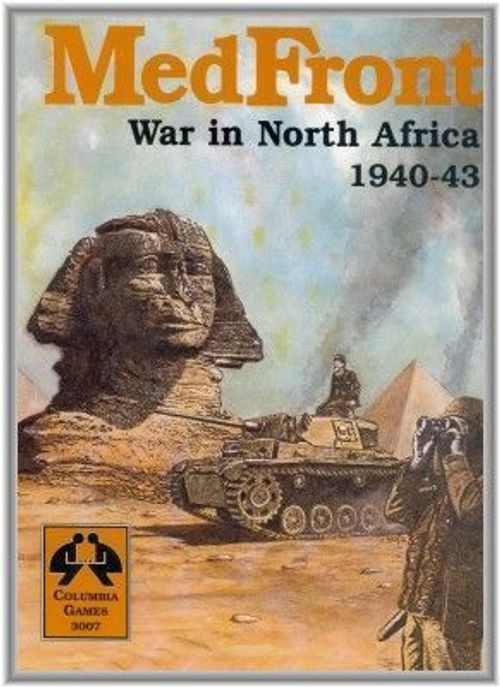
MedFront: War in North Africa 1940-43
Spanish Civil War Module Rules (MedFront Companion)
Table of Contents
Table of Contents
1.0 The Map
The Spanish Civil War (SCW) is played exclusively on the MedFront (west) map. The game uses WestFront rules except as noted below.
1.1 Spanish Theater. SCW units are restricted to Spain/Spanish Morocco. They cannot enter Portugal, Gibraltar, or France.
1.2 Spanish Cities. Cities and towns with a red symbol have Republican loyalty; black cities and towns have Nationalist loyalty. The loyalty of city/town hexes has several important effects on play.
Errata: La Coruna and Don Benito are red towns.
Map errata (section 9.0): add rail spur from Murcia to Cartagena.
2.0 The Units
2.1 Factions. Republican units are red blocks with yellow labels. Nationalist units are gray blocks with gray labels.
2.2 Garrisons. In the Spanish Civil War (as in most civil wars) control of territory was confused. Cardboard Republican and Nationalist garrison markers are provided to help define hex control.
Garrisons control their own hex and exert a ZOC. They are not units: they cannot move or fight and are immediately eliminated if an enemy unit enters their hex (unless a friendly unit is present).
Garrisons can be created during Production for 1 PP in any controlled, supplied hex.
5.0 Headquarters
5.1 Theater HQs. In addition to one normal HQ, each side has one Theater HQ (THQ) which functions as a weak Supreme HQ. THQs command the movement of one unit per CV and only within the 'theater' of Spain. Like Supreme HQs, THQs have attached airpower, but with normal (not doubled) air range.
Theater HQs (sidebar): Nationalist JDN (Junta de Defensa Nacional); Republican PF (Popular Front).
8.0 Hex Control
In the SCW, prior control of a hex has no meaning. Hex control is determined as follows.
8.1 Controlled Hexes.
- Hexes occupied solely by friendly units/garrisons.
- Friendly battles (controlled by the Original Defender).
- Unoccupied hexes controlled by an undisputed ZOC.
- Unoccupied and otherwise uncontrolled hexes containing a loyal city or town.
8.2 Disputed Hexes. Unoccupied hexes into which both sides exert a ZOC. Normal rules for disputed hexes apply as usual (e.g., units cannot disengage into them, rail through them, etc.).
8.3 Uncontrolled Hexes. Unoccupied hexes containing neither a ZOC nor a city/town. In the SCW, uncontrolled hexes are treated as friendly, except units cannot disengage into them. Command, supply, and rail movement are allowed through uncontrolled hexes.
9.0 Railroads
9.1 Rail Line Control. In the SCW, Rail Lines are traceable through friendly and uncontrolled hexes, but not through disputed or enemy hexes.
NOTE: Uncontrolled cities/towns of enemy loyalty block Rail Lines.
10.0 Supply
10.1 Supply Sources.
10.11 Capitals. The Republican capital is Madrid, and Lisbon acts as the Nationalist "capital."
10.12 External Supply. Four (4) External Supply markers are provided: two rail and one sea External Supply for the Republicans and one sea External Supply marker for the Nationalists.
The Republicans receive External Supply via Soviet and French Foreign Aid (see 11.2).
The Nationalists always receive External Supply in Lisbon, but may alternately receive it at any friendly port (place marker), subject to Blockade rules (see 11.24) when applicable.
When External Supply is received during Production, these External Supply markers are deployed on the map. Each marker functions as a friendly Supply Source throughout the upcoming month. They also add 1 PP of imported Production.
10.13 Supply Origins. Both the friendly capital (Lisbon or Madrid) and ports/rail lines with External Supply function as a friendly Supply Origin. Supply Origins and friendly rail lines emanating from these are Supply Sources.
10.2 SCW Siege Supply. Unsupplied units defending Loyal cities or towns are immune to supply attrition. However, unsupplied units still cannot be built during Production.
11.0 Production
11.1 Receiving PPs. The Republicans initially receive 3 PPs per month: 2 PPs for control of Madrid, and 1 PP for Barcelona (cities must be in Rail Supply to produce PPs). They may also receive Foreign Aid from France (11.21) and Russia (11.22).
The Nationalists receive 4 PPs of Foreign Aid per month: 1 from Portugal, 2 from Germany, and 1 from Italy. All of these PPs arrive via Lisbon.
11.2 Foreign Aid.
11.21 French Aid. The Republicans receive intermittent Foreign Aid from France, initially 2 PPs per month (place the 2 rail External Supply markers in the two rail hexes bordering France). However, French Aid is erratic, varying between 0-2 PPs per month. To begin Production, a die is rolled for French Aid (see sidebar table).
NOTE: French Aid cannot be received via a French border rail hex that is Nationalist controlled.
French Foreign Aid (sidebar table, as printed):
- 1: 1 PP of French aid received. Place one rail External Supply marker on a rail line hex bordering France.
- 2: 2 PPs of French aid received. Place rail External Supply markers on both rail line hexes bordering France.
- 3-4: No change from previous month.
- 5-6: French aid is reduced by 1 PP. Remove one French rail External Supply marker (if any remain).
11.22 Soviet Aid. The Republicans also receive 1 PP of Soviet Foreign Aid each Production, provided they control a port (place a sea External Supply marker in that port). Beginning S'37, however, Soviet aid is subject to Blockade (see 11.24 below).
11.23 Nationalist Aid. The Nationalists receive 4 PPs of German and Italian Foreign Aid per month in Lisbon (place a sea External Supply marker). This aid is not subject to Blockade.
Nationalist PPs (sidebar). Since units cannot enter Portugal, the "source" of Nationalist PPs cannot be captured. By controlling all rail lines from Portugal into Spain, the Republicans can prevent use of these PPs by the Nationalists, but not their accumulation in Lisbon.
Nationalist aid (sidebar). The international arms blockade initiated in April 1937 affected only the Republicans. The Nationalists continued to receive German and Italian arms via "neutral" Portugal, which was not subject to the blockade.
11.24 Blockade. Beginning S'37, Republican sea-borne Foreign Aid/External Supply is subject to Blockade.
To begin each Production, the Republican player rolls 1d6 (1 die) to see if Soviet Aid (1 PP) arrives. If the number rolled is less than or equal to the current number of Republican-controlled ports in Spain (Barcelona, a major port, counts double), the blockade is run successfully and Soviet Aid arrives (place a sea External Supply marker in any controlled port). If the die roll fails, the Republicans receive neither the 1 PP nor External Supply.
Blockade also applies to the arrival of Nationalist External Supply to any port other than Lisbon. Compare a die roll to the number of Nationalist controlled ports in Spain (note: Lisbon counts as two ports, but no other Portuguese or Spanish Moroccan ports count) and place a sea External Supply marker in the desired port if successful.
11.3 Saving PPs. PPs may be spent or saved as desired. However, as in the Med Front, if any PPs are spent during a Production, all accumulated PPs must be spent. If any PPs are spent, none may be saved.
Players keep track of their total Available PPs on the Production Track, using the die-cut markers provided. Adjust PPs totals as necessary when PPs are received and spent.
11.4 Building Units. Supplied, unengaged units can be built up one step per Production. Unit costs are shown in the sidebar table.
11.5 Building HQs.
11.51 Theater HQs. SCW Theater HQs (only) can always be rebuilt one step per Production at no PP cost (free).
11.52 Headquarters. An HQ is in Double Supply if it can trace supply to its Capital, which is itself connected to External Supply by rail. Lisbon is thus always a source of Nationalist Double Supply, but Madrid provides Republican Double Supply only when it can trace a rail line to External Supply.
SCW HQs (Mia/Fra) in Double Supply can be built at a reduced cost of 5 PPs per step (10 PPs/cadre). Other unit costs are unchanged by Double Supply.
Example: the Fra HQ can always rebuild a step for 5 PPs when it can trace supply to Lisbon.
11.6 Building New Units.
11.61 Cadres. Eliminated units can be rebuilt as new cadres in any controlled loyal City in rail supply (not if embattled). See Cadre costs in sidebar.
11.62 Garrisons. During Production, garrisons can be created in any unengaged, supplied friendly controlled hex at a cost of 1 PP.
11.7 Reinforcements. Reinforcement units (International Brigade, Pavlov armor, Italian Blackshirt mech) arrive as scheduled (or later) in any friendly controlled port. The International Brigade can also arrive in Albacete.
Reinforcements cannot be built up further in the month of arrival.
SCW Unit Cost Chart (as printed; CV / Cadre):
| Unit type | CV | Cadre |
|---|---|---|
| HQ | 10 [1] | 20 [2] |
| THQ | 0 [3] | 0 [3] |
| Armor | 8 | 16 |
| Mech | 6 | 12 |
| Infantry | 4 | 8 |
| Static | 3 | 2 |
| Int'l Brig | 2 | 4 |
| Garrison | • | 1 |
[1] 5 PPs when in Double Supply. [2] 10 PPs when in Double Supply. [3] Free 1 cv build each month.
Note: the chart values were read from a multi-column layout where footnote numerals run into the figures; the values above are the companion's printed figures.
12.0 Weather
Spain has WestFront weather:
- Dry: March - October.
- Mud: December & January.
- Mud/Dry (dieroll): November & February.
14.0 Seapower
Spanish forces cannot use sea power in any form. No Sea Movement, Sea Invasions or Sea Supply are allowed.
Exception: Spanish units may Sea Move between Tangier (Spanish Morocco) and Cadiz.
18.0 Victory
18.1 Pacification. Pacification Points are awarded for control of Spanish cities that are in Rail Supply (connected by rail to the friendly Capital or to External Supply).
One Pacification Point is awarded for each minor city, 2 (two) for Barcelona and Madrid. Spanish Moroccan cities are not counted (as never in Rail Supply).
The Pacification Level is the difference between friendly and enemy Pacification Points.
Example (as printed): The Nationalists have 9 Pacification Points, and the Republicans have 8. The Nationalists have achieved a Pacification Level of +1.
18.2 Foreign Recognition. Each side can win the game by gaining Foreign Recognition as the legitimate Spanish government.
Beginning W'36, the player leading in Pacification Points can appeal for Foreign Recognition by rolling 2 dice just prior to Production. However, only one such attempt may be made per Summer or Winter season.
The Nationalists or Republicans secure Foreign Recognition and win the game if they roll a number less than the current Pacification Level.
Foreign Recognition (sidebar, as printed). To have any chance of achieving Foreign Recognition, a player must have a Pacification Level of at least +3.
| Pacification Level | Success % |
|---|---|
| +3 | 3% |
| +4 | 8% |
| +5 | 17% |
| +6 | 28% |
| +7 | 42% |
| +8 | 58% |
| +9 | 72% |
| +10 | 83% |
| +11 | 92% |
| +12 | 97% |
| +13 or more | 100% |
18.3 Military Victory. A side also wins if at any time it controls all Spanish cities.
18.4 Stalemate. If neither side has won by the end of W'38 (May/39), the Republicans win a Marginal Victory (when WW2 breaks out in September/39, Franco will become isolated and unsupplied).
18.5 Level of Victory. The level of victory depends upon how quickly victory is won (see sidebar table).
SCW Level of Victory (as printed):
| Year | Nationalist | Republican |
|---|---|---|
| 1936 | Decisive | Decisive |
| 1937 | Major | Decisive |
| 1938 | Marginal | Major |
19.0 Special Rules
19.1 Deployment. No more than four (4) units may start in a major city, two (2) per minor City, and one (1) per town.
19.11 Historical Deployment. Deploy all units in the historical locations noted on the SCW O/B card.
19.12 Semi-Historical Deployment. Deploy all Armies (Infantry) and HQs in the historical locations noted on the SCW O/B card. Use Random Militia Deployment (see 19.15).
19.13 Hidden Deployment. Both sides secretly write down the starting location of all Armies and HQ units (must start in loyal cities). The Nationalist Franco HQ, AAf, and SFL units must start in Spanish Morocco. Use Random Militia Deployment.
19.14 Free Deployment. The Nationalist player deploys his 3 Spanish Morocco units. Players then alternate deploying one army/HQ at a time (Republicans first) in loyal Cities. Use Random Militia Deployment.
19.15 Random Militia Deployment [Recommended]. This option simulates the uncertain results of the various garrison revolts. Each player takes one militia unit at a time (without revealing its cv), and rolls a die for its Region of appearance, and then again for the City/Town within that region, according to the MILITIA TABLE on the O/B cards. If the specified location is already fully occupied for deployment purposes, roll again.
19.2 Late Start / Initiative. The game begins in July 1936, which has one turn only, and ends after May '39. The Nationalists always have the initiative (first turn).
19.3 Intervention "Ends" (Optional). Beginning W'38 (December), all foreign units (Italian mech, Pavl tank, and International Brigade) are removed from play.
Soviet and French Foreign Aid PPs to the Republicans are terminated (External Supply continues). 3 PPs of Axis Foreign Aid for the Nationalists continues.
Scenario Set-Up: Summer '36 (NO PASARAN!)
| Nationalist | Units | CV | Republican | Units | CV |
|---|---|---|---|---|---|
| HQ | 1 | 2 | HQ | 1 | 1 |
| Theater HQ | 1 | 2 | Theater HQ | 1 | 1 |
| Infantry | 6 | 10 | Infantry | 4 | 6 |
| Static | 4 | 2 | Static | 6 | 3 |
| Production | 4 | Production | 3 [*] | (+For. Aid) | |
| Air Power | DF | Air Power | SF |
Nationalist reinforcements: DEC '36 It Libya Mech Cps (Mech 1) [NAC unit; arrives in any controlled port]. Republican reinforcements: SEP '36 International Brigade (Inf 1) [arrives in Albacete]; OCT '36 Pav Tk Brigade (Armor 1) [arrives in any controlled port].
Nationalist O/B (as printed):
| Historical | Unit ID | Type | Free Deployment |
|---|---|---|---|
| Tangier | General Franco | HQ II | Spanish Morocco City |
| Tangier | Army of Africa | Infantry 2 | Spanish Morocco City |
| Melilla | Spanish Foreign Legion | Infantry 2 | Spanish Morocco City |
| Burgos | Junta de Defensa Nacional | THQ II | Loyal City |
| Burgos | 1 Army | Infantry 2 | Loyal City |
| Valladolid | 2 Army | Infantry 2 | Loyal City |
| Zaragoza | Carlist Army | Infantry 1 | Loyal City |
| Seville | Andalucian Army | Infantry 1 | Loyal City |
| Pamplona | Navarrese Militia | Static 1 | Loyal City/Town |
| Grenada | Andalucian Militia | Static 1 | Loyal City/Town |
| Vigo | Galician Militia | Static 0 | Loyal City/Town |
| Salamanca | Castilian Militia | Static 0 | Loyal City/Town |
Nationalist Militia Table (as printed; Region, then die roll 1-6):
| Region | 1 | 2 | 3 | 4 | 5 | 6 |
|---|---|---|---|---|---|---|
| 1 Coastal | Vigo | Vigo | Oviedo | Oviedo | Cadiz | Cadiz |
| 2 Castile | Toledo | Toledo | Caceres | Caceres | Avila | Avila |
| 3 Leon | Leon | Leon | Salamanca | Salamanca | Valladolid | Valladolid |
| 4 Navarre | Vitoria | Vitoria | Pamplona | Pamplona | Burgos | Burgos |
| 5 Aragon | Zaragoza | Zaragoza | Huesca | Huesca | Teruel | Teruel |
| 6 Andalucia | Seville | Seville | Grenada | Grenada | Cordoba | Cordoba |
Republican O/B (as printed):
| Historical | Unit ID | Type | Free Deployment |
|---|---|---|---|
| Madrid | General Miaja | HQ I | Loyal City |
| Barcelona | Popular Front | THQ I | Loyal City |
| Madrid | Communist Brigs | Infantry 2 | Loyal City |
| Madrid | Army of Madrid | Infantry 2 | Loyal City |
| Valencia | Army of Valencia | Infantry 1 | Loyal City |
| Barcelona | Army of Catalonia | Infantry 1 | Loyal City |
| Bilbao | Basque Militia | Static 1 | Loyal City/Town |
| Gijon | Asturian Militia | Static 1 | Loyal City/Town |
| Malaga | Malagan Militia | Static 1 | Loyal City/Town |
| Terragona | Catalan Militia | Static 0 | Loyal City/Town |
| Murcia | Murcian Militia | Static 0 | Loyal City/Town |
| Badajos | Extremaduran Mil | Static 0 | Loyal City/Town |
Republican Militia Table (as printed; Region, then die roll 1-6):
| Region | 1 | 2 | 3 | 4 | 5 | 6 |
|---|---|---|---|---|---|---|
| 1 Asturias | La Coruna | Gijon | Gijon | Gijon | Santander | Madrid |
| 2 Basque Provs | Bilbao | Bilbao | Bilbao | Bilbao | San Sebastian | San Sebastian |
| 3 Catalonia | Barcelona | Barcelona | Lerida | Terragona | Castellon* | Madrid |
| 4 Extremadura | Badajos | Badajos | Talavera | Ciudad Real | Linares | Aranjuez |
| 5 Murcia | Valencia | Valencia | Albacete | Alicante* | Murcia | Madrid |
| 6 Costa del Sol | Malaga | Malaga | Malaga | Almeria | Motril | Cartagena |
Note: the Militia Table entries marked * are as printed in the companion.
Sidebar: Volunteers (companion, as printed)
International Brigade. A volunteer force from many lands, including Britain, Canada, Germany, and the USA, about 60% of whom were Communists. With a peak manpower of 40,000 they were an elite unit of the Republican army, despite chronic language problems. The brigade suffered grievous losses on many occasions, but impassioned, idealistic recruits kept morale high.
Pavlov Tank Brigade. This Republican brigade, equipped with Soviet tanks (which were much superior to the contemporary German models supplied to Franco), was led by Soviet officers. General Pavlov, considered a preeminent Soviet tank specialist after his experience here, commanded the Soviet WEST Military District during Barbarossa, paying for that debacle with his life.
Black Shirt Corps. Supposedly a "volunteer" corps, this formation (represented in the SCW game by the NAC Libya Mech unit) was actually bona-fide Italian Motorized Corps, 50,000 strong. Sent by Mussolini to lead the way for Franco, this well armed unit was severely embarrassed militarily on several occasions (by the Soviet tanks for one), but earned a reputation for ferocity after executing prisoners promised clemency. Italian airpower was also responsible for heavy civilian bombings later in the war.
Other Volunteers. Germany and Portugal also provided 'volunteers' for Nationalist forces. Most notable of these was the Condor Legion, a German Air Corps of 5,000 pilots sent by Goering to test his rapidly expanding airforce under battle conditions. General von Thoma, (later captured at Alamein) also led a German tank battalion.
Sidebar: "No Pasaran!" "No Pasaran" (They Shall Not Pass) was the Republican rallying cry, popularized by La Pasionaria, a female orator who became a popular figurehead.