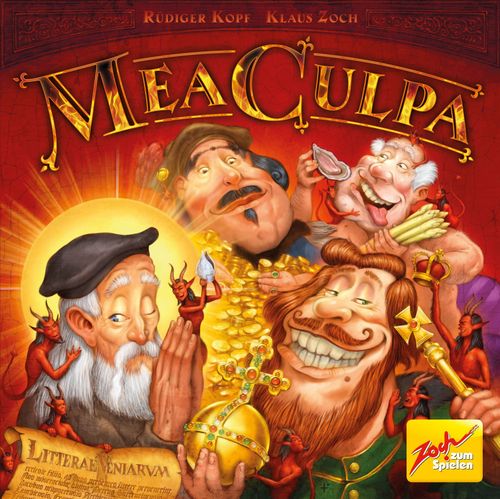
Mea Culpa
Mea Culpa Rulebook
Table of Contents
Table of Contents
Introduction
At the end of the game, the soul closest to the Pearly Gates is the winner, and only indulgences can raise a soul to Heaven. In this game, the Pope, the Emperor, a Merchant and a Petty Sinner will act on your behalf. You must try to donate more than your opponents towards the building of cathedrals. Whenever a cathedral is finished, the most generous donor receives Letters of Indulgence. But before you can donate money, bread, wine, fine cloth or jewels, you must first acquire them, and an occasional sin makes this much easier ...
Components
- 1 board
- 3 wooden cathedrals (3 naves and 3 spires)
- 4 character cards (Pope, Emperor, Merchant, Petty Sinner)
- 3 Pope stones
- 4 building crews
- 1 Pope die
- 1 black goods bag
- 35 goods (wooden cubes: 10 loaves of bread (brown), 9 bottles of wine (red), 9 rolls of cloth (pink), 7 jewels (white))
- 6 indulgence stones (light grey wooden cubes)
- 1 "Suite 5" card
- 24 House of Pleasure cards
- 51 Letters of Indulgence (10 yellow, 11 blue, 15 red, 15 green)
- 4 poor souls (in the four player colours)
- 4 etched posts (in the four player colours)
- 4 player screens (in the four player colours)
- 28 sin stones (4 x 7 discs in the four player colours)
- 4 chests (in the four player colours)
- 65 coins (18 x 1 taler, 18 x 2 taler, 16 x 5 taler, 12 x 10 taler)
Preparation
I. Before your first game assemble the etched posts and chests. The assembly instructions for the chests can be found in the punch-out sheets.
II. Place the following near the board: the cathedral elements (3 naves and 3 spires); the coins (forming the bank); the Letters of Indulgence (separated by colour).
III. Each player takes the following pieces in his colour: 1 etched post, 7 sin stones, 1 chest, 1 player screen, behind which he places 25 taler, taken from the bank.
IV. Place one Pope stone on each Den of Sin.
V. Place the 4 building crews in the builders' hut.
VI. Shuffle the 24 House of Pleasure cards and place them face down in the space beside the House of Pleasure, forming the House of Pleasure deck.
VII. The players' poor souls start the game in a random order in space 0 of the Record of Sins. Therefore, they will each be different distances from Heaven and Hell. For example, if purple is closest to Hell, next closest is black. Green is farther from heaven than yellow is.
VIII. Before the first round: A little bonus for everyone ... Each player starts the game with a small bonus. Place the following 4 bonuses near the board:
- Starting Bonus 1: 1 loaf and 1 bottle
- Starting Bonus 2: 1 jewel
- Starting Bonus 3: 10 taler
- Starting Bonus 4: blue Letter of Indulgence
In order of distance from Hell, starting with the player whose poor soul is closest to Heaven, each player chooses one starting bonus. Whoever chooses the Letter of Indulgence places it behind his screen. Whoever chooses one of the other bonuses donates them immediately by placing them secretly into either compartment of his chest. The loaf and bottle of Starting Bonus 1 may be divided between the two compartments.
IX. The remaining goods and indulgence stones are placed in the goods bag.
Goal of the Game
Whoever gets their poor soul to Heaven, or comes closest to doing so, wins the game.
Pay particular attention to the IMPORTANT NOTE and the TACTICAL TIP in the chapter on Movement Rules.
Here follow the rules for 4 players. The changes made when playing with 2 or 3 players are described under Rules for Two-player and Three-player Games.
Game Play
The game takes place over several rounds. Each round consists of 4 phases:
- Prepare the round
- Choose a character and perform Preliminary Action
- Take an action or two
- Adjust scores
1. Prepare the round
Market: Take 7 stones at random from the goods bag and place them in their respective areas of the market (bread stall, wine stall, cloth stall, jewel stall, letter of indulgence stall).
Character cards: Place the character cards face up in their respective character areas on the board. Place the Pope die on the Pope card. Take one building crew from the builders' hut and place it on the Emperor card.
House of Pleasure cards: If there is no yellow Letter of Indulgence in Suite 6, place one there. Make sure that the Suite 5 card is in Suite 5 with its "Welcome" side face up. Remove from Rooms 1-4 any cards remaining from the previous round and place them face up in a discard pile beside the board. Place the top four cards of the House of Pleasure deck face up in Rooms 1-4. If the House of Pleasure deck runs out, shuffle the discarded House of Pleasure cards to form a new one.
2. Choosing characters and performing their Preliminary Actions
Choosing a character. At the start of each round, the players try to win over the 4 characters: Pope, Emperor, Merchant, Petty Sinner.
To do this you each make a simultaneous offer, which you prepare in secret thus: You rotate your etched post so that your desired number of notches faces up. You may add to this number by placing any amount of taler on top of the etched post. All etched posts and taler are then revealed simultaneously. Your bid equals the sum of the notches showing and any added taler (e.g. 3 notches and 5 taler make a bid of 8).
The highest bidder then takes the character card of his choice, places it face up in front of his screen and immediately carries out its Preliminary Action (see below). Then, in descending order of bids, each other player chooses a remaining character card, carrying out its Preliminary Action immediately as above. Hold on to your chosen character card until the end of the round.
The player who revealed the most notches keeps any taler he bid. All other players must pay any taler they bid to the bank. Leave your etched post unchanged in front of your screen with the notches you bid showing, as this number will matter throughout the round.
If any bids are tied, the bid of the tied player whose poor soul is closer to Hell is considered higher. Tied numbers of notches are resolved in the same way.
Example: Dominik: 4 notches + 7 taler = 11. Johanna: 2 notches + 7 taler = 9. Paula: 3 notches + 12 taler = 15. Gregor: 1 notch + 8 taler = 9. Paula chooses a character card first, followed by Dominik. Gregor's poor soul is closer to Hell than Johanna's, so he chooses next. Dominik's etched post shows the most notches, so he keeps his taler.
Preliminary Actions:
- Pope: may move a Pope stone. Move one Pope stone from any Den of Sin to another. (Full rules concerning the three Dens of Sin and the Pope stones are under The Dens of Sin.)
- Emperor: must place his building crew on a cathedral site. Place the building crew that is on this card onto the cathedral site of your choice. If this completes a cathedral, its donations are evaluated immediately (see Evaluating Donations).
- Merchant: no Preliminary Action.
- Petty Sinner: must place 2 sin stones in the Den of Petty Sins and may visit the House of Pleasure immediately. Place two of your sin stones into the Den of Petty Sins. You may immediately (before the Action Phase) visit the House of Pleasure. Do not rotate your etched post. (The rules for the Petty Sinner are given under Visit the House of Pleasure.)
3. Action Phase
The Pope (1) starts the round, followed by the Emperor (2), then the Merchant (3) and then the Petty Sinner (4). Then again in the same order the Pope, the Emperor and so on until the end of the round.
The Action Phase ends as soon as the last stone (good or indulgence) is taken from the market, regardless of whose turn it is.
The Actions. On your turn you may either pass (until your next turn) or take one of the following actions:
- Buy one good or Letter of Indulgence (if available)
- Sell one good
- Donate
- Visit the House of Pleasure
You may, optionally, take a second action on your turn by rotating your etched post one notch higher. This second action cannot be the same as your first. You may not take more than two actions a turn.
Merchant Privilege: At the end of each of his turns, the Merchant takes any one stone from the market free of charge. If he takes a goods stone this way, he places it behind his screen. If he takes an indulgence stone, he swaps it for a red or green Letter of Indulgence, putting the Letter behind his screen and the stone back in the goods bag.
Buying
a) Letter of Indulgence: Pay 4 taler to the bank then take one indulgence stone from the market and swap it for a green or red Letter of Indulgence taken from the supply. Put the Letter behind your screen and the stone back in the goods bag. If no indulgence stones are available, you cannot buy a Letter.
b) Goods: Pay the purchase price of any one available good to the bank (e.g. 2 taler for a loaf of bread), then take that good from the market and place it behind your screen.
c) Greedily buy two goods: If the market contains two or more goods of a single type when you perform a Buy Action, you may buy two identical goods for the price of one. As this is clearly a greedy act, you must follow this by placing a sin stone in the Den of Greed. You may not buy two Letters of Indulgence in the same turn.
If there are no more stones in the market, the round ends.
Selling
Put one of your goods from behind your screen back into the goods bag and take from the bank its sale price (e.g. 6 taler for a loaf of bread). Goods already donated and Letters of Indulgence cannot be sold.
Donating
Show the other players the single good or single coin you wish to donate. Then put it in either of your chest's compartments, without showing the other players which compartment. Coins can be changed with the bank at any time, but once a donation has been placed in a chest it may not be removed again.
The Privilege of the Emperor: The Emperor may make two donations, of one or two types, and may divide them between his chest's compartments as he likes.
Visit the House of Pleasure
'The courtesans always know something useful!' In the House of Pleasure, alongside acts of lust, valuable information and favours are exchanged. A true place of sin ...
The House of Pleasure consists of 6 rooms: 4 ordinary rooms (spaces 1-4) and 2 suites (spaces 5 and 6). If you visit the House of Pleasure, choose one room not already visited this round and enjoy the benefit of its card.
A player may not choose a room or suite whose action would cause his etched post to be rotated to higher than 6 notches. It is forbidden to visit a room that has already been visited, or that causes the etched post to be rotated past the limit of 6 notches.
Visit an ordinary room 1-4: Visit a room of your choice and rotate your etched post as many notches as the card there requires (except the Petty Sinner and an undiscovered Pope). Carry out the card's action. Place the card face up in the discard pile beside the board.
Visit Suite 5: Place one of your sin stones in the Den of Lust (except an undiscovered Pope). Flip the card in Suite 5 to its "occupied" side. Choose one of rooms 1 to 4 and carry out its card's action, without rotating your etched post. Place the card of your chosen room in the discard pile beside the board.
Visit Suite 6 (only if a yellow Letter of Indulgence is present): Place one of your sin stones in the Den of Lust (except an undiscovered Pope). Rotate your etched post two notches higher (except the Petty Sinner and an undiscovered Pope). Take the yellow Letter of Indulgence from the suite and place it behind your screen.
Privilege of the Pope: The Pope visits the House of Pleasure incognito and doesn't say which room or suite he is visiting. Instead, he announces that he has "an urgent meeting" and secretly sets the Pope die to his chosen room or suite number. Now the other players try to catch the Pope in the act: advised by the other players, the player whose poor soul lies nearest Hell declares where he believes the Pope to be visiting. The Pope then reveals his Pope die, visits the chosen room and carries out its action.
- If the Pope's room was correctly guessed, he was caught in the act. If he is caught, his poor soul on the Record of Sins moves one step towards Hell. (Please note the Movement Rules.)
- If he is not caught, he needs neither to rotate his etched post higher nor place a sin stone in the Den of Lust.
Note: If the Pope accidentally chooses a room or suite whose action would cause his etched post to be rotated to higher than 6 notches, his poor soul moves one step towards Hell, his etched post is set to 6 notches and he does not carry out the action.
Privilege of the Petty Sinner: In the House of Pleasure the Petty Sinner does not have to rotate his etched post higher.
See the chapter on Dens of Sin for rules concerning players who have run out of sin stones (that is, all of whose stones have already been placed in Dens of Sin).
4. Compare the Etched Posts
Once the Action Phase is finished (empty market), find the difference between the etched post showing the most notches and the one showing the fewest.
Whoever's post shows the most notches moves his poor soul as many steps towards Hell as that difference. If tied, only the tied player whose poor soul is farther from Hell moves. (Please note the Movement Rules below.)
Examples: Dominik and Gregor have 2 notches showing, Paula 4 and Johanna 5. Johanna's poor soul descends 3 steps towards Hell, passing Paula's on its way. Johanna has 1 notch showing, Gregor, Paula and Dominik each have 5. Dominik's and Gregor's poor souls are closer to Hell than Paula's, so Paula moves hers 4 steps towards Hell.
The Record of Sins and Moving Poor Souls
Your poor soul's position on the Record of Sins indicates how well you are doing. The closer your soul is to Hell, the more sinful you are, and the farther you are from achieving the game's goal of entering Heaven.
IMPORTANT NOTE: During the game, your poor soul can only move towards Hell; how much it moves depends on your tactical skill. Only at the end of the game will you use your Letters of Indulgence to move your poor soul towards heaven.
TACTICAL TIP: Judge carefully how many sins you are willing to commit to obtain Letters of Indulgence. If you sin a lot, you will need many Letters to save you from Hell. You can also try to win with fewer Letters, but then you will need to sin less than your opponents.
Movement Rules
a) All poor souls start the game in the Start Position.
b) During the game, no other spaces of the Record of Sins can contain more than one poor soul.
c) If a poor soul would ever end its movement in an occupied space, it instead moves to the next free space. This applies also (when resolving Letters of Indulgence at the end of the game) to the Start Position.
d) A poor soul may not move beyond the 40th space. There is where Hell begins. If a poor soul would ever reach Hell, it doesn't move at all and instead stays where it is. (The 40th space, right before Hell, is the last space. No one can go farther.)
Resolving Ties
Ties are always decided in favour of the tied player nearer Hell.
- When choosing characters: his bid is considered higher than other tied bids; his notch count is considered higher than etched posts set identically.
- When comparing etched posts: his poor soul does not move towards Hell if his notch count shares highest place with another player. Only the tied player furthest away from Hell moves towards Hell.
- If more than one poor soul must move towards Hell at the same time: first move the poor soul that is closest to Hell, followed by the others in order of increasing distance from Hell.
- When resolving donations: his donation is considered higher than any tied donations.
The Dens of Sin
Every sin stone in a Den of Sin represents an act of greed, an act of lust or a petty sin. Every sin threatens to hasten its soul's descent to Hell. Whether it will ever come to that depends on the Pope stones, which grant sinners grace and protect them from punishment.
- Den of Lust: sin stone added when you visit a suite.
- Den of Petty Sins: two sin stones added when you commit a petty sin.
- Den of Greed: sin stone added when you buy two goods.
As long as a Pope stone remains beside two or more Dens of Sin, nothing happens. If all 3 Pope stones are beside one single Den of Sin, then the sins in the other two Dens of Sin are punished:
- For each sin stone in the two Dens of Sin without Pope stones, that sin stone's owner moves his poor soul one step towards Hell, beginning with the poor soul closest to Hell.
- The sins of the player who placed that third Pope stone are forgiven: his poor soul stays where it is.
- All players take back their sin stones from the two punished Dens of Sin.
- The Den of Sin in which the third Pope stone was placed is spared by the Pope's grace. Any sin stones there remain where they are and cause no poor souls to descend towards Hell.
- Finally, the three Pope stones are returned to their starting spaces beside the three Dens of Sin.
Player who placed the Pope stone: take your sin stones back from the other two Dens of Sin; don't move your poor soul. Other players: take your sin stones back from the other two Dens of Sin; for each stone, move your poor soul one step towards Hell. The Den of Sin where the third Pope stone was placed is unaffected.
Example: Johanna moves a Pope stone. Now, all three Pope stones are above the Den of Greed. The sins of lust and the petty sins must be atoned. Paula has 4 sin stones in those two Dens, so her poor soul moves 4 steps towards Hell. Dominik has just one stone between the two, so his poor soul moves 1 step. Gregor moves his poor soul 3 steps. Johanna's sins of lust and petty sins are forgiven. All four players take back all their sin stones from the Den of Lust and the Den of Petty Sins.
Run out of sin stones? If a player must place a sin stone but doesn't have any left, he must immediately take back all sin stones from one Den of Sin of his choice, moving his poor soul that many steps towards Hell. He then must place the sin stone(s) that he originally lacked. If he still does not have enough, he must empty another Den of Sin in the same way.
The Cathedral Site
This is where the construction of a cathedral takes place. A finished cathedral consists of a nave and a spire.
Placing a building crew here indicates that this cathedral is to be built. Placing a second crew here completes the nave. Return the two crews to the builders' hut and place a nave here. If there is already a nave here when a second building crew is added, return the two crews to the hut and add a spire. Now the cathedral is finished and donations are evaluated immediately, interrupting the normal flow of the game.
- Two building crews at one site: swap them for a nave.
- Nave and two building crews at one site: swap the builders for a spire. Cathedral is finished; immediately resolve donations.
Evaluating Donations
When the first cathedral is finished the first round of donations is immediately resolved. Each player empties his chest's compartment I. Compartment II remains closed. When the second cathedral is finished, each player empties his chest's second compartment and the second and final round of donations is resolved.
During the game only two of the three cathedrals will be finished. After the first evaluation of donations play continues where it was interrupted by the completion of the cathedral. After the second evaluation of donations the game ends.
Note: To keep things clear it is recommended that donations be placed on their owner's resealed box when evaluating.
To evaluate donations:
- Take from the supply the Letters of Indulgence listed beside the bread and wine symbols below the newly completed cathedral. Display these Letters side by side beside the board.
- Determine who has made the most valuable donation of bread and wine. For each player, add that player's donations of bread and wine together, counting each loaf as one point and each bottle as two. (Two loaves of bread are worth one bottle of wine.)
- The biggest donor of bread and wine takes one Letter of his choice from those displayed by the board. Next, the second biggest donor of bread and wine takes one of those remaining. If any Letters remain, these two players alternate picking one Letter until the entire display has been taken.
- If there is only one donor of bread and wine, he takes all the Letters in the display. If no one has donated any bread or wine, leave the Letters in the supply.
- Next determine, in the same way, who has donated the most cloth and jewels. Add each player's donation of each together, counting each roll of cloth as one point and each jewel as two. (Two rolls of cloth are worth one jewel.) The two biggest donors share, as with bread and wine, the Letters of Indulgence listed by the icon for cloth and jewels below the finished cathedral.
- Finally determine the two biggest donors of money. These two players, as described above, receive the Letters of Indulgence shown beside the coin icon below the finished cathedral.
- If donations are ever tied, the tied player whose poor soul is closer to Hell is considered the bigger donor.
The three categories compared are: bread and wine; jewels and cloth; money. The biggest donor in each category gets first pick of the Letters shown below the cathedral, followed by the second biggest, the right to pick then alternating between those two. For rules for two-player games, see below.
Example: Paula's four loaves of bread are worth the same as Gregor's two bottles of wine. Johanna has donated more, but the largest donation is Dominik's, so he chooses first and takes the red Letter of Indulgence. Then Johanna takes a blue one. Again back to Dominik, who also takes a blue one. Johanna takes the last blue one, leaving Dominik the green. Paula and Gregor get nothing. Had Paula given another loaf, she would have been tied with Johanna. The bigger donor of these two would have been whoever's poor soul lay closer to Hell.
All players, even those that received no Letters, now return any goods they donated to the goods bag and any money they donated to the bank.
Game End
When the second cathedral is finished and the second evaluation of donations has been conducted (empty the second chest compartment), the etched posts are compared once more (see Compare the Etched Posts). Next the collected Letters are scored. Each player's score is determined individually, starting with the player closest to Hell, followed by the second closest and so on.
Evaluate the Letters of Indulgence: first the player whose poor soul is closest to Hell, then the others in order of increasing distance from Hell, poor souls move towards Heaven:
- For each set of four Letters (one red, one green, one yellow and one blue): 8 steps towards Heaven.
- For each remaining Letter: 1 step towards Heaven.
Once all poor souls have been moved this way, the game is over. Whoever has reached Heaven has won. This may be more than one player. If no one has reached Heaven, the winner is the player who is closest to Heaven.
Rules for Two-player and Three-player Games
Starting bonuses that no one selects are returned to the supply.
Two Players
Character Choice: Each player receives two character cards. The highest bidder chooses first, followed by his opponent, then again the highest bidder and the last card goes to his opponent.
Evaluating Donations: The biggest donor (in each category) first takes two Letters, then his opponent takes two if any remain. The biggest donor takes any remaining after this. If there is just one donor he takes them all.
Three Players
Character Choice: Each player chooses a character as described for four players. One card will remain.
- If the Pope remains, the Emperor, in addition to his own Preliminary Action (use of builders), gets that of the Pope (placement of Pope stone). He chooses which to perform first.
- If the Emperor remains, the Pope, in addition to his own Preliminary Action (placement of Pope stone), gets that of the Emperor (use of builders), choosing which to perform first.
- If the Merchant remains, his Privilege is performed by the player whose poor soul lies closest to Hell at the end of his turn.
- If the Petty Sinner remains, nothing happens.
At the beginning of the next round, all four character cards can once more be chosen freely.
The House of Pleasure Cards
Each card shows the notches by which the etched post is rotated ("Etched post +N") and the number of copies in the deck.
- The Emperor presents you with a Letter of Indulgence. If an opponent has the Emperor card and any Letters of Indulgence, he must give you one of his choice. Etched post +1. 2x.
- Pope presents you with a yellow Letter of Indulgence. If an opponent has the Pope card and one or more yellow Letters of Indulgence, he must give you one of them. Etched post +3. 1x.
- All others move 3 steps towards Hell. Each opponent moves his poor soul 3 steps towards Hell. Please note the Movement Rules. Etched post +2. 1x.
- All others move 5 steps towards Hell. Each opponent moves his poor soul 5 steps towards Hell. Please note the Movement Rules. Etched post +3. 1x.
- Place 2 sin stones in the Den of Lust. Each opponent places 2 of his sin stones in the Den of Lust. Etched post +2. 2x.
- Place 2 sin stones in the Den of Greed. Each opponent places 2 of his sin stones in the Den of Greed. Etched post +2. 2x.
- Move a building crew. Move a building crew from one cathedral site to another. (Naves or towers may not be moved.) Etched post +2. 2x.
- Place a new building crew. Take a building crew from the builders' hut and place it in a cathedral site of your choice. Etched post +1. 3x.
- Move a Pope stone. Move a Pope stone from one Den of Sin to another. Etched post +2. 3x.
- Take 1 Good from the Market ... without paying for it. Etched post +2. 2x.
Variant: for the Sophisticated Penitent
To play is to sin!
How often have we forgiven our opponents when, having changed their mind about a move, they take it back? How often have we, with Papal forbearance, overlooked the fact that our neighbour took a good without first paying for it? And have we not countless times asked that all players begin new rounds by placing all game materials on their correct positions - rather than always leaving it up to a conscientious friend? Again and again have we graciously forgiven these shameful failings. But no more! From now on, let a sin be called a sin!
Anyone who commits such a petty sin in MEA CULPA must immediately place a sin stone in the Den of Petty Sins. The action, however, is not cancelled, though any associated costs that should have been paid must be paid. This is the variant's one and only rule.
Privilege of the Petty Sinner: The variant's one and only rule does not apply to him! He may sin and only has to adhere to the regular rules if one of the other players catches him committing a petty sin. He never has to place a sin stone in the Den of Petty Sins for being caught committing a petty sin.
Pay attention, watch your opponents closely. They will atone for their sins.
And how should we respond to a player who claims that he has not forgotten anything and that you merely interrupted him before he had a chance to do it? Well, to stop this, each player must declare when his turn is over. After this there can be no excuse - the sin is committed! Remember that the Petty Sinner may deliberately 'forget' to pay money, to rotate his etched post and to place sin stones in a Den of Sin. He only has to do these things if an opponent 'reminds' him.
Register of Sins
A sin stone must be placed in the Den of Petty Sins by any player, other than the Petty Sinner, who:
- Takes back (corrects) his turn, either in part or in full;
- Takes a character card before he has paid any coins he bid to the bank (or returned them to behind his screen, if he may);
- Doesn't rotate his etched post until he has started performing an action, or until after he has completed it;
- As the Merchant, forgets to take a good from the market at the end of his turn;
- Takes a good or a Letter of Indulgence before paying for it;
- As the Pope, takes a House of Pleasure action of his choice, forgetting that as the Pope he may only enter the House of Pleasure with the Pope die;
- Fails to return his character card to its place on the game board before the character choice auction of the next round;
- Forgets to perform his Preliminary Action;
- Places a sin stone in the Den of Lust only after performing the visited booth's action (for example, having already taken the yellow Letter of Indulgence from Booth 6);
- Places a sin stone in the Den of Greed only after taking two identical goods from the market;
- Doesn't reveal what he is donating;
- Doesn't realise that it is his turn when the player before him finishes his;
- Begins a turn, even though it is not his turn.
The Register of Sins can of course be altered to suit your needs. The important thing is that the players agree before the game which acts should be considered sins.