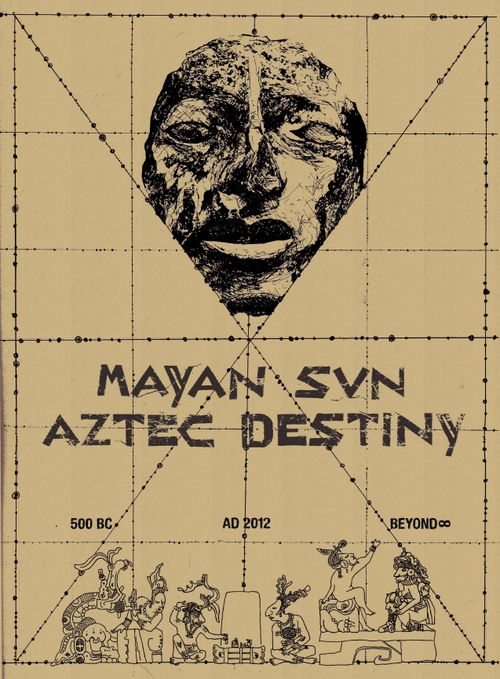
Mayan Sun, Aztec Destiny: 500 BC – AD 2012 – Beyond∞
Mayan Sun, Aztec Destiny: 500 BC – AD 2012 – Beyond∞ Rulebook
Table of Contents
Table of Contents
PART ONE: THE SUN GAME (BASIC)
Game Overview
In Mayan Sun, Aztec Destiny, players are ancient astronomers reading the stars and sun patterns. Using the Mayan Haab agricultural calendar invented in roughly 500 BC, players inform their villages the best time to plant so the harvests are plentiful. When harvests are plentiful the village eats, when harvests are bad the village starves. After the seeds are planted the astronomers perform rituals to both aid in the harvest and to further their reading of prophecies in the stars. Problems arise when neighboring villages use rituals to aid their own harvest. A village conducting a ritual to help their crop could be stealing the power of the cosmos from a nearby village. The prosperity of one village may be at the expense of their neighbors.
After the crops have been harvested, the prophecies are read by the ancient astronomers. These Aztec prophecies tell of the end of the world. These messages can be found embedded in the Aztec Calendar. With their knowledge of prophecy they may influence this ultimate end and can even know the exact date! Will the world end by the fires of a super volcano in AD 1969? Will an alien race arrive in AD 2012? Will a supernova occur light years away destroying our planet in 3,000,000,000 years? Players are now trusted prophets and will have knowledge of the end of time.
The game can be played as either a basic SUN game or the more advanced DESTINY game. The basic SUN game involves players moving the tiles by conducting rituals. Tile positioning can help or hinder players as they grow crops and collect prophetic knowledge. Players in the basic game will score for the amount of villages they feed and Prophecy tokens they collect. The DESTINY game is for players desiring a more involved game in which Prophecy tokens, earned by connecting star patterns, are used to either influence the value of villages, make investments in the future, and/or influence the time and method of the end of the world.
About Rules
The rulebook is separated into two sections, the SUN game and the DESTINY game. Players wanting to play just the SUN version of the game only need to read the SUN game booklet of the rules. Players may want to master the basics of the SUN game before playing the DESTINY game.
Players wanting to learn the DESTINY game must first read the SUN game portion of the rules. The DESTINY game adds more phases, opens up portions of the game board, adds purpose to a few components, and eliminates a few elements of the SUN game. The DESTINY game will be easier to grasp by players who are already familiar with the SUN portion of the game.
Set Up (SUN Game)
The SUN game will only use the Mayan Haab portion of the board. Any items not mentioned in this setup can be placed back in the box.
- Place board in middle of table.
- Shuffle the 18 regular Month tiles. Place one random tile face up on each space on the board clockwise beginning with the month space with the brown border. Tiles should be placed so the ground side is toward center and the sky portion is toward the Victory Point track.
- Shuffle each of the 5 Ritual decks separately. Depending on the number of players remove cards from each deck. In a 3 player game, remove 1 card from each deck. In a 2 player game remove 2 cards from each deck. Place the removed cards off to side as they will not be used in the first year.
- After each ritual deck is shuffled and prepared, place each deck face up on the side of the board in the appropriate positions.
- Place the 6 Special Month Tiles face up near the board.
- Separate and place the Prophecy Tokens, Jaguar Tokens, Death Tokens, and Hold Discs (not shown) near the board.
Each Player Chooses a Color and Receives:
a. A Maize, Squash, and Bean Seed token in their color. b. 10 Villages in their color. c. A small Scoring marker cube in their color. The player also receives a 40/80 point marker, which is used if the player passes 40 to 80 points. d. 3 discs in their color. 1 disc is placed on each 0 space of the resource track to keep track of the amount of Maize, Squash, and Beans the player may earn. e. 1 Phases of Play/Scoring card for the Sun game. f. 1 Resource Cost card.
Each Player Must Place:
g. Their Scoring Marker on the 11 on the Victory Point (VP) track. h. Three of their Villages in the middle of the board. i. A starting player is chosen and given the Starting Player marker.
SUN Summary
The game is played in two years (rounds). The board represents the 18 month cycle of the Haab Mayan calendar. Players have 3 seeds each representing a different crop. They must plant each seed in a different month on the board.
After each seed has been planted, players will take turns manipulating the calendar through ritual actions. Each seed must be harvested 4 months after it was planted. It is important that the players choose rituals that will optimize their crops harvest at the end of the 4 month growth period. The rituals chosen by a village may negatively affect another player's village.
At the end of the ritual cycle players harvest. The players then use each of their crops to feed their villagers (represented by a cylinder) and use any surplus crops to build new villages. If the year's harvest was plentiful a player's village will be fed and possibly grow larger, if it was poor, villages will starve and will decrease in size.
Players then score victory points for each Village they own. In addition, Prophecy tokens will be earned and scored for matching star patterns of their color on the calendar.
The year comes to an end and a new year's seeds are planted. After the scoring of the second year the game is complete. The player with the most points wins.
Game Play
The game is played in 2 years (rounds). Each year has 6 phases. Each phase must be complete before the next phase begins. When the 6th phase completes, a year comes to an end and a new one begins. After 2 years the game has a final scoring. The player with the most VPs wins.
The 6 phases of each year are as follows:
- Planting Seeds
- Perform Rituals
- Harvest
- Feed and Build Huts
- Score Huts and Star Connections
- Prepare for New Year.
1. Planting Seeds
Beginning with the starting player and continuing clockwise each player must plant 1 seed of their choice. The seed is placed below any one of the 18 Month Tiles in the Field section of the calendar. Only 1 seed can be placed below any empty month. It is never allowed to have two seeds below the same month at any time.
After each player has placed their first seed, the last player to place a seed places his second seed, and continuing in counter-clockwise order each player places their second seed ending with the starting player. The calendar is divided into 3 separate six month seasons. Players MUST place their second seed under any empty field in any of the two seasons they do not already have a seed in. At the start of a year (round) the player cannot have 2 seeds in the same six month season.
After each player has placed their second seed, the third seed is placed. Beginning again with the last player and continuing in counter-clockwise order each player places their third seed below any empty field in the six month season they have not yet placed a seed.
The first player will get the first and last seed placement. example of order: 1st seed 1,2,3,4. 2nd Seed 4,3,2,1. 3rd seed 4,3,2,1.
(Illustration captions: Incorrect Placement / Correct Placement / Seasons.)
Planting Seed Strategy: Crops are harvested over 4 months on the Mayan Calendar. The Month Tile above a seed plus the next three month tiles in a clockwise direction will be the seed's harvest and will affect it when it is time to harvest.
EX. Player white's Squash and player red's Maize seeds are affected by four months. The month directly above and 3 more months clockwise from the seed will be the harvest.
2. Perform Rituals
The rituals are the heart of the game. Beginning with the starting player and continuing clockwise, each player must perform a turn by conducting one Ritual action. This phase will last several turns.
On a player's turn he must choose any ONE of the face up Ritual Cards and perform the action on the card. The player takes the top card of the chosen deck and must perform the cards action. When the action is complete, the player discards the card face down near the matching deck beside the board and the next clockwise player takes a turn.
Each deck has a variety of cards so the next player will not have the same choices as the previous player.
The phase ends when a player draws the last Ritual Card of ANY of the five decks. The player drawing the final card completes the action on the card and the phase ends immediately.
Ex. A player must choose any ONE, face up, Ritual Card and complete the entire action. Here a player takes, HOLD Action.
The Ritual Phase ends immediately when a player chooses and plays the final card of any deck. **Please Refer to Ritual Action section for explanations of the card actions.
3. Harvest
Players simultaneously add (or subtract) the amount of crops they produced. Crop production is decided by adding and/or subtracting 4 Month Tiles. Beginning with the Month Tile above a seed and continuing with the next three Month Tiles clockwise from the first. Each green crop featured on a tile is a plus 1 crop harvested, each wilted black crop is a negative 1 crop harvested. (example below)
Players add the sum of the 4 Month tiles for each of his 3 seeds. A seed can only be harvested once, any seeds previously harvested by use of a Ritual Card action are not counted again. Any positive sum for a crop is added to the player's appropriate crop Resource Track. If a player has more than 10 of a single crop, the Resource Disc is placed to the left of the 0 space on the Resource Track to note the player is beyond the 10 space.
ex. Jason adds the 4 month tiles for his Squash crop. He has +7 crops. He moves his grey Squah disc to 7 on his Resource Track. Jason also harvests +13 pumpkin crops plus 1 left from the first year. The Resource Track only goes to 10, so Jason places his disc to the left of the "4" space of the Squash Track to show that he owns 14 Squash Crop.
Any negative harvest sum is decreased from a players victory points. ex. Keith adds up his four month tiles for his bean crop. He has -3 crops. He moves his Victory Point cube back 3 points.
Ex. Both players advance their discs on the appropriate Resource Track. Ex. Jason adds the 4 month tiles for his Squash crop. He has +7 crops. 3+3+3-2 = 7. Keith's Maize crop equals +2 crop. 3+3-2-2 = 2.
4. Feed and Build Villages
Each player must first feed each village he has on the board with their harvested crops. After each Village has been fed, the remaining crops must be used to build new villages. The success of the harvest demands that villages expand. Players spend crops as follows to feed and build villages:
- One of each type of crop can be spent to build or feed one village. ex. Bill uses one maize, bean, and squash crop to feed a village.
- Two pairs of any two crops can be spent to build or feed one village ex. Bill uses 2 bean crops and 2 Squash crops to feed his other village on the board.
- Four of any one crop can be spent to build or feed one village. ex. Bill uses 4 of his remaining bean crops to build a new village. He has one remaining bean crop which he will carry with him into the next year.
A player must build new villages using the same combinations until he hasn't enough crops to feed or build another Village. His harvest was good and his kingdom must grow.
Players can choose to Feed and Build simultaneously or in turn order.
Villages can be paid for in any combination desired by the player. If a player wants to spend 4 of one crop on every Feed or Build, he has absolute freedom to do so.
Jaguar tokens can be used at this time. The Jaguar tokens represent one of any type of crop. They cannot be carried into the next year. A player may use as many Jaguar tokens they wish to make a combination. ex. Keith uses one maize and bean crop together with a Jaguar token (rather than a Squash crop) to build one village. Jason uses 2 Jaguar tokens and 1 Squash to feed feed one village.
Players cannot buy Prophecy tokens (as featured on the Resource Cost card) in the SUN game.
If a player can not feed all of his villages, each village not fed is removed from the board. The player receives a Death token for each village that has not been fed. ex. Jason has 5 villages on the board but can only feed three. He removes two villages and receives two Death tokens.
Once players are finished with this phase, all Jaguar tokens are returned to pool.
Ex. The grey player could feed and or build 3 villages with the following combinations: 4 Beans could build one villages, another village could be built with 2 Squash and 2 Beans, and a final village could be made with one of each crop.
Ex. Grey could only feed 3 villages but has 5, he loses 2 villages to starvation and gains 2 Death tokens.
5. Score Villages and Star Connections
A player scores 5 points for each village he has on the board.
A player also earns a Prophecy token for each star connection he has on the board. A star connection is 2 adjacent Month tiles with stars of a player's color. Some Month tiles have two star colors. The stars themselves do not need to be adjacent, only the tiles need to be adjacent. The Comet Tile represents any player color, any player with stars adjacent to a Comet Tile will collect a Prophecy Tile. SEED PLACEMENT HAS NO EFFECT ON STAR CONNECTIONS. Players can collect Prophecy tokens for star connections ANYWHERE on the board.
Players receive a Prophecy token for each star connection and immediately earns 3 VPs for each Prophecy token earned. The tokens are scored only once, but are kept for the end game.
After all the villages and star connections are scored players move their score markers up appropriately. If someone passes the 40 point marker he places his 40 token near the 1 on the scoring track, and continues moving his cube to the appropriate score. If he passes his 40 point marker again, he flips the marker to 80 and continues along the track.
Ex. The Brown (dark grey) player has made 2 star connections and earns 6 vps and 2 Prophecy tokens which he'll save for the end of the game. The Red (light grey) player and Grey (white) player both have 1 connection for being adjacent to comet and both earn 3 VPs and 1 Prophecy token each.
6. Prepare for New Year
After the first year, players shuffle each of the ritual decks including the cards previously taken out. Remove any cards for 3 player game (1 card) and 2 player game (2 cards), and place the shuffled decks face up in their appropriate positions.
Remove any HOLD tokens and special tiles from the board and place the regular month tiles that had been removed back on the board randomly in the empty spaces left by the removed special tiles.
All players remove their seed tokens from the board.
The player with the least Victory Points becomes the new Starting Player. Ties are broken as follows: least Villages on the board, least Prophecy tokens, player closest to previous Starting Player in clockwise order.
The starting player receives the starting player piece.
After the second year phase 6 is not performed instead players continue to end game.
Endgame (SUN Game)
After everyone has scored their villages and star connections for the second year the game is complete and final scoring is added.
- Each remaining crop on a players Resource track scores 1 victory point.
- The player with the most Prophecy tokens scores 3 victory points. If there is a tie, each player with most earns 3 victory points.
- The player with the least Prophecy tokens loses 3 victory points. If there is a tie, each player with least loses 3 victory points.
- Players lose vp for each Death token they have collected. Each Death token increases in negative value as follows: 1/-1vp, 2/-2vp, 3/-3vp, 4/-4vp, 5/-5vp and so on.
ex. A player with 4 Death tokens has -10 victory points. (-1-2-3-4=-10)
The player with most points wins, and is the High Priest of the Sun and has the knowledge to create the Mayan Haab agricultural calendar. Ties are broken in the following order: most villages, most Prophecy tokens is superior, least Death tokens.
This completes the SUN rules, players of the SUN game should read the Ritual Actions section. Players of the DESTINY expansion should also read the Ritual Actions section before reading the extra Destiny rules.
Ritual Actions
The following describes the Ritual cards in detail. Each card and its action are explained below:
Move
A player must move one Month Tile on the board the full number of spaces stated on the card.
When moving, the player chooses any Month Tile and moves it clockwise or counter-clockwise. The Month Tile must move the full number of spaces stated on the ritual card. The tile can only move in one choosen direction; either clockwise or counter clockwise. See example.
The Month Tile that is moved is traded with the Month Tile that currently occupies the space it is being moved to. See Example.
If a tile is moved and a tile has a HOLD token on the month where the moving tile should be placed, the moving Month Tile continues in the same direction and is switched with the next available non-Hold Month Tile. This allows a player to move a Month Tile more spaces than stated on a Ritual Card. HOLD tokens explained below
ex. If Jason draws a Move 3 Ritual Card from one of the Ritual Action decks, he cannot move a Month Tile only 2 spaces clockwise he must move it the full 3 spaces. He must only move a Month Tile the full 3 spaces in one direction or the other. Jason moves a "2 Crop" tile 3 spaces clockwise and switches spots with a "2 wilted crop" Month Tile. The 2 wilted crop month tile is placed in the original "2 Crop" tile spot.
Hold
A player takes a Hold Disc from the stock and places it on any Month Tile he wants. A tile with a Hold Token cannot be moved or replaced for the rest of the year. If a player moves a tile and lands on a HOLD tile, the player must continue moving the tile in the same direction until there is a tile without a HOLD. A HOLD cannot be moved.
Ex. Keith takes a Hold Ritual Action and places a Hold Token on the Month Tile above his Bean Seed Token. Jason now takes a "Move 3" action and moves clockwise. Normally he'd have to move and switch with the third tile, but the Hold Token requires him to continue moving in the same direction until he finds the next available non-Hold month. The next clockwise tile is free and he switches tiles with that month. Due to the Hold token he was able to move a tile 4 spaces rather than the 3 stated on the card.
Harvest 1 Crop Now (-2)
A player may immediately harvest any one of his own seeds on the board. The player collects crops for the month the seed is planted on and the following three clockwise months (just the same way it is tallied during Harvest). The player then subtracts 2 crops from the seed's harvest (the subtraction of 2 crops from the total is due to an early harvest.) The player moves his disc up the appropriate Resource Track and flips over the harvested seed. It may not be harvested again that year. The seed token remains face down where it was planted for the rest of the year.
A player may not use the harvest 1 crop card on a seed that would produce a negative amount of crops.
Move 1 Seed
A player may move any ONE of his own Seed tokens on the board to ANY empty available Field. He can move his Seed token into any of the 3 seasons at this time even if he has another seed in that season.
Move Across Sky
A player may move any non-Hold month tile directly across the calendar. The tile is moved to the month with the same Mayan Number which is directly across. Both tiles switch places. A tile cannot move across if there is a tile on hold across from it.
About Mayan Numbers: The Mayan numbers are a combinations of dots and lines. Each dot equals 1, and each line equals 5. Three dots would equal 3. When moving across the calendar both numbers must match.
ex. Jason uses a "Move Across Sky" action to switch a -2 crop tile with a +3 crop tile. He switches places with the Mayan Number 9 (4 dots over 1 line).
Collect 1 Prophecy
A player collects a Prophecy Token (and in the SUN game immediately earns 3 victory points.) In the DESTINY expansion he keeps the Prophecy Token for the Prophecy Phase, in the SUN game he keeps the token or for endgame scoring. The Prophecy token is only scored once in the SUN game.
Match Stars
A player may take any non-Hold Month Tile with a star of his color on the board and move it directly adjacent to another Month Tile with a star of his color. The moving tile switches places with the tile in the new space. A player may move a tile with a star of his color adjacent to a Comet tile and visa versa.
Ex. Keith chooses a "Match Stars" action and moves a month tile with +3 crops and his color star (brown) next to a +1 tile with star of his color. The tile with +2 crops switches spaces with the moving tile.
Final Ritual
When choosing the Final Ritual, the player puts the card into his play area and does nothing further for this action. When the year ends as a result of a player drawing the final Ritual Card of any of the five decks, the player holding the Final Ritual card may then perform one final action using the top card of any of the remaining decks.
If more than one player has a Final Ritual card the player closest, in clockwise order, to the starting player plays his card first.
A player may own more than one Final Ritual action card, but he may only perform ONE final action even if he has 2 cards.
Cards with Jaguars
Some cards have a Jaguar option. Jaguars represent hunting for food. If a card has a Jaguar icon, the player may choose between taking the regular Ritual Action featured on the card or to take a Jaguar token. The player must choose one option not both. If the player takes a Jaguar token, he takes one token into his supply, earns 1 Victory Point and discards the card. A Jaguar token is wild and represents 1 resource of any type when building and feeding huts. In the DESTINY expansion a Jaguar token can be used to purchase Prophecy Tokens.
Jaguar tokens as a wild resource to be used to build villages may be confusing on Resource Cost card. The card shows one way to use the Jaguar for building villages (1 Jaguar with two separate resources). Jaguar is always a wild resource for any combination to build a village. To buy a Prophecy token, players must us card formula (1 Jaguar w/ a pair of the same resource).
Special Month Tiles
There are 6 special month tiles which can be placed on the board by playing their Ritual Action cards. When playing this action a player replaces any tile on the board with the tile featured on the card. A tile cannot replace any tile that has a Hold Token OR any tile with a Serpent Icon. The Tiles with a Serpent Icon cannot be removed from the board. Two tiles from the regular Month Tiles and all of the Special Tiles have the Serpent Icon THESE REGULAR TILES CANNOT BE REMOVED!!
Tiles taken off the board, due to Special Tiles, are placed nearby and will be used again in the next year.
The six special tiles (as described by the captions, in printed order):
- Tile equals 0 crops, but the Comet is considered any color star for Star Connection purposes.
- Tile equals +3 crops. When played a Hold Token is immediately placed on top.
- Tile equals -3 crops. When played a Hold Token is immediately placed on top.
- Tile equals +4 crops.
- Tile is equal to whatever tile is to the left. Ex. If a +3 crops tile is to the left this tile equals +3.
- Tile is equal to whatever tile is to the right. Ex. If a -2 crops tile is to the right this tile equals -2.
Game Contents
- 1 SUN game rulebook
- 1 DESTINY game rulebook
- 1 Gameboard
- 40 Ritual Cards
- 4 Phases of Play/Scoring cards for SUN game
- 4 Phases of Play/Scoring cards for DESTINY game
- 4 Resource Cost cards
- 18 Regular Tiles
- 6 Special Tiles
- 4 HOLD Discs
- 24 Prophecy Tokens
- 16 Jaguar Tokens
- 12 Death Tokens
- 9 Glyph Tiles
- 2 Destiny Point Tokens
- 1 Starter Marker
- 3 Seeds per Player Color (Maize, Squash, Beans)
- 1 40+/80+ point Token
- 40 Villages (cylinders), 10 in each player color
- 20 Discs, 5 in each player color
- 4 Victory Point markers (small cube), 1 in each player color
- 4 Fate (large) cubes, 1 in each player color
- 4 Date Sticks, 1 in each player color
- 1 Destiny Marker (cone)
- 1 Date Marker (octagon)
If players run out of Villages, Prophecy tokens, Jaguar tokens, or Death tokens please improvise.
Seeds had to be reprinted, as initial printing was the wrong size. Players can do whatever they like with the extra pieces.
Player Aid (SUN Game)
Ritual card icons:
- Move Month Tile: 1-6 Spaces
- Hold Tile
- Harvest 1 Crop Now (-2)
- Move 1 Seed: to any empty field
- Move Across the Sky
- Collect 1 Prophecy: SUN: 3VP immediately, save to endgame. DESTINY: collect to use in Prophecy Phase
- Match Stars: may move tile w/ star of your color next to another tile w/ star of your color
- Final Ritual: No action when drawing, can play final action from remaining cards at end of phase
- Serpent: cannot remove tile from board. 2 Regular tiles can never be removed!!
- Jaguar on card: Instead of action, draw a Jaguar token and earn 1 VP
The 6 phases of each year (SUN game):
- Planting Seeds: each seed must be planted in different season
- Perform Rituals: each turn player must draw one face up Ritual Card. phase ends when last card of ANY deck is drawn.
- Harvest: adding 4 Month Tiles of crop clockwise
- Feed and Build Huts: feed villages before building. players must spend as many resources as possible. villages lost gain Death token
- Score Huts and Star Connections: +5 VP for every village. any tiles w/ stars of same color adjacent earn Prophecy tokens. +3 VP for each Prophecy token.
- Prepare for New Year: remove Special Tiles, Seed tokens and HOLD discs. place regular tiles back on empty spaces. reshuffle decks. player with least VP become starting player
PART TWO: THE DESTINY GAME (ADVANCED)
Set Up (DESTINY Game)
The DESTINY game will use the entire board.
Set up is the same as the SUN game with the following additions.
- Each player gets 5 discs in their color, placing three on each of the 0s of the Resource Tracks. The other 2 discs are placed at the beginning of each Village Planning Track.
- The Glyph tokens are shuffled face down and 8 of the Tokens are placed randomly face up on top of each empty Glyph space. The Glyph tokens should be placed to match the background of the board. The remaining Glyph token is placed in the box.
- The Destiny Marker (cone) is placed on any one of the Glyphs. In the first game, we recommend setting up like the example.
- One of the Destiny Point Tokens is placed adjacent to the Destiny Marker at the Calendar edge as shown in the picture. The Point Token is placed to represent the value of Each Glyph at the beginning of the game. The Destiny Marker sits on a 1 victory point value Glyph. The Point Token should be placed to convey the values to players.
- The Date Marker (octagon piece) is placed on the 2012 date.
Each Player Also Receives:
a. 1 Prophecy Token. b. 1 Jaguar Token. c. 1 Large Fate Cube in the player's color. d. 1 Date Stick in the player's color. e. 1 Phases of Play/Scoring card for DESTINY expansion.
The player who most recently went on and on about the world coming to an end becomes the Starting Player.
Beginning with the starting player and going clockwise, each player advances one disc on either Village Planning Track. A player may go forward one space on either the Village Value track or Village Progress track. (Village Tracks are explained in the Prophecy Phase.)
"But more about the ancient Mayas. How can one fail to be astonished at their lack of practical sense? Here was a people which preferred to master the laws of the firmament and meditate on time and eternity rather than devote their attentions to inventions which might have saved them a lot of bother..." – Jesus Rome, "The Civilization of the Maya"
Gameplay (DESTINY Game)
In the DESTINY game players still use the valuable agricultural portion of the Calendar but now use the Aztec portions of the board, and can also use the Prophecy tokens they collect to improve their Villages, and/or try to predict the end of time.
The game is played in the same fashion as the SUN game, in 2 years (rounds) each year played in phases. In the DESTINY game players conduct 8 phases. Most of the phases are exactly the same as the Sun game. Each phase must be complete before the next phase begins. When the 8th phase completes, a year comes to an end and a new year begins. After 2 years the game has a final scoring. The player with the most Victory Points wins.
The 8 phases of each year are as follows:
- Destiny (1st Fate, 2nd Date)
- Planting Seeds
- Perform Rituals
- Harvest
- Feed and Build Villages
- Prophecy
- Score Villages.
- Prepare for New Year
1. Destiny (1st Fate, 2nd Date)
During the 1st year, each player must guess what the Fate of the world will be. Beginning with the Starting Player and going clockwise, each player must place his Fate Cube on the Glyph he believes will represent the end of the world. A player cannot place a Fate Cube on the same Glyph as another player. Players are making a prediction as to where they believe Destiny Marker (cone piece) could land at the end of the game.
Players can see the current value of the 8 Glyphs around the board by observing the Destiny Point token. At the beginning of the game, the value of the Glyph containing the Destiny Marker is worth 1 victory point, and the Glyph furthest away would be 10 victory points. The Glyphs adjacent to the Destiny Marker would be 3 victory points at this time and so on.
The value of these Glyphs will increase in the second year.
At the beginning of the Second Year, players must place the 2nd Destiny Point token on the Board. The Destiny Point token is placed next to the Destiny Marker's current position in the same fashion as year one. Each Glyph increases in value based on the Destiny Point token placement. The Glyph that the Destiny Marker sits on increases by 1 victory point, and the Glyph currently furthest away from the Destiny Marker increases by 10 victory points. The values of both Destiny Point tokens are added to establish what the final value a Glyph will be.
Ex. In year one the Glyph Jason placed his Fate Cube was worth 3 victory points. In year two, due to the Destiny Points placement, Jason's Glyph is now worth 11 victory points.
It is possible that the Destiny Marker will be on the same Glyph at the beginning of both years. The Victory Point values of both Destiny Point tokens are added together as normal.
In year 2, players make a second guess, this time being the Date the world will end. Beginning with the Starting Player and going clockwise, each player makes one guess as to the date of the end of the world by placing their Date Stick near the date they think the world will end. Each Date can be bet upon by only one player. Players are making a bet as to where they believe the Date marker could land at the end of the game.
Strategy Hint: The Destiny Marker will be moved by Prophecy Tokens in a later phase. At the beginning of the game, players will have no clue as to how many Prophecy Tokens they will collect. By betting their Fate Cube on a Glyph they will have a goal. The closer a Glyph is to the Destiny Marker, the easier it will be for the player to achieve victory points.
The Date Marker movement is determined by the Glyph the Destiny Marker lands on (Prepare for New Year phase). Players may want to bet on themselves and bet on the date influenced by their invested Glyph, but it might be smarter to bet on the Date that is linked to a Glyph an opponent clearly can achieve to 'piggy-back' on their points.
The Glyphs themselves are explained below and are purely for theme.
2. Planting Seeds
This phase is done exactly the same as the SUN game.
3. Perform Rituals
This phase is done exactly the same as the SUN game.
4. Harvest
This phase is done exactly the same as the SUN game.
5. Feed and Build Villages
This phase is done exactly the same as the SUN game with the following additions:
- Players must do this phase in turn order.
- As with the SUN game, players must first feed every village on the board.
- After feeding each village players must continue to spend as many crops as they can using the combinations on their Resource Cost card.
- In addition to building Villages, player may also purchase Prophecy tokens by spending 1 Jaguar and any pair of matched crops.
Players can decide to build Prophecy tokens and additional Villages only after each Village on the board has been fed. After each Village has been fed, a player must spend as many resources as possible on either new Villages or Prophecy tokens. If a player has the opportunity to make something with the Resources he has available he must make something.
If a player cannot feed every Village but has enough resources to buy Prophecy tokens he must buy tokens. He will receive a Death token for each Village that starved, but he must still purchase Prophecy Tokens if he has the resources.
6. Prophecy
As in the SUN game, players collect Prophecy Tokens for every Star Connection they have. A star connection is 2 adjacent month tiles with stars of a player's color, or a star of their color adjacent to a tile with a comet symbol on it.
Players must now spend the Prophecy tokens they have earned. Prophecy Tokens will be used to pay for actions. Beginning with the starting player and continuing clockwise each player with Prophecy Tokens must spend 1 or 2 tokens to conduct one Prophecy action. Players must continue spending Prophecy Tokens for actions until all of their Prophecy Tokens are spent, which may take several turns.
On a turn, players must choose ONE of the following actions, each action costs Prophecy tokens to conduct.
Actions
COST: 1 Prophecy Token:
- Advance on a Village Planning track
- Move Destiny Marker
COST: 2 Prophecy Tokens: 3. Change Prediction
If players do not have Prophecy tokens to spend they cannot perform an action and must wait until the other players are finished with the phase.
Prophecy Actions
A. Advance on a Village Progress track
For the cost of one Prophecy Token a player may advance one space forward on one of the Village Progress tracks. A player pays a Prophecy Token and moves his disc forward on one of the tracks. Discs cannot be pushed backwards on a track.
There are two Village Progress tracks a player may invest in. The track to the right is the Village Value Track, and allows a player to increase the Victory Point value of his Villages. At the beginning of the game Villages are worth 0 Victory Points. By increasing on the Village Value Progress track a player can make Victory Points off the Villages he owns during the Score Villages Phase.
ex. Jason Spends a Prophecy Token and moves his disc forward to the 4 Victory Point villages space. Each of his villages is now worth 4 Victory Points during the Score Villages Phase.
The Village Progress Track on the left hand side of the calendar allows a player to earn more Prophecy and Jaguar tokens, increase in Victory Points and can give the player special abilities in the new year. The following Progress abilities are as follows (spaces a to h, in order along the track):
- a. Hunting Party: Earn a Jaguar Token and Prophecy Token for the next year.
- b. Idea: Earn 1 Victory Point
- c. Tools: Earn 1 Prophecy Token and 1 Victory Point
- d. Hunting Party: Earn 1 Jaguar and 2 Victory Points
- e. Slash And Burn: Earn the Ability to Harvest 1 Crop in the next year using only 3 Months (starting above seed) instead of 4. And earn 2 Victory Points
- f. Irrigation: Earn the Ability to Harvest 1 Crop in the next year using 5 Months (starting above seed) instead of 4. And earn 3 Victory Points
- g. Meditation: Nothing
- h. Master of Long Count: Doubles Village Value Victory Points. If the Destiny Marker lands on a player's Glyph at the end of the game the player earns double Victory Points for his Glyph.
When a player advances on this track he will collect any of the Prophecy and/or Jaguar Tokens landed on or previously passed during the Preparing for New Year phase.
Any Mayan Numbers (black dots) passed on the Progress Track are immediate Victory Points earned. The player earns Victory Points equal to the number of Dots on the space. The player advances his token on the Victory point track.
B. Move Destiny Marker
Players may also spend one Prophecy token to move the Destiny Marker ONE SPACE clockwise or counter-clockwise on the Glyphs around the Calendar.
Ex. For 1 Prophecy token Keith may move Destiny Marker either clockwise or counter-clockwise. He chooses clockwise. Next turn he may spend another Prophecy token to move it again in either direction.
C. Change Prediction (Cost 2)
For 2 Prophecy Tokens a player may move either their Fate Cube to a different Glyph or Date Stick to a different Date. Players can only move to a Glyph or Date that does not have another players tokens; the Destiny and Date Markers may be there.
All Prophecy Tokens spent are returned to the token pile.
7. Score Villages
Players score the Victory Point value of their villages. The value is determined by the Village Value Progress track. The player earns the amount of points for each Village equal to the number the player's disc is on the Village Victory Point track. If a player is not on the track he earns 0 Victory Points for his villages. If a player sits in an empty space between two Village values, he earns the last value passed by his disc.
Players who have acheived Mastery of Long Count on Village Progress track double their Village Value Victory Points. (ex. Village Value of 4 vp is now 8vp.) Players advance on the Victory Point track for their Victory Points earned.
8. Prepare for New Year
The Phase is exactly the same as the SUN game with the following additions:
Players collect any Jaguar or Prophecy tokens they have landed on or passed on the Village Progress Track. They DO NOT earn the immediate Victory Points from these tracks again. Ex. Keith has advanced to Tools on the Village Progress track. He collects 1 Prophecy token for being on Tools. He also collects 1 Jaguar and 1 Prophecy Token for having advanced past Hunting.
Players look at the Glyph token the Destiny Marker is on and move the Date Marker (octagon). The Date Marker moves a number of spaces either clockwise or counter-clockwise based on the Mayan Number (black dots) on the Glyph Tile. If the dots are on the right the Date Marker must be moved clockwise, and if the dots are on the left the Date Marker is moved counter-clockwise. The Date Marker moves the number of spaces equal to the amount of dots shown on the Glyph Token. The Date Marker must move in the direction shown on the Glyph Token. If there are no dots, the date marker does not move.
Ex. The Destiny Marker sits on a Glyph that has 2 Dots on the Right side of the Glyph the Date Marker MUST move 2 dates clockwise. If the date marker was on AD 2012, it must move to AD 2240.
After this phase is completed in the second year the game is complete.
Endgame (DESTINY Game)
After the Second Year is complete players score for the Destiny Marker and Date Marker.
Players score 1 Victory Point for each remaining Resouce on the Resource Track and each remaining Jaguar and Prophecy token earned in the last Prepare for New Year Phase
The player whose Fate Cube is on the same Glyph as the Destiny Marker earns the Destiny Victory Points. The points can be determined by adding the two Destiny Point tokens together for the space the Destiny Marker ended (see Destiny phase). The player can earn anywhere from 2-20 Victory Points. The player also doubles his Destiny Points if he has achieved "Mastery of Long Count" on the Technology Village Progress track.
The Player that has his Time Stick on the same Date space as the Date Marker earns 10 Victory Points.
Players decrease any Victory Points for Death Tokens as they would in the SUN game. Each Death Token increases in negative value. 1/-1vp, 2/-2vp, 3/-3vp, 4/-4vp and so on.
The player with the most points wins and now has the sole knowledge of the endtimes!! This game is designed in such a way that the winner is now qualified to write a book discussing the endtimes the player has discovered. The winner is also qualified to call into late night radio talk shows to explain his findings. The game is very accurate in its foretelling of doom or hope - if players are unhappy with their findings playing the game again will change the course of their previous findings. Ties are broken in the following order: Most Villages, Most Village Progresses, Least Death Tokens.
When Finishing the game players can decipher what they have found with the following Glyph and Date descriptions.
Glyphs
"We are all gathered here at the endgame of developmental processes on this planet. We are about to become unrecognizable to ourselves as a species. Our technologies, our religions, our science has pushed us towards this for thousands of years without us awakening to what the denouemont would be. Now we stand close enough to it that all except the most lumpen among us must feel the tug of the transcendental and transformative." – Terrance McKenna
"on page 115 we read that 170,937 days after April 21st, 1519, the Fifth World will end; on the next page we are given the date August 16th, 1987 as the end date. This calculation is off by over 100 days, meaning that Harmonic Convergence should have happened in early spring! The mid-August date was probably chosen because the astrology was fortuitous". – Tony Shearer, author of Beneath the Moon and Under the Sun. Shearer's book, a study of the Aztec Calendar, would be used by José Argüelles to create the Mayan 2012 prophecy.
- Solar - The end will come through Solar or Star related activity. Possibly Solar Flares, Solar Storms, Increased sun size, burning of atmosphere, Supernova (even from another solar system many light years away), or an almighty Quasar. Move 3 counter-clockwise.
- Supervolcano - The end will come due to a great smoke and/or fire related catastrophe. Possibly Supervolcanoes; nuclear war; toxic pollution; earthquakes. Move 1 clockwise.
- Geomagnetic Reversal - The end will be brought about by a complete polar shift. The changing of the Earth's axis will devastate the entire world. Move 1 counter-clockwise.
- Meteorites and Comets - Gigantic objects will drop from the heavens crushing the entire planet. Move 2 clockwise.
- Planet Nibiru - also known as Planet X, will collide with planet Earth. Move 3 clockwise.
- Galactic Alignment - Earth will align with the sun and the supermassive black hole at the center of our Milky Way Galaxy and all hell will break loose. Other experts believe this Glyph could mean the sudden formation of a black hole created by the Hadron Supercollider. Move 4 clockwise.
- Alien Beings - Lifeforms from another world or dimension will begin communicating with humans. In doing so humans will either be killed or grow beyond human. Others believe this glyph could also mean that humans will abandon humanity DNA structures and take on robotic forms. Others also believe computers may take over. Move 4 counter-clockwise.
- Enlightenment - Humans will wake up. either through a new philosophy or greater understanding of some sort. At some point in time, previous human action will be finally seen as barbaric and a new way a viewing the world will take course. Move 2 counter-clockwise.
Dates
If players have ended the game on a date that has already occurred it means that we are already gone. We are just fragments of memory from a people who died years ago. The idea of consciousness continues to echo in fractal patterns traveling through time which is expanding much like the universe. So yeah, if the date has already occurred, we are already gone.
- AD 800 - Roughly the beginning of the collapse of the Mayan civilization.
- 1033 - Various Christians believed this to be the 1000th anniversary of the death of Jesus Christ and the time of his second coming.
- 1666 - this 666 related date led some to believe the Armageddon was at hand.
- 1874 - The Seventh Day Adventists bet on this date to be the Second coming of the Messiah.
- 1969 - Charles Manson and his Family believed this would be the end-time, also known as Helter Skelter. The actions of The Family arguably ended the psychedelic movement.
- 1982 - Prophet Damon Packard, in his film "Foxfur", suggests the world has already ended on December 21, 1982 and that we have been in an ongoing loop of ghastly uncreative realities ever since.
- 1987 - Tony Shearer believed this to be the year of the great Harmonic Convergence. A time for global meditation correlating to the alignment with planets in our solar system. Tony Shearer developed the studies that would become the 2012 Mayan Mythology.
- 2000 - Y2K. Computers wouldn't know how to tell time at midnight of this New Year and everything would melt.
- 2012 - The date of December 21, 2012 signifies the end-date of the 5,125-year-long Mayan Long Count calendar and the end of everything.
- 2060 - Isaac Newton calculated this date to be the beginning of the end-times according to his studies of the Bible.
- 2240 - The Talmud of Orthodox Judaism believes the Messiah with come 6000 years after the creation of Adam, and 1000 years later (2240) desolation will occur.
- 2280 - Rashad Khalifa has calculated dates using the Quran Code and believes the world will end at this time.
- 3333 - The designer of the game believes this to be the final date.
- 4772 - If the Mayan predictions get it wrong in 2012 there will be another chance in 4772 when the calendar will achieve the next b'ak'tun.
- 5m - meaning 5 million years in the future. The carbon dioxide levels will make the world uninhabitable.
Everything in this game is true.
Player Aid (DESTINY Additions)
The 8 phases of each year (DESTINY game):
- Destiny (1st Fate, 2nd Date): 1st year bet on Fate, 2nd year place new Destiny Point token, and bet on Date of end of world.
- Planting Seeds: each seed must be planted in different season
- Perform Rituals: each turn player must draw one face up Ritual Card. phase ends when last card of ANY deck is drawn.
- Harvest: adding 4 Month Tiles of crop clockwise (3 to 5 months with progress)
- Feed and Build Villages: feed villages before building. players must spend as many resources as possible on villages or Prophecy. villages lost gain Death token
- Prophecy: collect Prophecy tokens for star connections. players take turns spending Prophecy token for actions. Cost 1 Prophecy Token: 1. Advance on a Village Planning track; 2. Move Destiny Marker. Cost 2 Prophecy Tokens: 3. Change Prediction.
- Score Villages: based on Village Value track
- Prepare for New Year: collect Prophecy and/or Jaguar markers based on Progress Track, move Date marker, remove Special Tiles, Seed tokens and HOLD discs. place regular tiles back on empty spaces. reshuffle decks. player with least VP become starting player