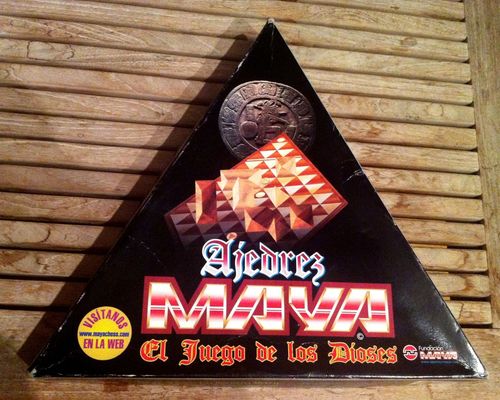
Maya Chess
Maya Chess Rulebook
Table of Contents
Table of Contents
1 The Rules of Maya Chess
1.1 Introduction
Maya Chess is a strategy game played on a board under set rules, between two players (White and Black) with an equal number of pieces, with no advantage for either side. Only ingenuity in developing strategies can make the difference.
The board, from the perspective of a three-dimensional game, is only a spatial reference for placing and moving the five pieces with which the game is played. Each player's turn consists of three moves, and the players alternate turns. The player with the White pieces opens the game. The final objective is to reach the K'Atún, which can happen in four different ways.
In Maya Chess there is no possibility of a draw. The option called Tsaul (obligatory) offers the perfect alternative.
1.2 Link Between Maya Culture and Maya Chess
Maya Chess is a strategy game created from the cosmogonic conception of the sacred ballgame known as Pok a Tok, which the ancient Maya practiced for thousands of years. The game offered a mythic explanation of the origin and movement of the stars and of the oppositions of nature.
Within this sacred meaning, the ballgame had the character of an initiation rite: the passage from profane life to sacred life through the acquisition of supernatural powers that allowed direct communication with the divinities. In the same way, the astral gods of the Popol Vuh reached apotheosis through the ballgame.
It should be noted that no source supports the interpretation, put forward by some researchers, that a player was sacrificed. The sacrifice by decapitation on the ballgame ground, or in association with it, could have been that of a prisoner of war or a slave.
The reliefs and texts associated with the ballgame, and the location of the courts within ceremonial enclosures, show that the game symbolized the cosmic antagonism of opposites, which is essential to Mesoamerican thought. The game was an initiation rite practiced by the governor-shamans, and it formed part of their sacralization. Its purpose was to make propitious the movement of the stars, which produces time, as well as the fertility of nature and the life of the cosmos in general.
The Cruciform Cosmos of the Maya
The Maya cosmos was quadripartite. It had four corners, each with a color: red for the east, white for the north, black for the west and yellow for the south. The most important direction was the east, "where the sun rises." The words for east (likin), west (chikin) and center (yaxkin) all contain the syllable kin, which means "sun," "day" or "time," indicating the importance of the east-west axis, the axis of the rising and setting sun.
The three realms of the Heavens, the earth and all the underworlds have a cruciform layout, and each level has its own gods of the directions. The multi-tiered Heavens were held up by four Atlantean gods, the bacabs or supports of the Sky, each presiding over one quarter of the 260-day year. Stationed at the four corners of the world were the four rain gods, the Chacs. The name Chac was also given to the four elders who assisted the priest in the sacrifice to the Rain God, standing in the four directions and holding the victim's arms and legs. Four more deities, corresponding to the directions and called panahtuns or acatuns, stood at the corners of the underworld and held up the earth. All the quadrants, on the three levels of the universe, were associated with species of flora and fauna and with the gods of the appropriate color.
The Popol Vuh, the Maya mythic epic, says the earth was divided into four sections corresponding to the four cardinal directions, each with its color, its gods and its categories. The Maya gods are characteristically associated with the four points of the compass.
Each god is at once unique and fourfold, with four manifestations, one for each of the four quarters. Each god is also double, with a benevolent and a malevolent aspect. For example, the four Chacs, each assigned to one of the directions, were gods of life-giving rain but also gods of destructive storms and floods. Itzamná, the god of the Sky, is sometimes represented as an old man with a hooked nose, and also as a dragon with a head at each end of its body, one dead and one alive. The dead head represents the gate of the Sky in the east of the world, where the stars are born, and the living head represents the western gate, where the sun and the stars disappear.
The iconography of the god Kukulcán shows his connection with the four corners. He holds a torch, which represents the central fire, and four other signs of the four elements. He is painted in the colors of the four elements and seated at the center of a cross-shaped tree, in a central position, manifesting himself as a fifth element.
In Maya Chess, in addition to the representation of the four elements or forces of nature, each identified by one of the geometric shapes whose function is obstructive and which act dynamically in the space of the board's surface (that is, in three dimensions), a fifth element takes part: the Leader. The Leader's essential characteristics are expressed in two dimensions, because its function and movements occur only on two planes (the Leader's form is decorative, since it moves on two planes). The Leader represents man, who uses his capacity for spatial perception and his tactical skills to make use of the four elements and reach the objective.
Question: What is the estimated time for a Maya Chess game?
Maya Chess games can last from five minutes (Maya Chess Seb), to 30 minutes (Maya Chess Pek), or up to four hours (with two hours per player), as used in higher-level championships.
1.3 The Board and the Pieces
The game is played on a board made of two equilateral triangles which, joined along one of their bases, form a rhombus. The board is a three-dimensional game space, but it serves only as a spatial reference for placing and moving the five pieces.
Each player's pieces face each other on the board. Four of them protect a piece called the Leader, obstructing the opposing player. A player must prevent any of the opponent's pieces from landing on their Leader and capturing it, because that would lose the game.
There are other ways to win. A player can reach the Temple of the Moon with their Leader, reach the Temple of the Sun, or win by Mak Chahal, which in the Maya language means "to enclose" (see the rules).
Transcriber's note: the printed chapter refers to "the rules" for Mak Chahal, but does not state its full conditions in the text. The annexes that would contain the complete rules (the Anexos listed in the manual's table of contents) are not in the source file used, so the full Mak Chahal condition is not transcribed here.
Each side has five pieces: one Leader, one Captain, one Guardian, one Attack piece and one Defense piece. All five pieces of a team can move across the whole board, with one exception: the area called the Forbidden Zone, which only the Leader may enter.
The geometric shapes of the pieces have a function: by their volume (their angles, vertices and edges) they obstruct the opposing player because of their three-dimensional form.
The pieces of each side
The printed table lists the same five pieces for White and for Black:
| Piece | Count (White) | Count (Black) |
|---|---|---|
| Leader (Líder) | 1 | 1 |
| Captain (Capitán) | 1 | 1 |
| Guardian (Guardián) | 1 | 1 |
| Attack (Ataque) | 1 | 1 |
| Defense (Defensa) | 1 | 1 |
Each side has 5 pieces. Each piece is drawn as a solid shape on the printed page; the shapes are not described in text here.
The 16 horizontal rows of triangles on the board are called Planes of Triangles (Planos de Triángulos). Each individual triangular location within those rows is called a Location Triangle (Triángulo de Ubicación). The board edges carry letters and the compass points N (north), S (south), E (east) and W (west), which are used to name positions.
Placing the pieces
The starting position of the pieces on the board is as follows:
| White | Position | Black | Position |
|---|---|---|---|
| Leader | La1 | Leader | Lp1 |
| Captain | Cd5 | Captain | Cm3 |
| Guardian | Gd4 | Guardian | Gm4 |
| Attack | Ad2,3E | Attack | Am5W,6 |
| Defense | Dd6N | Defense | Dm2S |
Reference points on the board
Chapter 1 of the Primer Nivel manual names the Temples and the Forbidden Zones but does not give their board locations. The following points come from the Segundo Nivel manual of the same series (its "Prácticas de entrenamiento" section, page 16), and are added here for completeness. PT means Plane of Triangles (rows a to p) and TU means Location Triangle.
- The Forbidden Zone of White lies on PT a, b and c; the Forbidden Zone of Black lies on PT n, o and p.
- The dividing line of White's Forbidden Zone lies between PT c and d; for Black it lies between PT m and n.
- The Temple of the Moon of White is on PT g, and the Temple of the Moon of Black is on PT j. Both are inscribed in Location Triangle number 7.
- The same passage notes that all the Location Triangles of one color have N (north) and the opposite color has S (south), and that the Location Triangles of the light color are odd numbers from a to h and even numbers from i to p.
The location of the Temple of the Sun is not given in the text.
1.4 Movement of the Pieces
Below, the difference in movement is shown by the shape of each piece, using as examples the White Captain (C), near the Temples of the Sun, and the Black Defense (D), coming from the Forbidden Zone.
The difference in movement can be seen by advancing them so that the Captain (C) tries to get past its opponent through the central part of the board.
The Leader (L)
The Leader is the most important piece in a game, because capturing it is the basis of the game. If one of the opposing player's four other pieces lands on the square the Leader occupies at that moment, that is one of the four ways of ending the game.
Its movement: The Leader (L) is the only piece that slides across the board. The other four pieces move by rolling over their edges to the next side.
The Leader can enter its own Forbidden Zone, while the other four pieces cannot.
The Leader moves along the sides of the triangles and can go to any place on the board that the spaces allow.
The Captain (C)
The Captain (C) and the Leader are the only pieces that can pass through the gaps left by the other pieces, because the Captain's volume is the smallest of the pieces.
Its shape allows it to defend the Temple of the Moon of its Leader with an advantage, and it also has the option of attacking the opposing Leader. Its movement is slow compared with the larger pieces.
Its movement: The Captain (C) moves by rolling over its edges or faces (in the same way as the Attack piece (A), the Guardian (G) and the Defense (D); it does not slide, as the Leader does), turning onto the next face and resting on the junction of two of its sides.
The Guardian (G)
The Guardian (G) has characteristics that allow it to protect the Leader from attack by the opposing player's pieces.
Its movement can be hindered by the volumes of the larger pieces, so staying close to the Leader and obstructing the opposing pieces may be its best role.
Its movement: The Guardian (G) moves in the same way as the Captain, that is, rolling over its edges, onto the next face, resting on the junction of two of its sides.
The Attack piece (A)
The Attack piece is identified by the letter A.
The plane of triangles on which it is placed is determined by a letter from d to p (for White) or from m to a (for Black), since it may not cross the Forbidden Zone.
Positions of the Attack piece: The Attack piece can rest in three different positions:
- Resting on a triangle, with its vertex pointing up. Its position is called Cénit (Z).
- Resting on a rhombus. Its orientation is determined by its largest vertex; in this case the vertex points to the East (E).
- Resting on a triangle. Its orientation is determined by its largest vertex; in this case the vertex points to the East (E).
Its movement: The Attack piece (A) moves by rolling over its edges or faces, turning at the junction of two of its faces onto the next one.
As can be seen, it can rest in three different positions.
The Defense piece (D)
The Defense piece (D) is the largest piece, and its size gives it certain advantages; for example, it covers more space and advances quickly.
Its movement: The Defense (D) moves by rolling over its edges, turning at the junction of two of its faces, to pass to the next one.
Positions of the Defense piece: As can be seen, it can rest in two different positions:
- Resting on a triangle.
- Resting on a trapezoid.
Obstruction of the pieces
Study the possible moves of the White Captain and try to capture the opposing Leader. Then take the Black pieces and observe the options that the diagram presents.
Remember that the pieces only obstruct each other.
Analyze the spaces and the possible moves between the pieces.
- Analyze why, if it is Black's turn, White's Leader receives the K'Atún by being captured by Black's Guardian.
- Conversely, if it is White's turn, Black loses the game by K'Atún, with White's Captain.
Transcriber's note: the source line for exercise 1 contains a stray fragment ("es capturado") that appears to be a layout error; it is omitted here.
Training practices
The following practices are suggested to reinforce the student's learning. It is important that each student has their own board (or at least one board for every two students) and a notebook, and that the instructor explains the class to everyone with the help of a wall board.
- Name the basic characteristics of the board (the source reads "chess board").
- Practice placing the pieces on the board. The student should be able to place the pieces correctly ever faster.
- Count the number of moves each piece has in the center, on one of the edges, and in a corner of the board.
- The Leader is the only piece whose movement differs from that of the other pieces, because of its two-dimensional nature in the development of the game.
Explain the difference between the two-dimensional movement of the Leader and the three-dimensional movement of the Captain, Guardian, Attack and Defense pieces.
The following exercises are recommended:
- a) Move the Attack piece from its starting position to the opponent's Forbidden Zone, observing its behavior on the board and making the fewest moves. Analyze the movement options that can be created by placing a piece that obstructs it along the route.
- b) Rotate the Attack piece, alternating between resting on a triangle and resting on a rhombus, and so on successively.
- c) Analyze how the Attack piece returns to its original position, resting on a rhombus and free to move, after rotating 360 degrees.
- d) Analyze how, resting on a triangle, it can only do so over three edges, and that after rotating 360 degrees its position is no longer the original one.
- Find various K'Atún options, using different pieces, with both sides. Ask the student to show each one, counting the total K'Atún captures by White and by Black from a given placement.
Instructor note (end of section 1.4): Before moving on to the next topic, the instructor must be sure that each student has mastered the previous topic to perfection.
1.5 The Value of the Pieces
The value of the pieces in Maya Chess is determined in three different ways:
- Positional value (spatial condition)
- Offensive-defensive value (strategic condition)
- Volumetric value (occupational condition)
Positional value (spatial condition)
Positional value is determined by the spatial reference of each piece as a body. The pieces are identified in the surroundings of the board, which is considered only as an exclusively spatial reference.
| Piece | Positional value |
|---|---|
| Leader | 1 |
| Captain | 1 |
| Guardian | 1 |
| Attack | 3 |
| Defense | 2 |
Each of these values is relative to space (the third dimension). The board is only a spatial reference (two dimensions) for placing the pieces.
Offensive-defensive value (strategic condition)
The offensive-defensive value is the quality a piece has from the different positions in which it can be placed on the board. The printed table counts the placement options of each piece in relation to the board:
| Piece | Placement options |
|---|---|
| Leader | 1 |
| Captain | 1 |
| Guardian | 2 |
| Attack | 14 |
| Defense | 12 |
Volumetric value (occupational condition)
The volumetric value is given in relation to the body of each piece, that is, the amount of matter each piece contains, taking the Captain as the reference. In this consideration the Leader has a value of 0, because the shape that characterizes it is decorative and its function in the game is two-dimensional.
| Piece | Volumetric value | Dimensions |
|---|---|---|
| Leader | 0 | Two-dimensional |
| Captain | 1 | Three-dimensional |
| Guardian | 4 | Three-dimensional |
| Attack | 5 | Three-dimensional |
| Defense | 10 | Three-dimensional |
The Leader has volumetric value 0 because of its two-dimensional condition. Of the other four pieces, whose shape and function are three-dimensional, the Captain is value 1 and is taken as the reference volume for the rest.
The printed diagrams carry these captions: "The Captain and Guardian together form the Attack piece." and "The Captain, Guardian and Attack together form the Defense piece."
Two examples of obstruction capacity
- The Defense piece can easily obstruct the movement of the Captain.
- The Attack piece, although slow in its movement, has the quality of penetrating any space with its greater diagonal (its vertex), as the Captain does.
The instructor is advised to invite students to find other obstructive options, taking care not to obstruct their own pieces.
Example 1: In the diagram, the Black Defense piece and the White Attack piece are obstructing each other. If it is Black's turn, it favors Black to obstruct the rival Attack piece, since that piece is better positioned than the Black Defense piece. (The diagram shows: Original position, Movement 1, Movement 2.)
Example 2: If it is White's turn, it is not advisable to obstruct the Defense piece, since it is in a privileged position to give the K'Atún to the Leader. The instructor should ask the student why pieces of smaller volume tend to obstruct larger pieces more easily. (The diagram shows: Original position, Movement 1, Movement 2, Movement 3.)
Conclusion: It is more convenient to obstruct the pieces that put your Leader at risk. The value of the pieces, and their possible positional exchange, depends on the strategy the player follows.
Training practices
- The instructor will create positions of the type of the two previous diagrams so that students can clearly appreciate the concepts of obstruction and positional value. As a visualization exercise, the instructor should place the position on the wall board and invite the students to recreate it on their own boards.
- The instructor will invite students in pairs to play several games. The player who achieves K'Atún more often wins. A player may retreat to the previous position, allowing the opponent to choose a different option for the moves of the pieces.
In this way students will practice placement, movement and the obstructive options of the pieces, and will begin to work out for themselves, in an entertaining way, strategic options.
1.6 K'Atún and the Harassment of the Leader
We have seen how the pieces move and obstruct each other, based on the volume they occupy in space on the board, because of their three-dimensional condition.
Leaders can obstruct each other; this is the only obstructive ability they have. Because they perform a two-dimensional function (remember that their shape is purely decorative), obstruction takes place only between the Leaders, since both perform a two-dimensional function.
Example: In the diagram one can observe that:
- If it is White's turn, the Black Leader is on the path to the Temple of the Sun, which makes access to the K'Atún impossible for it.
- Conversely, if it is Black's turn, the Black Guardian achieves the K'Atún by capturing the White Leader on its second turn.
The capturing action against a Leader is known as K'Atún. Since Leaders can be captured, it is necessary to use the pieces to obstruct those of the opponent; that is, to place the pieces so as to protect the Leader against a possible capture.
There are three different ways to oppose the capture of the Leader:
- Obstruct the attacking piece. (The printed diagram shows: Original position, Movement 1.)
- Move the Leader to a protected space. (The printed diagram shows: Original position, Movement 1, Movement 2, Movement 3.)
- Interpose a piece between the attacking piece and the Leader. (The printed diagram shows: Original position, Movement 1, Movement 2, Movement 3.)
Example of K'Atún: In this example the K'Atún cannot be countered by any of the three actions above, because it is Black's turn.
Further K'Atún situations
Further K'Atún situations are shown. Study each position and check how, through their volume, one's own pieces and the opposing pieces contribute to the capture of the Leader. It is important to recognize K'Atún positions quickly, since this is the objective of the game.
Training practices
Invite the students to discover K'Atún positions with various combinations of pieces, for example:
- Defense against Leader;
- Leader and Defense against Leader and Defense;
- Attack against Leader;
- Attack and Leader against Leader and Attack;
- Captain against Leader;
- Captain and Leader against Leader and Captain, etc.
Carry out the above exercises as an internal competition, and the winner will be the one who creates the K'Atún position fastest. Always motivate the students who achieve the best results in the internal competitions with words of encouragement or some other stimulus.
1.7 Tsaul (Obligatory) or the Absence of a Draw
In Maya Chess there is always a winner: a game never ends in a draw.
The Tsaul (obligatory) game
A Tsaul (obligatory) game is always carried out after Black has moved, under the conditions set out in this section. The Defense (D) piece of both players is immobilized. If the conditions described below persist, the Attack (A) piece of both players is also immobilized. In this way the obligation that one of the players be declared the winner is met.
The Tsaul game is entered under the following conditions:
- Lack of decision. When there is not sufficient decision to give the K'Atún, the game enters Tsaul.
- Number of moves. If after three turns (three moves each) there has been no K'Atún and no clear dominance, and the opponents so wish, either side may claim Tsaul.
- Triple repetition. If a position is repeated three times, the side that makes the triple repetition may claim Tsaul.
- Mutual agreement. At any moment the opponents may declare a Tsaul game, if they consider it appropriate.
1.8 Conclusions
The first lessons the instructor gives students are fundamental to capturing their attention and interest. Their objective is full knowledge of the board and its characteristics, as well as the movement of each piece. The next step is to teach the relationship between the pieces (through their movement and their obstructive value).
Once the above is mastered, concepts such as K'Atún, Mak Chahal and the different forms of Tsaul can be shown more clearly.
The instructor must take into account the differences in age and the diversity of background and culture of the students, and adapt their language and manner of explaining each topic so that the session is enjoyable and motivating. Maya Chess must above all be fun.
Each instructor should continuously build practical and psychological knowledge (ongoing training) throughout their teaching work, learning from specialized reading as well as from their own and others' experience. In this way they can form a well-founded personal view of the precise order of the basic topics they consider correct to teach their different types of students.
Do not forget that in teaching Maya Chess many exercises must be carried out constantly to reinforce what has been learned.
1.9 Teaching Suggestions
At the end of studying the topics of the first chapter, it is suggested that the participants form teams (by number), and that each member present some of the previous topics. This creates a positive discussion and an exchange of ideas about the various teaching possibilities that can be used.
When reviewing the spatial context of the game, it is also recommended to support the presentation with photographs of the great Maya ceremonial centers and a world map, which make it easier to illustrate the development of their culture.
1.10 Self-Assessment
The position diagrams that accompany exercises 4 to 6 are images in the printed manual and are not reproduced here; the printed prompts are transcribed.
- Explain why the value of the Leader is absolute, and why the value of the Captain, Guardian, Attack and Defense is relative.
- Explain what the Temples of the Sun and of the Moon, and the Forbidden Zones, are, and where they are located.
- Define the terms "K'Atún", "Mak Chahal" and "Tsaul".
- Count the number of K'Atún options available with each of the pieces (in any turn of three moves) for both sides, in the two following positions (Diagram 1 and Diagram 2).
- Analyze each position and explain why it is a K'Atún situation. Always read the statement printed below each diagram, which states whose turn it is.
- a) Black to play. Black wins in one turn (three moves).
- b) White to play. White wins in one turn (three moves).
- c) Black to play. Black wins in one turn (three moves).
- Study the following two positions and explain why they are Mak Chahal situations.
- a) Black to play. K'Atún is declared by Mak Chahal.
- b) Black to play. K'Atún is declared by Mak Chahal.