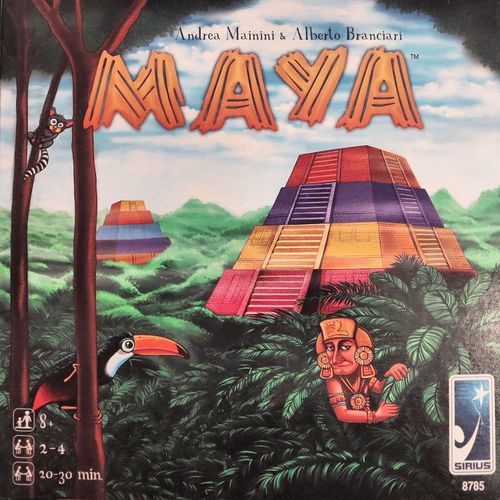
Maya (2012)
Maya (2012) Rulebook
Table of Contents
Table of Contents
Variant for Two Players
Object of the Game
To earn the most victory points! You can earn victory points by:
- completing a tower using only one color;
- joining together blocks of the same color.
Game Setup
Set the board between the players. The board shows nine spaces. Each space holds one tower. Each tower is built from five blocks of different sizes.
Create 9 five-story towers using the colored blocks. Each tower must use five different colored blocks (no tower can begin the game with two blocks of the same color). The blocks create the five "levels" of the tower. Towers must be built with the smaller blocks on top of the larger ones.
Place the towers on the 9 spaces of the game board, one tower per space. Each player chooses a color and takes all the matching playing pieces (ladders and priests).
Figure note: the levels are numbered 1st level (bottom) to 5th level (top). A tower with the smaller blocks on top is shown as "Right"; a tower with two levels of the same color (red) is shown as "WRONG!"
The player with the black pieces sets the Monolith between any two adjacent towers, and sets the Raven symbol at the level of his choice.
Figure note: the Monolith and the Raven symbol.
Figure note: the game completely set up. Your towers may have a different mix of colors.
Hint: To make the game more interesting try to choose the colors for each tower randomly!
IMPORTANT: Towers are adjacent if they touch at the walls (not corners — diagonal does not count!).
Figure note: adjacent towers are joined by blue arrows; towers that are not adjacent are joined by red arrows.
The player with the white pieces starts the game and takes the first turn.
The cards with pictures of single color towers are only used in games with three or four players. You do not need them now. You may return them to the box.
How to Play
The players alternate taking turns during the game. When it is your turn you must:
- Exchange blocks on two adjacent towers; then
- Move the Monolith between those two towers and place the Raven at the proper height
- Place ladder and priest (if possible).
Then the other player can begin his turn.
1. Making Exchanges
To make an exchange, choose two blocks (one in each tower) that are at the same level of two adjacent towers. Swap those blocks between the two towers, along with all the blocks that are on top of them.
When you exchange blocks, you must exchange the same levels — each tower will still have five different sized blocks after the exchange. You must take blocks from the top of the towers (you cannot slip the middle blocks out and exchange them).
You may exchange up to four blocks each time — if you exchange the second level blocks between two towers, you will also exchange the three blocks above them.
Figure note: four types of exchanges are shown.
EXCHANGE RESTRICTIONS:
You must follow these restrictions when you make an exchange.
- You must not change the foundations! The bottom block of each tower cannot move. You may only exchange the second, third, fourth, or fifth level blocks.
- You must not disrupt the Monolith! You cannot exchange any blocks from the two towers that are next to the Monolith, regardless of the level of those blocks.
Figure legend: "Exchange here" (blue arrows); "No exchanges!" (red arrows).
Example: The Monolith sits between towers A and B. No blocks from either of these towers can be exchanged with any tower. You can only exchange blocks between the towers connected by the blue arrows.
- You must not disturb the Raven! You cannot exchange any blocks that are at the same level as the Raven symbol's wings. These blocks may be part of an exchange of lower level blocks, however.
Example: The Raven symbol is set at the fourth level. An exchange of fourth level blocks cannot be made at any tower. Only second, third, or fifth level exchanges can be made. Of course, if the third level blocks of two towers are exchanged, the fourth level blocks on top of them will also move.
- You must not break apart colors that are joined together! Any time two or more blocks of the same color are touching in the same tower, we say that those blocks have been "joined together."
You cannot separate blocks that are the same color once they have been joined together.
Example: The blocks on the third and fourth levels of Tower A are the same color. The first, second, and third levels of Tower B also match. These two groups of blocks are joined together and cannot be split apart.
An exchange can only be made with Tower A if it uses 1, 3, or 4 blocks — because a 2-block exchange would break the joining of the pink blocks. Tower B can only make a 1 or 2 block exchange: 3- or 4-block exchanges would split up the purple blocks, and the first level (bottom) of a tower can never be part of an exchange.
The only exchange that can be made between these two towers is a 1-block exchange that includes only the top block.
2. Moving the Monolith and Placing the Raven
After you have completed your exchange, you must move the Monolith. The Monolith must be placed between the two towers where you made your exchange this turn.
You must also move the Raven symbol so that its wings point to the lowest level block that you exchanged this turn.
Example: Two blocks from Towers A and B have been exchanged (levels 4 and 5). Since the two pink blocks were joined together, the player gets to place one of his ladders next to Tower B. Then the Monolith is moved between these two towers, and the Raven symbol is moved to the fourth level.
Hint: Clever use of the Monolith and Raven symbol may force you to make an exchange that you don't want to make. You must make this exchange anyway! If your opponent cannot see any legal exchanges, give him a hint!
3. Placing Ladders and Priests
When you make an exchange, it is possible that some blocks of the same color will be joined together. If you make this kind of exchange, add a ladder of your color to the base of this tower. If you join colors in two towers at the same time, you get to add a ladder to each of those towers.
Hint: You may find that it is difficult to add your ladder to a tower because of the direction the towers are facing. You may freely rotate the towers if you wish. This will have no effect on the game because the towers are completely symmetrical.
When you join blocks together, you may be able to complete the tower: a tower is complete if all five blocks in the tower are the same color. If you complete a tower, after you add your ladder to the base of the tower, place a priest of your color on top of the tower.
The spaces around the base of each tower show where ladders can be placed. If all of the ladder spaces around the tower are already occupied, you do not get to place a ladder next to the tower, but you still get to place your priest on the tower if you completed it.
Figure legend: "Ladder Spaces"; "No Ladders Here".
Example: The white player has just exchanged three blocks between towers A and B (levels 3, 4, and 5).
Two green blocks are now joined together in tower A, so the white player gets to add a ladder to that tower.
All five blocks of tower B are now red, so that tower is complete! White gets to place one of her priests on top of the tower. Since she joined two red blocks together, she would normally add one of her ladders to the tower also. But both of the ladder spaces already have black ladders. So, white can't place her own ladder there.
The End of the Game
If you cannot make any legal exchange on your turn, the game ends immediately! It's time to count the score!
Victory Points
You earn victory points for the following:
- Each of your priests that is standing on top of a tower awards you 1 victory point.
- Each tower that has more ladders of your color than your opponent's color awards you 1 victory point (if there is a tie for ladders, nobody gets the point!).
The player with the most victory points is the winner!
If there is a tie, the player with the most priests on top of the towers is the winner. If the priests are also tied, the player with the most ladders next to the towers on the board is the winner. If you are still tied, then there is no winner — you'll have to try again!
Scoring Example
The final score:
- 5 for BLACK
- 4 for WHITE
BLACK wins!
- 1st tower: 1 point for BLACK for his priest (the ladders are equal);
- 2nd tower: 1 point for WHITE (only she has ladders here);
- 3rd tower: 1 point for BLACK (only he has ladders here);
- 4th tower: 0 points for BOTH players (the number of ladders is equal);
- 5th tower: 1 point for WHITE (2 white ladders vs. 1 black ladder);
- 6th tower: 1 point for WHITE (only she has ladders here);
- 7th tower: 1 point for BLACK (only he has ladders here);
- 8th tower: 1 point for WHITE for her priest, 1 point for BLACK (2 black ladders vs. 1 white ladder);
- 9th tower: 1 point for BLACK (only he has ladders here).
Variant for Three Players
Object of the Game
To earn the most victory points! You can earn victory points by joining together blocks of your color.
Game Setup
For a three-player game, you will need the Task Cards (with pictures of completed towers). The priest and ladder pieces are not used. You may return them to the box.
The game board is set up the same way as the two-player game: towers are placed on the nine spaces and each tower is built with blocks of different colors.
Place the Raven Monolith near the board.
Find the Task Card that matches the color of the bottom block of the center tower and set that card to the side of the board, face up. Shuffle the rest of the Task Cards and deal two cards to each player, face down (you may look at your own cards). The last two cards are placed face down next to the center tower card.
Your goal is to join together the blocks that match the colors on your two Task Cards.
Choose a player to take the first turn.
How to Play
On your turn, you must do the following:
- Exchange blocks on two adjacent towers; then
- Move the Monolith between those two towers.
When you exchange blocks, follow the same rules as the two-player game.
EXCEPTION: The rule "You must not disturb the Raven" does not apply. The Raven symbol can be placed at any height on the Monolith.
If you join together two blocks of the same color do not place any ladders on the tower, and do not place a priest on any tower you complete.
When you have completed both actions on your turn, the player to your left begins his turn.
Hint: Keep your Task Cards secret! At the beginning of the game, the other players do not know what task you were given. Try not to rush completing the towers of your colors. If your opponents can guess your color, they may try to block you!
The End of the Game
If you cannot make any legal exchange on your turn, the game ends immediately!
Also, during your turn, you can declare that the game is over. You may only do this if:
- One of the towers pictured on your Task Cards is complete, and
- The central tower is complete.
In either case, all players now reveal their Task Cards and count their victory points.
Victory Points
You score victory points based on how well you have completed your assigned tasks. You earn the most points for completed towers, but you also score points for all the blocks of your colors you are able to join together, as shown below:
- Completed Tower: 10 points
- 4 Joined Blocks: 6 points
- 3 Joined Blocks: 3 points
- 2 Joined Blocks: 1 point
- 2 Pairs of Joined Blocks: 2 points
If you complete the central tower you may earn 5 bonus victory points, but only if you can declare the game is over on that same turn. You do not have to declare the end of the game that turn, but if you do not, no one earns the bonus points.
Hint: Try playing three games in a row and adding your points from all three games together. The player with the highest total is the winner! The winner of each game gets to set up the board for the next game, and takes the first turn.
Variant for Four Players
If there are four players, all of the rules for the three-player game are used except for these two changes:
- Only the Task Card matching the central tower is set aside. All eight of the other Task Cards are dealt out to the players.
- The players are divided into two teams: the players opposite each other are allies and work together. Their victory points are added together at the end of the game. You may not show your Task Cards to your partner!
Alternative Setup
If you want a more strategic way to set up the game, the players can take turns placing random blocks on the board. Start with all 9 of the largest (lowest level) blocks and continue up through each level until all towers are complete. As before, each tower must be made up of 5 different colored blocks.