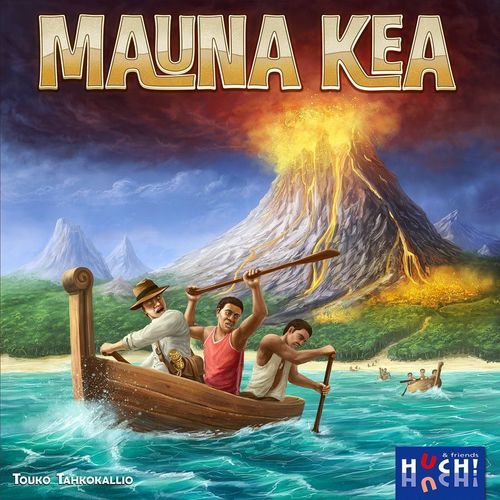
Mauna Kea
Mauna Kea Rulebook
Table of Contents
Table of Contents
Object of the Game
The explorers' starting point is located in the center of the island, directly next to the cone of the awakening volcano.
By laying terrain tiles, you create landscapes. But for advancing your explorers, you have to use your terrain tiles to get movement points. Therefore, you have to carefully weigh what you want to use a terrain tile for. The game ends as soon as one player has no explorers left on the island. After that, the scoring takes place.
The player who has saved the most of his explorers and the most artifacts wins.
Game Materials
- 1 gameboard, showing: the volcano; starting spaces for explorers; landings for boats; spaces for starting tiles
- 118 square tiles, of which there are:
- 24 starting tiles (front side shows the symbol for starting tiles; back side is plain)
- 94 island tiles, divided into:
- 70 terrain tiles with movement points
- 24 lava tiles
- Terrain tiles and lava tiles have a front side and a back side
- 20 explorers in four colors
- 25 artifacts in three colors: 17 white, 7 gray, 1 black
- 30 game cards (front side and back side)
- 8 boats
- 1 cloth bag
Preparation of the Game
Set-up
After laying out the gameboard, pick out the 24 starting tiles, mix them face down and randomly distribute them face up on the 24 spaces marked accordingly on the gameboard.
The starting tiles partly show different colored markings, indicating the corresponding artifact that is now placed there. There are artifacts and markings in white, gray and black.
Mix up the 8 boats unseen and then distribute them randomly, face up, on the 8 boat landings of the gameboard, so that one boat lies at each point.
Material for the players
Each player takes the explorers in the color of his choice:
- With 2 players, each player gets 5 explorers.
- With 3 players, each player gets 4 explorers.
- With 4 players, each player gets 3 explorers.
Unused explorers are removed from the game.
Before the First Turn
Starting player
The player who can correctly say the game title backwards three times becomes the starting player.
Placing explorers
The starting player places one of his explorers on any one of the 16 starting spaces. Then, all players, in turn (in counterclockwise order) place one explorer at a time until all explorers have been placed. There can be only one explorer per space.
Drawing tiles
Put the 94 island tiles into the cloth bag and mix them. One after another, counterclockwise beginning with the starting player, each player now draws one tile from the bag and puts it in front of him face up.
You continue drawing one tile at a time in turn until the number of movement points on your tiles totals 5 or more symbols.
If you draw a tile with a lava flow (without movement points), you put it aside and draw another tile.
Example: The player draws, one after another, one tile with 2 movement points, then one with 1 point, and finally, one with 3 points. Now he has tiles with 6 points overall and may not continue drawing.
When all players have drawn their tiles and laid them out in front of them face up, lava tiles that have been put aside are mixed back into the bag.
Beginning the game
The last player to have placed an explorer begins. After that, play proceeds clockwise.
Course of the Game
Playing tiles
On your turn, you have to play all your tiles; you can choose the order.
You can play each tile in one of two ways:
Expanding the terrain
You place the tile face up on any one empty space on the gameboard. You can freely choose the orientation of the tile. The movement points shown on the tiles are not taken into consideration. (4 orientations are possible. The tile is played as a terrain tile.)
Using movement points
You use the points on a tile to move your explorers (see page 16, "Moving Explorers"). After that, you mix the tile back into the bag.
Example: Yellow first plays one tile as a terrain tile, placing it on the gameboard. Then, he still has 2 tiles with overall 5 movement points available that he uses to advance his explorers.
Drawing other tiles
After you have played all your tiles, you draw as many new tiles out of the bag as necessary until the overall number of the movement points indicated is 5 or more. Again, lay these tiles face up in front of you.
Lava tiles
If you draw a new tile that shows a lava flow, you have to place this tile on the gameboard (see page 17, "Volcano eruption"). After that, you keep drawing tiles until you get at least 5 movement points.
Ending your turn
When you have finished drawing your new tiles, your turn is over and it is the next player's turn.
Moving explorers
You can distribute the number of points indicated on the tile among your own explorers as you wish. You can combine the points of several tiles in order to move an explorer the according number of spaces. You don't have to use up all points.
The tiles from which you have used at least 1 movement point go back into the bag. You cannot use them anymore to expand the terrain on the gameboard.
Movement directions
Explorers can be moved only from one space to an adjacent space; diagonal movements are not allowed.
You may not move an explorer to lava or mountain spaces or to spaces that do not yet have a tile.
You may not move an explorer onto a space on which another explorer is already standing, either.
You may not have your explorer jump over any space that he is not allowed to move onto.
Movement costs
Depending on the kind of terrain of the space entered, it takes a different number of movement points to move an explorer to that space:
- to a jungle space: 1 point
- to a water space: 2 points
You get these points by playing your tiles.
Collecting and taking artifacts
When you move an explorer to a space with one or more artifacts, you may take these artifacts with you. An explorer can carry no more than 3 artifacts at one time. You can also leave an artifact on a space anytime or take more artifacts with you as long as your explorer doesn't carry more than 3 artifacts. An explorer who is carrying artifacts moves in the same way as an explorer without artifacts, and the movement costs don't change either.
Reaching the boats
When an explorer reaches the space adjacent to a boat (each boat has 4 neighboring spaces), he can go on board and take the artifacts he's carrying with him.
For this, he needs 1 movement point. If the space on the boat is not sufficient for him and his artifacts, he must leave the excess artifacts behind on his space. Loading the boat with the explorer and the artifacts costs a total of 1 movement point. The four dashed lines indicate the 4 neighboring spaces from which a boat may be entered.
As soon as the explorer is on board, you take this boat (including the explorer and his load) off the gameboard and put it down in front of you face up for scoring at the end of the game.
Illustration: The steps cost the following number of movement points: 2 points (into water) + 2 points (into water) + 1 point (into the jungle) + 1 point (into the jungle). In doing so, the explorer takes the white artifact with him. He doesn't need any extra movement points for this.
Volcanic eruption
If you turn over a lava tile while you are drawing new tiles, you have to lay it on the gameboard immediately.
In contrast to the other island tiles, lava tiles may not be laid out as you wish but are subject to the following laying-out rules:
- A lava tile must be placed adjacent to a space with a lava flow so that the flow is extended. The arrows always show away from the volcano!
- Each lava tile must be connected to the matching lava flow. There are 4 different ones which can be identified by different arrow symbols.
- If a terrain tile is already lying at the spot where the lava tile is to be placed, it is simply placed on top. All explorers and artifacts there are removed from the game.
Example: The lava flow reaches 2 artifacts and 1 explorer; therefore they have to be removed from the game. Then the lava tile is placed on top of the terrain tile.
- If another lava tile is already lying there (for instance, another lava flow is crossing it), the new tile is placed one space further in the direction of the flow (the new flow "tunnels under" the existing one).
Lava flows can cross.
- From the moment when a tile with a branch of the lava flow has been placed, the two branches of the lava flow concerned that have been formed must be extended evenly. That means: If you draw a new lava tile of the lava flow concerned, you have to extend the branch that consists of fewer tiles. If both branches have the same length, the branch marked with a "•" is extended first.
If a lava flow branches, you always extend the shorter branch first. If the branches are equally long, you extend the branch that is marked with the point.
- If a lava tile cannot be placed anymore (e.g., at the edge of the gameboard), it is removed from the game.
You may not place a lava tile that would interrupt the lava flow. Two mistakes have been made here: different arrows are bordering each other; and they show in the wrong direction.
End of the Game
The game ends when one player has no explorers left on the gameboard. The player whose turn it is may still play all tiles that he has lying face up in front of him.
After that, all the other players get one more turn. Then the scoring takes place.
Scoring
Now each player takes account of the boats with the explorers and artifacts on board that he has in front of him (the ones he has been able to save!). Victory points (VP) are assigned as follows:
- for each explorer: 3 VP.
- for each white artifact: 1 VP.
- for each gray artifact: 2 VP.
- for the black artifact: 3 VP.
Deductions:
- for each unoccupied place in the boat: -1 VP.
The player who, after all deductions, has the highest total of victory points wins the game.
Example: Red gets 7 victory points for the boat with the brown symbol: Explorer 3 VP; White artifact 1 VP; White artifact 1 VP; Gray artifact 2 VP.
For the boat without a gray artifact, the player gets only 4 victory points: Explorer 3 VP; White artifact 1 VP; White artifact 1 VP; Empty place -1 VP.
Resolving ties
In the case of a tie, the player who has more explorers on the island at the end of the game wins. If there is still a tie, the player whose explorers on the island carry the most artifacts overall wins. If there is still more than one player with the same result, the game ends as a draw.
Rules for Advanced Players
The rules of the basic game apply, with the following additions and changes:
In this variant, the game cards come into play. They are divided into action cards that provide extra possibilities of movement and task cards that allow you to gain additional victory points at the scoring at the end of the game.
Set-up
Shuffle the game cards face down and deal out 6 cards to each player. Now, each player selects 4 of his cards; he keeps them hidden from the other players during the game. The remaining cards are removed from the game, unseen.
Illustration caption: Each player receives 6 cards from which he may select 4. The remaining 2 cards are removed from the game.
Course of the Game
Playing cards
Anytime during your turn, you may play one or more of your action cards, face up. You don't need any movement points to play these cards. Played action cards are taken out of the game immediately after they have been used.
Playing tiles
Played tiles (used for movement) are not put back into the bag but are removed from the game.
End of the Game
The game ends
- either when one player has no explorers left on the gameboard
- or when the supply of tiles has been used up.
The player whose turn it is may still play all tiles that he has lying in front of him.
After that, the scoring takes place immediately.
Scoring
Each player gets the victory points and deductions that he would receive in the basic game. Additionally, he obtains victory points for fulfilled task cards.
The players turn over their task cards and check which cards have been fulfilled.
Keep in mind that each explorer and each artifact may only be used for one task card.
Overview of the Tasks and Actions of the Game Cards
Task cards
These cards show specific combinations of artifacts, explorers, and boats.
If, at the scoring, a player has a task card showing a combination of objects that he has lying in front of him, he gets additional victory points. The cards show the objects required and the number of victory points.
One of the task cards (2x in the game), however, does not show any objects; this card saves the player from having victory points deducted for those of his boats that are not fully occupied.
Task card texts:
- The player receives 2 additional victory points for 3 white artifacts collected. The card may only be used once. [There are 7 cards with artifacts in the game.]
- The player receives 1 additional victory point for 2 explorers saved. The card may only be used once. [2x in the game]
- If the player has boats with unoccupied places lying in front of him, he doesn't get a deduction of victory points for this. [2x in the game]
- The player receives 1 victory point for a green boat. The card may only be used once. [There are 4 cards with boats in the game.]
Action cards
Jungle movement [3x in the game]
The player may move one of his explorers any number of spaces, but only over jungle spaces. The movement may also start from a water space, but it needs to end on a jungle space. If the explorer enters a space with an artifact, he must stop.
All jungle spaces that have been entered have to border one another on at least one side; a diagonal connection is not sufficient.
Mountain movement [3x in the game]
The player may move one of his explorers any number of spaces, but only over mountain spaces. The movement must begin and end on a water or jungle space.
All mountain spaces that have been entered have to border one another on at least one side; a diagonal connection is not sufficient.
Earthquake [3x in the game]
The player may change the orientation of any one terrain tile lying on the gameboard. There may be artifacts on this tile, but no explorers.
After that, the player may draw one tile out of the bag and place it (terrain or lava tile) on the gameboard according to the rules.
Helicopter rescue [3x in the game]
The player may rescue one of his explorers, including his artifacts, from the island. He puts this card in front of him, face up, and places the rescued explorer and his artifacts on this card.
At the scoring, the player gets victory points for the artifacts, but not for the explorer.
This card may not be used for the player's last explorer.
Water movement [3x in the game]
The player may move one of his explorers any number of spaces, but only over water spaces. The movement may also start from a jungle space, but it needs to end on a water space. If the explorer enters a space with an artifact, he must stop.
All water spaces that have been entered have to border one another on at least one side; a diagonal connection is not sufficient.