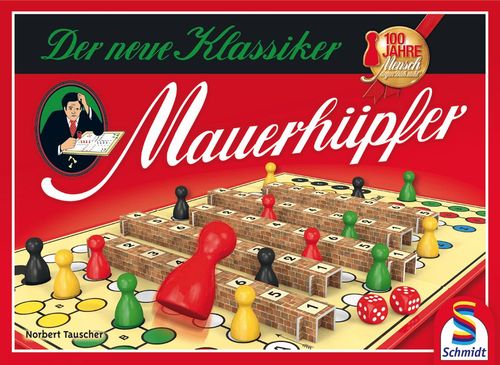
Mauerhüpfer
Mauerhüpfer Rulebook
Table of Contents
Table of Contents
Spielmaterial
Components
- 1 game board
- 5 walls
- 2 dice
- 16 pawns (4 per colour)
Before the first game, carefully punch the wall parts out of the punch sheets as shown in the illustration and fit them together. Each wall consists of three cardboard parts. After play, the assembled walls fit into the game box.
Spielziel
Object of the game
The players move their pawns as quickly as possible along the track to the goal. At the same time, each player tries to annoy the others: by taking wall jumps to shorten their own route, and by beating opposing pawns as often as possible, so that those pawns have to start again from the start.
The first player to bring all four of their pawns from the start to the goal wins the game.
Spielvorbereitung
Setup
The game board is placed in the middle of the table.
Each player receives 4 pawns of one colour. These are placed on the start area of the matching colour (marked "B").
The walls are placed in the designated cut-outs on the board as shown in the illustration.
Spielablauf
Turn sequence
The youngest player begins. Play proceeds clockwise.
Pawns can enter play with any dice roll. A 6 is not needed to enter. Pawns enter on the start field "A". The start field must always be counted!
The player whose turn it is always rolls both dice. Both dice must then be used for the same pawn.
The player moves a pawn according to the dice results. The direction of movement along the track may be chosen freely, so a pawn can move forward or backward. However, the value of one die must be carried out completely before the direction can be changed for the result of the second die.
Example: Red rolled 2 and 5. The pawn moves 2 and then 5 fields further. Occupied fields are counted. It is not possible to split the roll between the two red pawns.
Own and opposing pawns may be jumped over during movement; occupied fields are counted. A player who has several pawns on the track may choose which pawn to move.
Mauersprung
Wall jump
The track is divided by five walls. On many fields, pawns stand next to wall pieces marked with a number from 1 to 6. The player can shorten the route with a wall jump.
A wall jump is possible if the player has one of their pawns standing at a wall piece whose number matches the value of one of the two dice, and that number has not yet been used. It does not matter whether the pawn was already standing next to the matching number, or whether it arrives next to a number matching the second die only after the move with the first die.
If the number matches, the wall may be jumped at that point, and the pawn is placed on the field adjacent to the wall on the other side. It is also possible to jump directly one after another with both dice, over two walls.
Example: Red rolled 1 and 4. First the pawn moves 1 field forward, then it jumps over the wall with the 4. Had Red rolled 3 and 5, the pawn could have jumped over two walls and reached field "X" (blue).
Hinauswerfen
Knocking out
Each field of the track can hold only one pawn. If a player lands on a field occupied by an opposing pawn, the player beats that pawn and places their own pawn on the field. There is no compulsion to beat. Beaten pawns are placed on the B-fields of their colour.
Own pawns cannot be beaten. In this case the player must move a different pawn.
If a pawn is moved with both dice values in one direction, an opposing pawn can only be beaten on the last field reached. An opposing pawn on the field reached after the first die value is jumped over and not beaten.
Example: Red rolled 3 and 3. The pawn is moved 6 fields forward. The yellow pawn, which is reached after 3 steps, stays where it is and is not beaten, but the green pawn at the end of the move is beaten.
If, while moving a pawn with the first of the two dice values, the player reaches an occupied field and then changes direction or makes a wall jump, the pawn is knocked out at the "Zwischenstation" (intermediate stop). In this way, up to two pawns can be knocked out in a single turn.
Example: Red rolled 2 and 5. The pawn first moves 2 fields forward and then jumps over the wall with the 5. Because Red changes direction on the field of the yellow pawn, the yellow pawn is beaten. Red then also beats the black pawn at the end of the move.
Always remember: the pawn can be moved forward and backward!
Example: Red rolled 2 and 4. First the pawn moves 2 fields to the left (1). Then it runs 4 fields to the right (2). Because Red changes direction on the field of the yellow pawn, the yellow pawn is beaten. Red then also beats the green pawn at the end of the move.
Zieleinlauf und Spielende
Reaching the goal and end of the game
As soon as a player's pawn ends its turn (after the pawn has been moved with both dice) on one of the two goal fields "Z", the player may place the pawn in their goal area (a–b–c–d). Pawns are placed in the goal area starting at "d" after they reach the goal field.
It is not possible to move onto the goal field with only one die and let the second die lapse.
Example: Red rolled 2 and 3. First the pawn moves 2 fields to the left (1). Then it runs 3 fields to the right (2). Because Red ends the move on the goal field "Z", the pawn is placed on one of the fields in the goal area (a to d).
The player who first brings all their pawns onto their goal fields wins the game.