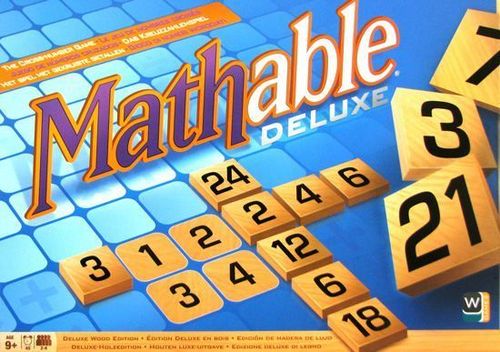
Mathable
Mathable Rulebook
Table of Contents
Table of Contents
Contents
- 1 gameboard
- 4 racks
- 106 tiles numbered from 0 to 90 (detachable)
- 2 blank spare tiles
- 1 pouch
Players
For 2 to 4 players, ages 10 to adult.
Setting Up
- Detach the tiles and put them into the pouch, then shuffle.
- Give each player a sheet of paper and a pencil to keep a tally of score.
- Each player draws one tile from the pouch. The player who draws the highest number begins play, followed by the player to his left, and so on.
- Each player then draws six more tiles and places them on his rack.
The Game
Play consists of forming crossword-style basic mathematical equations (+ - x ÷). The player with the highest score wins the game.
Fundamentals
- The four numbered center squares (orange) constitute the starting point. The board also features blue "sign" squares as well as red or green "premium" squares.
- The four center squares form numerical pairs: (1,2), (3,4) and (1,3), (2,4). Any pair may be used to complete a basic mathematical equation (+, -, x, ÷). Take pair (3,4): 3 + 4 = 7 and 3 x 4 = 12. The player with a 7 or a 12 on his rack can place his tile to the right or left of the pair. Remember that tiles played must always constitute the solution of the equation suggested by the pair. Moreover, a pair can only be formed by numbers in two adjoining squares.
- The same applies to vertical pairs (1,3) and (2,4). Take pair (1,3): 1 + 3 = 4 and 1 x 3 = 3. The player places the appropriate tile directly above or below the pair.
- Subtractions and divisions are calculated in similar fashion. Take pair (2,4): 2 - 4 = (-2). As there are no negative digits in the game, simply reverse the equation to 4 - 2 = 2, and place the appropriate tile in the square above or below the pair. The order of the two numbers that make up a pair is irrelevant. The same applies to divisions. Since 2 ÷ 4 = 1/2, and there are no fraction tiles, reverse the equation to 4 ÷ 2 = 2, and place the appropriate tile above or below the pair.
To Begin Play
-
The first player places a tile next to one of the four starting squares. The tile must match the solution to an equation suggested by the pair (addition, subtraction, multiplication or division). Let's assume he places a 4 (1 + 3 = 4).
Note: You cannot place tiles over the 4 center squares.
-
The player continues by trying to play the other tiles on his rack. Let's say he has a 2. He can use it to complete the equation 4 - 2 = 2 by placing his tile above or below the central pair (2,4). He chooses to place it below.
-
The two tiles played form yet another pair (4,2). Assuming the player has an 8 and a 6 on his rack, he can place the 8 to the right or left of the new pair (4 x 2 = 8) and also place the 6 (4 + 2 = 6). He could also have opted to place a 2 by performing a subtraction or a division.
-
Hence, the player can match his tiles to any of the pairs on the board. In the above example, he can continue his turn by placing a 32 to the left of tile 8, or a 7 below tile 4, and so on.
-
There is but one restriction: equations may not be performed in diagonal.
-
A turn ends when a player exhausts all possibilities or chooses to stop, at which point he draws additional tiles from the pouch to bring his rack total back up to 7. The second player is not obliged to start from the center squares when there are tiles already in play.
Scoring
Each time a player places a tile on the board, he records the value of the tile on a sheet of paper.
"Sign" Squares (Blue)
In order to place a tile on a "sign" square, a player must perform the type of calculation prescribed by the square (+, -, x, ÷). As a result, only a 16 can be placed to the right of tile 12 (4 + 12 = 16), and only a 6 to the right of tile 3 (2 x 3 = 6).
Important! Once you place a tile on a "sign" square, you have the option of immediately drawing one tile as a bonus.
"Premium" Squares: 2X and 3X (Green or Red)
When placing a tile on a "premium" square (2x or 3x), double or triple the value of the tile when recording your score.
Simple and Multiple Equations
Simple equation: a simple equation is completed with one pair only.
- Tile placed: 6
- Points: 6
Tile 6 equals 42 ÷ 7, but does not solve any other equation.
Multiple equations: multiple equations are performed with two or more pairs.
- Tile placed: 8
- Points: 16 (8 multiplied by 2 equations performed simultaneously)
Tile 8 solves two equations at once (10 - 2) AND (7 + 1). Indeed, it is possible to solve three or even four equations with a single tile. To calculate your score, multiply the value of the tile by the number of equations solved correctly.
Sample Play
Player 1 places a 7 by adding (3 + 4). During the same turn, he places a 2 after subtracting (3 - 1). Note that the order in which we read the equation is of no importance. Let's assume that he can no longer play any of his tiles. He tallies his scores (7 + 2), for a total of 9 points.
Player 2 places an 8 (2 x 4). To the right of tile 8, he then places a 16 (2 x 8). Note that he cannot place the 16 above tile 8, as the "sign" square warrants an addition. He does, however, have a 10 on his rack which he can place on that square (2 + 8). Should he decide to place tile 10 over the "sign" square, he has the option of immediately drawing from the pouch one tile as a bonus.
50-Point Bonus
Any player who plays all of his tiles in a single turn scores an additional 50 points. However, players with less than seven tiles at the start of their turn are not eligible for the bonus (a situation you will generally encounter near the end of a game, when the tile reserve in the pouch is depleted).
Exchanging Tiles
A player may use his turn to exchange some or all of his tiles. He then awaits his next turn to play.
Challenging a Solution
An opponent may challenge another player's solution to an equation as soon as the latter places his tile. If the solution challenged is unacceptable, the player at fault takes back his tile and loses his turn. He does not, however, lose any points scored prior to that play.
End of the Game
Once all tiles have been drawn, the game ends when one player has used all of his tiles or when each player declares having made all possible plays or chooses to stop playing.
Declaring a Winner
Each player tallies his points and reduces his total by the sum of his unplayed tiles. The winner is the player with the highest score.