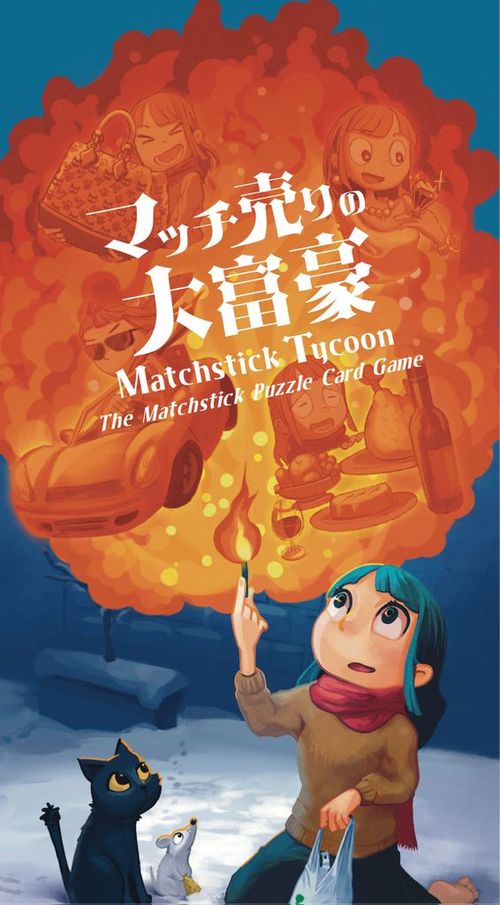
Matchstick Tycoon
Matchstick Tycoon Rulebook
Table of Contents
Table of Contents
Components
- 56 Number Cards (63mm x 88mm). There are 14 types: 0, 1, 2, 3(E), 4, 5, 6(9), 7, 8, A, B, C, D, F, with 4 copies of each.
- The 3 and E, as well as the 6 and 9, are interchangeable. When flipped upside down, "3" becomes "E," and "6" becomes "9."
- In this game, the letters 'A' to 'F' are also considered numbers. Note that the letters 'b' and 'd' are in lowercase.
- Strength Indicator Sheet, 1 piece
- Matchstick Tokens, 40 pieces
- Quick Reference Sheets, 6 pieces
- Instruction Manual, 1 copy
If you encounter any issues with the contents or have any questions, please contact the publisher through the official website (heyteam.net) or X account (@h_e_y_team). Errata (such as data or rule mistakes) will also be posted on the official website.
Objective of the Game
The goal is to play all your cards and matchsticks!
This game is a card game with rules similar to Tycoon, where the goal is to play all your cards as quickly as possible. The player who plays all their cards and matchsticks first becomes the "Winner" (Agari) and the game continues until only one player remains. The player who becomes the first Winner is ranked 1st (Champion), followed by 2nd, 3rd, and so on.
Game Setup
Let's deal the cards according to the table below.
The dealt cards are your hand, and you should keep them hidden from other players.
| Number of Players | 2 | 3 | 4 | 5 | 6 |
|---|---|---|---|---|---|
| Number of Cards to Deal | 15 cards | 15 cards | Deal all the cards. | Deal all the cards. | Deal all the cards. |
For 5 or 6 players, there may be a difference of one card, but this is not a problem. If it concerns you, you may adjust the number of cards to make them even.
Let's distribute the "Matchstick Tokens" and "Quick Reference Sheets."
- Give one Quick Reference Sheet to each player.
- Give one matchstick to each player, and place the remaining matchsticks in the center of the table.
- Place the "F" side of the Strength Indicator Sheet face up in the center of the table. This represents the strongest number, and the initial strength order is as follows: "0 < 1 < 2 < ... d < E < F" (from weakest to strongest).
Let's decide who the dealer (banker) will be
The player who recently lit a match (or won a game of rock-paper-scissors) will be the first dealer (parent).
Starting the Game
The game starts with the dealer (parent), and players take turns in clockwise order.
On each turn, a player can either "play a card" or "pass."
Play a Card
Parent's First Turn
You can play one up to five cards of the same strength (refer to the Card Strength diagram below) at the same time. By playing five cards at once, a "Revolution" (described later) will occur.
Subsequent Turns
On subsequent turns, you must play the same number of cards as the dealer just played, and the combination of cards must have higher numbers than the previously played cards.
Example diagrams: a single 6 can be followed by a single 9 — OK. A pair of 4s can be followed by a pair of 9s — OK.
A straight (run), such as a 2, a 3, and a 4 played together, cannot be played.
A different number of cards cannot be played — for example, a pair of 9s cannot be followed by three C cards.
Pass
If you cannot or do not want to play a card, you must pass and take one matchstick from the center of the table.
If your turn comes after passing, you can either play a card or pass again. (This is called a "Soft Pass.")
You cannot choose not to take a matchstick. You cannot pass on the dealer's first turn.
If all players except the last one to play a card choose to pass, the cards played so far are cleared (set them aside on the edge of the table), and the last player to play a card becomes the next dealer. All matchsticks placed on the cards are returned to the center of the table. If there are not enough matchsticks, you may substitute them with chips or similar items.
If you play the strongest card, F (or 0 during a revolution), all other players are forced to pass. After receiving one matchstick each, the cards are cleared and the turn passes.
Card Strength
At the start of the game, "0" is the weakest, and "F" is the strongest. When a "Revolution" (described later) occurs, the strength of the numbers is immediately reversed.
Strength order (weakest to strongest): 0, 1, 2, 3, 4, 5, 6, 7, 8, 9, A, b, C, d, E, F
Card Changes
When playing a card, you can flip the card upside down or place as many matchsticks as you like on top of the card to change its number.
For "3" and "E," or "6" and "9," you must declare the number when you play the card.
The number must satisfy the format shown on the quick reference sheet.
The card's number can be changed! Place 2 matchsticks on the 4 card to change it to a 9!
Example: a 4 card can have matchsticks added to become an A. A 3 card can be flipped upside down to become an E — flipping the card is OK. A 1 card can be flipped and have a matchstick placed on it to become an F — flipping and placing the card is OK. Stacking cards is not allowed.
Revolution
A Revolution occurs when you play five cards at once. You can play up to five cards.
If you play five cards with the same number (e.g., 8 8 8 8 8) at once, a "Revolution" occurs. The strength of the numbers is immediately reversed. Flip the "Strength Indicator Sheet" over.
Strong to weak after a Revolution: F, E, d, C, b, A, 9, 8, 7, 6, 5, 4, 3, 2, 1, 0
After that, if another player plays five cards at once following the new strength order, a "Revolution" will occur again, and the strength will be reversed (Revolution Return).
Example 1: If a "Revolution" occurs with an 8, the next player can start a Revolution with numbers from 0 to 7.
Example 2: If a "Revolution" is triggered with an 8, it can be followed by another "Revolution" with a 3, then an A, and finally a 9. Multiple "Revolutions" can occur in succession.
Continued on the back (Winner and Game End)
Winning (Agari) and Game End
You win (Agari) when you have 0 cards and 0 matchsticks! If you have matchsticks remaining, you can return one matchstick during your turn.
The player who has 0 cards and 0 matchsticks becomes the "Agari" (winner).
However, if a player has 0 cards but still has matchsticks remaining, they are not considered "Agari." On their turn, they must return one matchstick at a time. Once all matchsticks are returned and they have 0 matchsticks, they become "Agari."
The game ends when all players, except one, have become "Agari."
Special Situations
If you play all your cards while still having matchsticks left, and all other players pass, the cards played so far are cleared (set aside), and you become the next dealer. All matchsticks placed on the cards are returned to the center of the table.
Example for 3 players:
- Player A: "Out of cards!" (Player A still has matchsticks remaining.)
- Player B: "Pass" — takes a matchstick.
- Player C: "Pass" — takes a matchstick.
- Player A (Dealer): "The dealer has no cards!"
In this case, if the dealer has no cards on their first turn, the following actions will take place:
- The dealer returns one matchstick.
- The next player (in this case, Player B) becomes the new dealer.
After this, the game proceeds as usual.
Rules That Are Easy to Forget or Make Mistakes With
- If the strongest card, F (or 0 during a revolution), is played, all other players are forced to pass, and after receiving one matchstick each, the cards are cleared.
- The dealer cannot pass on their first turn.
- When passing, you cannot choose not to take a matchstick.
- If there are not enough matchsticks, you may substitute them with chips or other items.
- This is a soft pass.
- Cards cannot be played in sequences such as "2, 3, 4" or "9, A, B, C" (no straight flushes).
- There are no special rules like the "8 cut" or "falling from grace" that are commonly found in Daifugo (except for the revolution).
- You cannot create numbers like -1, L, P, etc., which do not exist in this game.
- Cards cannot be played as "b" or "Q" for 6 or 9. You must play them according to the quick reference sheet.
- A revolution occurs when five cards are played simultaneously (not four).
- You cannot play six or more cards at once.
- In this game, for example, you cannot play 2-5 cards when 1 card is played, or 4-5 cards when 3 cards are played. Always follow the number of cards played by the dealer.
- You are free to rearrange your hand.
- When a revolution occurs, flip the strength indicator sheet. Example: If a revolution happens with five 8s, a "Revolution Return" can occur with five cards from 0 to 7.
Hints
- 2 cannot be used to create any other number, and the only number that can be created from 2 is 8. It is likely the most difficult number to use.
- 7 cannot become F.
- The only number that can become F is 1.
- The quick reference sheet also serves as the matchstick storage area. Please place the matchsticks you take on top of the quick reference sheet.
Message from the Creator
- This game can even be played with 7-8 players! Since you may run out of matchsticks, please substitute them with other items.
- Feel free to modify the rules, such as making a revolution occur with 4 cards, and try out different variations!
- For a different experience, try mixing or swapping the separately sold first expansion cards, "G, H, = (Equals), and Blank (White)," into the game. The creator's recommendation is to add 2 G cards and 2 H cards to make a total of 60 cards. Give it a try once you're familiar with the game!
- Playing with all 16 cards and 7-8 players creates a chaotic, fun atmosphere—it's a different kind of experience (laughs)!
- A big thank you to everyone who helped with playtesting! Thanks to you, we were able to create something great.