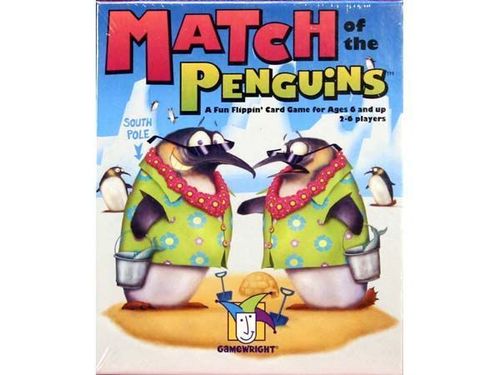
Match of the Penguins
Match of the Penguins Rulebook
Table of Contents
Table of Contents
Material
- 64 playing cards (46 lady pheasants with one earthworm, 6 lady pheasants with two earthworms, 12 detail pictures)
- 4 snatch figures (3 x blue, 1 x red)
- Game instructions
Preparation of the Game
- The red snatch figure is placed in the middle of the table.
- The three blue snatch figures are placed around it (see fig. 2).
If only three players are taking part, only two blue figures are placed beside the red one; only one blue figure, if there are only two players.
- All 64 cards are shuffled thoroughly.
Aim of the Game
The players act as doorkeepers at the pheasants' great gala night. Lady pheasants are not admitted if their outfits are not completely different from the others'. Nor will they be admitted if they are carrying two earthworms with them. The player who discovers the most violations of the dress and earthworm rules, and thus collects the most cards, wins the game.
How to Play
The player with the most colourful clothes picks up the shuffled cards and starts to slowly place the cards face up on the table next to each other.
While this is being done, all players (including the one turning up the cards) look for umbrellas, hats, scarves, beaks, tail feathers, or pet worms of the same colour. They also look for lady pheasants bringing two pet worms along.
The rest of the pheasant body (which has the same colour on all cards) is not taken into account. The 12 detail pictures thus show just one coloured element (e.g. a hat).
As soon as a player discovers a card with two earthworms, he tries to be the first to knock on the table.
As soon as a player discovers elements in the same colour, he tries to be the first to call or snatch a figure.
Players who do the right thing first receive the cards lying on the table.
Then the player who turned up the cards passes the remaining stack to his left neighbour, whose turn it is now to turn up the cards, etc.
ATTENTION: To prevent the player turning up the cards from having an advantage, he has to turn them away from himself, so that the other players see the picture first. In order not to disadvantage the player who turns up the cards, the other players hold on to the edge of the table with both hands, until someone calls, knocks, or snatches a figure.
Calling, Snatching a Figure, Knocking
The table on page 8 of the original sheet shows the different situations that can occur during a game. That table is not included in the printed sheet supplied, so the situations are described below as the text gives them.
1. Calling: An Element in the Same Colour
The player who discovers one element in the same colour on the cards turned up calls the name of the element immediately. The player who calls first receives all cards turned up at that time and places them in front of himself (see fig. 3).
But: If one of the cards turned up shows two earthworms, the players who spotted the correct element do not receive any cards (see fig. 8).
Wrong Calls
A player who calls an element which is not present twice in the same colour does not receive any cards. He has to return one card from his stack (see fig. 3).
Cards which have to be returned are placed face down below the main card stack. Players who haven't yet collected any cards do not have to return any.
Fig. 3: Two lady pheasants are wearing red hats. Diana and Terry call out "Hat". Diana is faster and receives all the cards that are turned up. Terry receives nothing. Michael calls "Scarf" by mistake and has to return one of his cards to the stack.
Players who call for one element although there are more elements of one colour than the one he called do not receive any cards, but do not have to return any either.
The same is true for players who call an element of the same colour although there is a card showing two earthworms.
Players who call elements of one colour may then snatch a figure or knock; this cancels their call (see fig. 4).
2. Snatching a Blue Figure: Several Elements in One Colour
Players who discover more than just one element in the same colour snatch a blue figure.
All players who snatch a blue figure correctly receive one of the cards turned up and place them on the table before them (see fig. 4 and 5).
If there are more cards turned up than are needed, those remaining are returned to the bottom of the stack (see fig. 4). If there are not enough cards turned up, the missing cards are taken from the stack (see fig. 5). If there are not enough cards in the stack, the game is over. Players who should have received another card may add it to their final result.
But: If there are two earthworms on one of the cards turned up, the players who snatch a blue figure receive no card (see fig. 9).
All figures snatched are then placed back to their starting position (before the next card is turned up).
Fig. 4: Diana and Terry call "Scarf". Only then does Diana notice the tail feathers in the same colour (green). She snatches a blue figure. Michael and Chris do the same. Diana, Michael and Chris each receive one of the cards turned up. As there are more than three cards turned up, the remaining cards are returned under the stack.
Fig. 5: Two lady pheasants are wearing green tail feathers and yellow scarves. Diana, Michael and Chris discover these common elements and each snatch a blue figure. As there are only two cards turned up, one of them receives the card on top of the stack.
Snatching a Blue Figure in Error
Players who snatch a blue figure despite there being no or just one element in the same colour must return one of their cards to the stack (see fig. 6).
Players who snatch a blue figure despite there being two completely identical cards turned up also have to return one of their cards (see fig. 7). They may not snatch the red figure or knock on the table.
Fig. 6: The cards turned up show just one element in the same colour (beak). Nevertheless, Chris snatches a blue figure and Terry even snatches the red one. Both have to return one of their cards.
3. Snatching the Red Figure: Two Identical Cards
Players who discover two completely identical cards snatch the red figure. They then receive all the cards turned up and place them in front of themselves (see fig. 7).
Fig. 7: Two cards turned up are completely identical. Chris reacts first and snatches the red figure. He receives all cards turned up. Michael and Terry, who both snatch a blue figure, have to return one of their cards. Diana knocks on the table in error and has to return a card as well.
Snatching the Red Figure in Error
Players who snatch the red figure despite there being no completely identical cards on the table have to return one of their cards (see fig. 6).
4. Knocking: Two Earthworms on One Card
If a card is turned up which shows two earthworms, the player who knocks on the table first receives all cards turned up - even if someone else has called or snatched a figure because they spotted one or more elements in the same colour (see fig. 8 and 9).
NOTE: KNOCKING CORRECTLY ALWAYS WINS OVER CALLING OR SNATCHING A FIGURE
Fig. 8: The cards on the table show one element in the same colour (the scarf). Diana calls "Scarf", which is correct. But Chris spots a card showing two earthworms. He knocks on the table and thus receives all cards turned up. Diana receives nothing.
Fig. 9: The cards on the table show several elements in the same colour: two scarves, worms, and beaks, and three hats. Chris and Michael each snatch a blue figure. They are right, but Diana spots a card with two earthworms. She knocks and receives all cards on the table. Chris and Michael receive nothing.
Knocking in Error
Players who knock despite there being no cards with two earthworms on the table have to return one of their cards to the stack (see fig. 7).
Players and Winners
As soon as the last card is turned up, players have a last chance to knock, call or snatch a figure. Then the game is over.
The player who has collected the most cards (in front of them on the table) wins.
If several players claim that they knocked or called the right element first, the majority of players decides on who is right. If no decision can be reached, each player in question receives one of the cards on the table. If there are too many or not enough cards on the table, follow the rules in the box on page 4 of the original sheet (see also fig. 4 and 5).