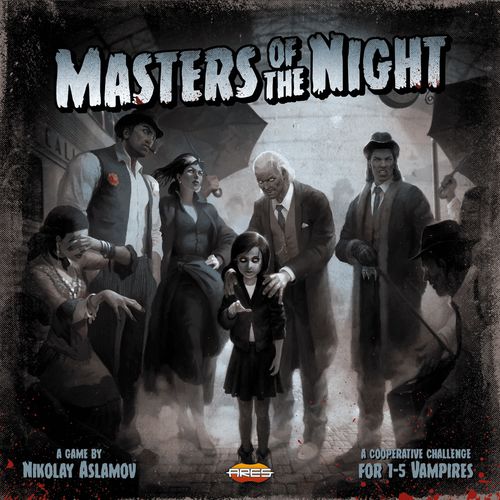
Masters of the Night
Masters of the Night Rulebook
Table of Contents
Table of Contents
- Components
- District Tiles
- Vampire Sheets, Miniatures and Tokens
- Dread Sigil Tokens
- Kill Count Markers
- Veil Trackers and Marker
- Event Cards
- Blood Tokens
- Leading Vampire Token
- Relic Cards
- Agent Tokens
- Minion Tokens
- Dice
- Setup
- Playing the Game
- Victory and Defeat
- Combat
- Drained Vampires
- Relic Cards
- Character Selection Tips
- Frequently Asked Questions
Components
Masters of the Night includes:
- This Rulebook
- 9 District tiles
- 2 Veil trackers
- 6 Vampire miniatures
- 6 Vampire sheets
- 54 Event cards (18 each of level I, II and III)
- 13 Relic cards
- 10 six-sided dice
- 3 punchboards with markers and tokens:
- 6 Vampire tokens
- 6 Kill Count markers
- 6 Dread Sigil tokens
- 22 Blood tokens
- 1 Veil marker
- 1 Leading Vampire token
- 12 Agent tokens
- 9 Minion tokens
District Tiles
The city is made up of 9 district tiles. Each district has its own unique effect that either triggers during the day, or may be activated by one of the characters during the night.
Example district tiles include:
- Cathedral (day/night effect): As long as there are more agents and minions in this district, all vampires cannot use their abilities and relics, both during the day and night phases.
- City Hall (night effect): Spend 2 AP to recruit 1 minion into any district instead of this one. Increase the Veil by 1, like in a normal recruit action.
- Asylum (day effect): If there are more minions than agents in this district, you may expose and move 1 agent from any other district to the Asylum. If there are more agents than minions in this district, move 1 minion from any other district to the Asylum.
Vampire Sheets, Miniatures and Tokens
There are six playable vampires: Agnieszka, Imre, Ishtvan, Laszlo, Mila, and Nevena. Each vampire has their own vampire sheet, serving as a reference for their actions, abilities, and kill counts. On the game board, each vampire is represented by a vampire miniature (or by a colored vampire token, if you prefer).
Each vampire sheet shows the available actions, blood ability, dark ability, and vampire's name.
Dread Sigil Tokens
Each vampire can conjure their own unique dread sigil to enshroud one of the city districts with powerful magicks. Doing so adds a new effect to the district and moves the Family closer to victory.
Kill Count Markers
Use these markers on the kill count tracker on each vampire's sheet by slotting them into the appropriate diagonal cut.
Veil Trackers and Marker
There are two double-sided veil trackers, one side for each player count. Increasing (moving to the left) or decreasing (moving to the right) the Veil using the veil marker shows how effectively you are operating without exposing the Family. As long as the marker gets down to zero, the vampires draw closer to their ultimate exposure and defeat.
Event Cards
There are 54 event cards, divided into decks I, II, and III, each with 18 cards. Shuffle these decks separately before the start of the game. Based on the chosen difficulty, more or less cards go into the event deck.
Each round, you draw an event card that indicates, in conjunction with the veil tracker, how many agents appear and in which districts. Many event cards drastically modify the game, providing new opportunities or adding more challenges.
Blood Tokens
Use blood tokens to track each vampire's stamina, spend blood tokens to activate their abilities, and recover them by hunting mortals. Each vampire can normally have up to 4 blood tokens. A vampire losing all blood becomes drained (see page 16).
Leading Vampire Token
The leading vampire token shows which character acts first in the round and makes decisions in difficult situations. It is double-sided to act as a reminder to the players whether it is day or night.
Relic Cards
Relic cards represent valuable artifacts you can find at the museum. Possessing and using relics requires a vampire to reach a certain kill count first. Each vampire can hold a maximum of 2 relic cards.
Agent Tokens
Agents are your main adversaries. They are adepts of the Inquisition - an ancient order of vampire hunters. They operate in secrecy and must be flipped to their 'exposed' side before you can deal with them.
Minion Tokens
Minions are loyal servants of your Family. They help you keep city districts under control and defend you from the agents of the Inquisition. Ultimately, they serve as sacrifices in magical rituals. All vampires can use minions, regardless of who recruited them. You can choose which side of the minion token to use (showing a woman or a man). This has no effect on gameplay.
Dice
Six-sided dice are used in combat and some specific game situations.
Setup
Regardless of the number of players, you can use 2-5 vampires in a game. A single player can control more than one vampire. You can play solo with two or more vampires. You can play a two player game with five vampires, splitting them however you want. During the game only the number of participating vampires is relevant.
Always use the veil tracker corresponding to the total number of vampires. So, if you play with two players with two vampires each, use a tracker for four, not for two.
The leading vampire token applies to a vampire, not to a player. To make passing the token easier, arrange the vampire sheets in the order of play.
In your first couple of games, use this number of vampires:
- 3, 4 or 5-players: one vampire per player;
- 2-players: one or two vampires per player;
- Solo game: 2-5 vampires.
When you're familiar with the rules, you can use any number of vampires per player.
For your first game, the following vampire combinations are recommended:
- 2 vampires: either Imre and Mila, Agnieszka and Laszlo, or Imre and Laszlo.
- 3 vampires: Agnieszka, Ishtvan, and Mila.
- 4 vampires: Agnieszka, Imre, Nevena, and Laszlo.
Setup Steps
-
Lay out the district tiles in a 3 x 3 square, with all districts oriented the same way. The railway station must always be placed in the top left corner of the city. Place the other districts randomly. Only orthogonally connected districts are considered adjacent.
-
Decide how many vampires you will use during this game and how you will distribute them.
Pass the vampire sheets, vampire miniatures, and dread sigils for the vampires you are using to their respective players. Return the components belonging to any unused vampires to the box.
Put 4 blood tokens on each vampire sheet. Slot the matching colored kill count marker next to space 0 of each vampire's kill count tracker.
-
Place all the vampire miniatures on the railway station district tile.
- If you are playing with 2 vampires, place 2 minions on that district.
- If you are playing with 3 vampires, place 1 minion on that district.
- If you are playing with 4 or 5 vampires, do not place any minions on that district.
-
Take the veil tracker corresponding to the number of characters in your game. Place the veil marker on space 6.
-
Place the number of agents stated on the veil tracker near the district tiles. Return the rest of the agent tokens to the box.
-
Put remaining minions and two extra blood tokens near the agent tokens. This is your token reserve. Return the rest of the blood tokens to the box.
-
Shuffle each event deck separately. Choose your difficulty level and draw the following number of cards from each event deck without looking.
- Easy: 6 cards from each deck;
You are now ready to turn this city into your domain!
Dice Reserve
Dice are used for combat and for some special effects. During the game, dice are stored in the reserve near the district tiles, with their values visible.
When you need to use dice, select one from the reserve and set it aside. The value on that selected die influences the result of the combat or special effect.
Once a die is set aside, it is out of the game until all dice from the reserve are used.
When the reserve is empty, take all the dice, roll them and create a new dice reserve without changing the dice values.
Playing the Game
The game is played over a series of rounds, each consisting of a day phase, followed by a night phase. During the day, events are resolved and agents appear. During the night, vampires take their turns.
Day Phase
During the day phase, complete the following steps in order:
1. Pass the Leading Vampire Token (ignore this during the first round)
Pass the leading vampire token to the next vampire clockwise, flipping it to the day side as a reminder that you begin the round with the day phase.
Usually this means giving the token to the player to your left, but if there are more vampires than players, pass the token to the next vampire clockwise, regardless of who controls that vampire. Skip this step during the first round of the game.
2. Resolve Day District Effects
The leading vampire announces and resolves all day district effects (marked on a district tile with the day symbol).
These can be resolved in any order. However, the effect of one district must be fully resolved before resolving the effect of another district. Because the situation in one district may affect other districts, the exact order of resolution for different districts is up to the players to decide, but the final decision should always be made by the leading vampire.
EXAMPLE: One agent and one minion are in the museum, and one minion is in the asylum. The museum effect only activates when there are more minions than agents there. So the players decide to resolve the asylum first, moving their agent from the museum. Now they can also resolve the museum effect and get a valuable relic.
3. Draw and Resolve an Event Card
The leading vampire reveals the top card from the event deck and resolves it. Each card features a city grid, indicating the districts where new agents appear. First place the new agent tokens, hidden side up.
Refer to the veil tracker to see how many agents appear in each district, depending on the current position of the veil marker. If the veil is at 4 to 6, use the numbers below to the left; if the veil is at 1 to 3, use the numbers below to the right.
- For district positions marked with a red cross, there is always a single number. Place the indicated number of agents into the district at that position in the grid.
- For district positions marked with a blue-gray cross, there will be either two of the same numbers or two different numbers. When the numbers are the same, place the required number of agents into both districts at those positions. When the numbers are different, you can decide where to allocate that number of agents.
After the card is resolved it is usually returned back into the box, though some cards stay in play and have continuous effects.
After agents are placed, the leading vampire resolves the event card's text. Sometimes this effect adds even more agents to the board. Remember that new agents enter the city with their hidden side up, unless specifically stated otherwise on the card.
Decreasing the Veil
If, because of the city grid and/or the event card text, you place or move one or more agents into a district with a minion or non-drained vampire, you must decrease the veil by 1 (once per district, not once per agent).
Whenever you need to add an agent into a district and you have no agents available in the reserve, you must decrease the veil by 1 for each agent you couldn't place.
When you have to decrease the veil tracker because of an event, do so after the card is completely resolved.
EXAMPLE: The event card Last Crusade is being resolved. There are 3 vampires in play and the veil marker is at 4. The left bottom district is marked with a red X, so we place 2 new agents there. According to our veil tracker, one blue-gray district should get 1 agent and the other should get 0. The leading vampire decides to place an agent on the top left district (because it doesn't have minions or vampires). No agents are added to the left middle district.
The player now has to add 1 agent into each non-sigillated district with no agents, vampires or minions. There are 3 districts like this, but there is only 1 agent token left in the reserve. The player adds an agent to a district of their choice and then moves the veil marker from 4 to 2. Also, because the agents entered a bottom-left district with 2 vampires in it, the veil marker now goes down to 1. Now the players really are in trouble, as the vampire in that district will have to fight against 3 agents in the next step!
Now the Last Crusade card has been resolved, there are 3 agents in the bottom left district. These will fight a vampire hiding there. First, flip all the agent tokens to their exposed sides. Then, a day combat is resolved (see page 14).
4. Agents Hunt the Vampires
During the day, in each district with at least one non-drained vampire and at least three agents, a combat occurs.
If there are multiple districts that apply, the leading vampire decides the order in which fights are resolved.
Before the combat begins, flip all agents in that district to their exposed side. The combat is then resolved following the Combat rules (see page 14). Daylight renders vampires weaker: they cannot fight with their full strength and will be more vulnerable than when they fight at night.
Night Phase
During the night phase, each vampire can execute a number of actions by spending action points (APs). Each vampire gets 2 action points at the beginning of the night phase, though this amount can change later in the game.
The leading vampire flips the leading vampire token to the night side as a reminder, then takes their actions first.
The next vampire clockwise then takes their actions, followed by the next, and so on until all vampires have acted once. You must finish all your actions before passing the turn to the next vampire.
When it is a drained vampire's turn to act, they receive 1 blood and the veil is decreased by 1. Then, the vampire acts normally.
The player controlling the active vampire decides how to spend their available action points and makes all the decisions regarding them. You can perform the same action more than once, if necessary.
The actions are summarised on your vampire sheet's kill count tracker. Some actions are available to you from the beginning of the game, while others become available after you reach a certain number on your kill tracker.
EXAMPLE: You will be able to start a Wild Hunt after your kill tracker has reached 4.
"Your vampire" always refers to the vampire performing the current action.
After all characters have spent their action points, the night phase ends and the day phase of a next round begins.
Vampire Actions
| Kill Count | Available Action | Action Points |
|---|---|---|
| 0+ | Move into adjacent district | 1 |
| 0+ | Expose all agents in your district | 1 |
| 0+ | Fight exposed agents in your district | 1 |
| 0+ | Recruit a minion and increase veil by 1 | 2 |
| 0+ | Activate night effect of your current district | 1-2 |
| 0+ | Use your own Blood ability | 0 |
| 1+ | Hunt: gain 1 blood token | 1 |
| 2+ | Give and/or take a relic from another vampire in the same district | 0 |
Move Into Adjacent District
Some prefer to swiftly traverse the city in their bat form, others ride in a limo or blaze through on a motorcycle.
1 AP · Veil: Not affected · Kill Count: 0+
Move your vampire into an adjacent district. While moving, vampires can take minions with them; move the necessary number of minions along with the vampire.
Expose Agents
You can't simply see an agent in crowd. It's not like they wear black glasses or some uniform. Finding and revealing their identities requires many special efforts.
1 AP · Veil: Not affected · Kill Count: 0+
Flip all agents in the same district as your vampire to their exposed side. Agents that are already exposed remain that way.
Fight the Agents
When you know who your enemies are, don't wait for them to attack you. It's always better to deal with them immediately.
1 AP · Veil: Not affected · Kill Count: 0+
Your vampire fights all exposed agents in the same district. Agents with their hidden side up don't participate in combat. Unlike fights during the day, when you attack agents by yourself during the night, you may choose any dice from the reserve.
Recruit a Minion
To reign over mortals, vampires need other mortals. There are those who will serve out of fear, zeal, passion or simply a need for money. After they are initiated, their will is yours to command.
2 APs · Veil: Increase by 1 · Kill Count: 0+
Take 1 minion token from the reserve and place it in the same district as your vampire. You cannot recruit minions when there are no minion tokens left in the reserve.
A new minion helps the Family to stay in the shadows; also increase the veil by 1.
Use Night District Effect
Behind the facade of offices, restaurants, shops and condos, there is a secret network that vampires use to advance their cause.
AP: See district · Veil: Not affected · Kill Count: 0+
If your vampire is in a district with a night effect, you can activate it using the listed amount of action points. A district can be activated multiple times during the same game round. The effect always refers to the vampire who activated the district.
Use Your Blood Ability
One of the defining vampire traits and part of what makes them so powerful is their supernatural abilities, honed during a seemingly endless lifespan.
AP: Blood tokens · Veil: Not affected · Kill Count: 0+
Each vampire has their own unique blood ability that usually can be activated by spending blood tokens during the night (except for Laszlo's ability that can be used during any combat, day or night). You don't spend any action points on blood abilities. If your vampire becomes drained by paying the cost of the ability, it still fully resolves.
Agents removed by a Blood ability increase your kill count. However, minions created by a blood ability do not increase the veil.
Hunt
Hunting is not a pastime for a vampire—it is a matter of survival. Out of sheer hunger or just to rejuvenate themselves, vampires still resort to preying in the dead of night.
1 AP · Veil: Not affected · Kill Count: 1+
Your vampire gets 1 blood token. Take it from the reserve and place it on your vampire sheet.
Each vampire can have up to a maximum of 4 blood tokens (or 6 with the 'Pristine Blood' relic).
Exchange Relics
Relics are hard to procure, but for sake of the Family's common goals, it is imperative to make sure those powerful artifacts are in the right hands.
0 AP · Veil: Not affected · Kill Count: 2+
Your vampire can exchange a Relic card with another vampire in the same district. You can also simply give or take a Relic card. This doesn't cost any action points, but both vampires must still comply with their own limits for the number of relics they can have.
Start a Wild Hunt
Sometimes insatiable hunger, a guileful scheme or simply a struggle to survive compels a vampire to forget about caution and paint the town red.
1 AP · Veil: Decrease by 1 · Kill Count: 4+
Your vampire gains blood tokens up to the maximum (4 tokens, or 6 with the 'Pristine Blood' relic). Take the necessary number of tokens from the reserve and place them on your vampire sheet.
Wild Hunt causes such havoc it is impossible for it to go unnoticed by mortals; therefore you must decrease the veil by 1.
Use Dark Ability
As vampires take more and more lives, their souls strengthen their bonds with darkness itself, unraveling powerful and long forgotten tenebrious arts.
AP: Veil · Veil: See ability · Kill Count: 6+
Unlike Blood abilities, your vampire gets Dark abilities after reaching 6 on their kill count track. Dark abilities are used during night (except for Laszlo's) and require decreasing the veil as the cost. However, if paying that cost lowers the veil down to 0, the game ends immediately and the players lose; even if resolving the ability would have caused the veil to go up.
Agents killed by a Dark ability increase your kill count. However, minions created by a Dark ability do not increase the veil.
Sigillate a District
Vampires need their own domain. And with time, they created powerful rituals to slowly transform any place into their own turf.
1 AP, 1 minion · Veil: Not affected · Kill Count: 9+
Your vampire can sigillate their district if there is at least one minion there and no agents or other dread sigils. Spend an action point, remove a minion from the district, and place your dread sigil into the district.
Each vampire only has a single dread sigil and can only sigillate one district.
A dread sigil adds a new effect into the district where it is conjured. This effect works passively and doesn't require an activation.
Sigillated districts are also considered to always have more minions than agents, even if there are actually no minions there. Sigillated districts still retain their original effects and may be activated after the dread sigil is placed.
Initiate Blood Moon Ritual
Performing this ritual is the culmination of all the Family's efforts, as it will finally give them power over the city.
1 AP · Veil: Not affected · Kill Count: 9+
If your vampire takes this action successfully, the game ends with a victory for the players. However, you can only initiate the ritual when all dread sigils are already placed into districts, all vampires are in the same district with no agents, and there are also at least the same amount of minions as vampires in the district.
Victory and Defeat
Performing the Ritual
To win the game, players must perform a Blood Moon ritual. This takes several stages:
- Each character must seal a district of the city with their dread sigil.
- All vampires must gather in a single district, with no agents present. There must also be at least the same number of minions as the number of vampires in the district.
- Finally, one of the vampires must begin the ritual using an INITIATE BLOOD MOON RITUAL action.
If the vampires manage to complete these tasks, they subjugate the people of the city with their magic, securing a source of blood for many years to come.
End of the Game
The game ends immediately in three cases:
- The Blood Moon ritual is performed. The vampires turn the people of the city into their obedient herd. The players win.
- The veil marker reaches zero (the 'Vampires hunted down and destroyed!' box). The people of the city uncover the truth about the vampires and hunt them down. The players lose.
- A player must draw an event card from an empty event deck. The agents of the Inquisition consolidate their army of vampire hunters in the city. The vampires run out of time. The players lose.
Combat
Combat can occur during both day and night. Only one vampire is initially involved in a combat, fighting against a group of agents in the same district. Other vampires may get involved in the fight, if the first fighting vampire becomes drained.
Fights during the day and night are resolved similarly, with a few differences.
Night Combat
Fighting vampire: the vampire who initiated the fight with FIGHT AGENTS action. The player use any dice from the reserve.
Opposing agents: all exposed agents in the same district. Hidden agents do not participate in combat and are ignored.
Day Combat
Fighting vampire: a non-drained vampire in a district with three or more agents. If there are several vampires in that district, players choose who will fight. The player can only use the dice with the lowest values.
Opposing agents: all agents in the same district. Flip all agents in the district to their exposed side before the combat begins.
General Combat Rules
At the beginning of the combat, the fighting vampire can remove any number of minions from the district they are in to also remove the same number of exposed agents from the district.
Then, the player picks a die from the reserve for each exposed agent still in the district (any die at night, the die with the lowest value during day combat).
Resolve the effect of the used die immediately, according to its value:
- 1 or 2: The agent stays in the district and the fighting vampire loses 1 blood;
- 3 or 4: Remove the agent and the vampire loses 1 blood;
- 5 or 6: Remove the agent.
The player continues to pick dice, one by one, until the number of used dice matches the initial number of exposed agents in the district.
If there are not enough dice in the reserve, the player must first use and apply all the available dice, then roll all the dice again and continue to pick the necessary number of dice.
If the fighting vampire loses all blood and becomes drained, another non-drained vampire in the same district must become the fighting vampire. If all vampires in the district are drained, the combat ends immediately, even if you used less dice than the number of exposed agents.
Increasing the Kill Count
During combat, fighting vampires can increase their kill count by one for each agent removed. For agents removed by minions, increase the kill count of the first fighting vampire. For agents removed by using dice, increase the kill count of the vampire who is fighting at the moment a die is used.
Combat Example
In a 3-player game, Ishtvan and Mila are in the district with 1 minion and 4 exposed agents. Dice in the reserve have values 6 and 2. Ishtvan spends one action point to start the combat.
First, the player who controls Ishtvan decides to remove the minion from that district to remove 1 agent.
Now Ishtvan has to fight 3 agents and the player must pick 3 dice from the reserve.
Ishtvan picks the only 2 dice in the reserve, with 6 and 2. One agent is removed (using 6) but Ishtvan loses his last blood token (using 2) and becomes drained — lay down his miniature or flip his token.
Mila is also in the district, so the fight must continue. The player rolls all six dice to pick the third one. New values are 1, 1, 3, 4, 4, 4. Mila picks a dice showing 4, removing another agent and losing 1 blood token.
In total, two more agents have been removed from the district (for dice 4 and 6) and one survives.
Ishtvan's kill count is increased by 2 (1 for the minion and 1 for the dice) and Mila's kill count is increased by 1.
Drained Vampires
If, after combat, using an ability, or as a result of some other effect, a vampire no longer has any blood tokens, they are considered drained.
Lay their miniature down or flip their token over to the drained side in the district where this happened. If the vampire had any action points left, the points are lost.
A drained vampire is mostly ignored by agents, as they look dead. They cannot be attacked during the day and, when an event card adds an agent into a district with only a drained vampire, you don't have to decrease the veil.
If a drained vampire gains a blood token from any effect, they are no longer drained - flip the token back over, or stand the miniature up.
At the start of a drained vampire's turn, during the night phase, they gain 1 blood token. However, the vampire's resurrection won't go unnoticed - you must also decrease the veil by 1. Then, the vampire acts normally.
Relic Cards
During the game, vampires can find powerful artifacts called relics. Each vampire can only have up to 2 relics. You can possess and use one relic once your kill count reaches 2, and you can possess and use two relics once your kill count reaches 5.
Vampires procure artifacts by using the effect of the museum district. When this district is activated, the leading vampire draws the top card from the relic deck, reveals it to everyone, then passes it to a vampire of their choice. The leading vampire can choose any vampire that is allowed to have a relic or relics, themselves included.
However if no one can have a relic yet, don't draw a card at all.
When they are in the same district, vampires can exchange relics. This doesn't cost any action points, but the exchange must still involve a character currently taking their turn.
An exchange can be done in any way (it can be one-sided), but it cannot result in any vampire having more relics that they are currently allowed to have.
Whenever a vampire gets a relic over their current limit, they must immediately discard one; either one of the relics they got previously or the new relic.
All relics can be used only during the night phase, according to the specific text on the card. Most of the relics provide new opportunities for their owners. Some of the effects are passive, and others can be activated by spending action points, blood, or even decreasing the veil.
Some relics may be put into a district, adding some effect to it, like dread sigils. Placed relics are not owned by any vampire, and they cannot be picked up or moved again. There can be multiple relics placed into the same district, even one with a dread sigil.
Character Selection Tips
The flow of the game and the strategies open to you are mostly dependent on your character choice. So, take your time and explore all the vampire abilities.
Some vampires, like Mila, can be effective from the start of the game. Others only realise their true potential toward the end, like Ishtvan, whose dread sigil and Dark ability can swiftly fulfill the victory conditions during the endgame.
Think about how your characters will synergize with each other.
For example, Agnieszka can lure the agents for Ishtvan's Demon Summoning or Laszlo's combat during the day. On the other hand, she can also divide the agent groups, opening up more opportunities for effective usage of Nevena's abilities.
Imre can help Mila to recover blood after a Temptation, but he also can help Laszlo by focusing on exposing agents.
Have fun finding the vampiric combination best suited to your own playstyle!
Frequently Asked Questions
Can a die value go below 1 or above 6?
No. When any effect would cause a die value to go beyond these numbers, they remain at 1 or 6 respectively.
Which districts are considered adjacent?
Districts connected either vertically or horizontally (but not diagonally) are considered adjacent.
Will day district effects trigger with same number of agents and minions there?
No, one side must dominate at least by 1 token. There is one exception: sigillated districts are always considered as having more minions than agents.
What happens if we need to increase the veil, but it is already on 6?
The veil cannot increase above its maximum of 6, so nothing happens.
What happens if we need to replace an agent with a minion, but no minions are left in the reserve?
Remove the agent token without replacing it.
What if we need to replace a minion with an agent, but no agents are left in the reserve?
Remove the minion token, and don't forget to decrease the veil by 1 if this replacement came from an event card.
Some event cards are placed into a district and must be removed when certain conditions are met. When should we check for these conditions?
Cards of this type are discarded immediately after their condition is fulfilled, but not before their placement on a district or vampire sheet.
For example, if the leading vampire has 1 blood left and the 'Curse of our Clan' event card is drawn, first you place the card on the leading vampire sheet; then, 1 blood is lost and that vampire becomes drained. The discard condition is now met, so the event is discarded and veil is increased by 1.
Should you decrease the veil when an agent enters the Asylum district with a minion?
No, the veil should be decreased only for the agent who appeared in the district with the minion or non-drained vampire during the event card resolution. District effects, relics, sigils and vampire abilities only affect the veil when it is specifically stated.
How exactly do we use Laszlo's abilities?
Laszlo can use one or both of his abilities whenever he fights against agents, immediately after he selects dice. You can use his abilities any number of times, as long as you can pay the costs.
Should we resolve an event card used by Nevena's ability?
No, whenever Nevena draws or discards an event card, it's only used to decide the area of effect of her ability. The card itself doesn't resolve.
When I use 'Distortion Timepiece' and then give it to another vampire, can they immediately use it?
No. This relic can only be used once per game round, regardless of how it changes hands.
If an event card should have added an agent into a district with a minion, but I've used 'Funerary Urn' to add this agent to the Funerary Urn's district instead, should we still decrease the veil?
If there are no minions or non-drained vampires in that district, no.
Only the district where the agent token actually appeared is checked, not the district where it was 'supposed' to appear.