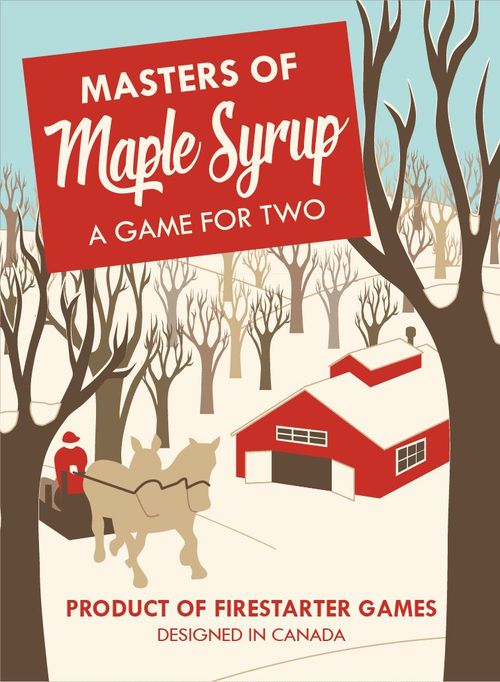
Masters of Maple Syrup
Masters of Maple Syrup Rulebook
Table of Contents
Table of Contents
Introduction
GOAL: Place 10 cards on your property to end the game and earn the highest value (maple leaf points) from them.
2 players, 20 minutes, ages 14+.
Components
50 Property Cards
- TREE CARDS: Tapping and harvesting from trees is how you will draw new cards.
- UTILITY CARDS: Unique effects and abilities to help develop your farm and score points.
3 Action Cards Action cards are double sided. Use the red sides for a standard game and the white sides for the rivals variant.
Setup
Each player takes a "Red Maple" tree card and lays it face up in front of them as the first card on their property.
Shuffle the other property cards and deal 5 cards to each player. They choose 3 to keep as their starting hand. The other 2 are placed in a face up discard pile.
If this is your first game, try and keep trees and card drawing utilities!
The deck, discard pile and 3 action cards are arranged as shown (the deck and discard pile at one end, the three action cards in a row between the two players' properties, each player's property extending in a row on their own side).
STARTING PLAYER: The player wearing the most red goes first.
Action Card Set Up Notes
- Use the red sides of action cards for a standard game. See RIVALS VARIANT for an alternate set up.
- It is important that the action cards are set up sideways so that their text isn't facing either player.
The game ends after a turn where either property has 10 cards on it.
Gameplay Overview
In this game, players work their maple farms by taking turns selecting an action card for both players to use.
The TAP action prepares trees for harvest, the HARVEST action allows you to draw cards from tapped trees and the DEVELOP action lets you place new cards onto your property.
As good neighbours, both players will usually benefit from each other's turns. Taking the lead in this game is all about selecting the right action at the right time to better benefit yourself over your neighbour.
On Your Turn
1) Select an Action
Rotate any available (sideways) action card 90º so that the side showing the action you want points towards you.
- You may not re-use an action card that is already rotated towards a player.
- If no actions are available at the start of a turn, reset all 3 to their sideways position first, then select one as usual.
2) Perform the Action
Both players may now take the action (the one pointed towards you or the one pointed towards your neighbour) now pointed towards them on the selected action card. Start with the current player.
TAP: Rotate a TREE card on your property 90º to signify it is tapped. It is now ready for Harvest.
HARVEST: Return a tapped TREE to its upright position then draw the number of cards listed in the WHEN HARVESTED section of that card.
DEVELOP: Place a card from your hand onto your property after having paid its ¢ cost (see CARD OVERVIEW). You may only develop one card per turn.
A player may choose to TAP, HARVEST or DEVELOP fewer cards than is listed on an action card, including none at all.
3) End Your Turn
Discard cards from your hand until you hold 5 or fewer cards. It is now your neighbour's turn to select an action.
Ending the Game
The game is over at the end of a turn when either or both players have 10 or more cards on their property.
Maple leaf points are tallied from the cards on the player's properties. Don't forget the bonuses!
The player with the highest maple leaf value wins! Ties remain ties.
Card Overview
In your hand, cards are both options for future development and the currency used to buy them.
On your property, TREES are tapped and harvested to draw cards and UTILITIES have varied special effects.
- Card Name & Type
- Card Effects: Effects the card offers once it is on your property. BOLD text specifies exactly when. Details in GLOSSARY.
- Value: The card's point value at the end of the game. "GAME END" effects detail the value of ? and + symbols.
Develop Cost
This is the number of cards you must discard from your hand to place this on your property.
Each card discarded is worth only 1¢ towards the development of another, regardless of their own develop cost.
Ex: To develop this 4¢ card, 4 cards must be discarded from your hand.
Rivals Variant
The rivals variant uses the white sides of the action cards. These allow you to lock your rival out of actions more easily. A strategic puzzle, but a less friendly game mode.
The following cards have new rules:
DEVELOP A ____ (-1¢ DISCOUNT): This action card specifies which type of card can be developed by each player. "INSTEAD OF DEVELOPING" card effects can still override either of these.
CHOOSE ONE... / NO ACTION: This action card lets a player choose to either TAP, HARVEST or DEVELOP. It only triggers card effects for the chosen action. The other player takes no action.
The game is otherwise played as usual.
How Is Maple Syrup Made?
SUGARING SEASON begins with the Spring thaw where cold nights give way to warm days. This daily change in temperature also changes the internal pressure of maple trees causing sap to flow up the stem at night and back down during the day.
A TREE IS TAPPED by drilling a hole near its base and inserting a spile into it. The pressurized sap is pushed towards this exit and then guided through gravity to collection buckets.
Modern producers now use a series of hoses to guide sap straight to larger reservoirs!
HARVEST involves pouring the individual buckets of sap into a cauldron or evaporator pans for boiling. A large barrel sled was sometimes used to collect and transport sap on larger farms.
SAP IS BOILED at 104°C until its desired thickness is achieved. It typically takes 40L of sap to produce 1L of maple syrup!
The syrup is then cooled and stored or made into maple butter, taffy, candies and more.
Origins of Maple Syrup
Maple sap, sugar and syrup have been produced by the Anishinaabe, Haudenosaunee and Wabanaki peoples for countless years prior to the industrialization and commercialization of their traditional methods.
Traditional Indigenous uses of maple products include use as a sweetener, a source of minerals, a meat curing agent and as an anesthetic.
Maple syrup is now ubiquitous and widely celebrated in North America. Its origins, however, stem from the traditional knowledge sharing of the Indigenous peoples of Turtle Island.
Card Effect Glossary
All card effects are optional.
WHEN FIRST DEVELOPED: This effect happens only once, immediately after you pay the cost to develop the card onto your property.
Effects in a bordered box remain relevant as long as the card is on your property. Their specific timing written at the top of their box.
Effects with action triggers "WHEN/BEFORE/AFTER/INSTEAD OF ______" can be triggered by action cards or other property card effects that allow you to use that action.
INSTEAD OF ______: This effect can be used in place of the specified action.
WHEN ______: Modifies the specified action.
BEFORE/AFTER ______: These effects occur each time you would use the specified action, before or after you apply the action's effect.
GAME END: Details about the alternate (?) or additional (+) scoring benefits of the card.
Frequently Asked Questions
Q: My opponent chose the develop action card and plays their 10th property card, do I still get to develop a card? A: You still get to take the action pointed towards you on the selected action card. After that, the game ends.
Q: Can I look through the discard pile? A: Yes, you may look through the discard pile, but the order of cards must remain the same.
Q: Do tucked cards count towards the 10 property cards needed to end the game? A: No. Tucked cards do not count as property cards.