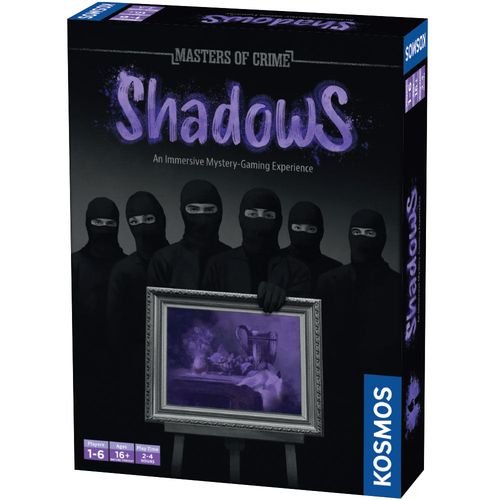
Masters of Crime: Shadows
Masters of Crime: Shadows Rulebook
Table of Contents
Table of Contents
The Case
This is your offer you cannot refuse: a gripping story, and you decide how it unfolds. The interactive crime game for home.
What's Inside a Masters of Crime Case
- A gripping story whose direction YOU determine.
- 12 envelopes containing mysterious documents, puzzles, and clues.
- 72 detailed, illustrated game cards.
- A Detective Board to write on and pin up, for recording your investigation.
- Various website links where you gather information, solve puzzles, and crack codes.
- A seamless blend of fiction and reality — use search engines you already know, write emails, and call suspects to get hold of every piece of information.
Contents
72 game cards, 12 objects, 1 Detective Board, 1 notepad.
Important: internet access is required.
Ages: 16 and up. For 1–6 players. Playing time: 2.5–4 hours.
How the Story Is Played
With every decision you make, the course of the thriller changes. A willingness to take risks won't hurt you here — but up to what point? Get to know exciting locations and masterful accomplices.
Interactive Help
You receive important information through authentic websites and via Google Maps. When you find a fully written-out phone number, you can try giving it a call.
Tips and Help
Should you reach a point in the game where you don't know how to continue, that's no problem.
First, look again at all the illustrations on the fronts of the revealed cards and on the objects. They help you solve puzzles, make important decisions, and uncover new locations.
Next, check whether you have perhaps found a complete phone number marked with a handset symbol. You can call these numbers.
If that still hasn't helped, help for every object and every card is available. Simply click the tab for the card or object you'd like a tip for. The hints for the cards are split into up to two levels of assistance and a solution.
Further down the help page you can also get tips on the game's central questions, which mainly concern choosing your crew members and making decisions about the theft itself.
Note: the game's dedicated hint pages give the specific, spoiler-bearing content for each individual card and object — including the exact hints, solutions, and code answers. Because Masters of Crime: Shadows is a one-time-solvable mystery, that case-specific content is intentionally left out of this transcription.
Entering Codes
Select which card or object the "enter code" symbol appears on. Here you can both enter codes you've found and find out what kind of code is being sought for that particular card.
Please enable JavaScript in your browser to complete this form.
Note: the actual code-entry form is populated with the specific questions, answer fields, and outcome text for each card and object in this case, all of which reveal solutions to the mystery. That case-specific content is intentionally left out of this transcription.
Saving the Game
The game can be paused and saved at any time, so you can take a break of any length. We recommend taking a break after about 120 minutes of play. If you prefer, you can of course play the game through without interruption. To save the game, sort the cards into piles as follows and bind each pile together with a rubber band.
- Pile 1 gets all cards that have already been discarded. You no longer need these cards.
- Pile 2 gets the draw pile, with all the locations currently laid out that you have not yet made a decision about. Note on the enclosed notepad which locations are currently laid out.
- Pile 3 gets all cards that have already been read and drawn. You can look through this pile again when you load the game, to refresh your memory.
- Pile 4 is the execution pile. Simply leave it exactly as it lies on your "Heist Board."
Put all documents you have already opened back in the box. With this sorting and the notes on the Heist Board, you can dive straight back into the art heist.
Saving and Loading, in Short
- Pile 1 → All discarded cards.
- Pile 2 → Draw pile and openly laid-out locations (note the locations on the Detective Board).
- Pile 3 → All cards already drawn and read.
- Pile 4 → Execution pile.
Put all other materials back in the box.
Loading
- You can leave all the cards from Pile 1 in the box.
- Without looking at Pile 2, lay it out as the draw pile.
- Draw all the locations from Pile 2 that you noted on the Detective Board.
- You may look through Pile 3, as well as all opened objects, to refresh your memory.
- You may not look at Pile 4. Leave it exactly as it is and place it back on the "execution pile."
Resetting the Game
You can fully reset Shadows in order to play the game again at a later time. To do this, simply reseal the documents and sort the cards back into the deck in ascending order.
A printable version of the Heist Board, notepad, and select objects is available from the publisher's website for anyone who needs to replace a damaged or lost component after resetting the case.
The Heist Board
The Detective Board doubles as the "Heist Board," a large write-on-and-wipe-off mat that organizes play. It lays out slots for locations Location A through Location K, each with a place to slide in that location's card, a set of star boxes for tracking your progress, and a notes box for jotting down clues as you uncover them.
The board also holds:
- A draw pile slot, for the location cards you haven't yet resolved.
- An execution pile slot, for the cards you set aside to play later during the heist itself.
- Two symbol overview slots, for the reference cards that explain the game's icons.
- Two Heist selection slots — one for choosing your crew, and one for choosing which painting to steal.
Small icons throughout the board (an exclamation mark, sometimes paired with an arrow to a star) mark places where reading a card or resolving a location earns your team a star.