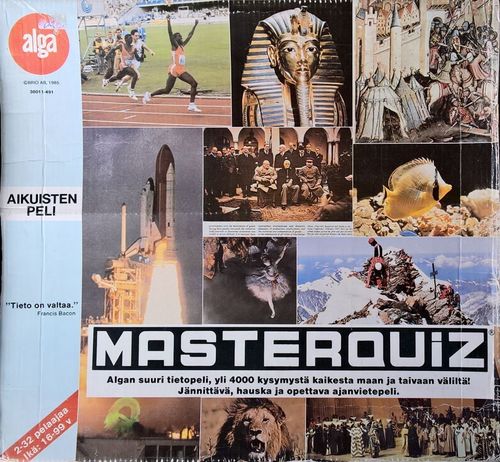
Masterquiz
Masterquiz Rulebook
Table of Contents
Table of Contents
Components
- One four-part game board.
- One die.
- Eight playing pieces in different colours.
- One card box with 840 cards carrying questions and answers.
- Small and large game markers in five different colours.
Setup
- Assemble the game board and lay it in the middle of the table, within reach of all players.
- Remove the lid from the card box and take the protective plastic off all fifteen card decks, then put all the cards in the box. It does not matter in what order the cards come, as long as they all have the question side (the one with red edges) facing the same way.
- Remove all the plastic markers from their respective "trees" and place them in the bank (preferably ask the game).
- Each player or team chooses a playing piece and places it on the start square. (Since there are eight playing pieces in the game, you must automatically form teams if there are nine or more players. You may also form teams with fewer players. The teams need not have the same number of players; the players decide this themselves.)
- Everyone rolls the die. The highest roll starts, and play then continues clockwise.
Playing the Game
General Rules
Each time it is a player's turn, he or she must first roll the die and move their playing piece. The player then tries to answer a question whose category is determined by the square the piece has landed on.
As long as a player answers correctly, they get to roll again, move the piece and try to answer a new question, and so on. If a player does not answer correctly, their own turn ends at once and the turn passes to the next player or team.
Note that the game board is divided into three "levels", plus the goal square at the top. The lowest level, which consists of 17 squares, holds the start square.
When a player manages to fulfil certain conditions, they may move their piece up from the lowest level to the middle level, which consists of 13 squares. In the same way, when new conditions are met, a piece may move from the middle level to the top level, and then from the top level to the goal square.
Within each level, a piece must at all times move anticlockwise. Follow the arrows! Two or more pieces may stand on the same square.
Subject Squares
There are five types of subject squares, which correspond to the five question categories. Each subject square is also marked with a colour corresponding to its category. The 4200 questions are divided into the following five categories:
- H (yellow): History and "social studies" ("samhällskunskap")
- G (blue): Geography and travel
- K (red): Culture (books, films, music, etc.)
- N (green): Natural sciences (animals, space research, etc.)
- B (white): Mixed (can be whatever at all!)
Note that all the category concepts are to be interpreted "broadly": within geography, for example, you may come across cities from songs, and so on.
If a player's piece lands on a subject square, the participant to the right of the player draws the top card from the card box (with the red question side facing up) and reads aloud the question that matches the subject square. The card should be held so that the player who is to answer cannot see the correct answer on the back.
As soon as the player has given an answer and it has been compared with the correct answer on the card, the card is put back at the very back of the box. In this way the next question is always read from the next card, and so on.
Correct and Incorrect Answers
A player has the right to have the question read again, if they so wish. In addition, the player has a reasonable amount of time to think. What is reasonable is decided by the participants themselves, but about 30 seconds may be suitable. Note that a player has only one attempt at an answer. Of course it is fully permitted to guess wildly if the player cannot work out the answer.
In team play, team members are welcome to confer among themselves, but once they have decided, there must be no doubt about which answer they have agreed on.
After a player has given their answer, the person who read out the question shall also read out the answer on the back of the card for comparison. If the answer is deemed correct, the participant whose turn it is may roll again and continue. If the answer is deemed wrong, the turn passes to the next participant.
Since this is a quiz game, the participants must decide for themselves what is required for an approved answer: for example, whether both first and last name must be given, or whether a year or a place name must be exact. All such questions should be settled in friendly discussion, in the spirit of the game as social entertainment. In the final analysis, however, the participant who read out the question has the final say.
Plastic Markers
If a player answered correctly, they immediately take from the bank a plastic marker of the matching colour (yellow for history, etc.). All markers a player receives must be kept on the table in front of them.
Small markers count as 1 and large markers count as 2.
Important rule: a player may have at most three markers in each category! (That is, three small markers, or one small and one large.) If, for example, a player already has three blue markers and answers a new geography question correctly, they receive no new marker, but they do, as usual, roll again and move on.
Special Squares
Chance squares: If a player lands on a chance square, they may choose the question category themselves. Otherwise the same procedure applies as above.
Roll-again squares: If a player lands on such a square, they do not answer any question, but instead roll again and move on at once.
Start square: Once the game has begun, the start square is counted in the same way as a roll-again square.
Chance-or-roll-again squares: If a player lands here, they choose: either roll again at once and move on, or choose a category and try to answer a question as above.
Pot squares: If a player lands on a pot square, the opponents must agree which category applies, and the player then tries to answer a question just as above. But if the player answers wrongly, the plastic marker must not stay in the bank: it must immediately be placed on the pot square of the matching colour, at the top of the board (level with the goal). Note that there are two different colours of pot squares! Note also that there may never be more than two plastic markers on any pot square.
If a player lands on a pot square and answers the question correctly, they receive one plastic marker in the right colour and also the marker or markers lying in the pot (if the pot is empty, they receive none). The colours of the markers in the pot do not matter; the player receives them anyway. (But remember that the rule of at most three markers of each colour always applies. If the player would be "full", the marker or markers stay in the pot.)
Duel squares: If a player lands on such a square, the following happens. First the player chooses a category themselves. The participant to the right then draws the next card as usual and reads out the question. If the player answers correctly, they receive a marker as usual and may roll again. But if the player answers wrongly, the question passes to the next participant or team clockwise, and so on around the table, with the exception of the participant who read out the question; that participant or team may not take part (someone must of course check the answers!). If nobody can answer correctly, it is simply the next participant's turn as usual. But if someone answers correctly, the turn passes to that participant or team, who immediately both receives the plastic marker and continues by rolling and moving.
If only two participants are playing, the duel square counts as an ordinary chance square.
Moving Up Between Levels
Moving up from the lowest level to the middle level: If a player a) can land on one of the two squares marked "Up", and b) has at least three markers (they need not be of different colours), the player may move their piece up at once to the duel square in the middle level. After that, the turn passes automatically to the next participant.
Note that the above does not apply "retroactively": a player must already have their three markers when they land on an "Up" square. If a player had fewer markers, landed on one of the Up or pot squares, and answered correctly so that they suddenly had three markers or more, they must nevertheless move on, and instead hope to be able to move up on the next lap.
Moving up from the middle level to the top level: If a player a) can land on one of the two squares marked "Up", and b) has at least six markers (it is not necessary for all five category colours to be represented), the player may move their piece up at once to the duel square in the top level. After that, the turn passes automatically to the next participant.
Just as above, the conditions here do not apply "retroactively": a player must already have their six markers when they land on an "Up" square. Note also that a player keeps their plastic markers the whole time; they can never be got rid of. It is therefore possible for a player to collect six or more markers quickly while still on the lowest level, which makes the passage through the middle level up to the top level all the faster.
Moving from the top level to the goal square: If a player a) can land on the Up/Chance square, and b) has nine or more markers (but now there must be at least one of each colour!), and c) can answer a question correctly (the player chooses the category themselves, since they are standing on a chance square), then the player immediately moves their piece to the goal square. If the player answers the chance question wrongly, the turn passes to the next participant as usual, and on the player's next roll they get to roll again, try to go round and land on the Up/Chance square once more, and try again.
Who Wins?
The participant or team that first succeeds in bringing their piece to the goal square has won.
Handicap Play
Thanks to the marker system, skilled and less skilled participants can compete on equal terms. For the less skilled, two, three or four markers may suffice to meet the promotion conditions, while for the really skilled the limit can be set higher, perhaps at four, seven or ten markers. What counts as a fair handicap is for the players to find out by trial and error.
Game Master
If you wish, you may appoint someone to be the game master. This person does not take part in the game, but has the task of distributing markers and reading out the questions, and of impartially deciding which answers are to be approved or rejected.
Extra Rule
In addition to the main rules, we can recommend this extra rule: when it is one's own turn, one may, whenever one wishes, forgo a dice roll and instead move one's piece the desired number of steps, provided one pays from one's stock of markers, one marker per square moved. This makes it easier to land on a promotion square, but of course it costs. This extra rule therefore speeds the game up somewhat.
Note that within a single turn a player may very well combine a dice roll with movement paid for with one or more markers. For example, a player first rolls, lands on a subject square and answers correctly, and so may continue, but then chooses to pay and move instead of rolling again.
Even for such a paid movement, the rules for the square the player lands on apply as usual, exactly as if they had rolled the die and moved.