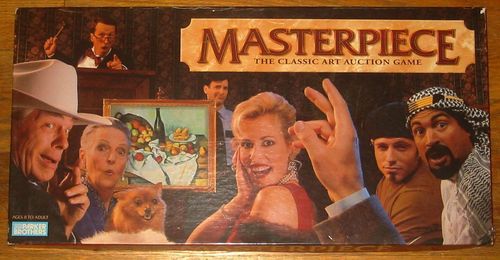
Masterpiece
Masterpiece Rulebook
Table of Contents
Table of Contents
Object
To be the player who has acquired the largest fortune in paintings and cash at the end of the game when all the bank's paintings have been sold.
Equipment
Game board; 6 Movers; 24 Painting cards; Display easel; 42 Value cards, 6 value charts; Millions in play money; Die
Assemble the Easel
- Have an adult use scissors to snip the A-shaped front easel piece and the back leg piece off the runners. Discard the runners.
- Snap the angled end of the back leg into the notch located halfway up the vertical center support on the back of the A-shaped piece.
- The completed easel will stand on three legs.
Setup
- Place the board in the center of the playing area. Each player selects a playing token and places it on any space on the circular track. (Instructions on these spaces are not obeyed at the start.)
- Remove the 6 value charts from the deck, and give one to each player. These show the distribution of the various value cards.
- Shuffle the value cards and place them face down in a pile on the playing board.
- Place the painting cards face up in a pile next to the value cards.
- Place the easel where all players can see it.
- Select one player to be the banker. If you're the banker, give all players, including yourself, $15 million (one $10-million and one $5-million bill) and place the remaining money in a convenient location.
- Each player in turn, beginning with the banker, draws one painting card and one value card from the top of the piles. Slip the value card under your painting so the value is hidden from the other players; always keep the values secret. Display your painting(s) face up in front of you.
Game Play: "Who'll start the bidding?"
- Roll the die for high score to determine who goes first. Play passes to the left.
- If you're the highest roller, roll the die again and move your piece that number of spaces. Depending on which space you land on, you have a number of options, as follows.
- For all board spaces that call for an "auction," see the Auction Rules on the back page.
- Movement is always clockwise around the board, and a space may be occupied by more than one player.
BANK AUCTION: Take the top painting from the pile and prop it on the easel. You and each of the other players may, but are not required to, bid on it. The actual value of the painting will not be known except to the highest bidder, who takes possession of the painting, draws the top value card and slips it under the painting, and pays the bank the amount of the winning bid, regardless of the value indicated on the value card.
PRIVATE AUCTION: Any of the other players may, but are not required to, bid on one of your paintings. If you have more than one, the painting to be auctioned is selected by the player on your left. Place it on the easel and auction it off. You may not enter the bidding. The new owner pays you the amount of the high bid, then takes possession of the painting and the value card(s) that was hidden underneath.
COLLECT $3,000,000 OR A VALUE CARD: You may collect the money from the bank or draw the top value card and add it to any one of your paintings. There is no limit to the number of value cards you can add to one painting; the value of any painting is the sum of all the cards underneath it. If you don't have a painting in front of you, you may not draw a value card; take the money instead.
If you draw a FORGERY, it must be assigned to a painting and it cancels the value of that painting. Once a fake, always a fake!
Once a value card is assigned to a painting, it must stay with that painting and may not be removed from it.
MAY BUY A PAINTING FROM THE BANK FOR $X DOLLARS: You may, if you desire, pay the bank the amount specified, and take the top painting together with the top value card. If you do not want to buy the painting, the play automatically becomes a BANK AUCTION in which all players participate according to Auction Rules, except that if you refused the painting, you act only as auctioneer and may not bid.
MAY SELL ANY PAINTING TO THE BANK: You have the opportunity, but are not required, to sell any one of your paintings to the bank. The value is determined by its value card(s). You will do well to sell an expensive painting, since you might be forced to sell it at a loss at a PRIVATE AUCTION. When you cash in a painting, display the value card(s) for all players to see, then put it aside, face down, along with the painting; both are out of play for the rest of the game.
MAY BUY A PAINTING FROM ANY PLAYER FOR $3,500,000: You have the opportunity, but are not required, to purchase any one painting of your choice (with its value card) from any other player for $3,500,000. The player who owns the desired painting must sell it if the buyer has the ready cash.
INHERIT A PAINTING FROM THE BANK: You receive free and clear the top painting from the pile on the board along with the top value card.
SELL A PAINTING TO THE BANK FOR $3,500,000: You must sell one of your paintings to the bank, which pays you $3,500,000, regardless of the value on the value card(s). You will do well to sell your least valuable painting (particularly a forgery if you have one), but you are required to sell, even if your least valuable painting is worth more than $3,500,000. When you turn in your painting to the bank, display the value card(s) for the other players to see, then put it aside, face down, along with the painting.
If you don't own any paintings, take no action on this turn.
Winning the Game: "...Sold!"
The game ends when the last painting has been drawn from the board and any action for that last card has been completed. Players add up their cash and the value cards on their paintings. The player with the highest total worth in cash and paintings is the winner.
Auction Rules: "Going once, going twice, SOLD!"
- If an auction occurs on your turn, you act as the auctioneer, even though you may be participating. You shall endeavor to maintain reasonable order during the auction and shall make final decisions in the event of disputes, but you must decide fairly and see that all these Auction Rules are obeyed.
- Place the painting to be auctioned on the easel.
- The opening bid must be at least $1 million.
- Succeeding bids must be in increments of not less than $500,000.
- Any player may open the bidding. Thereafter bidding is at random, without regard to the order of play around the board.
- If, at any time, you or another player are caught bidding an amount higher than your cash holdings, you must pay the bank a $1-million penalty; if you have less than $1 million in cash on hand, you lose your next turn. You may not be penalized for bidding above your cash assets if you are not discovered until after the high bidder has paid for his or her painting. If you're the high bidder and you have insufficient cash to pay for the painting, you must pay the bank $1 million and the auction is re-run; if you don't have $1 million, you lose your next turn. A high bidder with sufficient cash must pay the high bid for his or her painting even if another player without sufficient cash was involved in the bidding.
- In the event two or more players simultaneously bid the same amount and there is no higher bid, the auction is canceled.
- Play passes to the next player in the regular order of turns after a high bidder has paid and received his or her painting and value card.
- Borrowing cash from another player or the bank, and private sales of paintings are not allowed.
- Should the pile of value cards run out while the bank still owns paintings, shuffle any and all value cards already removed from the game* and place them face down on the game board.
*This may occur during May Sell Any Painting To The Bank or Sell A Painting To The Bank For $3,500,000.