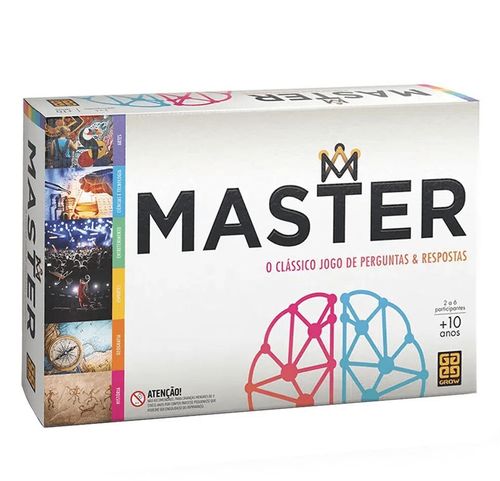
Master
Master Rulebook
Table of Contents
Table of Contents
Components
Participants: 2 to 9. Age: 14 and up.
- 1 board
- 605 question and answer cards
- 56 subject cards
- 1 scoring pad
- 9 tokens
- 9 stickers for the tokens
Setup
Cut out the stickers and stick them onto the tokens. The tokens are labelled with the following subject codes:
- AR (artes): Arts
- CI (ciências): Sciences
- CO (cotidiano): Everyday life
- EN (entretenimento): Entertainment
- ES (esporte): Sports
- GE (geografia): Geography
- H (história): History
- HN (história natural): Natural history
- V (variedades): Miscellany
Introduction
Master 3rd Edition can be played in four different ways. Each has its own rules, but there are common procedures:
a) In each round, everyone asks and answers once.
b) To ask a question, draw a card and read the question to the player on your left, taking care that they do not see the answer on the back.
c) Check the answer and return the card to the box.
Game 1
Game 1 can be played with 2 to 9 participants, using the board, the question and answer cards, and the subject tokens.
Goal
Be the first to reach the centre of the board by correctly answering the questions asked.
Setup
The participants decide how many tokens each will use. The quantity must be the same for everyone. For example, with 3 participants, each may play with up to 3 tokens. With more than 5 participants, it is only possible to play with one token.
Then everyone draws the tokens they will use, and each player places their token on the first space of the path corresponding to the subject they drew.
If you are playing with more than one token, decide the order in which they will be moved around the board: which token will be used in the 1st round, which in the 2nd, and so on. This sequence must be followed for the whole game. Finally, by any criterion you choose, decide who will ask the first question.
How to play
To advance one space, you must correctly answer a question about the subject of your token.
If you are playing with more than one token, alternate the subjects each round, following the defined sequence.
After correctly answering 4 questions on the same subject, your token will be in the position shown in the figure.
From then on, you must advance through the spaces marked with the subject initials and correctly answer a question about each of them, until you reach the space of your starting subject.
When you correctly answer a question about the last subject, you move the token to the centre of the board, and you become the winner.
If you are playing with more than one token, it is enough to reach the centre of the board with one of them to become the winner.
Hitch a Ride
When moving across the spaces marked with the subject initials, more than one token may occupy the same space. When this happens, the tokens are stacked in order of arrival.
The player who answers correctly advances one space with their token, but is obliged to take with them all the tokens on top of it. The tokens below stay in place.
Players whose tokens "hitch a ride" skip questions and can thus reach the end of the path faster. However, whoever reaches the centre of the board first is the only winner, even if they are carrying other players' tokens.
Caution: luck can turn into misfortune. If, while hitching a ride, you are forced to pass straight through your entrance to the centre of the board, you must go around the board one more time.
Game 2
Game 2 can be played with 2 to 9 participants, using the question and answer cards, the subject cards, and the scoring pad.
Goal
Be the first to correctly answer 3 questions on the same subject.
Setup
Players place the subject cards, face down, in the centre of the table. Give one sheet of the scoring pad to each player. By any criterion, decide who will ask the first question.
How to play
On your turn to answer, turn over the first subject card and place it on the table for everyone to see.
Answer a question on the subject indicated by the subject card. If you answer correctly, take your scoring sheet and mark an X in the column for the subject of the question. If you answer incorrectly, mark nothing.
Finally, leave the card on the table, together with the cards already used by the other players, forming a discard pile.
Then it is the next player's turn: they turn over the first card of the pile and answer a question on the subject it indicates.
The first player to correctly answer 3 questions on the same subject is the winner.
If, during the game, the subject cards run out, shuffle the ones already discarded and place them again in the centre of the table.
To make the game even more exciting, players may increase the number of questions to be answered.
Subject cards
There are three types of subject cards:
- Cards that indicate a single subject. Example: Sciences.
- Cards that indicate two subjects (they allow the player to choose which of the two they want to answer). Example: Arts or Sports.
- "Any subject" cards. There are two cards of this type, which give the player the option of choosing which of the 9 subjects they want to answer.
Game 3
Game 3 can be played with 2 to 6 participants, using the question and answer cards, the subject cards, and the scoring pad.
Goal
Be the first to correctly answer questions on a predetermined number of subjects.
Setup
Players decide on the number of subjects on which they will have to answer during the game. For example: only 5 of the 9 subjects.
Note: the subjects are not chosen, only how many.
Each player takes a sheet of the scoring pad to note the subjects on which they manage to answer correctly.
One of the players shuffles the subject cards and deals 4 to each participant. The remaining cards are stacked face down.
Finally, by any criterion, decide who will ask the first question.
Subject cards
There are three types of subject cards:
- Cards that indicate a single subject. Example: Sciences.
- Cards that indicate two subjects (they allow the player to choose which of the two they want to answer). Example: Arts or Sports.
- "Any subject" cards. There are two cards of this type, which give the player the option of choosing which of the 9 subjects they want to answer.
How to play
If, at the start of the game, it was decided that the match will cover 5 subjects, each player must correctly answer 5 questions, each on a different subject. The subjects vary according to the subject cards the players hold in their hands.
When it is your turn to answer, discard one of them face up on the table and answer a question on the subject it indicates.
If the card indicates two subjects, you must choose one of them. If you answer correctly, put an X in the column of the subject the question refers to. If you answer incorrectly, mark nothing on the scoring sheet.
Since the subject cards vary, the subjects marked on the players' scoring sheets will not necessarily be the same.
After each discard, take a new card from the start of the pile, so that you always have 4 cards in hand.
If you are lucky enough to draw one of the "any subject" cards, you may, on your next turn, discard it and choose one of the subjects that is not among the cards you hold in your hand.
The match continues with players discarding, drawing cards, and answering questions on the subjects indicated by them. The first player to correctly answer questions on the number of subjects agreed at the start of the match is the winner.
Game 4
Game 4 can be played with 3 to 8 participants, using the question and answer cards and the scoring pad.
Goal
Score the most points by correctly answering questions on the selected subjects.
Setup
Before starting the game, define the number of rounds, the subjects that will enter the match, and the round in which each subject will be covered.
For example, each match may have 4 rounds and cover 4 subjects, with Geography in round 1, Miscellany in round 2, Sports in round 3, and Arts in round 4.
Then the players take a sheet of the scoring pad and write down the initials of each subject, for scoring.
Finally, decide who will ask the first question.
How to play
Imagine you are going to answer the first Geography question. If you answer correctly, you score two points. Then it is your turn to draw another card and ask a Geography question of the player on your left.
If, however, you answer incorrectly, ask the same question of the next player: they will score only one point if they answer correctly. If they also do not know the answer, the question is repeated, always worth one point.
If, by the end of the round, no one manages to give the correct answer, the question is eliminated, and the players move on to answering about the second subject.
All points obtained must be marked on the scoring pad, and at the end of the game the points are counted. Whoever scores the most points is the winner.