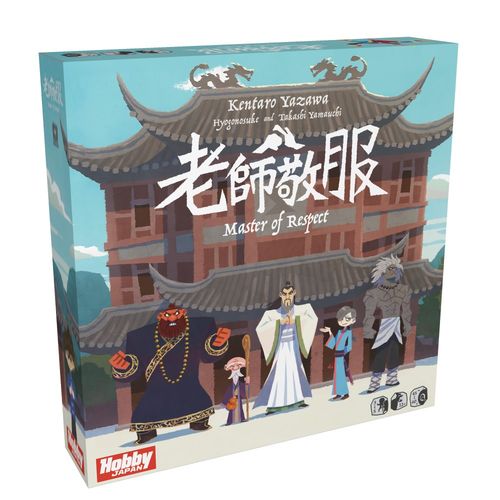
Master of Respect
Master of Respect Rulebook
Table of Contents
Table of Contents
Components
- Rulebook: One each in Japanese/English/German/French
- 1 round marker
- 5 master cards (front and back)
- 1 start player marker
- 5 screens
- 34 student cards: (16 starter students + 18 extra students)
- 39 action tiles (3 master tiles x5, 12 different technique tiles x2)
- 1 map (back of box)
- Items (30 gold tokens, 30 sake tokens, and 60 respect tokens — 1 respect x40, 5 respect x10, 10 respect x10)
Contents
- Object of the Game ...... 3
- Setting Up the Game ...... 3
- Game Progression ...... 4
- Ending the Game ...... 7
- Starter student ...... 7
- Extra student ...... 8
- Technique Tiles ...... 10
- Master ...... 12
Object of the Game
As a Chinese martial arts master, you seek students to inherit your style, take lessons, and bring success and prosperity to the dojo. Will your dojo thrive? That all depends on you, Master. That, and how much respect you can earn from the other masters...
How to Win: The player who amasses the most points is declared the winner.
Setting Up the Game
Player Set-Up
- Decide the starting player. The player who trained most recently becomes the starting player. If no one's trained recently, choose the starting player using whatever method you prefer. The chosen starting player places the starting player marker in front of them.
- Each player chooses one of the five master cards at random. Any remaining master cards will not be used in the current game.
- Take Bokunenjin starter student cards equal to the number of players plus one. Have each player pick one in counterclockwise order, beginning with the player to the right of the starting player. After choosing a card, players place it in front of themselves. The remaining Bokunenjin card is removed from the game.
- Each player takes a master tile corresponding to the master they took, along with a screen, and the starter student cards Touraku and Kasei. The remaining master tiles, screens, and starter student cards won't be used during the game and should be set aside.
- Each player takes items (gold, sake, and respect tokens) according to the icons on their master card.
Player Board Placement
a. Dojo — Student cards are placed here. b. Tournament Arena — A single student card and action tile are placed here. c. Storehouse — Items are placed here. Place cards so that they're visible to other players at all times.
General Game Set-Up
- Place any remaining items in the center of the playfield. This area is known as the town. There's no limit to the number of items players can have; if you run out, use something else as a replacement.
- Flip the box upside down so that the map on the bottom is visible, and place the round marker on the section of the map that designates the first round.
- Shuffle all the extra student cards together and place them face up. This is the deck.
- Draw extra students from the deck equal to the current number of players in the game plus one, and arrange them around the deck face up. This area is known as the bar.
- Split the technique tiles into three groups: A, B, and C. Shuffle each group face down, and flip the top card of each group face up. These three types of technique tiles will not be used in this game. Remove them and any matching tiles (six total) from the game.
Place the remaining nine types of technique tiles (each with two tiles each) face up next to each other in individual piles sorted by type. This area is known as the training grounds.
Game Progression
Each game consists of five rounds with four phases each.
The phases proceed in the following order:
- Impart
- Execute
- Tournament
- Upkeep
Tournament is skipped during the first round.
1) Impart
This phase is taken by all players at the same time.
Each player imparts a task to the students in their dojo.
Players do this by placing face-down action tiles for each of the students in their dojo behind the screen, making sure that other players can't see them.
You can place 1 action tile for each student. Master tiles have two actions on them, but you can only use the action adjacent to the student.
During this phase, you can freely adjust the placement of your student cards.
During the ②Execute phase, you'll reveal the action tile of your left-most student card. During the ③Tournament phase, your right-most student card and action tile will be entered in the tournament.
If you don't want to place an action tile for a certain student card, or if you've run out of action tiles or have nowhere to place them, you can choose not to place an action tile for a student card.
Place student cards without action tiles beneath the dojo in sideways position.
Once all players have decided on their action tiles and student order, proceed to the ②Execute phase.
2) Execute
All players put their screens away and reveal their dojos.
Player take turns carrying out their actions in clockwise order beginning with the starting player. After a player performs the steps below, the turn proceeds to the player to their left.
The player who's currently taking their turn is referred to as the "current player."
- Reveal action tile
- Execute action
- Demand respect
The ②Execute phase continues until the action tiles played during the ①Impart phase have all been revealed.
If a player has already revealed all their action tiles when they become the current player, skip that player.
(1) Reveal action tile
The current player reveals the leftmost face-down action tile and flips it face up.
When revealing action tiles, be sure to flip it horizontally to avoid flipping it in a way that disturbs card placement from the ①Impart phase.
Skills: When revealing a student card's action tile, if the student card has a skill, collect the specified items from the town before proceeding to (2) Execute actions.
(2) Execute actions
The current player executes the action(s) displayed on the tile.
If the revealed tile is a master tile, execute the action adjacent to the student card.
When revealing an action tile, you may choose not to execute the selected action.
The Four Actions
Action tiles are composed of the following four actions.
Receive Item(s) — Receive the items printed on the tile from the town.
Exchange Items — Pay the item shown on the left side to the town in order to receive the item shown on the right side in return.
Learn Technique — Take a technique tile from the training grounds. When you do so, it's necessary to pay the items shown to the town. Place the acquired technique in front of you. From the next round's impart phase, you can place it on top of one of your student cards just like any other action tile.
A single player can't acquire more than one technique tile with the same name.
A technique tile shows, in order: Name, Cost, Power, Effect, Points.
Invite or Train — Either acquire a new student card (invite) or flip over a previously-acquired student card (train). Choose one of the following two actions and execute it.
Invite: Acquire one student card from the bar by paying the items shown on the card to the town. Acquired student cards are placed below your dojo sideways.
A student card shows, in order: Name, Cost, Power, Effect, Points.
Players are free to check both sides of student cards in the bar at any time, but players are not allowed to look at student cards from the deck.
Train: Choose one face-down student card you have and flip it over. Choose one student card you want to flip over, pay the specified items to the town, and flip the chosen student over.
As long as you've acquired the student card, they can be chosen for training regardless of their position in your dojo.
When you respect invite or train action, you can choose a different action than the action chosen by the current player.
(3) Demand respect
After executing the revealed action, the current player, in clockwise order from the player to their left, demands respect. A player whose respect is being demanded chooses one of the following:
a) No respect. Do nothing. If you have no unused respect tokens, you must choose this.
b) Pay respects and perform an action. Flip over an unused respect token (turning it into a used respect token) and give it to the current player. The player who does so then gets to perform the same action that the current player just executed, but they don't receive any items from executing student skills. The current player places the used respect token they received on top of the student that performed the action.
(3) Once respects have been demanded, the turn proceeds to the player to the left.
Used respect tokens can't be used to pay future respects, but they do count toward points at the end of the game.
Tributes: When (3) demanding respects, if a respect token is put on top of a student card that has a tribute, a tribute occurs. Take the items shown on the tribute from the town and place them on the student card's tribute space. The number of spaces indicates the item limit. When all the spaces have been filled up, if the student card is respected by another player, only take the respect token. You do not receive any of the tribute items.
Items received from tribute are claimed during phase ④Upkeep and can be used in the following round.
3) Tournament
Skip this phase during the first round.
This phase is carried out simultaneously by all players.
During the ③Tournament phase, the rightmost student in the dojo enters a tournament. Each player moves their student card and its action tile to the arena together as a pair.
If any card/tile pairs are still in the arena from the previous round's tournament, return them to their dojos.
Total up the power of each student card and action tile pair. The highest takes first place. If there's a tie with another pair's total, the pair with the higher-powered student card wins. If there's still a tie, the pair belonging to the player closest to the starting player (according to clockwise order) wins.
The prize for each placing varies by round. Once all players have received their prizes, the game proceeds to the ④Upkeep phase.
List of prizes
| Placing | Round 2 | Round 3 | Round 4 | Round 5 |
|---|---|---|---|---|
| 1st | 1 gold + 1 sake | 2 unused respect tokens + 1 gold | 4 unused respect tokens | 6 unused respect tokens |
| 2nd | 1 gold or 1 sake | 1 gold or 1 sake | 2 unused respect tokens | 4 unused respect tokens |
| 3rd | 1 gold | 1 gold | 1 unused respect token | 2 unused respect tokens |
4) Upkeep
This phase is carried out by all players at the same time.
④Upkeep is carried out in the following order.
- Retrieve action tiles.
- Retrieve used respect tokens and tributes.
- Bar upkeep.
- Move round marker.
(1) Retrieve action tiles
Return any action tiles played on students in dojos to the playfield. Action tiles in the arena stay where they are.
(2) Retrieve used respect tokens and tributes
If there are any used respect tokens or items received as tributes on top of any students, move them to their respective player's storehouse. Make sure not to forget to do this for any students in the arena.
(3) Bar Upkeep
Shuffle all extra students in the bar together and place them at the bottom of the deck, then replace the students that were in the bar by drawing from the deck (there should be one more student than the current number of players). If there aren't enough cards in the deck, place student cards in the bar until you run out.
(4) Move Round Marker
Check the current round number by looking at the map. If the round marker is on the fifth round space on the map, proceed to final scoring calculations and ending the game.
If not, move the round marker to the next round.
The player who currently has the starting player marker passes it to the player to their left.
From there, the next round starts from the ①Impart phase.
Ending the Game
Totaling Points
Once the fifth round ends, the game is over, and points are totaled up.
The plain yin-yang symbol (☯) is worth 1 point, and the shaded yin-yang symbol is worth -1 point (subtract them from your score). Each player adds up points according to the below criteria and calculates their final point totals:
- 0.5 points for each used respect token.
- 1 point for every 5 items in your storehouse (gold, sake, unused respect tokens).
- Points from any technique tiles you obtained.
- Points from any student cards you obtained.
- Bokunenjin calculates points in a unique way described on the right (see below).
The player with the most points is the winner. If there's a tie, the player with the most used respect tokens is the winner. If there's still a tie, the game is declared a draw between those players.
Determining Points
The plain yin-yang symbol (☯) = 1 point. The shaded yin-yang symbol = -1 point.
Bokunenjin calculates points in a unique way described below.
| Category | Tier 1 | Tier 2 | Tier 3 |
|---|---|---|---|
| Student Points — number of student cards they have | 4 | 5 | 6~ |
| Technique Points — number of action tiles they have | 6 | 7 | 8~ |
| Gold Points — amount of gold they have | 1~ | 3~ | 5~ |
| Sake Points — amount of sake they have | 1~ | 3~ | 5~ |
| Token Points — number of unused respect tokens they have | 1 | 2 | 3~ |
At the end of the game, players earn points corresponding to the thresholds shown for each category above. Bokunenjin's owner uses the bottom row (2, 3, or 5 points) in place of the normal per-card point count.
Starter Student
豆楽 Touraku
Brought under the care of an elderly couple after the loss of his parents, Touraku's incessant rowdiness led to him ending up in his master's care. He may look like a disrespectful punk, but that's just because he hasn't yet learned to restrain his anger when confronted with the unfair way the world torments the weak.
花生 Kasei
After losing his family, Kasei lived life on the edge. Thankfully, his master's house happened to be built precariously close to it. Kasei now views his master like a father...and drinking buddy. Possessed of a profoundly sensitive nature, Kasei's heart fills to bursting with gratitude after the slightest of charities.
朴念仁 Bokunenjin
A taciturn monk who just kind of showed up in the dojo at some point. He speaks only when necessary. Attempting to get him to talk about his past is an exercise in abject futility.
Extra Student
1. 澄譽 Choyo
Beautiful and ambiguous of gender, those who survive this gorgeous assassin's sultry ploys must then contend with a sharp and terrifying martial onslaught. Should Choyo manage to land a precision strike on your pressure points, it's too late: You're already dead.
2. 董芙 Tofu
An unassuming village girl, Tofu's something of a slow starter, and is more childlike than her actual age would suggest. She enjoys practicing martial arts as something of a game, and she's learning fast. She's also noticed Ogura and his son's wife (that is to say, the wife of the current king) meeting for a secret rendezvous or two.
3. 於蔵 Ogura
Once the king of a great kingdom, he's long since bequeathed his power and position to his child, and now lives in secret. He's led a life of love won and lost (but mostly won), and remains an active lothario with beaus in towns across the land. Before you judge, please realize that he's serious in the moment, and never forgets a past love.
4. 厨義 Chugi
Ingen's brother-in-law. Though born without the use of his eyes, Chugi can "see" his surroundings very clearly with his enhanced sense of noise and movement. Quick to anger, there's little Chugi finds more intolerable than being pitied for his condition, frequently quarreling with others when they cross the line.
5. 燈玄 Dogen
Dogen spends his days wallowing in the throes of despair after contracting a terrible lung disease. Convinced that his illness is a curse wrought by a great evil infesting the world, he plays a dirge on his erhu night after night, slaying those he judges to be evil with a swift swing of his blade.
6. 鼓鼓 Gugu
A chance encounter with a wandering saint-in-training awakened this wild panda to the way of the fist (and other appendages), and he continues practicing the poses and strikes he was taught within the bamboo forest he calls home. Gugu once rescued Kasei after he made a mountain road misstep, which led to the panda teaching Kasei all the techniques he had on offer.
7. 豈叡 Kaiei
A born prodigy, Kaiei is a skilled practitioner of the arts, both literary and military. His keen sense of pride, combined with an acute loathing of the unambitious, makes him quite the challenging fellow to get along with. Anko, being of similar age and ability, makes a particularly good case in point, with the two incessantly fighting like cats and dogs.
8. 那登 Natto
A walking tree trunk of a man, Natto runs a butcher shop. His tough exterior hides a gentle soul and people person. After seeing a beautiful woman in the village some time ago (Syouyu), she's been burned into his mind ever since.
9. 笹解 Sasage
One of the daughters resulting from Ogura's days of illicit romance. Her mother perished shortly after her birth, and since Ogura wasn't there to witness it, she came to believe that he abandoned her. She now lives with her younger sister as a mountain robber, waiting for the chance to exact revenge on her father.
10. 亜鋤 Azuki
One of the daughters resulting from Ogura's days of illicit romance. Her mother perished soon after her birth, forcing her still young elder sister to raise her instead. Desperate for the love of her father, she's opposed to her sister's quest for revenge, and secretly wishes to reunite with Ogura and live with her family once more.
11. 胤元 Ingen
Chugi's brother-in-law. A kind brother with a tenuous grasp of hand-to-hand combat, Chugi occasionally shows great leadership and skill as a salesman...something few seem to notice.
12. 甇禅 Rozen
Just a frog. Those who study martial arts typically do so by imitating the motions of animals, so from the perspective of a martial artist, this frog definitely seems to know what it's doing...
13. 淵道 Endou
Taken in by Shinzu after an assassin (Choyo) killed his parents, Endou is in secret possession of scrolls detailing ancient and deadly techniques, making him a wanted man by many...including his adopted father. He hides behind a mask to prevent others from knowing his fear.
14. 庵虚 Anko
Abandoned in the mountains and raised by monkeys, Anko found a scroll detailing secret and deadly techniques and proceeded to teach himself the fundamentals of martial combat by imitating the pictures. Clearly a prodigy. After finding his master, he quickly mastered a smorgasbord of powerful moves, and is taking to the world of humans just fine.
15. 荳宗 Tousou
A middle-aged performer who mastered the "Skill of Nephrite Belt," one of the 72 Arts of Shaolin, on a lark. Having learned the ability to harden his body at will, a swift kick from Ingen is as hard and painful as a spear strike.
16. 宵瑜 Syouyu
A beautiful and sharp-witted woman who hides her gender by dressing as a man. Moody and prone to acts of wanton cruelty, she can shake hands with someone one minute, and strike them down the following should the feeling strike.
17. 真逗 Shinzu
A kindhearted man who brought Endou under his wing...or so he seems. His true goal is to steal Endou's secret scrolls in the hopes of selling them for a staggering sum. He instructs Endou in the meantime, waiting for just the right moment...
18. 豊心 Hosin
A monk of profound nobility, honesty, and sincerity, Hosin does not doubt others, and is easily deceived in return...but he'll still try to view it as a learning experience. He's reluctant to harm others, and rarely fights with his full strength.
Technique Tiles
A1. Delightful Dragon Kick
A delightful, sharp kick that conjures up the majestic form of a dragon rising toward the heavens. When performed by a master, onlookers will likewise feel the urge to applaud—and cough up some coin—rising within them.
Receive 2 gold from the town.
A2. Respectful Rush
Instill a sense of awed reverence in those around you with stunning choreography and bold eye contact. Those fortunate enough to bear witness to this technique will find themselves on their knees, heads bowed low in admiration.
Pay 1 gold to the town, receive 2 unused respect tokens from the town.
A3. Banquetmaker
Lead your audience's attention on a journey to the feast (specifically: yours). With movements untraceable to the human eye, your average bystander won't even know what hit 'em. And even if they do, they're probably dead or in the hospital.
Receive 1 sake and 1 gold from the town.
A4. Valorbringer
With a spirit like steel, pain and fear are now things of the past. Those who perfect this technique will find the strength of mind to push forward to victory, free of fear and untouched by the blows of their enemies.
Receive 1 unused respect token from the town. You can then choose to learn a technique.
B1. Dirge of Golden Beads
Unleash this technique, and all who hear its decadent dirge will fall under your spell. A master manipulator can make those within their thrall obey their every whim.
Receive 2 gold from the town. You can then choose to learn a technique.
B2. Falling Lotus's Dragon Fist
One of the sacred techniques said to have been created by the holy monk known as Falling Lotus. Mastery of this move allows its wielder to strike foes with a decidedly dragon-esque flurry of blows. Falling Lotus also created techniques inspired by tigers, hounds, snakes, and monkeys. A lotus by any other name would hurt just as badly...
Receive 1 gold from the town. You can then choose to invite or train.
B3. Drunken Tiger's Palm
A mysterious technique that, by emitting spirit energy (along with a large amount of alcohol) in the immediate vicinity, can cause onlookers to witness phantasmic visions. Because of the large amount of alcohol that users of the technique must ingest beforehand, only those capable of maintaining composure in the face of legendary drunkenness need apply.
Receive 2 sake from the town.
B4. Danse Metempsychosis
Attach bells to your fist and prepare to dance in honor of souls past. Beyond its use in purification ceremonies, it is said the virtuous can use this dance to soothe the souls of even the most barbaric of fighters, purging them of the will to fight.
Receive 1 gold and 1 unused respect token from the town.
C1. Falling Lotus's Sacred Fist
One of the sacred techniques said to have been created by the holy monk known as Falling Lotus. By vibrating one's fist at supersonic speeds, any foe that stands in your way will be rent asunder. If on your journey you should encounter God, God will be punched.
Receive 1 sake from the town. You can then choose to invite or train.
C2. Reverent Fist
Use the powers of reason to release a concentrated stream of finely honed fighting spirit, but take heed: Falter in the heat of combat, and you will find yourself unable to execute the technique. It is for this very reason that those who bring its powers to bear receive the respect and admiration of their opponents.
Receive 1 sake and 1 unused respect token from the town.
C3. Dragon Overseer's Palm
Unleash a roar as you imitate the opening of a dragon's maw with your palms, and all that stands in your way will be torn asunder. Once, a practitioner unleashed this technique deep within the mountains, causing villagers to mistakenly assume the arrival of a terrifying dragon.
Receive 1 unused respect token from the town. You can then choose to invite or train.
C4. Dance of the Mad Bird
By performing a dance involving the use of two willow leaf blades, one can unleash a truly unpredictable barrage that will lacerate any foe. With a flurry of movement not unlike that of a wild bird swooping in on its prey, those unlucky enough to be in the vicinity will wake up the next morning covered in difficult-to-explain cuts.
Receive 1 gold and 1 sake from the town. You can then choose to learn a technique.
Master
東正 Tosyo
After establishing a dojo on an easterly hill, Tosyo now spends his days teaching eager students. Though an accomplished fighter, he retired and never bothered revealing his true name, so people came to call him Tosyo, a reference to his easterly location and strong sense for doing what's right.
Play Tips: A balanced master suited for new players. Because of Touraku's high victory points, you should be able to get a significant number of victory points by gathering and training 5 students.
西富 Seifu
Seeking acclaim, Seifu left his wealthy family to become a martial-artist. His impulsive nature causes him to butt heads with others, but that's nothing his money and brute strength can't fix.
Play Tips: Use your abundant starting items to get an extra student card and technique tile from the first round and increase your options. Both Touraku and Kasei have tributes, so acquiring technique tiles that would be respected by others is a core strategy.
南俊 Nanshun
Renowned as a prodigy since he was eight, Nanshun is a clearheaded and brilliant young fighter with distinct opinions about how to fight. New disciples who quickly rise through the ranks are sure to receive praise from him.
Play Tips: Training Touraku will earn you skills, so it's a good idea to train her in the early rounds. Kasei can earn you respect tokens through tributes, so victory can hinge on whether or not he gets respect.
北禅 Hokuzen
A wizened fighter who runs a dojo deep in the northern mountains. Possessed of a strong sense of virtue, there are always new students looking to join the ranks of his disciples. Despite his meager means, he's skilled at employing others to keep the dojo running.
Play Tips: Hokuzen's master tiles don't allow you to learn techniques, so you'll have to make use of his two respect tokens to win. Touraku also learns powerful skills through training, so choosing the right time to train him is key.
中猛 Chunmou
A true master of the fist, Chunmou thinks only of honing his abilities. Those who wish to become his pupils are true believers in Chunmou's philosophy, providing him a healthy supply of powerful fighters to raise in his image.
Play Tips: With a powerful starting student, you should aim to win tournaments early and often. Using the powerful actions on his master tiles properly is a true test of skill.
Master Tiles
Master tiles are composed of combinations of the following 8 actions. Each master has a different combination.
- Gamble — Receive 1 gold from the town.
- Drink — Receive 1 sake from the town.
- Meditate — Receive 1 unused respect token from the town.
- Give Lesson — Receive 2 gold from the town.
- Buy Sake — Pay 1 gold to the town, receive 2 sake from the town.
- Feast — Pay 1 sake to the town, receive 2 unused respect tokens from the town.
- Learn Technique — Take a technique tile from the training grounds. (See page 5.)
- Invite or Train — Acquire a new student card from the bar (invite) or flip over an acquired student card (train). (See page 5.)