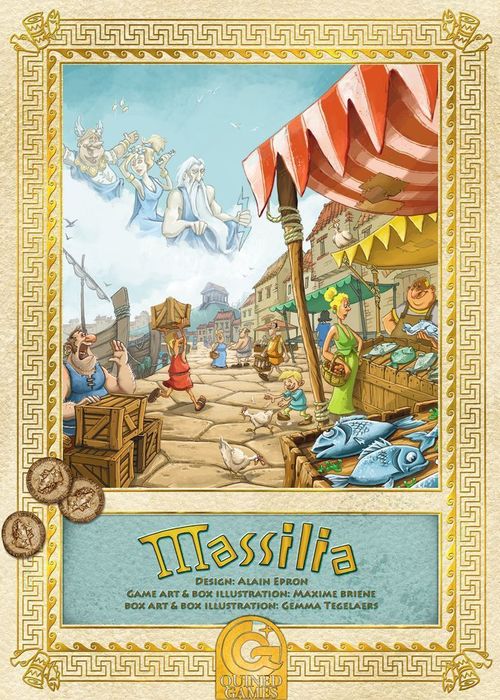
Massilia
Massilia Rulebook
Table of Contents
Table of Contents
Object of the Game
In MASSILIA, you have one week to grow your business and establish the best reputation in town.
To accomplish this you will set up your market stalls and supply them with goods to meet the demands of your customers. Satisfied customers provide the best word-of-mouth. In addition, you can curry favor with the Consul, directing him to your rivals so that he can upset their plans instead of yours.
Finally, you can make offerings to the gods, whose assistance will often be very helpful.
Setup
-
Place the board in the middle of the table.
-
Place the 10 BEIGE goods cubes as well as 6 PURPLE, ORANGE, and PINK in their respective areas of the port on the board.
Place the rest of the GOODS cubes in the bag.
Place the SESTERCES and 10 PENALTY tokens per player near the board to form a general reserve.
-
Shuffle the DIVINITY cards and place them facedown in the space provided on the board.
-
Randomly place the four CHARACTER pawns on the center spaces of each side of the market.
-
Place the TURN marker on the first space of the SUNDIAL time track.
-
Place randomly, face up, one PRICE tile on each space provided on the board (one at the Temple and one at each of the PINK, ORANGE, and PURPLE port areas).
-
Place the TURN ORDER tiles in a face up stack on the space provided on the board. The stack should be sorted with highest value tiles on top.
With two players, return the tiles of values 3 and 4 to the box. With three players, return the tile of value 4 to the box.
-
Place the POINTS tokens (PINK, ORANGE, and PURPLE) on the value "2" spaces of the tracks next to their respective port areas.
-
Place the "+50" tiles near the board.
-
Each player takes a screen, stall tiles, and PLAYER tokens of one color. They place their small PLAYER token at the start of the reputation track.
-
Randomly determine turn order. Each player places their large PLAYER token on the corresponding space of the board's turn order track. The first player will be on the space with the lowest value.
-
Each player places one die of each color (GREY, BROWN, BLACK, and BEIGE) behind their screen.
In addition, place one die of each color on the matching Temple areas of the board. Any remaining dice can be returned to the box, as they will not be used in the game.
- Starting with the first player and proceeding clockwise, each player places one STALL tile on a free market space on the board. Each player must place their STALL tile in a different corner section of the market, but may choose any of the three spaces in the section. They then draw 3 GOODS cubes from the bag and place them on the STALL.
If playing a two player game, repeat this step, reversing the player order.
- Each player takes 6 SESTERCES from the bank and places them behind their screen.
General Rules Concerning Tiles, Goods, Sestertces, and Penalty Tokens
One stall can hold all type of good but can never hold more than 6 goods in total.
Players' SESTERCES and PENALTY tokens are always kept behind their screens.
The BEIGE goods are special. Their use and effects are explained later in the rules.
Game Play
The game is played over seven rounds. Each round consists of three phases.
Phase 1. Preparation (skip during round one)
Rotate the PRICE tiles one space to the left (Temple -> PURPLE port area -> ORANGE port area -> PINK port area -> Temple).
Randomly draw GOODS cubes from the bag (8 cubes in a 2-player game, 10 for 3 players, or 12 for 4 players) and place them in their respective port areas, adding them to any goods already present. If there aren't enough cubes in the bag, simply draw until it's empty.
Phase 2. Rolling the Dice
Roll all dice currently in the Temple and place them back on the Temple spaces matching their color.
The first player then takes any dice that are behind their screen and rolls them in view of all players. The player may keep 1 or more dice in a personal reserve by paying 2 SESTERCES per die. The reserved dice are kept in front of the player, in view of their opponents. The unreserved dice are placed in their corresponding areas of the Temple.
Continuing in turn order, each subsequent player then takes any dice from behind their screen and repeats this process.
Ex: The first player rolls the dice in front of him and decides to place the two BROWN dice and the BLACK die on the Temple. He keeps the BEIGE die in his personal reserve, paying 2 SESTERCES to the bank.
Phase 3. Actions
Beginning with the first player and continuing in turn order, each player takes one of the following two actions:
-
Take one die from the Temple or from their personal reserve and apply its effect (see DICE EFFECTS). The die is then placed behind their screen.
A player may, by taking 1 PENALTY token, ignore the color of the die and apply the effect of their choice. A player may also, by taking 1 PENALTY token, add or subtract 1 to the value of a die, or transform a 6 into a 1, or a 1 into a 6. Finally, 1 PENALTY token may also be taken to claim an extra die, adding its value to any others taken (all dice must be able to yield the same effect, however). Multiple PENALTY tokens may be taken during a single turn, up to the number of available tokens, and these powers may be used multiple times. Thus, a player may take 2 PENALTY tokens to, e.g., add 2 to the value of a die or to take 2 extra dice.
-
Pass their turn and take the TURN ORDER tile with the highest available value. The player then receives SESTERCES from the bank equal to the value of the tile. They place the tile in front of them, and then remove their large PLAYER marker from the TURN ORDER track and place it on top of this tile. The player will no longer participate in this game round. The last player to pass does not take a tile, but instead simply moves their large PLAYER marker to the first space of the TURN ORDER track.
The players continue taking actions in this fashion until all players have passed. A player may continue taking dice actions even if all other players have passed.
End of Round
Each player places their large PLAYER marker on the TURN ORDER track in the space corresponding their TURN ORDER tile. Then they return their TURN ORDER tiles to a stack on the board, sorted as before with the highest-value tiles on top. The TURN marker is then advanced to the next space.
Dice Effects
Each color of die corresponds to a particular action. The game board contains printed reminders of each color's effects.
BROWN Die: Move a Client or the Consul
The player MUST move either the CONSUL (the WHITE pawn) or a CLIENT (the PINK, ORANGE, or PURPLE pawn) a number of spaces equal to the value indicated by the die and apply the effects of movement (see "Clients" and "The Consul"). The pawns may be moved in either direction, but must move the full distance in one direction. Multiple pawns may share the same space.
Ex: The RED player selects a BROWN die of value 4 and chooses to move the PURPLE client. He first takes a PENALTY token to reduce the value of the die to 3. He then moves the PINK client three spaces to his market stall and sells him a good (see "Clients").
BEIGE Die: Buy Goods from Port
The player MUST buy, from port, a number of GOODS cubes equal to the value of the die. The cubes must be of a single color (PINK, ORANGE, or PURPLE), and the player must pay SESTERCES for each cube equal to its port area's PRICE tile.
However, the player may purchase any number of BEIGE goods as substitutes, so long as at least one good of another color is purchased and the total number of purchased goods equals the value of the die. The BEIGE goods each cost SESTERCES equal to the PRICE tile in the BEIGE port area.
The player places the goods on their market stalls as they see fit, so long as each stall has no more than 6 GOODS cubes on it. Previously placed GOODS cubes may not be moved or discarded.
The player then reduces the POINTS token matching the GOODS taken by 1 space on its track. If the token is already on the "1" space of the track, it is not moved any further.
A player may not take this action if they do not have enough SESTERCES, enough room in their stalls, or if there aren't enough available cubes at port.
Ex: A player chooses a BEIGE die with a value of 5 and buys goods at port. He uses a "Neptune" DIVINITY card to reduce the die to 4. He then buys 2 PURPLE goods for the price of 4 SESTERCES (2x2), and 2 BEIGE goods for the price of 2 SESTERCES (2x1). He pays 6 SESTERCES to the bank, and places the 4 GOODS cubes on his stalls. The DIVINITY card is discarded. Finally, he reduces the POINTS token on the PURPLE goods track by 1.
GREY Die: Make an Offering to the Gods
The player draws as many DIVINITY cards as the value of the die. They then MUST add at least one of these cards to their hand (but may add more). For each card kept, the player discards 1 PINK, ORANGE, or PURPLE cube, or 2 BEIGE cubes (taken from any mix of stalls). The remaining cards are discarded face-up near the board.
If the DIVINITY card deck becomes exhausted, shuffle the discard pile to create a new deck.
A player may never have more than 4 cards in their hand. If a player has already reached that limit, they must use some of their cards before they may take this action. Players may keep their hands hidden, but must reveal their size if asked.
BLACK Die: Gain Reputation
The player scores reputation points equal to the value of the die. For each point scored, the player MUST pay SESTERCES equal to the value of the PRICE tile in front of the Temple.
PENALTY Tokens
If there are no PENALTY tokens available in the reserve, it is not possible to do an action requiring one.
Clients
Whenever a player moves a CLIENT pawn to a space in front of one of their own market stalls, the client buys all of the GOODS cubes matching its color. For each good sold, the player takes SESTERCES from the bank equal to the value of the PRICE tile in front of the Temple. Additionally, for each good sold, the player scores reputation points equal to the value indicated by the POINTS token for that color of good. The sold GOODS cubes are returned to the bag.
If at least one GOODS cube is sold, the corresponding POINTS token is advanced on its track by 1 space. If the token is already on the "3" space of the track, it is not moved any further.
If, when the client stops, there are no matching goods available, the client will instead buy any BEIGE goods present at the stall. This earns the owner SESTERCES as usual but no reputation points. No POINTS token is advanced. After being sold, BEIGE goods are immediately returned to port rather than to the reserve.
Ex: The GREEN player chooses a BROWN die of value 3. He plays a MINERVA card and takes a PENALTY token to reduce the value of the die to 1. He moves the PURPLE client 1 space, landing in front of his stall, and sells 2 PURPLE goods. Each good earns him 2 SESTERCES (the value of the Temple's PRICE tile). He also earns 4 reputation points and advances the POINTS token for PURPLE goods to the "3" space on its track.
If a CLIENT stops in front of an empty space or a stall that doesn't belong to the current player, nothing happens.
The Consul
If the CONSUL stops in front of an empty space (no stall), the player may pay 5 SESTERCES to the bank and place one of their stalls there. They may then move any goods (up to 6) to this new stall from any of their existing stalls.
Ex: The YELLOW player moves the CONSUL in front of an empty space in order to build a stall. He pays 5 SESTERCES to the bank and places one of his stalls on the space in front of the Consul.
If the CONSUL stops in front of an empty stall (no goods), he closes the stall! The owner of the stall returns the STALL tile to their reserve. The player who moved the Consul may then, if they wish, build a stall of their own color by paying 5 SESTERCES to the bank.
It is not possible to close the last stall of a player. If the CONSUL stops in front of an empty last stall, there is no effect.
If the CONSUL stops in front of a stall with goods, the owner of the stall must pay SESTERCES to the bank equal to the number of goods in the stall. If the owner is unable (or unwilling) to pay all of this tax, then for each unpaid SESTERCE they discard one GOODS cube from the stall.
Note that if a stall is left completely empty as a result of this action, it is not closed. Stalls are only closed if they are empty when the Consul arrives.
The Divinity Cards
During their turn, a player may play one or more DIVINITY cards from their hand and apply their effect. Once played, the cards are discarded face-up in a pile next to the board. (See "DIVINITY CARD EFFECTS" at the end of these rules). DIVINITY cards can also be combined with PENALTY tokens.
Ex: A player plays a JUPITER card to use a GREY die for a BROWN effect, plays a MINERVA card to modify its value, and finally plays a MERCURY card to modify the value of the PRICE tile in front of the Temple.
End of the Game
At the end of round 7, the game ends.
Each player adds to their reputation points:
- Points for their stalls present in the market:
- 1 stall = 0 point
- 2 stalls = 4 points
- 3 stalls = 9 points
- 4 stalls = 16 points
- 5 stalls or more = 25 points
- plus 1 point for every 3 SESTERCES in their possession
and subtracts:
- 2 points for each PENALTY token behind their screen.
DIVINITY cards and goods present on stalls are not worth any points.
The player with the most reputation points is the winner.
If a player surpasses 50 points, they take a "+50" tile and continue to score points from the beginning of the track.
In case of a tie, the player with the most stalls wins. If still a tie, the player with the most SESTERCES wins. Finally, if still a tie, the player with the least PENALTY tokens is the victor.
Divinity Card Effects
JUPITER (5)
The player can apply any dice effect, regardless of the color of the die selected, without taking a PENALTY token.
JUNON (5)
The player can take 2 dice with the same effect and add their values together for a single effect.
MINERVE (7)
The player can add or subtract 1 from a die used for a BROWN effect without taking a PENALTY token.
NEPTUNE (7)
The player can add or subtract 1 from a die used for a BEIGE effect without taking a PENALTY token.
PHOEBUS (7)
The player can add or subtract 1 from a die used for a BLACK effect without taking a PENALTY token.
VENUS (9)
The player can return up to 2 PENALTY tokens from behind their screen to the general reserve.
MERCURE (5)
The player can add or subtract 1 from the value of a PRICE tile. The value of the tile cannot be below 1 or above 3, and is restored after their turn ends.
MARS (5)
The player can keep one die in reserve without paying any cost in SESTERCES.
PLUTON (5)
The player is protected from the effects of the CONSUL (taxation and stall closure). This is the only card that can be played on an opponent's turn.
The PHOEBUS, MINERVE, and NEPTUNE cards also permit the player to change a 6 to a 1, or a 1 to a 6. These cards can be used if they match the color of the effect applied, not necessarily the color of the die used. Thus, a player using an alternate die by taking a PENALTY token or through use of the JUPITER card can still use the DIVINITY card corresponding to the action taken.
Ex: A player takes a PENALTY token to use a BLACK die for a BROWN effect. He can then use his MINERVE card to modify its value. He cannot, however, use his PHOEBUS card, as the BLACK die is not being used for a BLACK effect.
PLUTON is the only card that can be played on an opponent's turn.