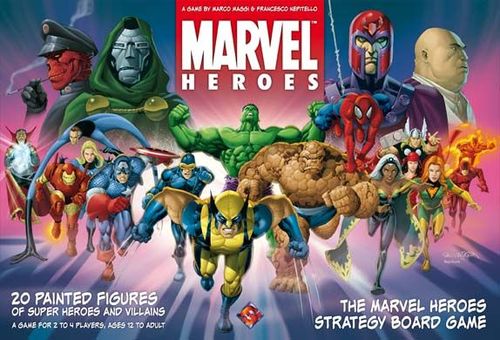
Marvel Heroes
Marvel Heroes Rulebook
Table of Contents
Table of Contents
Game Overview
In the Marvel Universe, groups of superhuman heroes defend New York City and the world against menaces and dangers, while in the shadows evil masterminds unleash their plots to control humanity.
In the Marvel Heroes Strategy Board Game, two to four players each control a Team of Super Heroes, competing to solve mysteries, rescue innocent bystanders, and defeat criminals. At the same time, each player controls an individual Mastermind Villain, trying to advance his evil agenda.
Object of the Game
At the start of the game, you will select one of the 10 different Scenarios included in the game. The Scenario represents the main storyline narrated in the game: Think of each Headline as a part of a single issue of a comic book, while the Scenario is like the larger story developed in a story arc.
Most Scenarios make a specific change to the game rules ("Effect" text), and each Scenario provides a specific goal for the players to achieve to win the game ("Victory" text). Often the goal listed by the Scenario card is for the players to acquire the most Victory Points (by solving Headlines), but sometimes the goal is to be the first player to acquire a certain number of Victory Points, or to be the first player to resolve a Special Headline. See "Winning the Game" for more information on the Scenario cards. The Victory text also specifies in which round the game ends, although in some scenarios the game ends when a certain victory condition is achieved.
For your first game, we recommend using the "Born Again" Scenario. This Scenario does not alter the rules of the game. Its Victory description is simply to play until one player acquires 15 or more Victory Points, and then finish the current Game Round. At the end of that Game Round, the player with the most Victory Points wins. Once you have played this basic Scenario, you will want to try the other Scenarios, which provide more flavorful victory conditions.
Summary of Game Play
Each player controls a Team of four Super Heroes. Each player also controls the Mastermind Villain that is the Nemesis of the Team controlled by the player to his right (see below).
The game progresses in Game Rounds, which are divided into three different phases. Each Game Round, the players send their Super Heroes to solve Headlines, the stories and dangers around which the game revolves. In general, during the course of the game you will try to solve as many Headlines as you can with your Super Heroes, in order to develop the abilities of your Team and gain Victory Points.
When a player uses his Team to solve a Headline, he is called the Hero player; all the other players act as Villain players, trying to hinder the Hero player and advance the secret agendas of their own Mastermind Villains.
Team, Characters and Team Nemesis
| Team | Characters | Team Nemesis |
|---|---|---|
| The Avengers | Captain America, The Hulk, Iron Man, Thor | Red Skull |
| The Fantastic 4 | The Human Torch, The Invisible Woman, Mr Fantastic, The Thing | Doctor Doom |
| The Marvel Knights | Daredevil, Doctor Strange, Elektra, Spider-Man | Kingpin |
| The X-Men | Cyclops, Jean Grey, Storm, Wolverine | Magneto |
The Game Board
The game board represents the island of Manhattan and its surrounding areas. The city is divided into 6 Areas, each in a different color: Upper Manhattan, Central Manhattan, The Village, Lower Manhattan, Queens, and Brooklyn. Each Area is divided into 4 Districts, and each District in an Area is identified by a different symbol (✖ ◆ ★ ●). Any number of Super Heroes can be in a District at the same time.
In addition, each Area has two Support spaces: Each Support space can hold one Super Hero, who may be used to help his Teammates in the corresponding Area.
Note: The Brooklyn and Queens Areas are not used if playing a two-player game.
The board also features several spaces and tracks:
- There is one Headline space for each Area on the board. These spaces hold the Headline cards, which represent missions in the Area that Teams can try to complete.
- The Scenario space. This space is for the current game's Scenario card.
- The Story track holds the four available Story cards, which represent positive developments for the different Super Hero Teams. The cards advance on the track in the direction shown by the arrows.
- 3 Most Wanted Villain spaces, where certain Villains are placed if they defeat Super Heroes in combat.
- The Game Round track and Action Round track, which are used to mark the current Game Round and the Action Round within a Game Round. If the game goes to 6 or more rounds, set it back to the "1" space.
- The Victory Point track, which is used to record the Victory Point total and the Plot Point bonus of each Team. Red spaces on the Victory Point track indicate your Plot Point bonus.
- The Trouble Level track, which is used to record the difficulty level of a Headline as it is being resolved. If the Trouble Level goes above 10, use the side of the Trouble Level marker with a "+10" to indicate this.
In addition, there are spaces on the board for the Headline, Resource, Story, and Villain decks, and spaces for the Villain and Resource discard piles.
Game Components
1 First Player token — The First Player token is given to the player who acts first in each Action Round.
1 Archnemesis token — The Archnemesis token is given to the player controlling the Nemesis of the Team with most Victory Points.
12 Combat Power tokens — Each player has a set of 3 Combat Power tokens used to choose Powers during combat.
1 Game Round marker — The Game Round marker keeps track of how many rounds have been played. If the game goes to 6 or more rounds, set it back to the "1" space.
1 Action Round marker — The Action Round marker keeps track of how many Action Rounds have been played in this Game Round.
4 Team Victory Point markers — The Team Victory Point markers keep track of how well each Super Heroes Team is doing.
13 Super Hero Wound/KO tokens — KO tokens are used to keep track of how many times a character has lost in a combat; the opposite side is called a Wound token and is put on a Super Hero when he's defeated.
36 Threat tokens — Threat tokens have a number on them and are placed in a District to show the Threat number of the active Headlines.
52 Plot Point tokens — Plot Point tokens are used to manage the use of the Super Heroes and their Allies during the Planning phase.
1 Trouble Level track marker — The Trouble Level marker keeps track of the current level of Trouble during the resolution of a Headline.
The Dice
Eight special dice are included with the game. They are used to resolve combat and to determine the Trouble Level of Headlines.
On each die, one face is blank, and the other faces show one or two special icons:
- Hit icon: This icon is the most important one on the dice. When you roll the dice in combat, you add together all the HIT icons to determine the value of the roll.
- Trouble icon: The TROUBLE icon is only used in the Mission phase, when you roll to determine the Trouble Level in a District (see Missions).
- Boost icon: This icon means that you may be able to reroll some dice, if you have the appropriate special ability or if the rules indicate that you should use dice boosting. If you are able to use dice boosting, then when a die shows a BOOST icon, it can be rolled again and the new results are added to the previous total. You reroll only once: BOOST icons on the additional roll are ignored.
The Mission or Combat rules will tell you how many dice you must roll and the effects of the roll. However, the number of dice you roll can never be more than 8 (not including rerolls).
The Game Round
A Game Round in Marvel Heroes consists of three phases:
- Game Round Setup
- Planning
- Mission
Initial Game Setup
- Determine randomly or by choice who will control each Super Hero Team. Each player takes his Team Reference card, his Super Hero figures and Super Hero reference cards, the Team's Power-Up cards, and one set of Combat Power tokens. Place all of your Super Heroes on the middle of their respective Reference cards.
- Each player controls the Mastermind Villain that is the Nemesis of the Team controlled by the player to his right. Each player should take his Mastermind Villain card and figure and the three corresponding Master Plan cards.
- Each player then draws two cards from the Resource deck and two from the Villain deck. Note: Draw three cards from each deck in a two-player game.
- Give the First Player token to a player chosen randomly.
- No Archnemesis is named for the first Game Round.
- Place the Resource deck, Villain deck, Headline deck, and Story deck on their respective spaces on the board.
- Shuffle the Headline and Story decks, then fill the Headline spaces on the board with Headline cards, and the Story track with Story cards.
- Form a pool of Plot Point tokens by placing them beside the board. You will take tokens from here whenever you receive Plot Points, and put them back here whenever you spend them.
- For each Headline, place one Threat token with a number matching that of the Headline's Threat Number on the District where the Headline is taking place.
- Randomly draw (or choose) a Scenario card and place it on the appropriate space on the board. (We recommend using the "Born Again" Scenario the first time you play.)
- Put the Game Round marker on the first space of the Game Round track, and the Action Round marker on the first space of the Action Round track.
- Put the Victory Point marker of each Team on the "0" space of the Victory Point track.
- Put the Trouble marker on the "0" space of the Trouble Level track.
Phase 1: Game Round Setup
During the first Game Round, skip this phase. At the beginning of each Game Round thereafter, do the following:
- Advance the Game Round marker.
- Reset the Action Round marker to the first step of the Action Round track.
- Advance the Story track (see below).
- Draw and place new Headline cards to fill the empty Headline spaces, and place the corresponding Threat tokens on the board.
- Assign the Archnemesis and First Player tokens (see below).
Advance the Story Track
Story cards represent public and personal events that affect the Super Heroes and their Teams.
At the beginning of the game, four Story cards are drawn and placed faceup in a row, in the appropriate spaces on the board. This row of cards is called the Story track.
At the beginning of each Game Round, a new Story card is drawn and placed at the beginning of the track. The cards already on the track are shifted in the direction of the arrows on the track to make room for the new card, and the card that is "pushed off" the Story track is discarded without effect.
During the game, players will affect the Story track by using Story actions.
Headline Cards
Headline cards represent events initiated by criminals, supernatural creatures, or natural hazards in the streets of New York City.
Using Headline Cards
Headline cards are placed on the appropriate spaces on the board, each corresponding to one Area of the city.
At the beginning of each Game Round, Headline cards are drawn and placed to fill the empty Headline spaces. Read aloud the Headline text, its Threat Type, Threat Number, and the Skills involved.
Each card bears a District Icon linking the card to a specific District in the Area, to identify where the incident is taking place. Place a Threat token in each District where a Headline takes place, corresponding to the Threat Number of that Headline.
Example: If this card is played in The Village (Area), place a "5" Threat token in Chelsea (District).
Some Headlines also bear a Mastermind Icon. This icon indicates that a Mastermind is possibly behind the criminal activity.
Assigning the Archnemesis and First Player Tokens
The player that controls the Nemesis of the Team which currently has the most Victory Points receives the Archnemesis token, and keeps it for the coming Game Round (during the first Game Round, there is no Archnemesis). In the case of a tie, the Archnemesis token goes to the tied player whose Mastermind Villain has the highest Henchmen rating.
The First Player token is then assigned to the player who has the fewest Victory Points. If there is a tie, then the tied player with fewer Team Power-Ups in play receives the First Player token. If there is still a tie, break it randomly.
The Scenario
At the beginning of the game, the players must choose or randomly draw a Scenario card.
The card includes both a Game Effect and a Victory description. The Game Effect changes the rules of the game, while the Victory description explains how and/or when the game will end. One player should read this card aloud at the beginning of the game, and all players should keep the Scenario's Game Effect and Victory description in mind throughout the game.
Super Hero and Mastermind Reference Cards
Each Super Hero reference card provides information on the abilities of a character, but is also used during the game to keep track of what a Super Hero is doing. The position of a Super Hero's figure on his card indicates that character's status: If a figure is on the left side of the card it is Ready; if it is on the right it is Supporting; and if it is on the middle of the card it is In Recovery.
Super Hero Status
Ready: All Super Heroes in a District on the board or in the Ready (left) position on their card are said to be "Ready." During the Game Round, Ready Super Heroes will be able to troubleshoot Headlines and fight Villains.
Supporting: All Super Heroes in any Support space on the board or in the Supporting (right) position of their card are said to be "Supporting." During the Game Round, Supporting Super Heroes can help Ready Super Heroes in troubleshooting Headlines and in combat, or they can complete other non-combat activities, such as engaging in scientific research.
In Recovery: All Super Heroes in the Recovery (middle) position on their card are said to be "In Recovery," whether they are wounded or not. Super Heroes in Recovery will not be used during the current Game Round.
To assign Super Heroes to "Ready" or "Supporting" status you must spend Plot Points, as explained under "Assign Super Hero Status."
The left part of a Super Hero card is also called the Ready section; this Combat Special Ability can be used when the Super Hero is Ready and in combat. The right part is also called the Supporting section; this Support Special Ability can be used when the Super Hero is Supporting. The middle part of the card is also called the Recovery section; when the Super Hero receives this number of KOs, he is wounded and moved to Recovery.
The card's Troubleshooting ratings are used when the Super Hero is reducing the Trouble Level of a Headline, and the Skill indicated shows which Headlines are best solved by this Super Hero.
On a Mastermind Reference card, the Level indicates how many Plot Points you must spend to make this Hero Ready (for a Super Hero card); the Mastermind is the Nemesis of a Team, and the Henchmen rating indicates how many Villain cards to play when the Mastermind is in combat — it is also used to determine who the Archnemesis is in case of a tie. The Mastermind's Combat Special Ability can be used when the Mastermind is in a combat, and its Scheming Special Ability can be used during the Troubleshooting of a Headline when the Mastermind is involved. When the Mastermind receives its listed number of KOs, he is defeated. Its Threat ratings are used when the Mastermind is increasing the Threat Level of a Headline.
Phase 2: Planning
During the Planning phase, players plan their courses of action for the current Game Round. Mainly, planning involves spending Plot Points to assign your available Super Heroes to different tasks, by placing their figures on different positions on their Super Hero cards. Players can also play Allies and acquire Team Power-Ups in this phase.
At the beginning of the game, Plot Points are limited, and players will not be able to field all their Super Heroes. As the game progresses, players will accumulate Plot Points and will soon be able to field more characters.
The steps of the Planning phase are:
- Receive Plot Points
- Assign Super Hero Status
- Heal
- Allies and Power-Ups
All players may perform the Planning phase simultaneously, or you may have the First Player perform his Planning phase first and proceed clockwise around the table, as you prefer.
Receive Plot Points
Take all your Super Heroes that are on Support spaces on the board, and all your Super Heroes positioned on their reference cards - unless they have a Wound token - and place them in a group in front of you. These are your available Super Heroes.
You receive a number of Plot Points equal to the number of your available Super Heroes. You don't receive any Plot Points for your Super Heroes that are in a District on the board or that are wounded.
Important: At the start of the first Game Round, all your Super Heroes are considered available, so you receive 4 Plot Points.
You also receive a number of additional Plot Point tokens equal to your Plot Point bonus score, which is determined by how many Victory Points you have. You receive 1 bonus Plot Point for every 5 Victory Points. This is indicated on the Victory Point track by the red spaces: You receive 1 Plot Point for each red space your marker has passed.
Example: After a Team has reached 10 Victory Points, it receives a bonus of 2 Plot Points during the "Receive Plot Points" step of each Game Round.
Assign Super Hero Status
Now you decide what the status of each of your Super Heroes will be for this Game Round, spending Plot Points for each Super Hero that you want to be Ready or Supporting.
First, if you left a Super Hero in a District on the board from the previous Game Round, you must spend a number of Plot Points equal to his Level in order to keep him on the board. If you do so, the Super Hero is left where he is and is considered to be Ready in this Game Round. If you cannot or do not wish to spend these Plot Points, move the Super Hero off the board and to the "Recovery" position on his card: He is considered to be in Recovery for this Game Round.
Then you must choose the status of your available Super Heroes:
- You may spend a number of Plot Points equal to a Super Hero's Level to place an available Super Hero on the Ready position of his card.
- You may spend 1 Plot Point to place an available Super Hero on the Supporting position of his card.
- Any other available Super Hero is considered to be In Recovery and is placed in the middle of his card. You don't spend any Plot Points to place a Super Hero in Recovery.
Example of a Planning phase: It's turn one of a 2-player game and James, the Fantastic Four player, has received the First Player token. He receives 4 Plot Point tokens at the start of the first Game Round. James takes a look at the board and decides he will try to solve "You Can't Defeat Me" (a Crime/Fight Headline with a Threat Number of 5) using the Human Torch with the support of the Invisible Woman. So, he spends 2 Plot Points to make the Human Torch "Ready" and 1 Plot Point to make the Invisible Woman "Supporting." He still has 1 Plot Point remaining: He decides to use it to play the "Black Widow" Ally card. With no points left, he has to put both the Thing and Mr. Fantastic in the "Recovery" position on their cards.
His opponent, Rich, is playing the X-Men. Rich also completes his planning, making Wolverine Ready (2 Plot Points), making both Jean Grey and Storm Supporting (1 Plot Point each), and putting Cyclops in Recovery. The Mission phase may now begin.
Heal
If a Super Hero is wounded, leave him or her in Recovery and discard the Wound token.
Allies and Power-Ups
You may play one Ally Resource card from your hand (up to three can be on the table at the same time) by spending one Plot Point. You may also place additional Plot Points on the Ally card you just played (see Allied Heroes). However, you may not place Plot Points on Allies already in play.
You may also discard 3 Story cards to purchase a Team Power-Up (see Using Story Cards).
Important: You keep any unspent Plot Points, for use in later Game Rounds.
Phase 3: Missions
The Mission phase is the focal point of the game, during which the Super Heroes try to solve the crimes and mysteries on the board, and the Villains seek to thwart the Super Heroes.
Each Mission phase in a Game Round is divided into five Action Rounds. During each Action Round, all players alternate in taking actions, starting with the First Player.
When a player acts in each round he is called the Hero player, and he can choose to do one of the following actions:
- Movement
- Troubleshooting
- Medical Treatment
- Story Action
- Use a Special Ability
Important: Each action may be done more than once in the same Game Round.
These actions are explained in detail below.
Supporting Super Heroes
Supporting Super Heroes can be moved to special Support spaces on the board. Each Area on the board has two Support spaces. A Super Hero in the Support Space of a given Area is considered to be in that Area, and you can use the Support ability of that Super Hero in all the Districts of that Area.
Note: You can't move a Super Hero to a Support space if it is already occupied by another Super Hero. So, a maximum of two Super Heroes can be Supporting in the same Area.
The Movement Action
You may use a Move action to move one Ready or one Supporting Super Hero, as follows:
- Move a Ready Super Hero: You may move a Ready Super Hero from his card to any District on the board, from one District to any other District, or from a District to the Recovery position on his card.
- Move a Supporting Super Hero: You may move a Supporting Super Hero from his card to any Support space on board, from one Support space to any other empty Support space, or from a Support space to the Supporting position on his card.
Free Movement of Supporting Super Heroes
When you use a Movement action to move a Ready Super Hero to a District, he may take one Supporting Super Hero along with him. In this way, you can move two Super Heroes with one action.
The Supporting Super Hero you move in this way must be on the Supporting position on his card. He must be moved to one of the Support spaces of the Area containing the District where you move the Ready Super Hero. The movement of the Supporting Super Hero is "free" and does not count as an action.
Important: A Supporting Super Hero that is already on the board (in a Support space) may not benefit from this "free" move. To move a Supporting Super Hero that is already on the board, you must use a Movement action.
The Troubleshooting Action
During a Troubleshooting action you try to resolve a Headline in a District containing at least one of your Ready Super Heroes. See Troubleshooting a Normal Headline below for a complete explanation of the Troubleshooting action.
The Medical Treatment Action
You may use a Medical Treatment action to remove a Wound token from one Super Hero currently in Recovery. The token is removed and the Super Hero remains in Recovery. He will be available again at the start of the next Game Round.
The Story Action
During the game, whenever you take a Story action, you draw one card from the Resource deck. You may then either:
- Advance the Story track: Draw a new Story card and place it at the beginning of the track, shifting the other cards on the track in the direction shown by the arrows on the track. Give the card that is "pushed off" the track to the player whose Team icon is shown on the card. In this way, it is possible that a player taking a Story action benefits another Team. If the related Team is not in play, the Story card is simply discarded.
— or —
- Manipulate the Story track: Move a Story card belonging to your Team to the last position on the Story Track, shifting the other cards back to fill the empty space.
Using Story Cards
Whenever you receive a Story card, add 1 Victory Point to your score.
During the Planning phase, you can discard three Story Cards in your possession to put a Team Power-Up card into play. The Victory Point value of the discarded Story cards is not deducted from your score.
Use a Special Ability
Certain abilities of Super Heroes are preceded by the terms "Support (Action)." These abilities require the use of an action, so using such an ability will be all that you can do during one of the Action Rounds. A Super Hero must be "Supporting" to use a Support (Action) ability.
Example: The Hulk's "Rampage" ability is a Support (Action) ability. This means that you must use an action and move the Hulk from either a Support space on the board or the Supporting position on his card to Recovery to draw 2 Resource cards and discard the first 2 cards on the Story track.
Example of a Mission phase: Let's continue the previous example.
First Action: James, the F4 player, goes first. With his first action, he moves the Human Torch to the District with the "You Can't Defeat Me" Headline, moving the Invisible Woman to a Support space of that Area (a free movement).
Rich, the X-Men player, decides to use Jean Grey's Support (Action) Ability, "Cerebro," to take two consecutive Story actions. Jean Grey is moved to Recovery.
Second Action Round: James decides to take a Story action, since the last card on the Story track is an F4 card and he wants to take it. He also wants more Resource cards in his hand before he attempts to solve the Headline. He draws 1 Resource card and advances the Story track, taking the F4 card that is pushed off the track and adding 1 Victory Point to his score.
Rich moves Wolverine to the District with the "Serial Robbers on Crime Spree!" Headline and takes Storm along to a Support space of that Area (a free movement).
Third Action Round: James decides to Troubleshoot the "You Can't Defeat Me" Headline and a Troubleshooting sequence begins (see Troubleshooting a Normal Headline). After Troubleshooting is completed, the action goes to Rich. When both players have taken five actions, the Game Round ends and a new one begins.
Troubleshooting
A player may use a Troubleshooting action to try to resolve a Headline, in order to score Victory Points. There are two types of Headlines: normal Headlines and Mastermind Headlines. Mastermind Headlines are indicated by the Mastermind symbol.
Troubleshooting a Normal Headline
When Troubleshooting a normal Headline, your Super Hero will first attempt to resolve the Headline by reducing the Trouble Level of the District to zero. If he is unable to do this, however, your opponents will have an opportunity to play Villains in the District, whom your Super Hero will have to fight.
To Troubleshoot a normal Headline, first choose a District that has an unresolved normal Headline and at least one of your Ready Super Heroes. Then, follow these five steps:
- Determine Trouble Level
- Reduce Trouble
- Play Villains
- Combat
- Headline Resolution
1) Determine Trouble Level
Each District with an unresolved Headline has a Threat token on it, corresponding to the Threat Number of its Headline card.
To determine the Trouble Level of a District, roll a number of dice equal to the number on the District's Threat token. Add up the number of HIT and TROUBLE icons. Also, dice boosting applies to the "Determine Trouble Level" roll (unless your Super Hero has the appropriate Skill – see below). If any dice show a BOOST icon, roll them again and add any HIT or TROUBLE icons to the total. Ignore any BOOST icons that result from this second roll. The total after dice boosting is the Trouble Level of the District. Record the result on the Trouble Level track.
BOOST Icons and Skills: When Troubleshooting, if one of your Ready Super Heroes in the relevant District or one of your Supporting Super Heroes in the relevant Area possesses a skill displayed on the Headline card you are Troubleshooting, then dice boosting does not apply to the "Determine Trouble Level" roll: Ignore all BOOST icons obtained in the roll.
Example: The "You Can't Defeat Me" Headline that the Human Torch is Troubleshooting has a Threat Number of 5. Rich, playing as the Villain player, rolls five dice: Two of them show 1 HIT icon, one of them shows 1 TROUBLE icon, one of them shows a HIT/BOOST icon, and the final die comes up blank. The total Trouble Level is 4. The Human Torch's skill is "Protection," while the skill listed on the Headline is "Fight." Therefore, the BOOST die is rolled again: An additional TROUBLE icon results, so the Trouble Level of the District becomes 5.
2) Reduce Trouble
Now you use your Ready Super Hero to reduce the Trouble Level of the District.
Each Super Hero has a Troubleshooting rating in the 3 Trouble types: Crime, Danger, and Mystery. Reduce the Trouble Level by the appropriate Troubleshooting rating of your Ready Super Hero in the District. (Adjust the marker on the Trouble Level track accordingly – it cannot go below zero.)
Example: The Human Torch has a Troubleshooting rating of 2 in Crime, 1 in Danger, and 1 in Mystery. He is currently Troubleshooting a Crime Headline, so he will reduce the Trouble Level by his Crime Troubleshooting rating of 2. In our example, the Trouble Level was 5 after the roll: It becomes 3, and the Trouble Level track is adjusted accordingly.
If you have more than one Ready Super Hero in the District, you may use whichever Super Hero's rating is highest.
Support (Troubleshooting) Special Abilities: Some Super Heroes have special abilities that are preceded by the terms "Support (Troubleshooting)." These abilities may be used to reduce the Trouble Level of a Headline during a Troubleshooting action. Such abilities do not require the expenditure of an action; however, to use the ability the Super Hero must be in a Support space of the Area where his Teammate is performing a Troubleshooting action.
If the Trouble Level is still higher than zero, proceed to the next step, Play Villains. If the Trouble Level is at zero, proceed directly to the Headline Resolution step.
3) Play Villains
If you did not reduce the Trouble Level in the District to zero, then the other players may play Villains cards against your Super Hero, as follows.
Draw Villain Cards: All Villain players, starting with the Hero player's Nemesis and proceeding clockwise, may draw one Villain card from the Villain deck. When playing a two-player game, the Villain player draws two Villain cards.
Determine Whether There Will Be a Lead Villain: In clockwise order, starting with the player controlling the Hero player's Nemesis, each Villain player must decide whether or not to play a Villain card. If he does not, then the player to his left may play one card, and so on, until all Villain players have passed. However, as soon as one player plays a Villain card, this step stops and that Villain card represents the Lead Villain. There may only be one Lead Villain.
If all the Villain players choose not to play a Villain card, go directly to the Headline Resolution step.
Paying for Villain Cards: There are two numbers in the upper left of each Villain card: The Trouble Level Requirement and the Trouble Cost.
- Trouble Level Requirement: To play a Villain card as a Lead Villain, the current Trouble Level in the District must be equal to or higher than the Trouble Level Requirement shown on the Villain card.
- Trouble Cost: When you play a Villain card as a Lead Villain, you must reduce the Trouble Level in the District by the Villain card's Trouble Cost (adjust the marker on the Trouble Level track accordingly). Thus, when you play a Villain card, you lower the Trouble Level, making it harder for the other Villain players to play further Villain cards.
Play Backup Effects and Agents: If there is a Lead Villain, then the Villain players may also play Backup Effects and Agents. Beginning with the Hero player's Nemesis and proceeding clockwise, each Villain player may play one or more Villain cards as Backup Effects or Agents. While there may only be one Lead Villain, there may be any number of Backup Effects and Agents.
The lower half of a regular Villain card shows what effect that card has if it is played as a Backup Effect. Backup Effects usually give additional powers to the Lead Villain. Depending on the situation, you may think of the Backup Effects you play as actual characters helping the Lead Villain, but these cards may also represent unexpected abilities, power and equipment of the Lead Villain, or other special circumstances.
When playing a Villain card as a Backup Effect, use the Trouble Cost on the lower half of the Villain card. This cost is usually lower than the cost to play it as a Lead Villain. There is no Trouble Level Requirement to play a Villain card as a Backup Effect.
Agent Cards: Agents are a special type of Villain card. Unlike other Villain cards, Agents can only be played as a Backup Effect to a Lead Villain and, rather than boosting the Lead Villain's ability, they hinder a Super Hero by reducing the value of his or her Powers.
Example: In our example, the Trouble Level of the District is 3. Rich has two Villain cards in his hand and now draws a third card. With 3 points of Trouble available, he decides that the Lead Villain will be the strongest Villain he can play, "Avalanche," who has a Trouble Level requirement of 3 and a Trouble Cost of 2. After playing Avalanche, there's still one point of Trouble left, so Rich decides to play the Backup Effect of the "Crimson Dynamo" card, "Innocent Bystanders," which gives Rich the ability to manipulate James's dice rolls in the upcoming combat. Rich still has one Villain card but no Trouble is left, so now it's time to fight!
Most Wanted Villains: When a Villain showing a Most Wanted icon defeats a Super Hero (or group of Super Heroes), place the Villain card faceup on one of the three Most Wanted spaces on the board. If all spaces are occupied, the player controlling the Nemesis of the defeated Team must decide whether to replace one of the three cards (discard the replaced card), or discard the victorious Villain.
Each card on a Most Wanted space is available to all players during the "Play Villains" step of a Troubleshooting action, to be played as if part of their hand of cards. A Most Wanted Villain may only be played as a Lead Villain, not as a Backup Effect, and the Trouble Level Requirement of Most Wanted Villain cards is considered to be 0. The Trouble Cost must still be paid normally.
4) Combat
When all Villain players have either played cards or passed, the fight between Super Heroes and Villains is resolved using the Combat rules (see Combat).
If the Villain wins: The defeated Ready Super Hero is immediately placed in Recovery with one Wound token, and all Backup Effect and Agent cards are discarded. The Lead Villain card is also discarded, unless it shows a Most Wanted icon: In that case, place it on an available Most Wanted space on the board (see Most Wanted Villains above).
Note: When a Hero player is defeated, only his ready Super Hero is moved to Recovery; his Super Heroes on Support spaces in the Area remain where they are.
If the Super Hero wins: Discard all KO tokens accumulated during the Combat, then discard the Lead Villain card and all Backup Effect and Agent cards. Then proceed to the Headline Resolution step.
5) Headline Resolution
If your Super Hero defeats the Villain (or if no Lead Villain was played), you score the Headline. Take the Headline card and place it in front of you, and advance your marker on the Victory Point track by the amount indicated on the card.
If the Super Hero was defeated, the Headline card is discarded.
Finally, reset the Trouble Level track to zero.
Troubleshooting a Mastermind Headline
If a Headline card has a Mastermind Icon, it is a Mastermind Headline: The criminal activities of a Mastermind Villain may be behind this event.
The rules for Troubleshooting a normal Headline apply to Mastermind Headlines, with some important differences.
In game terms, these special Headlines have an added level of difficulty, as the Hero player's Nemesis has at his disposal two possible interventions: taking a Scheming action, and attempting a Master Plan.
Scheming
During the Troubleshooting phase, the Hero player's Nemesis can choose to take a Scheming action, choosing one option from the following list:
- Increase the Threat: Before the "Determine Trouble Level" step, the Nemesis may decide to add his appropriate Threat rating (Crime, Danger, or Mystery, depending on the Headline) to the number on the Threat token on the District, increasing the number of dice to roll.
- Draw Additional Villain cards: At the start of the "Play Villains" step, the Nemesis may draw a number of additional Villain cards equal to the highest Level among the Ready Super Heroes in the District.
- Boost Combat: Before combat starts, the Nemesis may decide to give the Lead Villain dice boosting.
Attempting Master Plans
At the start of a Troubleshooting action involving a Mastermind Headline, the Hero player's Nemesis may decide to intervene directly with his Mastermind to attempt a Master Plan. Master Plans must be attempted in order, starting with the "Prologue," continuing with the "Development," and ending with the "Conclusion."
The player places his Mastermind Villain figure on the Headline card, and shows the Hero player which one of his Master Plans he is trying to achieve.
Note: If a player has already achieved all his Mastermind Villain's Master Plans, he may not attempt any further Master Plans, but the Mastermind Scheming abilities may still be used on Mastermind Headlines.
The Troubleshooting action proceeds normally until its conclusion. If the Hero player is victorious, he scores the Headline normally; then he must decide if he wants to challenge the Mastermind Villain or not. If the Super Hero is defeated by the Lead Villain or chooses not to challenge the Mastermind Villain, the Mastermind Villain completes his Master Plan.
Challenging the Mastermind Villain
If the challenge takes place, any KO tokens accumulated by the Super Hero (or Super Heroes) during the previous combat are not discarded. The challenge is resolved as a new battle against the Mastermind, using the Mastermind's combat abilities and powers.
Mastermind Villains are always able to use dice boosting on their combat rolls. Furthermore, at the start of the challenge, a number of Villain cards equal to the Henchmen rating of the Mastermind are drawn from the Villain deck and played as Backup Effects, without paying their Trouble Cost.
If the Mastermind Is Defeated: If the Hero player wins the combat, he may put one of his Team Power-Up cards into play. The failed Master Plan card can be attempted again by the Mastermind Villain later in the game. However, the Mastermind Villain can not attempt the Master Plan again in the current Game Round.
If the Mastermind Is Victorious: If the Mastermind Villain wins the combat (or the Hero player decides not to challenge), the Mastermind player succeeds in his Master Plan and can from now on use the special ability of that Master Plan card.
The Archnemesis
The Archnemesis role is taken at the start of a Game Round by the player controlling the Nemesis of the Team with the most Victory Points (if more than one Team is tied for the most Victory Points, then no player can take the Archnemesis role for the Round). As the Archnemesis, a player can take a Scheming action and attempt a Master Plan when his opposing player is trying to solve any Headline, not just a Mastermind Headline.
Winning the Game
At the beginning of the game, the Scenario, which represents the main storyline of the game, is revealed. Each Scenario has a Game Effect that modifies the normal rules of the game, as well as a Victory description that describes how and when the game ends and what the victory conditions are for the current game.
Some scenarios set a specific condition or Game Round at which the game will end. In many of these Scenarios, the player with the most Victory Points is then declared the winner. In case of a tie, the tied player who scored the Scenario Headline (if there is one) is the winner. If there is still a tie, then the tied player with the most Team Power-Ups in play is the winner.
Special Headlines
Some Scenarios include a Special Headline, which enters play as indicated on the Scenario card. This Headline has all the characteristics of a normal Headline, except that it is not linked to any specific District or Area on the board. When the condition described by the card is achieved, a player can move Super Heroes onto the Scenario card exactly as if the card were a District, and then use another action to Troubleshoot the Scenario Headline. The Scenario has no Support space, so Super Heroes can only move to a Scenario if they are Ready.
The attempt to solve a Scenario Headline is conducted normally, except that the Nemesis of the Team may not attempt a Master Plan. The Nemesis, however, may still take a Scheming action if he is the Archnemesis or if the Scenario has a Mastermind icon.
If the Headline is solved, the game will end when the current Action Round is completed; if the Headline is not solved, it remains in play to be solved later. When a Team successfully Troubleshoots the Scenario Headline, it receives the amount of Victory Points indicated on the card.
The "House of M" Scenario
The "House of M" Scenario is similar to a Scenario with a Special Headline. However, the final confrontation will not be the Troubleshooting of a Headline, but a special challenge against Magneto, who in this Scenario has a Henchman rating of 4 instead of his usual rating.
At the end of the fourth Game Round, place the Magneto reference card on the table. All the players challenge Magneto one after the other, starting with the player who has the most Victory Points and proceeding clockwise. Every player must choose two Super Heroes from his Team for the challenge. The combat is treated like a normal challenge against a Mastermind, with Magneto played by the Nemesis of the Team challenging him.
The first player to defeat Magneto wins. If the Super Heroes are defeated, Magneto returns to 0 KOs and draws new Henchmen before the next combat. If no player defeats Magneto, Magneto wins and everybody loses!
Using Resource and Villain Cards
Allied Heroes
Ally cards, which make up the bulk of the Resource deck, represent characters that temporarily help your Team.
Playing Allies
You may play Ally cards during the Planning phase, in the Allies and Power-Ups step, by spending one Plot Point per Ally Card. The Ally is played on the table, near your Super Hero cards, and the Plot Point is discarded. You may also place one additional Plot Point on the Ally card, so that you can use it two times instead of just once.
Each Team can have a maximum of three Ally cards in play at any time. If you already have three Allies in play, you can discard one in order to play a new Ally.
Allies are used during combat to help your Super Heroes (see Combat).
Team Allegiance
If an Ally is showing your Team's icon, the Ally is linked to your Team. You may place the Plot Point that you spend to bring a linked Ally into play onto the card instead of discarding it as normal. You may also still place one additional Plot Point on the card. In this way, you can potentially use Allies that are linked to your Team up to three times.
Example: Namor is an Ally showing the "Avengers" icon. If a player controlling the Avengers spends one Plot Point to bring Namor into play, he would place the Plot Point token that he spends on to the Namor card. If a player controlling a different Team brings Namor into play, he would discard the Plot Point token that he spends to bring Namor into play. In either case, the player may spend an additional Plot Point and place it on the Namor card.
Activating Allies
Allies are used during a combat to help your Super Heroes (see Combat).
To activate an Ally's special ability, you must discard a Plot Point token from that Ally card. If there is no Plot Point on the card, you must discard the Ally card itself after using its special ability.
Note: You cannot spend Plot Point tokens from your Plot Points pool to activate Allies. Only the Plot Point tokens on the Ally card you want to use can be spent to activate the ability of that Ally.
Event Cards
In addition to the Ally cards, the Resource deck also includes Event cards. Most of these cards begin with "Play as an action," indicating that playing the card counts as an action (so playing one of these cards will be all you can do during one of the Action Rounds).
Villain Cards
As explained in the Troubleshooting section, Villain cards may either be played as Lead Villains or as Backup Effects.
To play Villain cards, the players must spend Trouble points from those available in the District where the Troubleshooting takes place, as described above.
Discarding Cards
To use the combat abilities of most Super Heroes or Villains, you usually have to discard one card from your hand, as stated in the ability text itself. You must discard a Resource card to use the ability of a Super Hero, and you must discard a Villain card to use the ability of a Villain.
Important: Any Villain player may discard a Villain card to use the ability of a Lead Villain, not just the player controlling it.
Reshuffling Decks
Whenever a deck of cards is exhausted, you must reshuffle all the cards in the discard pile to form again a drawing deck.
Combat
The confrontation between Super Heroes and Villains, where their superpowers and special abilities are used to the fullest, is often the focal point of a comic-book story and is therefore a very important aspect of the Marvel Heroes board game.
The outcome of a combat is shaped by many factors, including the Super Heroes' and Lead Villains' Combat Powers, Allies, Backup Effects, Supporting Super Heroes' special abilities, and the roll of the dice.
In this section we will refer to both Super Heroes and Villains as characters.
Combat Powers
Each character has one to three Combat Powers, distinguished by color (red, orange, and yellow).
Each Power has three numerical values, ranging from zero to five. The first number is that Power's Attack (a) rating, the second number is the Power's Defend (d) rating, and the third number is the Power's Outwit (w) rating. These numerical ratings indicate how many dice you roll in each step of the combat sequence if you choose that power.
Combat Special Abilities
Most characters also have one or more Combat Special Abilities which can be used in combat. Normally, you use a special ability by discarding a card from your hand. You must discard a Resource card for the abilities of Super Heroes, or a Villain card for the abilities of Villains.
Combat Support Abilities
Some Super Heroes possess special abilities that are preceded by the terms "Support (Combat)." These abilities are used during combat. To use a Combat Support special ability, your Super Hero must be in the Support space of the Area in which one of his Teammates is engaged in combat.
Resolving Combat
The Hero player controls the Super Heroes during combat, while the player who played the Lead Villain controls the Lead Villain and any Backup Effects.
Before combat, the Hero player takes three Combat Power tokens of different colors, and his opponent does the same. Then combat begins.
Each combat follows the Combat Sequence below:
- Choose Powers.
- The character with Initiative attacks, and the opponent defends.
- The character without Initiative attacks, and the opponent defends.
- Outwit Contest.
These steps are repeated, if necessary, until the combat ends. In the first combat sequence the Super Hero has Initiative.
Choose Powers: Each player secretly chooses one Combat Power, by selecting one of the three Combat Power tokens. Then both players simultaneously reveal their choice and check the values of their Attack, Defend, and Outwit ratings.
Note: Certain characters have only one or two Powers, and therefore have fewer choices in this step.
First Attack Phase: The character with Initiative rolls a number of dice equal to the Attack (a) rating of his chosen power; his opponent rolls a number of dice equal to the Defend (d) rating of his chosen power. Count and compare the number of HITS rolled on the dice.
If the attacker's total number of HITS is equal to or greater than the defender's, the attacker scores one KO against the defender. The attacker must roll at least one hit to inflict a KO. If the defender now has a number of KOs equal to his KO value, the defender is defeated and combat ends immediately. Otherwise, combat continues with the Second Attack phase.
If the attacking player's Attack rating is 0, skip this phase. If the defending player's Defend rating is 0, the attacker will score a KO unless he does not roll any HITS.
Second Attack Phase: The second attack is resolved just like the first attack, except that the character with Initiative is the defender and his opponent is the attacker. If neither the Super Hero nor the Villain has been defeated after this phase, combat continues with the Outwit Contest.
Outwit Contest: In the Outwit contest, each player rolls a number of dice equal to the Outwit (w) rating in his chosen Power. The player that scores more HITS inflicts a KO on the opposing character.
Note: In both of the Attack phases, only the attacker can inflict a KO, but in the Outwit contest, either player can inflict a KO.
In addition, the player who wins the Outwit contest gains Initiative for the next combat sequence (if the opponent has not been defeated already). In case of a tie, no KOs are inflicted; the player who currently has Initiative keeps it, and another combat sequence is fought.
Dice Boosting and Support: If a Super Hero in combat has a Team member in a Support space of his Area, he receives dice boosting: Whenever he rolls a BOOST icon on a die, he may reroll that die, and add the new result to the number of HITS already scored. BOOST icons rolled on the second roll do not grant further rerolls.
If there is not a Teammate in Support, simply ignore the BOOST icon. Villains do not receive dice boosting unless a Mastermind Villain uses a "Boost Combat" Scheming action.
Example of a Combat: Let's continue the previous example, where the Human Torch (played by James) is facing Avalanche (played by Rich). James also has Black Widow in play as an Ally and the Invisible Woman Supporting, while Rich has played "Innocent Bystanders" as a Backup Effect. The Human Torch has Initiative.
Choice of Powers: First, both players secretly choose a Combat Power. James wants to go for an all-out attack, so he chooses the red Power token: The Human Torch will use his "Fire Blast" attack (a4 | d2 | w2). Rich knows that Avalanche, with only 1 KO and no Initiative, must try to get the upper hand, so he chooses his orange Power, "Shatter" (a1 | d2 | w5).
First Attack Phase: James rolls four dice to attack: Two come up blank, one shows 2 HITS, and one shows 1 HIT.
Avalanche uses a dirty trick, taking advantage of the presence of "Innocent Bystanders" to hide behind them! He discards the "Innocent Bystanders" Backup Effect to change the Human Torch's 2 HITS die so that it shows only 1 HIT. This reduces the total attack result to 2, which is not enough to beat Avalanche's Defend roll of 3 HITS. The fight continues.
Second Attack Phase: Now it's Avalanche's turn to attack, but he rolls no HITs on the only die allowed by his poor "1" rating.
Outwit Contest: Now, the Human Torch sees the danger of his situation: His opponent could easily win the Outwit roll, score a KO, and gain Initiative for the next combat sequence. It's time to get some help! James decides to use Black Widow to raise the Human Torch's Outwit rating to 4 for the next roll. Since there are no Plot Points on the card, James discards the Black Widow card: She will not be able to help him again!
James rolls his four dice: Two dice show 1 HIT, one shows a HIT/BOOST, and the last one is a blank. Because the Invisible Woman is Supporting, the BOOST die is rolled again, and the result is 2 more HITS! James's attack total is 4.
Rich rolls five dice for Avalanche: three of them show 1 HIT, and two of them show a HIT/BOOST. The total would be 5, scoring a KO on Human Torch and winning Initiative for the Villain! But then James smiles, points at the Invisible Woman, and discards one of the Resource cards he has in his hand to use the Invisible Woman's "Invisible Force Fields" Support (Combat) ability! Invisible Woman's ability cancels Rich's two dice with a BOOST icon. Avalanche's result is now 3, and the Human Torch's is still a 4... Avalanche receives a KO, enough to defeat him and end the combat!
It's good to have friends, isn't it?
Allies and Backup Effects in Combat
The special ability of an Ally or Backup Effect can be used at the appropriate moment during combat, as explained by the card text. To activate an Ally's ability, you must discard one Plot Point token on the Ally card, or discard the card itself if it has no tokens on it. To use the ability of a Backup Effect, you must discard the card. Agents remain in play for the duration of the combat and are only discarded once the combat has ended.
Henchmen
During a challenge with a Mastermind Villain, he may have Henchmen at his disposal. Henchmen are put into play at the beginning of the combat against the Mastermind. Draw a number of cards from the Villain deck equal to the Henchmen rating of your Mastermind, and play these cards without paying their Trouble Costs. Once they are in play, Henchmen are used exactly like Backup Effects or Agents.
Timing of Special Abilities
Super Heroes, Allies, Villains, Backup Effects, Agents, Master Plans, and Team Power-Ups all have special abilities, which may be used at different moments.
An ability may never be used retroactively, unless it specifically states otherwise. For example, you cannot decide to use an ability that changes the number of dice you roll after you've rolled the dice!
- Abilities do not "stack"; that is, abilities may not be used multiple times to affect the same dice roll or value. For example, an ability that adds 1 to a rating or the result of a combat roll may not be used twice to add 2 to the rating or combat result. In another example, an ability that allows you to reroll a die may not be used twice to gain a second reroll.
- Abilities usually apply either to your next roll, that is, the one that is immediately to come, or to the dice roll you just made. When an ability refers to dice "just rolled," this includes both the initial roll and any rerolls from dice boosting.
- Some abilities affect a result, not a roll, usually by adding to or subtracting from the number of HITS rolled. Use these abilities after both players have rolled their dice and performed any dice boosting, but before they compare results.
- Some abilities state in their text that their effect lasts for one combat sequence: Abilities that state that they affect "this" combat sequence must be used at the beginning of the sequence, before the choice of Powers, while abilities affecting the "next" sequence must be used at the end of a sequence.
- Some abilities state that they last until the end of the combat (that is, until either the Super Heroes or the Villain are defeated). These abilities can be used at any time, but usually they should be used at the beginning of the combat!
- Agents' abilities, which modify the ratings of Super Heroes, are considered to be continuously in use throughout the combat.
- If two players want to use abilities at the same moment, the ability of the player with Initiative goes into effect first, followed by the other player's ability.
Multi-Character Combat
When more than one Ready Super Hero from your Team is in the same District, at the beginning of each combat sequence you must decide which Super Hero will fight. Then combat is resolved normally (one-on-one). The following rules also apply to multi-character combat:
- Combat does not end until either the Lead Villain or all the Ready Super Heroes have been defeated.
- If the Lead Villain is defeated, the Super Heroes are considered to have won the combat, even if one or more Super Heroes were also defeated.
- If one Super Hero is defeated, then the Lead Villain has initiative on the next combat sequence if another Super Hero continues the fight.
- Any Super Hero that is defeated goes to Recovery with one Wound.