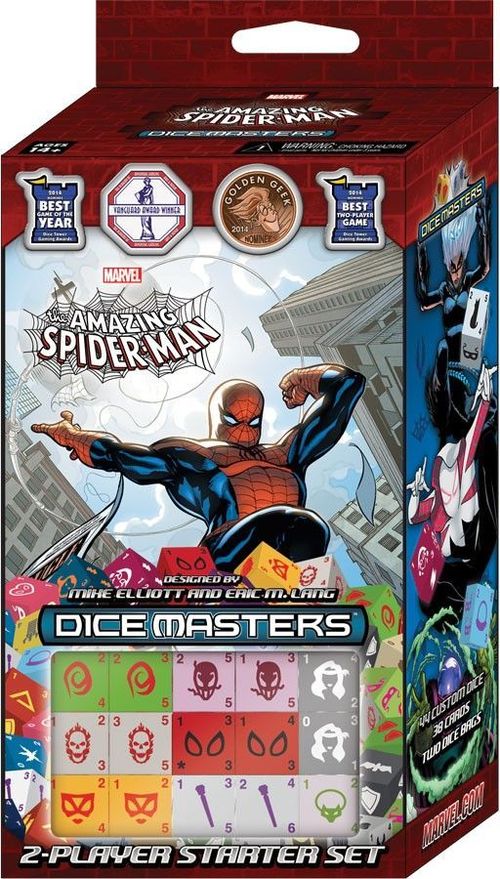
Marvel Dice Masters: The Amazing Spider-Man
Marvel Dice Masters: The Amazing Spider-Man Rulebook
Table of Contents
Table of Contents
Components
Aside from these rules, this set includes:
- 44 Custom Dice
- 12 Basic Action Dice (3 in each of 4 different colors)
- 16 Character Dice (2 in each of 8 types)
- 16 Sidekick Dice (white)
- 38 Cards
- 24 Character Cards (3 versions for each of the 8 characters; Sidekicks have no cards)
- 10 Basic Action Cards
- 4 Color Reminder Cards
- 2 Dice Bags
There are multiple cards available for each character die; you can choose which one you want to use! This lets you specialize your dice to suit your play style.
Additional cards and dice to expand your team can be found in foil packs — ask your retailer! High-quality playmats are also available for purchase, or you can download one from dicemasters.com and print it out yourself.
Quick Start
Ready for awesome comic book action? Hope so! It's a smack-down of cosmic proportions—and you're in the middle of it!
Getting Ready to Play
Set up Player 1's heroes, Player 2's heroes, and the Basic Action Cards. Only Player 1 can buy the dice on Player 1's cards; only Player 2 can buy the dice on Player 2's cards. Both players can buy dice from the Basic Action Cards. Use the playmat in the center of this rulebook to manage your dice!
Take a bag and put 8 Sidekick Dice (white) in it. This is your starting collection! You start the game with 10 life. You win by reducing your opponent's life to 0!
How to Play
Player 1 goes first. To take your turn, follow these five steps:
1. Clear and Draw Step If you have any dice in your Reserve Pool, they go to your Used Pile. Then, draw 4 dice from your bag and put them in your Prep Area. If your bag runs out, put all the dice from your Used Pile in your bag, mix well, and keep drawing until you get a total of 4 dice.
2. Roll and Reroll Step Roll all the dice in your Prep Area. If you want, you can reroll any or all of them, but you must keep the new result! Results will be energy (for purchasing heroes/Basic Action Dice) or a Sidekick face. Move all the dice you rolled into your Reserve Pool.
3. Main Step Now you can do any or all of the following, in any order you want, as many times as you like:
Purchase Dice. Pay the energy cost in the upper left of the card (any Basic Action Card or your character cards) by "spending" dice from your Reserve Pool that show energy symbols. If you buy a die from a character card, at least 1 energy you spend must match the symbol on that card (Fist / Bolt / Mask / Shield). The dice you spent and the die you buy all go to your Used Pile.
Field Characters. If you rolled a character face on any of your dice, you can put them into your Field Zone by paying energy equal to the number in the top left corner of the die — using any kind of energy. Sometimes, a character will have a special effect that takes place when you field them: just follow what the matching card says. Most dice have three character faces denoted by small numbers in the corners. When you're done taking actions, move any dice with character faces that you didn't field to your Used Pile.
Play Actions. If you rolled an action face on one of your dice, move the die to your Used Pile and follow the instructions on the matching card. Generic energy provides two energy, but of no particular type.
Special: Burst and Double Burst. Sometimes, dice you have purchased (Character and/or Basic Action Dice) will show a burst or double burst symbol. That means that you must use the special power described on the matching card!
Use Global Abilities. Globals are game effects on cards that either player can use by paying the cost to activate them.
4. Attack Step Now it's time to send your characters to attack your rival! Follow these four steps to attack:
Declare Attackers. Any dice in your Field Zone can attack. You can use some, none, or all of them. Each attacker can be blocked by multiple blockers.
Declare Blockers. Your opponent decides which of the characters in their Field Zone they want to block with: some, none, or all of them. Each blocker can only block 1 attacker, but multiple blockers can team up on a single attacker!
Use Actions and Global Abilities. Now the attacker can use action dice from their Reserve Pool, and both players can use Global Abilities.
Assign Damage. All attacking or blocking characters deal damage simultaneously: a blocker does damage to the attacker it blocked. A blocked attacker does damage to the blocker. If two or more characters blocked the same attacker, the attacker chooses how to divide the damage between the blockers. If a character takes damage equal to or greater than its Defense, that character is KO'd and goes to its owner's Prep Area. All unblocked attackers do damage to the defending player's life total. If you run out of life, you lose the game!
5. Cleanup Step Blocked or blocking characters that were not KO'd return to their Field Zone. Unblocked attackers in the Attack Zone go to the Used Pile instead. All damage to all dice is cleared. Any unused action dice in your Reserve Pool go to your Used Pile. All card effects end. Now it's your opponent's turn!
You're ready to fight your first battle! If you have any questions about an ability or action, you can find the answers in this rulebook or at www.WizKidsEventSystem.com/bb.
Cards
Each card details all the powers of one set of dice. Cards and their associated dice come in two types: Characters and Actions. Characters are named after people in the Marvel Universe (Sidekicks are the exception, and represent the people who have no special powers, but are nonetheless helpful), and their dice have numbers around the faces with a custom symbol. Actions are named for events or activities, and have no numbers around the die's custom symbol.
At the top center of the card is the card's title and subtitle. Most cards have several versions that are differentiated by their subtitle.
At the upper left of the card is the die's cost (a number) and energy type (a symbol of a Bolt, Fist, Mask, or Shield). Cards of a given energy type require that energy to be purchased, and provide that type of energy during play. Spider-Man is a Bolt character that costs 3. Sidekicks and Basic Action Cards have no energy type.
Below the cost and energy type, some characters have a team logo to identify their affiliation (action dice have no affiliation). The affiliation is shown by the team's logo:
- Avengers
- Guardians of the Galaxy
- Spider-Friends
- Villains
- Sinister Six
- Zombies
Card anatomy:
- Cost & Type — upper left
- Affiliation — below cost & type
- Card Name & Subtitle — top center
- Collector Number — upper right (very small)
- Card Art — center
- Text Box — details the die's abilities
- Rarity Stripe — see "Customizing Your Team" below
- Die Face Reference — bottom of card, shows Level 1 / Level 2 / Level 3 character faces of increasing level, and energy faces
- Die Limit — how many of these dice you're allowed on a team (Basic Action Cards show "Use:" instead, since you always use a fixed number of them in every game)
The text box in the center of the card details the die's abilities. Below that, the color of the rarity stripe provides information for collectors. Directly below the rarity stripe, "Max: #" shows the die limit; that's how many of these dice you are allowed to have on a team. (Basic Action Cards have "Use:" because you always use a fixed number of them in every game.)
At the bottom, the die face reference shows the various faces of the die. Faces that provide energy are on the left, and character or action faces are on the right.
Dice
Each die consists of a unique combination of colors and graphics.
All dice have faces that generate energy. Energy faces have one or two of the special energy symbols on them.
The special sides on Action Dice have a custom icon, and some have one or two burst symbols on them. Action Dice never have numbers.
Character Dice have a custom icon and may have burst symbols, but they always have several numbers that define the character's basic abilities.
- The number in the top left is the fielding cost of the die. This is how much energy you must spend to send the die into the field where it can engage the forces of your opponent.
- The top right is the die's attack; this is how much hurt it dishes out. On card text, a die's attack is abbreviated as A.
- The bottom right shows the die's defense; how much damage it takes to knock the character out. On card text, defense is abbreviated as D.
- The bottom left may have one or two burst symbols. These activate special abilities on dice, if any are listed. If no burst abilities are listed on the card, the burst has no effect.
Dice on their energy faces can move from your Reserve Pool to pay for costs. If they do that during your turn, they go Out of Play (they are moved to your Used Pile at the end of the turn). If it isn't your turn, they go straight to your Used Pile.
Setup
How you set up depends on whether or not this is a demo game (for you or a friend). If you're just learning or teaching a new player, you should give the setup below a try. If you're an experienced Dice Masters player, feel free to skip ahead to Customizing Your Team.
A Demo Game
For this demo game, place the following Basic Action Cards in the center of the Play Area:
- Back for Seconds!
- Betrayal
- Exposed!
Put a set of three Basic Action Dice on each of those cards (it doesn't matter which color, but this example will refer to them as if you had used orange, cyan, and pink in order). Place the Orange Dice Reminder Card under Back for Seconds! with the label sticking out from the top or side of the card. Do the same with the Cyan Dice Reminder Card and Betrayal, and the Pink Dice Reminder Card with Exposed! These cards will help players remember which dice represent which card when all the dice on a Basic Action Card have been purchased.
Basic Action Cards can be used by either player, no matter who brings them! In this demo game, we don't specify who brought them anyway.
Decide who goes first by flipping a coin or rolling a die (one player could call energy or character while the other player rolls the die). The player who wins the coin toss or die roll can choose to go first or second. Each player gathers the cards listed below and the two dice that match them. Every character in this starter has three versions, so be sure to grab the right one based on the subtitle.
- First Player: Drax: Pained, Silver Sable: Wild Pack
- Second Player: Spider-Man: Tangled Web, Spider-Woman: Secret Avenger
Each player places their cards, each with their two matching dice on their side of the table. These cards, unlike Basic Actions, can only be purchased by the player whose cards they are.
Finally, each player takes 8 of the Sidekick Dice (this starter comes with 16) and places them in one of the dice bags (this starter comes with 2). Each player will start the game with 10 life for this demo game.
Play Areas
There are several distinct areas where you place your dice to indicate what they can and can't do for you.
The Bag: One of the two dice bags provided (or your own bag). This is where you draw dice from. If your bag is ever empty, and you need to draw a die, move all dice from your Used Pile into your bag and shake it well to mix the dice thoroughly.
Prep Area: This area holds dice that you'll roll during your Roll and Reroll Step in addition to the dice from your draw. This is where KO'd dice go.
Reserve Pool: This area holds dice that you have rolled but have not yet done anything with. Dice on energy faces here can be spent, dice on action faces can be used for their effects, and dice on character faces can be fielded.
Field Zone: This is where characters go. Sometimes you'll be paying their fielding cost to get them here, other times you'll be using their abilities from here.
Attack Zone: This is a special part of the Field Zone. It's where your characters go when you assign them as attackers or blockers. Characters in the Attack Zone are also in the Field Zone.
Out of Play: Nothing can happen to dice here. Energy spent during your turn goes here, so do Action Dice you use during your turn or unblocked characters.
Used Pile: Dice here have been used up. At the end of your turn, all dice Out of Play are moved here. When you spend energy during your opponent's turn, it goes directly here. Dice here are returned to your bag when you would try to draw a die but cannot.
How to Play
First we'll outline the basic structure of the game. Later we'll have more detailed rules that should be referenced when questions arise.
Each player has a certain amount of life points at the start of the game (this is 10 points in the demo; when you play a full game, you'll have 20 life). Keep track of your life total with a method of your choice like a piece of scrap paper or using the track in the center of this booklet.
During the game, you'll want to purchase Character Dice and Action Dice. Character Dice can be sent to the field to attack your opponent, they can stay in your Field Zone to block, or sometimes they can even use special abilities. Unblocked characters can damage your opponent, reducing his or her life. When you reduce your opponent's life to zero, you win!
Energy
Dice can produce energy. The Sidekick Dice you start with can produce all different types of energy; some dice will even produce more than one energy. Energy allows you to buy additional dice, pay to field characters, and pay for Global Abilities (we'll explain all these soon).
There are four types of energy:
- Fist
- Bolt
- Mask
- Shield
In addition, some other die faces provide energy:
- Wildcard — may be used as any type of energy
- Generic — provides two energy, but of no particular type
- Doubles — some faces will provide two Fists, two Masks, etc. by showing two of that symbol
Cards and Dice
Sidekicks have no cards associated with them. Basic Action Dice can be paired with any of the Basic Action Cards and an Indicator Card.
All other dice are associated with a few cards. Before playing, you'll choose one of those cards to use with each type of die. The card gives a variety of details about the die, such as its cost, its special abilities, and its faces in order.
Characters have levels (normally three). These levels are the die faces that show the die's custom symbol and the character stats. The leftmost character die face shown on the die's card is level 1. The level increases by one for each face moving to the right. In the top left of each character face is a number: that is the cost to field that character. In the top right is that character's attack (abbreviated as A in card text). Below a character's attack is its defense (abbreviated as D in card text).
Burst Symbols Many dice have a burst symbol or two burst symbols in the lower left corner of one or more of their faces. These burst symbols indicate that the die might activate a special effect. When you roll a face that has one or two burst symbols on it, you must apply the matching text on the card (you can't choose not to). If there is no corresponding text on the card, then the burst symbol has no effect.
Turn Order
Players alternate taking turns. During a player's turn, that player goes through the following steps in order. Once a step is completed, a player cannot go back to it in the same turn.
1. Clear and Draw Step Move all dice still in your Reserve Pool to your Used Pile. Since they were never used, they do not go Out of Play, but move directly to your Used Pile.
Draw four dice from your bag. If your bag has fewer than four dice, draw all of them, then place all the dice from your Used Pile into the bag, shake the bag well, and continue drawing until you have drawn four dice in total. Sometimes, cards or abilities will make you draw more dice: draw those additional dice now. Place all dice drawn into your Prep Area.
If, after refilling the bag, you are only able to draw four dice or fewer, lose one life and gain one generic energy for each die less then four that you drew. For example, if you only drew three dice from the bag, you would gain one generic energy and lose one life.
2. Roll and Reroll Step Roll the dice you drew from the bag as well as all of the dice that were already in your Prep Area (that were placed there in an earlier turn).
After you have rolled your dice, you may choose to reroll any or all of them. When rerolling, you select all of the dice to reroll at once, and you reroll them as a group.
You do not get a second reroll opportunity even with dice that you did not choose for your first reroll.
Once you have rolled (and possibly rerolled), place all of your dice from the Prep Area to your Reserve Pool, keeping the same face up.
3. Main Step During this step, you may purchase dice, activate Global Abilities, field characters, and use Action Dice. You can do these multiple times and in any order; for example, you could purchase a die, use an action, field a character, and then purchase another die.
Spending Energy. To pay energy during your turn, move dice showing that much energy from your Reserve Pool to Out of Play. Those dice will go to your Used Pile during Cleanup. You can also pay energy during your opponent's turn, but that energy goes directly into your Used Pile. You can't choose to spend energy for no reason.
Purchasing a Die. On your turn, you can purchase any combination of dice you like. You can purchase dice from the Basic Action Cards in the center as well as from the cards on your side of the table.
To purchase a die, you must pay its purchase cost in energy. If the card shows that it is a certain energy type, at least one of the energy used to pay that cost must be that type of energy.
Example: Spider-Man: Tangled Web, has a cost of 4 and is a character. You can buy a Spider-Man die with a Bolt and three Generic, or a Bolt, a Fist, and a Mask, etc. Basic Action Dice have no energy type next to their cost; you can use any type of energy to pay for Betrayal for example.
Bought dice go to your Used Pile.
If you have a die that produces two or more non-generic energy, you may partially spend the die's energy by spinning it down to a face that reflects the unused portion of the die's energy. For example, if a die face shows two energy symbols, you may use one to purchase a die that costs two, and change the face on the die to a face that shows the remaining one. This only applies to symbol dice and not dice that produce generic energy. For generic energy dice, any unused portion that is not immediately spent is lost. However, you can purchase multiple dice simultaneously to spend a generic die completely.
GAME TIP: For dice that provide an ongoing bonus, you can move them into the field as a reminder. Just move them to the Used Pile at the end of your turn, or when moving your Used Pile into your bag.
Using a Global Ability. Some cards have Global Abilities printed in red text on them. These effects are always available, whether or not a die from that card is in the field. You can use a Global Ability listed on an opponent's card even though you cannot purchase a die from that card.
During a player's Main Step, both players can use any or all Global Abilities available. To use a Global Ability, you must pay the energy cost, moving the die or dice used to pay that cost to your Used Pile (unless it's your turn, then they are Out of Play). In many cases, these effects may be used more than once if the cost can be paid multiple times. As with purchasing dice, you can partially spend non-generic energy. If both players want to use a Global Ability at the same time, the player whose turn it is goes first.
Playing Actions. You may use the action faces on your Action Dice during your Main Step. To do so, apply the effect and then move the Action Die from your Reserve Pool to Out of Play (it will go to your Used Pile at the end of the turn). It costs no energy to use an Action Die.
Field Characters. It costs energy for you to send your Character Dice from your Reserve Pool to the Field Zone, though in some cases, that cost is zero.
When you field a character, you must pay energy equal to the character's fielding cost as shown in the upper left corner of the die. This cost can be paid with any type of energy, even generic. As with purchasing dice, you can partially spend non-generic dice, and you can pay more than one cost at once to fully spend a generic-energy die. You cannot field a character if you cannot pay the energy cost.
Dice used to pay for a fielding cost are moved Out of Play and can't be targeted by character abilities, Action Dice, or Global Abilities.
You are not required to field a die if you do not wish to. Any characters that you do not field (because you can't or choose not to) by the end of the Main Step go to your Used Pile (they do not go Out of Play, since they were never used).
4. Attack Step After you have completed all of your activity in the Main Step and moved leftover characters from your Reserve Pool to your Used Pile, you are ready to attack. During the Attack Step, the attacking player can use any Action Dice still in the Reserve Pool. In addition, both players can use Global Abilities whenever appropriate; for example, they can use Global Abilities that react to damage or other effects when that happens. All other Global Abilities can be used after blockers are declared.
The Attack Step has the following parts, in order:
Declare Attackers. Any or all of your fielded characters can attack. Move these characters into the Attack Zone. It costs no energy to move a character into the Attack Zone; it is just a part of the Field Zone. You can send all, some, or none of your characters to attack. If you do not attack, your turn immediately ends (neither player can use Global Abilities in this case).
After you declare all attackers, apply any effects that happen due to characters attacking.
Declare Blockers. Your opponent declares blocking characters, moving them into the Attack Zone and assigning each one to block a specific attacker. Your opponent can block with all, some, or none of his or her characters.
A single blocker can only block one attacking character: it can't block more than one. However, more than one blocker may be assigned to block a single attacker.
After all blockers are declared, apply any effects that take place due to blocking or being blocked. As is the case with all ties, the player whose turn it is (the attacker) resolves first, then the defender.
Use Actions and Global Abilities. The attacking player can use Action Dice and Global Abilities; the defending player can use Global Abilities. If both players have such effects that they wish to use, the attacking player gets to go first. Once both players are finished, move on to assigning damage.
Assign Damage. Both players assign damage. Damage occurs simultaneously. (In the rare case where it is relevant, the attacking player assigns first, although damage still resolves simultaneously.)
Each attacking character that was blocked assigns its Attack Value in damage to the character(s) blocking it. If more than one character is blocking an attacking character, the attacker can choose how to divide the damage between the blockers (and can even assign all the damage to one and none to the other). An attacking character must assign all of its damage. Likewise, each blocking character assigns damage equal to its Attack Value to the character it blocks. Damage dealt to a character in excess of its defense has no effect.
Attacking characters that were unblocked (or those with the appropriate special ability) assign damage to the defending player instead of a character. That damage will be deducted from the player's life total.
Unblocked characters are moved Out of Play after dealing damage, before any other effects resolve other than those that would replace damage. They'll go to the Used Pile during Cleanup.
Once all damage has been assigned, knock out each character that took damage greater than or equal to its Defense Value. When a character is knocked out, move it to that player's Prep Area. If game effects are generated by a character taking damage or being knocked out, the attacking player resolves all effects first, then the defender.
5. Clean Up Step Characters that were KO'd (by damage from an attacker, damage from a blocker, or some other effect during the Assign Damage Step) are sent to the Prep Area.
Characters that blocked or were blocked but not KO'd return to the Field Zone.
All damage to all dice is cleared. All effects end (except "While active" and "effects that occur at the end of turn"). Actions still in a player's Reserve Pool move to the Used Pile (unless they're on an energy face). Only dice showing energy faces can remain in the Reserve Pool.
The turn ends. Move all of your dice from your Out of Play Zone to your Used Pile.
Winning
As soon as your opponent's life reaches zero, the game ends and you win! If both players would reach zero at the same time, the game ends in a tie.
Example of Play
Alisa and Sam sit down to play a game using the Demo Game setup. Alisa won the coin toss and gets to go first. They both start with 10 life.
- First Player (Alisa): Drax: Pained and Silver Sable: Wild Pack.
- Second Player (Sam): Spider-Man: Tangled Web and Spider-Woman: Secret Avenger.
Alisa, Turn 1 Alisa draws four dice from her bag (all Sidekicks) in her Clear and Draw Step. She rolls them in her Roll and Reroll Step.
Alisa would like to purchase Silver Sable, so she makes a point of rerolling in order to try and get a fourth energy. She already has the energy she'll need for Drax, so she doesn't reroll any other dice. After her reroll, Alisa will be able to purchase her Silver Sable: Wild Pack die. She's hoping her ability will come in handy against Sam. She moves her four energy Out of Play (one wildcard counts as the matching energy). She moves a Silver Sable die from her card to her Used Pile. She'll skip her Attack Step since she has no characters in the Field Zone. She has no energy in her Reserve Pool to use during Sam's turn. She moves her dice from Out of Play to her Used Pile.
Sam, Turn 1 Sam draws four dice (all Sidekicks) in his Clear and Draw Step. He rolls them in his Roll and Reroll Step. Sam couldn't have hoped for a better roll, he'd like to field his Sidekick Die and purchase a Spider-Woman die this turn. He'll be able to do both of those without rerolling! During Sam's Main Step he buys a Spider-Woman die, adding it to his Used Pile. He isn't going to pursue Basic Action Dice right now. He fields his Sidekick for free but in the Attack Step, decides not to attack, and keeps the die as a blocker. At the end of the turn, all the dice in Sam's Out of Play Zone move to his Used Pile.
Alisa, Turn 2 Alisa draws four dice (again all Sidekicks) in her Clear and Draw Step. She rolls them in her Roll and Reroll Step. Alisa could either purchase her remaining Silver Sable die or a Drax die. She decides to purchase her Drax die. The Drax die is moved to her Used Pile when she purchases it. When she refills her bag next turn, two of those dice will be Character Dice!
Sam, Turn 2 Sam rolls the last four Sidekick Dice in his bag, and after the Roll and Reroll Step, he was hoping for a Sidekick instead of a fourth energy so he could get another blocker and another Spider-Woman die, but he figures he'll make the most of his energy and purchase a Spider-Man die. Going into Alisa's turn, he'll have a single Sidekick as a blocker.
Alisa, Turn 3 Alisa knows this could be a big turn for her. She has no dice in her bag, so she refills her bag with the 10 dice in her Used Pile (eight Sidekick Dice, one Silver Sable die, and one Drax die). She mixes the dice in her bag thoroughly, and draws two Sidekick Dice, a Silver Sable die, and a Drax die. Pretty lucky! Alisa rolls her dice. Since she has no characters she rerolls.
She fields Silver Sable for free, and pays 1 life to field Drax for free using his ability, saving her remaining energy for later.
Alisa knows that Sam won't be able to block all her characters with only one Sidekick. She attacks with her Drax and Silver Sable, hoping that she might be able to finish him off next turn with a lucky roll!
Sam can't block both of Alisa's characters, but blocks her Silver Sable. Both his Sidekick and Alisa's Silver Sable are KO'd and go into their respective Prep Areas. Sam will get a chance to roll his Sidekick next turn in addition to the dice he draws from his bag. Just the thing for a comeback!
Tournament Rules
Once you've mastered the basics, this section provides details and additional rules.
Fundamental Rules
Card text always supersedes basic rule text. Unless otherwise stated, game effects can only target Character Dice that are in the Field Zone. The Attack Zone is considered part of the Field Zone.
If two cards directly conflict, the one that says "you can't" beats the one that says "you can".
You cannot avoid paying costs. For example, if the cost of something is spinning a die down one level, and all you have are level 1 characters that can't be spun down, you cannot pay that cost.
A player cannot gain life beyond the game's starting amount. Excess gains are wasted.
Powers, Abilities, and Card Text
Card text that names a character only considers your characters for its effects. Your card's text doesn't trigger because your opponent has the same character, nor do your dice get a bonus from your opponent's cards of the same name.
Unless otherwise specified, card effects and bonuses end at the end of a turn.
Bonuses and Damage Damage dealt to a character remains on that character until the end of the turn (or the character is KO'd). In the Cleanup Step of each player's turn, all damage clears.
Bonuses are listed as a modifier either to attack ("A") or defense ("D"), thus a bonus of +1D would add one to a character's defense. Add all bonuses together before applying the total modifier to the die's stats. Bonuses cannot reduce a number below zero. However, if a die's defense is reduced to zero, it is KO'd (because it has taken damage greater than or equal to its defense of zero).
Once gained, bonuses last until the end of the turn.
Free to Field Characters Usually Character Dice need to be fielded or in the Field Zone to use their game text. Character Dice that field themselves for free are an exception to this, so you won't need a copy in the Field Zone to field a second copy of the die for free.
Bursts Bursts are the stars that appear in the lower left-hand corner of the die face. Note that a single burst result is different from a double burst result.
If you roll a burst symbol, the first thing to do is check to see if the die's card has a matching burst symbol: one burst only matches one burst, two only matches two, and combined single-or-double burst text matches both one burst and two bursts. If your card does not have the matching number of burst symbols on it, nothing happens.
If your card does have the matching symbol, then those special effects happen. Burst effects are mandatory, not optional. If your die has a burst symbol but your card doesn't, ignore the burst.
Active and Fielded When game text says, "While ___ is active," that means "When one or more of this card's dice are in the field." In other words, when dice of that character have been fielded, the effect on the card takes place. It takes place only once, no matter how many copies of that die are fielded.
The term "when fielded" refers to the moment you send a Character Die from your Reserve Pool to the Field Zone. It does not refer to assigning the die to attack, since the Attack Zone is still considered part of the Field Zone. Likewise, "when fielded" does not refer to characters returning to the field from the Attack Zone, nor does it refer to moving a captured or controlled die from your opponent's field to yours. Moving dice as part of an effect is not the same as fielding them. Rhino reads, "When fielded, KO target enemy Sidekick." which means you would do it each time you field a Rhino die (even if it is more than once during the same turn).
Preventing and Redirecting Some powers prevent a game effect (damage, drawing a die, etc.). This includes cards that "take no damage." When an action is prevented, all of the effects of that ability are canceled, and that effect can no longer be reacted to. Costs for that ability are not refunded.
Other powers redirect a game effect (usually damage). When an effect is redirected, the target of the effect changes from its original target to the new one as described in the game text, even if that target was not a legal one for the original effect. The source of the effect remains unchanged from the original.
Timing Conflicts If there is a conflict of timing (e.g., both players want to use an ability simultaneously), the person whose turn it is always resolves their effects first. If simultaneous effects are controlled by the same player, that player chooses the order of those effects.
Once activated, an effect is always resolved entirely before the next effect begins. You cannot use an effect after your opponent starts an effect but before it resolves. The only exception to this is when an effect redirects or prevents damage, but those situations are clearly spelled out in the card text.
In tournament play, the active player takes as many sequential actions as desired (from zero to all possible actions) before pausing and indicating that the inactive player can take an action. The inactive player can then either perform an action or decline the opportunity. Then the active player can take more actions.
If the inactive player passes, and then the active player passes, no more actions can be taken during that step (except for reactions to damage, as usual).
This structure is only used for initiating a game effect. Players are allowed to use Global Abilities that react to events at the appropriate time (for example, a Global Ability that allows you to redirect damage when one of your characters takes damage).
More About Dice
Rolled dice in the Field Zone or in your Reserve Pool are considered to be whatever their face is. If you have a Sidekick Die in the Reserve Pool showing energy, then it's an energy die. If you have a Sidekick showing the character face in your field, then it's a Character Die.
Dice in your Used Pile, Prep Area, and bag are not considered rolled dice. Their dice type is either character or action, based on what faces they have. Dice are always affiliated with the team specified on their cards, if they're Spider-Friends, or Villains etc.
Dice that leave the table or end up cocked must be rolled again.
Rerolling Dice Many powers allow you to "reroll" a die. When you reroll a die, it stays in the same area it was in unless (a) otherwise specified by the card text for the resulting face, or (b) it's in a location that the die face cannot be (for example, an energy result in the field). If the die face cannot be in the specified location and its fate is not specified in the card text, move the die to the Reserve Pool.
Capturing, Controlling, and Copying When you capture a die, move the captured die to your Field Zone and place your capturing die on top of it. The captured die no longer exists for game purposes. Once the capturing ends, place the die wherever it came from (the text on the capturing die's card will tell you where you captured it from). Unless otherwise noted, capturing ends at the end of the turn, or when the capturing die is KO'd.
When you take control of a die, it becomes yours for game purposes. Move it into your field and place it on top of the die controlling it. Your controlling die cannot attack, but can send the controlled die to attack (controlling another mind takes a lot of effort). If the controlled die is of a character that you also have (e.g., you take control of a Spider-Man: Spectacular die when you have a Spider-Man: "Public Menace!" card on your side of the table), the controlled die still continues to reference your opponent's card. If the controlled die is sent to your Prep Area or Used Pile, it goes to your opponent's Prep Area instead. Otherwise, when your control of the die ends (at the end of the turn or when your controlling character is KO'd), return the controlled die to your opponent, placing it in whatever area you took it from. Your die (that was controlling the other die) remains where it was.
Copying means that your die takes on the stats and/or abilities of another die. If the text says, "copy the stats," then the die copies the numerals of the other die, including any benefits that die may have by virtue of a burst symbol. Your copying die also gets to retain its own burst symbol for extra game effects. If the text says, "copy the abilities," the die uses the opposing die's card as if it were its own. When a die copies another die, the text that references the die's name applies to the copying die as well.
Levels and Spinning
Characters have levels (normally three levels, although the Sidekicks Die has only one); these are the die faces at the bottom of a card that show the die's custom symbol and the character stats. The leftmost character die face shown is level 1, and the level increases by one for each face (thus the next die face on the card to the right of the level 1 die face would be level 2). Note that a die face's level is different from its fielding cost.
Some abilities have you take a die and spin it up or down a level. To do this, check the card and locate the face corresponding to your character to determine its level. Then set the die face up one level or down one level using the character card as a guide. If an effect causes a character to spin up one level, move it to the next face to the right on the card. Characters that are already at their highest level cannot be spun up. If an effect causes a character to spin down one level, move it to the next character face to the left. Unless specified, a character cannot spin down from level 1 to a non-character face.
Using Global Abilities
During the Main Step and Attack Step, both players can use Global Abilities. In many cases, Global Abilities may be used more than once if the cost can be paid multiple times. As with purchasing dice, you can partially spend non-generic energy. Global Abilities that are paid for in a batch resolve as a single effect.
During the Main Step, the active player can use a Global Ability as one of the actions available. The other player can also initiate a Global Ability (that is, use one that is not a reaction to something else happening) after each action that the active player uses during the Main Step (purchase, field, etc.).
However, in cases where both players wish to use Global Abilities at the same time (e.g., one player is trying to use a Global Ability to KO a character, and the other wants to boost the character's defense), the active player always takes precedence. Thus, while it is fine to play loose in casual play, tournament play requires a stricter procedure.
If a Global Ability prevents or redirects damage, then the damage inflicted on the original target no longer exists and cannot be reacted to.
Customizing Your Team
There are 142 different cards in the set of Marvel Dice Masters: The Amazing Spider-Man. Each card is marked with its collector number in the upper right-hand corner of the card. More cards and dice can be found in expansion packs from this set and others!
Rarity
Each expansion pack has cards of different rarities, each with a matching die. Common cards (including all the ones found in this set) have a gray border above the die index. Uncommon cards have a green border, and rare cards have a yellow border. The super-rare cards have a red border. Blue bordered cards are promo cards.
Play Variants
Once you've mastered the rules and expanded your collection, you'll want to try these variants. However, regardless of which variant you use, you always start each game with eight Sidekick Dice. No more, no less. You cannot buy more, nor can you get rid of them.
Rainbow Draft
Rainbow Draft format is a draft format unique to Dice Masters which allows players to use Basic Action Cards they already own along with dice from 12 foil packs of Dice Masters to build a team.
Find complete details on Rainbow Draft at http://dicemasters.com/rainbowdraft.pdf
Tournament Teams
For tournament competition, each player starts with 20 life and 20 dice. For fun games, feel free to use 15 life and 15 dice instead. Each player will choose two different Basic Action Cards and up to eight character and/or action cards. While you can use heroes and villains together, or characters from different teams, you can't use two cards with the same name (even if they have different subtitles). For example, if you choose White Tiger: Hero for Hire, you cannot also choose White Tiger: Razor Sharp. Your 20 dice can be distributed among your eight cards however you like, as long as no individual card has more than the maximum number of dice listed on it. Each card must have at least one die.
In official play, reveal all the cards and dice you chose at the same time as your opponent.
Dice Masters Doubles
Dice Masters Doubles lets you play Dice Masters in a 2 vs 2 format! It gives players a new Dice Masters experience for constructed play. Each team will have 30 life, and each player gets to bring four cards with up to their maximum number of dice and a Basic Action Card with six dice. For complete details on this format, please see http://dicemasters.com/dicemastersdoubles.pdf
Lexicon
- Abilities: The text on the die's associated card.
- Action Die: A die that has no character faces. A face on such a die that shows the special graphic and can be used for a powerful effect.
- Active: An effect that takes place when one or more of that card's dice are in the Field Zone.
- Aftershock: When this character leaves the Field Zone because of your opponent (damage from their characters or actions, getting KO'd, being removed from the game, sent to the Used Pile or Reserve Pool) you must use their Aftershock effect.
- Ally: Character dice with the Ally ability count as Sidekicks also while in the Field Zone. They don't count as Sidekick Dice when in the bag, Prep Area, Used Pile, or anywhere else.
- Assign: To commit your characters to attack, or to block an attacking character. Also, to designate how a character's Attack Value is dealt as damage to targets in an Attack Step.
- Attack: To send your characters to try to damage your opponent.
- Burst: A star-shaped symbol that indicates extra abilities may be in effect for a die.
- Capture: To place under your die.
- Combat Damage: The damage a Character Die deals during the Attack Step as a result of attacking or blocking.
- Engaged: A character blocking or being blocked is engaged with the opposing character.
Turn Summary
A turn consists of the following:
Clear and Draw Step
- Move all energy dice from your Reserve Pool to your Used Pile.
- Draw four dice from your bag; refill it from the Used Pile if necessary.
Roll and Reroll Step
- Roll the four dice you drew plus any in your Prep Area.
- Reroll (all at once) any of those dice that you wish.
Main Step
- A player may do these as many times as they like in any order.
- Field characters by paying energy equal to their fielding cost.
- Use Action Dice. Place them Out of Play when finished.
- Purchase dice by paying energy equal to the cost. Place them in your Used Pile.
- Both players can use Global Abilities.
- At the end of this step, move any unfielded characters to the Used Pile.
Attack Step
- Select attackers. Resolve effects that occur due to attacking.
- Assign blockers. Resolve effects that occur due to blocking.
- Use Action Dice. Place them Out of Play when finished.
- Both players can use Global Abilities.
- Assign and resolve damage. Resolve effects that occur due to damage or KO.
Cleanup
- Move unblocked attackers to the Used Pile.
- End all effects and clear all damage.
- End turn. Move dice from Out of Play to the Used Pile.
Meet new friends, get new cards, and discover new strategies! Log on to WizKidsEventSystem.com to find game stores in your area hosting Marvel Dice Masters: organized play events!