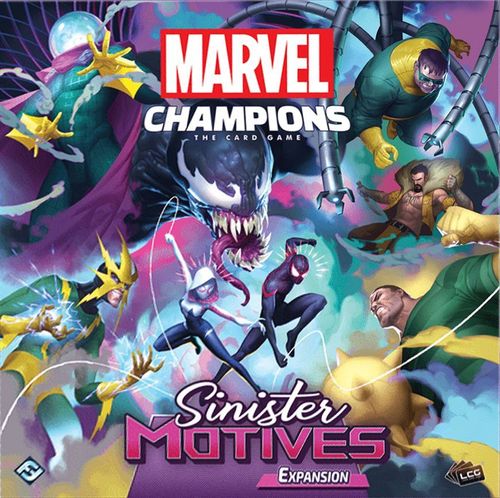
Marvel Champions: The Card Game – Sinister Motives
Marvel Champions: The Card Game – Sinister Motives Rulebook
Table of Contents
Table of Contents
Components
- 265 cards consisting of 95 player cards, 18 villain cards, and 152 encounter cards.
- Cards from the Sinister Motives expansion are identified by the Sinister Motives set symbol.
- Two pre-built player decks introduce two new heroes, Ghost-Spider and Spider-Man. See the Starter Decks section for their decklists.
Featured Keywords
* Keywords new to this expansion.
Hinder X
When a card with the hinder X keyword is revealed, place X threat on that card.
Incite X
When a card with the incite X keyword is revealed, place X threat on the main scheme.
Patrol
While any minions with the patrol keyword are engaged with a player, that player cannot thwart the main scheme.
Permanent
A card with the permanent keyword cannot leave play.
Piercing
An attack with the piercing keyword discards any tough status cards from the target of the attack before dealing damage.
Requirement (Resources) *
A card with the requirement keyword cannot be played unless each resource of the specified type is spent while paying for that card's cost.
Setup
A card with the setup keyword begins the game in play.
Stalwart
A character that has the stalwart keyword cannot be stunned or confused.
Steady
A character with the steady keyword can have one additional stunned status card and one additional confused status card. That character is not stunned unless they have two stunned status cards, and is not confused unless they have two confused status cards. After that character's activation is replaced by a status card effect, remove all status cards of that type from that character.
Team-Up
The team-up keyword names two characters. To include a card with the team-up keyword in your deck, your chosen identity must match one of the named characters. Additionally, a card with the team-up keyword cannot be played unless both of the named characters (identity or ally) are in play.
Villainous
When a minion with the villainous keyword activates, give it a facedown boost card from the top of the encounter deck. When you resolve that minion's activation, turn the boost card faceup and apply its boost icons to the minion's stats for this activation. If the boost card has a boost ability, resolve its effects. Discard the boost card after the activation.
Victory X
When a card with the victory X keyword is defeated, place it in the victory display instead of its owner's discard pile.
Victory Display
The victory display is an out-of-play game area shared by all players. Cards in the victory display follow the standard rules for out-of-play cards.
Amplify Icon
The amplify icon increases the number of boost icons on boost cards. When a boost card is turned faceup during an enemy activation, add one additional boost icon to that card for each amplify icon in play.
New Mode of Play
Each of the scenarios in this expansion can be played individually as standalone adventures or as part of one epic campaign.
Campaign Mode Rules
Campaign mode combines all five scenarios in the Sinister Motives expansion into an epic experience where the outcome of each game impacts the next scenario. To complete the campaign, the players must win all five scenarios in numerical order, starting with scenario #1 (Sandman) and ending with scenario #5 (Venom Goblin).
To begin a campaign, the players start by choosing their identities. Each player must use their chosen identity for the entire campaign, but they are free to change aspects and alter the contents of their deck following the deck customization rules in the Marvel Champions Rules Reference between scenarios.
To play a scenario in campaign mode, set up the scenario as per the normal rules of the game. Then, follow that scenario's Setup instructions as listed below in its scenario section.
When the game ends, if the players won, follow the Victory instructions at the end of that scenario's section. If the players lost, they may reset the scenario and try again with no penalty.
Prohibited Cards
While playing the Sinister Motives campaign, players cannot include the following cards in their player deck unless a campaign rule states otherwise:
- Venom (Eddie Brock) (card 190)
- Symbiote Suit (card 191)
While playing the Sinister Motives campaign, cards from the following modular encounter sets cannot be included in any scenario unless a campaign rule states otherwise:
- Osborn Tech (cards 147–152)
- Sinister Assault (cards 158–163)
Campaign-Specific Cards
During a campaign, campaign-specific cards may be added to encounter decks and player decks. These cards cannot be included in a deck unless players are playing the Sinister Motives campaign.
Cards 182–189 are the campaign-specific player cards in the Sinister Motives campaign and belong to the "Campaign - S.H.I.E.L.D. Tech" deckbuilding classification. (The S.H.I.E.L.D. Tech Upgrades are shown as card art on page 4 of the printed rulebook.)
Cards 176–180 are campaign-specific encounter cards used during the Sinister Motives campaign and belong to the "Campaign - Community Service" modular encounter sets. Setup instructions for each scenario may direct players to include cards from this set in the scenario. (Each Community Service side scheme is shown as card art on page 4 of the printed rulebook.)
Reputation Track
The heroes' reputation score (as a group) is a new variable that is used during this campaign. The track on page 22 is used to record this. Higher reputation can be a blessing and a curse. Citizens may be more appreciative of your efforts to protect them and other heroes may join your cause, but villains will treat you as a greater threat and bolster their efforts against you.
At the end of each scenario, players will be instructed to use the "Conditions" section of the reputation track to calculate the group's total reputation value. When this occurs, refer to the "Conditions" section at the bottom of the reputation track. Mark the proper number of nodes on the track for each condition met, starting at the topmost unmarked node, and marking each subsequent node going down the track.
As nodes are marked, any connected reputation effects are activated. Whenever a node connected to a white box is marked, resolve the effects of that box immediately. Whenever a node connected to a pink box is marked, the Setup instructions in that box will trigger at the beginning of each remaining scenario in the campaign (the Setup instructions of each scenario will remind you of this).
Note: It is possible to exceed the reputation track by accumulating more reputation than the track allows. While there is no reward or penalty for this, continuing to record reputation after the last node can allow for a more accurate final reputation score at the end of the campaign. To assist in this, smaller, additional nodes have been included beneath the track's last primary node.
Track Layout
The track is a column of nodes running from the star at the top (the first node) down to the last primary node. The printed numbers 5, 10, 15, 20, and 25 mark every fifth node. Each box is connected to a node on the printed track, and which node each box is connected to is shown graphically there. The boxes below are listed in printed order, from top to bottom, left column first. Items beginning "Setup:" are the pink part of a box; the other items are the white part.
Left column:
- Deal 3 "Campaign - S.H.I.E.L.D. Tech" upgrades at random to a player. That player may choose 1 to add to their deck for the rest of the campaign, record that card's title in their "S.H.I.E.L.D. Tech" section of the campaign log, then return the others to the collection. Cards chosen this way do not count toward minimum or maximum deck size. Repeat this process for each player.
- During step 13 of game setup, each player may take 1 additional mulligan.
- Each player chooses an aspect card in their collection from any aspect and adds the maximum number of copies of that card, by title, to their deck for the rest of the campaign. Record the title of that card in their "Aspect Advantage" section of the campaign log. Cards chosen this way do not count toward minimum or maximum deck size.
- Setup: Each player flips their "Campaign - S.H.I.E.L.D. Tech" upgrade to its Enhanced side.
- Each player chooses one card from their deck, then records the title of that card in their "Planning Ahead" section of the campaign log.
- Setup: Each player searches their deck and discard pile for 1 copy of the card recorded in their "Planning Ahead" section of the campaign log, then adds that card to their hand. (Shuffle.)
- Setup: Each player may search their collection for a Helicarrier support (Core Set 92) and put it into play under their control.
- Setup: Each player may search their collection for a Symbiote Suit upgrade (Sinister Motives 191) and put it into play under their control.
Right column:
- Choose one "Osborn Tech" attachment at random. Record its name in the "Osborn Tech" section of the campaign log.
- Setup: Shuffle each card recorded in the "Osborn Tech" section of the campaign log into the encounter deck.
- Setup: Place 1 threat on the main scheme.
- Setup: In player order, each player must search the encounter deck and discard pile for a minion, then put that minion into play engaged with themself. (Shuffle.) For each player who did not put a minion into play this way, deal that player 1 facedown encounter card.
- Choose one "Osborn Tech" attachment at random. Record its name in the "Osborn Tech" section of the campaign log.
- Setup: The first player must search the encounter deck and discard pile for a scenario-specific side scheme, then reveal it. Place 1 threat on that side scheme. (Shuffle.)
- Choose one "Osborn Tech" attachment at random. Record its name in the "Osborn Tech" section of the campaign log.
- Setup: Deal 1 facedown encounter card to each player.
Conditions
The "Conditions" section at the bottom of the reputation track:
- (+X) Victory points in the victory display
- (+1) No side schemes in play
- (+1) Fewer than 1 acceleration tokens in play
- (+1) No minions in play
- (+1) No threat on the main scheme
- (+1) No defeated identities
Campaign Log
The campaign log found on page 23 of this rulebook tracks the progress of the entire campaign. At the end of each scenario, the players record their results by entering the required information in the campaign log.
Once the campaign has been completed, the "Final Reputation Score" section of the campaign log provides players the option of determining how successful they were during the campaign. The higher the final score, the greater number of objectives the players achieved, and the better they did!
The campaign log has these sections:
- Player #1–#4's Identity with Remaining Hit Points (Expert Mode Only), one entry for each player.
- Community Service (Victory for Scenarios #1–4): record the title of a "Campaign - Community Service" side scheme that is in the victory display.
- Waking Nightmare (Victory for Scenario #3 — Mysterio).
- Last Ones Standing (Victory for Scenario #4 — The Sinister Six).
- Final Reputation Score (Victory for Scenario #5 — Venom Goblin).
- S.H.I.E.L.D. Tech, Aspect Advantage, and Planning Ahead (each a Reputation Track Reward, with an entry for each of players P1–P4).
- Osborn Tech (Reputation Track Penalty).
A printable copy of the reputation track and the campaign log can be found on the publisher's support page at www.fantasyflightgames.com/marvel-champions.
Expert Campaign
For players who want a more challenging campaign experience, the Sinister Motives expansion comes with everything you need to play an expert campaign.
Some Setup and Victory instructions are preceded by "Expert Campaign Only." Ignore these instructions unless you are playing an expert campaign.
Elimination and Victory
In an expert campaign, if a player is defeated during a scenario that their teammates go on to win, the defeated player does not participate in the Victory steps of that scenario.
Persistent Damage
While playing the Sinister Motives campaign at the expert level, each player must record their remaining hit points in the campaign log after they win a game. This determines each player's starting hit points for the next scenario.
If a player's remaining hit point value is greater than their base hit point value, record their base hit points in the campaign log instead.
However, during the Setup instructions of the next scenario, the defeated player may rejoin their teammates and reset their hit point dial to their identity's printed hit point value by dealing themselves facedown encounter cards from the encounter deck (as described previously).
Deck Customization Restrictions
(Optional) Once a player starts an expert campaign, they cannot add, remove, or change the aspect and/or basic cards in their deck (following the deck customization rules) for the remainder of the campaign. However, campaign-specific cards can be added to their deck as per the campaign rules.
The Setup instructions for each of the last four scenarios offer players the opportunity to reset their hit point dial to their identity's printed hit point value by dealing themselves facedown encounter cards from the encounter deck (per the second step within each Expert Campaign Only box).
Scenarios
Each of the five scenarios can be played individually, or together as a campaign (see Campaign Mode Rules). Each scenario's Campaign Instructions (Setup and Victory) are reproduced in its entry below.
Scenario #1 – Sandman
Villain Deck: Sandman (I), Sandman (II). Remove Sandman (I) and add Sandman (III) for expert mode.
Main Scheme Deck: Hapless Pedestrians (1A/1B).
Encounter Deck: Sandman, City in Chaos, Down to Earth, and Standard encounter sets.
The Down to Earth modular set can be removed from this scenario and/or added to other scenarios when using scenario customization rules. The City in Chaos modular set can be used in other scenarios but is required while playing the Sandman scenario. The Standard set can be found in the Marvel Champions Core Set.
Campaign Instructions – Sandman
Setup:
- Put the Public Outcry (174) environment into play (in standard mode, use the side with the text "Standard Mode Only"; in expert mode, use the side with the text "Expert Mode Only").
- Shuffle the Smear Campaign (175) treachery into the encounter deck.
- Choose 1 "Campaign - Community Service" (176–180) side scheme at random. Shuffle that side scheme into the encounter deck.
- Expert Campaign Only: Place 2 additional sand counters on the City Streets environment. Resolve its "Surging Sands" ability.
Victory:
In the reputation track:
- Using the "Conditions" section, calculate your group's total reputation value, then mark that number of nodes (starting at the topmost unmarked node, and marking each subsequent node going down the track).
In the campaign log:
- If a "Campaign - Community Service" (176–180) side scheme is in the victory display, record its title in the "Community Service" section.
- Expert Campaign Only: Record each identity's remaining hit points.
Scenario #2 – Venom
Villain Deck: Venom (I), Venom (II). Remove Venom (I) and add Venom (III) for expert mode.
Main Scheme Deck: "Leave Us Alone!" (1A/1B).
Encounter Deck: Venom, Down to Earth, Symbiotic Strength, and Standard encounter sets.
The Down to Earth modular set can be removed from this scenario and/or added to other scenarios when using scenario customization rules. The Symbiotic Strength modular set can be used in other scenarios but is required while playing the Venom scenario. The Standard set can be found in the Marvel Champions Core Set.
Boost Cards on Your Identity
During this scenario, boost cards may be placed on your identity. When this occurs, take the top card of the encounter deck and place it facedown on your identity (do not look at it). That boost card remains on your identity until a card ability (specifically the "Forced Interrupt" ability on the main scheme) instructs you to move that card to Venom during an activation.
Campaign Instructions – Venom
Setup:
- Put the Public Outcry (174) environment into play.
- Shuffle the Smear Campaign (175) treachery into the encounter deck.
- Choose 1 "Campaign - Community Service" (176–180) side scheme at random that does not have its title recorded in the "Community Service" section of the campaign log. Shuffle that side scheme into the encounter deck.
- Follow all "Setup" instructions on the left side of the reputation track for any marked nodes, from top to bottom. Repeat this for "Setup" instructions on the right side.
- Expert Campaign Only: Set each player's hit point dial to their remaining hit point value recorded in the campaign log.
- Expert Campaign Only: Each player may deal themself 1 facedown encounter card from the encounter deck to set their hit point dial to their identity's printed hit point value.
- Expert Campaign Only: Place 1 facedown boost card on each identity.
Victory:
In the reputation track:
- Using the "Conditions" section, calculate your group's total reputation value, then mark that number of nodes.
In the campaign log:
- If a "Campaign - Community Service" (176–180) side scheme is in the victory display, record its title in the "Community Service" section.
- Expert Campaign Only: Record each identity's remaining hit points.
Scenario #3 – Mysterio
Villain Deck: Mysterio (I), Mysterio (II). Remove Mysterio (I) and add Mysterio (III) for expert mode.
Main Scheme Deck: Maze of Mirrors (1A/1B), Edge of Reality (2A/2B).
Encounter Deck: Mysterio, Personal Nightmare, Whispers of Paranoia, and Standard encounter sets.
The Whispers of Paranoia modular set can be removed from this scenario and/or added to other scenarios when using scenario customization rules. The Personal Nightmare modular set can be used in other scenarios but is required while playing the Mysterio scenario.
Encounter Cards in Your Player Deck
Throughout this scenario, cards from the encounter deck may be added to your player deck, hand, or discard pile. Similar to player cards, encounter cards added to your deck are added facedown (even if the card backs are different), and encounter cards added to your discard pile are added faceup.
After the scenario ends, remove all encounter cards from your deck, hand, and discard pile.
Campaign Instructions – Mysterio
Setup:
- Put the Venom (190) ally card into play under the first player's control.
- Put the Public Outcry (174) environment into play.
- Shuffle the Smear Campaign (175) treachery and the Snitches Get Stitches (181) attachment into the encounter deck.
- Choose 1 "Campaign - Community Service" (176–180) side scheme at random that does not have its title recorded in the "Community Service" section of the campaign log. Shuffle that side scheme into the encounter deck.
- Follow all "Setup" instructions on the left side of the reputation track for any marked nodes, from top to bottom. Repeat this for "Setup" instructions on the right side.
- Expert Campaign Only: Set each player's hit point dial to their remaining hit point value recorded in the campaign log.
- Expert Campaign Only: Each player may deal themself 2 facedown encounter cards from the encounter deck to set their hit point dial to their identity's printed hit point value.
- Expert Campaign Only: In player order, each player must shuffle the top 2 cards of the encounter deck into their deck.
Victory:
In the reputation track:
- Using the "Conditions" section, calculate your group's total reputation value, then mark that number of nodes.
In the campaign log:
- If a "Campaign - Community Service" (176–180) side scheme is in the victory display, record its title in the "Community Service" section.
- Count the total number of Illusion cards in all player decks. Record that number in the "Waking Nightmare" section.
- Expert Campaign Only: Record each identity's remaining hit points.
Scenario #4 – The Sinister Six
Villains: Doctor Octopus (I), Electro (I), Hobgoblin (I), Kraven the Hunter (I), Scorpion (I), Vulture (I).
Main Scheme Deck: Sinister Synchronization (1A/1B), Sinister Beatdown (2A/2B).
Encounter Deck: The Sinister Six, Guerrilla Tactics, and Standard encounter sets.
The Active Counter
During this scenario, there may be more than one villain in play. However, only one villain at a time will have the active counter (all-purpose counter), which is placed on a villain at the start of the scenario and will move between villains through card abilities.
The active counter determines which villain is considered active. This is the only villain that activates during step 2 of the villain phase. Encounter card effects that refer to "the villain" without a qualifier refer only to the active villain. Card effects that specify "the villain" who best meets a certain condition (such as "the villain with the highest activation order value" or "the villain with the most remaining hit points") refer to the specified villain regardless of which villain is active.
After the villain with the active counter is defeated, move the active counter to the next villain in the activation order. If no other villains are in play, set the active counter aside.
Activation Order
Each villain in this scenario has the text "Activation Order X". This text determines the order in which the villains activate.
When instructed to "move the active counter to the next villain in the activation order," move the active counter from the villain who has it to the villain with the next ascending value in the order. If there is no activation order value greater than the current villain's value, move the active counter to the villain with the lowest activation order value.
Campaign Instructions – The Sinister Six
Setup:
- Put the Venom (190) ally card into play under the first player's control.
- Put the Public Outcry (174) environment into play.
- Shuffle the Smear Campaign (175) treachery and the Snitches Get Stitches (181) attachment into the encounter deck.
- Choose 1 "Campaign - Community Service" (176–180) side scheme at random that does not have its title recorded in the "Community Service" section of the campaign log. Shuffle that side scheme into the encounter deck.
- Place threat on the Light at the End side scheme equal to the number recorded in the "Waking Nightmare" section of the campaign log.
- Follow all "Setup" instructions on the left side of the reputation track for any marked nodes, from top to bottom. Repeat this for "Setup" instructions on the right side.
- Expert Campaign Only: Set each player's hit point dial to their remaining hit point value recorded in the campaign log.
- Expert Campaign Only: Each player may deal themself 2 facedown encounter cards from the encounter deck to set their hit point dial to their identity's printed hit point value.
Victory:
In the reputation track:
- Using the "Conditions" section, calculate your group's total reputation value, then mark that number of nodes.
In the campaign log:
- If a "Campaign - Community Service" (176–180) side scheme is in the victory display, record its title in the "Community Service" section.
- Expert Campaign Only: Record each identity's remaining hit points.
- In the "Last Ones Standing" section, record the name of each villain in play.
Scenario #5 – Venom Goblin
Villain Deck: Venom Goblin (I), Venom Goblin (II). Remove Venom Goblin (I) and add Venom Goblin (III) for expert mode.
Main Scheme Deck: Skies Over New York (A), Lower Manhattan (B), Midtown Manhattan (C), Upper Manhattan (D).
Encounter Deck: Venom Goblin, Symbiotic Strength, Goblin Gear, and Standard encounter sets.
The Goblin Gear modular set can be removed from this scenario and/or added to other scenarios when using scenario customization rules. The Symbiotic Strength modular set can be used in other scenarios but is required while playing the Venom Goblin scenario. The Standard set can be found in the Marvel Champions Core Set.
The Glider Counter
There are three main schemes in play at the start of this scenario. However, only one main scheme at a time will have the glider counter (all-purpose counter), which is placed on Midtown Manhattan at the start of the scenario and will move between the main schemes through card abilities.
When threat would be placed on "the main scheme" by an enemy activation, card ability, or acceleration icon, place it on the scheme with the glider counter. Additionally, when an acceleration token would be placed on "the main scheme," place it on the scheme with the glider counter.
Any encounter card that refers to "the main scheme" without a qualifier refers to the main scheme with the glider counter. Encounter cards that refer to "the main scheme" that best meet a certain condition (such as "the main scheme with the least threat") refer to that scheme regardless of which main scheme the glider counter is on.
During step 1 of the villain phase, place threat on each main scheme according to its own acceleration value, without reference to the acceleration values of other main schemes. Likewise, each acceleration token places additional threat only on the main scheme it is on. When a main scheme is completed, flip it to its environment side.
Campaign Instructions – Venom Goblin
Setup:
- Put the Public Outcry (174) environment into play.
- Shuffle the Smear Campaign (175) treachery into the encounter deck.
- Search the "Sinister Assault" (158–163) modular set for each minion with the same name as a villain's name recorded in the "Last Ones Standing" section of the campaign log. Shuffle each of those minions into the encounter deck.
- Follow all "Setup" instructions on the left side of the reputation track for any marked nodes, from top to bottom. Repeat this for "Setup" instructions on the right side.
- Expert Campaign Only: Set each player's hit point dial to their remaining hit point value recorded in the campaign log.
- Expert Campaign Only: Each player may deal themself 3 facedown encounter cards from the encounter deck to set their hit point dial to their identity's printed hit point value.
- Expert Campaign Only: Place 1 additional threat on each main scheme.
- Expert Campaign Only: If the players lose this game, Venom Goblin takes control of New York City and the players lose the campaign.
Victory:
- You win the campaign!
Optional:
- Using the "Conditions" section of the reputation track, calculate your group's total reputation value, then mark that number of nodes.
- In the "Final Reputation Score" section of the campaign log, record a value equal to the number of nodes marked on the reputation track. The higher this score, the better you did!
Starter Decks
These pre-built decks and character introductions are intended for the player who wants to immediately play the game without customizing their own deck.
Ghost-Spider / Protection
Ghost-Spider's superhuman agility and spider-senses allow her to react to almost any situation at a moment's notice. Through her Dizzying Reflexes ability, she can ready the first time she uses an event that has an "Interrupt" or "Response" ability, allowing her to perform astounding acrobatics such as flipping out of the way of an enemy's attack, Ghost Kicking that very same enemy (or a different enemy), and readying up to do it again. Getting her father, George Stacy, into play as soon as possible helps bring Ghost-Spider's explosive turns together, or use Ticket to the Multiverse to reset her turn entirely.
With the Protection aspect, Bait and Switch the villain to remove threat from the main scheme and force an attack against you, Jump Flip out of the way, and use a host of Web-Warrior allies to aid in the fight.
- Ghost-Spider cards: Ghost Kick x3, Parental Guidance, Phantom Flip x3, Pirouette and Punch x2, Web Binding x2, George Stacy, Ticket to the Multiverse, Web-Bracelet x2.
- Protection cards: Silk, Spider-Man (Miles Morales), Spider-UK, Bait and Switch x3, Jump Flip x3, Return the Favor x3, What Doesn't Kill Me x3.
- Basic cards: Spider-Man (Hobie Brown), Across the Spider-Verse, Young Love, Energy, Genius, Strength, Web of Life and Destiny, Plan B x3.
- Obligation: Worried Father.
- Nemesis set: Regenerative Research, The Lizard, Experimental Injection, In Cold Blood x2.
Spider-Man / Justice
Spider-Man has two powerful abilities of his own—Venom Blast and Spider Camouflage—both of which can only be resolved by utilizing specific cards within his very own card kit. Swing In to save the day, and go invisible with Spider Camouflage while you're at it, or Web Shot an enemy, then Venom Blast another with a high-powered jolt of electricity! Flip to Spider-Man's alter-ego, Miles Morales, to put signature cards back into your deck, and use Miles's best friend, Ganke Lee, or his father, Jefferson Davis, to help when you do.
Using the Justice aspect, enlist Monica Chang and her Surveillance Team for aid, call upon a Homeland Intervention for additional support from S.H.I.E.L.D., or make sure that you're steps ahead of the villain through S.H.I.E.L.D.'s vast network of Global Logistics.
- Spider-Man cards: Arachnobatics x2, Double Life x2, Swing In x2, Web-Shot x3, Ganke Lee, Jefferson Davis, Power Within, Defense Mechanism, Web-Shooter x2.
- Justice cards: Monica Chang, Spider-Woman, Homeland Intervention x3, Global Logistics x3, Field Agent x3, Surveillance Team x2.
- Basic cards: Agent 13, Dum Dum Dugan, Ghost-Spider, Spider-Man (Peter Parker), Young Love, Energy, Genius, Strength, Government Liaison x3, Sky-Destroyer.
- Obligation: Keeping Secrets.
- Nemesis set: Tracking Prey, Prowler, Razor Claws, Slice and Dice x2.
Rule Clarification
Identity-specific cards, obligation cards, and nemesis encounter set cards may only be used alongside an identity if those cards share a set icon with that identity.
Frequently Asked Questions
Spider-Man (Miles Morales)
Q. Can I use cards from the Spider-Man (Miles Morales) set when I play Spider-Man (Peter Parker), and vice versa?
A. No. Cards related to an identity—identity-specific cards, obligation cards, and nemesis encounter set cards—may only be used alongside the identity with which they share a set icon.
Scenario #2 – Venom
Q. If more than 3 chime counters are placed on Bell Tower by an attack, is that attack considered to have dealt excess damage?
A. No. Bell Tower's ability allows the player to place chime counters on it instead of dealing damage to Venom, effectively converting damage to chime counters. Because no damage is actually dealt to Bell Tower, excess damage effects do not apply.
Scenario #3 – Mysterio
Q. When an encounter card is added to my deck, do I have to re-sleeve that card to match my player cards?
A. No, encounter cards added to player decks are done so as is. Additionally, there is no requirement for players to treat the encounter card backs within their decks as hidden information, meaning players may (and are encouraged to) anticipate when an encounter card will be drawn from their decks and prepare accordingly.
Q. If I draw multiple cards, when are the encounter cards that I draw dealt to me?
A. If multiple cards are drawn due to a game step or card ability, those cards are drawn simultaneously. Afterward, deal each encounter card drawn during that process to yourself as a facedown encounter card (in any order).
Scenario #4 – The Sinister Six
Q. If the villain with the active counter is prevented from activating (such as through a stun or confuse status card), does the active counter move?
A. No. If the villain with the active counter is prevented from activating, that villain's ability that moves the counter (which triggers after the villain activates) will not resolve, so the active counter does not move.
Q. If there is only one villain in play, does the active counter move?
A. If there is only one villain in play, the active counter cannot move to another villain, so it stays on the one villain in play.
Q. Are there any suggestions for the easiest method to keep track of each villain's remaining hit points?
A. Because the villains in The Sinister Six scenario tend to enter and leave play often, it is suggested that players use either damage tokens or dice to keep track of each villain's remaining hit points. However, which method the players actually choose is up to them.
Scenario #5 – Venom Goblin
Q. Are players restricted to only removing threat from the scheme with the glider counter?
A. No. Player cards that specify "the main scheme" can remove threat from any main scheme.
Q. Multiple main schemes have the same amount of threat. Which scheme is considered to have the "least" or "most" threat on it?
A. Any time an encounter card targets a specific card and there are multiple eligible targets, the first player selects among the eligible options.
Q. How do the patrol keyword and the crisis icon interact with three main schemes?
A. The patrol keyword prevents the engaged player from thwarting "the main scheme," while the crisis icon prevents each player from removing threat from "the main scheme." In both cases, per the glider counter rules, encounter effects that refer to "the main scheme" only refer to the scheme with the glider counter.