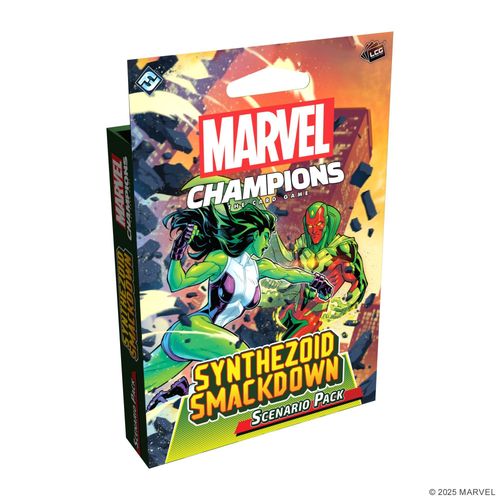
Marvel Champions: The Card Game – Synthezoid Smackdown Scenario Pack
Marvel Champions: The Card Game – Synthezoid Smackdown Scenario Pack Rulebook
Table of Contents
Table of Contents
Expansion Symbol
The cards in this expansion are identified by this symbol before each card's collector number.
New Card Type: Leader
Leader is a new card type included in this pack. Leaders are used in place of villains in the Synthezoid Smackdown scenarios and they function exactly the same as villains. The only difference between leaders and villains is that players can team up with their chosen leader in competitive play. Game rules and card abilities that affect villains affect leaders the same way.
She-Hulk (Leader)
- Stage I. Traits: Avenger. Gamma.
- SCH 1. ATK 2. Hit Points 16. Card number 1/14.
- Setup: The enemy team finds a copy of Superhuman Strength and attaches it to She-Hulk.
- Forced Response: After an alter-ego changes to hero form, deal 1 damage to that hero.
Vision (Leader)
- Stage I. Traits: Aerial. Avenger.
- SCH 1. ATK 1. Hit Points 14. Card number 1/14.
- Setup: The enemy team finds Vision's mass form attachment and attaches it to Vision, Dense side faceup.
- Forced Response: After resolving step 1 of the villain phase, flip Vision's mass form attachment.
Content
The Civil War story split the Avengers by forcing them to choose sides in response to the Superhero Registration Act. The resistance side went underground to fight against what they saw as an unjust law, while the registration side agreed to work for the government and hunt down the rebel heroes.
To bring this experience to your gaming table, the two scenarios included in the Synthezoid Smackdown pack are divided into registration and resistance.
Each side has the following content:
- 1 Leader: She-Hulk for the registration, and Vision for the resistance. Each leader has 4 stages and their own 10-card encounter set. Stages III and IV replace stages I and II in expert mode. Additionally, each leader comes paired with 4 basic player cards. These leader-specific player cards are used only when playing in competitive mode.
- 2 Main Schemes: 1 stage 1 and 1 stage 2.
- 4 Modular Encounter Sets: Each set is exactly 5 cards. Each set includes at least 1 minion, 1 treachery, and 1 side scheme.
- 1 Standard PvP Encounter Set: This set replaces the standard encounter set when playing in competitive mode.
Modes of Play
The Synthezoid Smackdown pack offers you two ways to play the included scenarios: cooperatively or competitively.
Playing Cooperatively
The Synthezoid Smackdown pack fully supports cooperative play for 1-4 players; however, many of the encounter cards in this set were built to highlight the exciting new possibilities of having an enemy team in competitive mode. As a result, some of the language on the cards requires clarification in cooperative mode.
To play a Synthezoid Smackdown scenario cooperatively, simply follow the normal rules of the game with these clarifications in mind:
- The leader in play is called "the enemy leader." Any rule or ability that refers to "the villain" refers to the enemy leader.
- Any rule or ability that refers to "the enemy team" refers to the players. Resolve these abilities using the grim rule: Imagine what an opponent would do if it were their choice.
- A card ability that refers to "your leader" cannot be resolved. These cards typically have alternate effects that will resolve instead. Do as much as you can.
Playing Competitively
The Civil War story pits hero against hero in a conflict over the Superhero Registration Act. To better immerse players in that story, the two scenarios included in this pack can be played competitively either 1v1 (one registration player against one resistance player) or 2v2 (two registration players against two resistance players).
To learn how to play the Synthezoid Smackdown scenarios competitively, see the Competitive Mode section below.
Pre-Constructed Scenarios
The Synthezoid Smackdown pack comes with two preconstructed scenarios ready to play right out of the box. Here is an introduction to both the registration and resistance scenarios.
She-Hulk (Registration)
A long time Avenger, Jennifer Walters is also an attorney in the state of New York and she believes strongly in the rule of law. When the Superhero Registration Act is first proposed, she endorses it. After it becomes law, she fights to enforce it as She-Hulk.
- Leader Deck: She-Hulk (I), She-Hulk (II). Remove She-Hulk (I) and (II) and add She-Hulk (III) and (IV) for expert mode.
- Main Scheme Deck: Enforce the Law, Mighty Avengers.
- Encounter Deck: She-Hulk, S.H.I.E.L.D. Ops, Thunderbolts, Taskmaster, Deadly Duo, and Standard sets. (The Standard set can be found in the Marvel Champions core set.)
The S.H.I.E.L.D. Ops, Thunderbolts, Taskmaster, and Deadly Duo sets can be removed from this scenario and/or added to other scenarios when using the scenario customization rules.
Vision (Resistance)
Created by Ultron to be the ultimate artificial organism, Vision rebelled against his creator and joined the Avengers. Now free of Ultron's control, Vision is reluctant to submit to S.H.I.E.L.D.'s authority under the new registration law. Instead, he joins the growing superhero resistance in their fight for autonomy.
- Leader Deck: Vision (I), Vision (II). Remove Vision (I) and (II) and add Vision (III) and (IV) for expert mode.
- Main Scheme Deck: Protect Secret Identities, Expose Overreach.
- Encounter Deck: Vision, Young Avengers, Scarlet Twins, Moon Knight, Royal Guard, and Standard sets. (The Standard set can be found in the Marvel Champions core set.)
The Young Avengers, Scarlet Twins, Moon Knight, and Royal Guard sets can be removed from this scenario and/or added to other scenarios when using the scenario customization rules.
Amplify Icon
The amplify icon increases the number of boost icons on boost cards. When a boost card is turned faceup during an enemy activation, add one additional boost icon to that card for each amplify icon in play.
Featured Keywords
Hinder X: When a card with hinder X enters play, place X threat on that card.
Incite X: When a card with incite X is revealed, place X threat on the main scheme.
Patrol: While any minions with patrol are engaged with a player, that player cannot thwart the main scheme.
Permanent: A card with permanent cannot be defeated, leave play, or have any part of its text box blanked.
Piercing: An attack with piercing discards any tough status cards from the target of the attack before dealing damage.
Stalwart: A character with stalwart cannot be stunned or confused.
Villainous: When a minion with villainous activates, give it a facedown boost card from the top of the encounter deck. When you resolve that minion's activation, turn the boost card faceup, resolve any boost ability on that card, and apply its boost icons to the minion's stats for this activation. Discard the boost card after the activation.
Competitive Mode
For players who want to test their mettle against a live opponent, the Synthezoid Smackdown pack provides rules for an exciting new competitive mode! This mode can be played either 1v1 or in teams of 2v2.
Setting Up a Competitive Game
To set up a competitive game of Marvel Champions, follow these instructions:
- Each team chooses a leader: She-Hulk or Vision.
- Players cannot use an identity that shares a title with the leader for their side, so be sure to choose a leader that is different from your hero.
- Replace the standard set with the standard PvP set when playing in competitive mode.
- The opposing teams sit across the table from each other.
- Each team finds their chosen leader's basic player cards and sets them aside.
- The players on that leader's team can earn those cards during the game. (See Leader-Specific Basic Cards below.)
- The teams trade scenarios with each other so that each team faces the leader, main scheme deck, and encounter deck of the opposing team.
- The registration team battles Vision, and the resistance team battles She-Hulk.
- Follow the normal set up rules for the game.
The printed game area diagrams show the layout of a registration game area and a resistance game area. Each diagram labels the following areas: First Player Token, Enemy Leader, Choosing Sides (side scheme), Main Scheme Deck, Encounter Deck, the Player 1 and Player 2 Play Areas, the Player 1 and Player 2 Heroes, and the Player 1 and Player 2 Decks.
Playing a Competitive Game
To play a competitive game of Marvel Champions, follow these rules in addition to the regular game rules:
- The registration team goes first each round.
- In a 2v2 game, each team has its own first player token that passes at the end of their villain phase. If you do not have enough tokens or dials, you can use coins, pen & paper, etc.
Each round is threaded as follows:
- The registration team plays their entire hero phase, including readying cards and refilling their hands.
- The resistance team plays their entire hero phase, including readying cards and refilling their hands.
- The registration team plays their entire villain phase.
- The resistance team plays their entire villain phase.
During your opponents' hero and villain phases, your side of the table is inactive and you should observe their game to make sure they don't accidentally miss any relevant game effects.
Unique Rule and Other Abilities
Card abilities on your side of the table completely ignore cards on the other side of the table unless they specifically refer to them.
The unique rule only applies to your player cards and your teammate's player cards. Unique enemy cards have no impact on unique friendly cards.
- Players still cannot use a hero if it has the same title as their chosen leader.
- For example, if the registration team chose She-Hulk as their leader, neither player on the registration team can use the She-Hulk hero for that game.
Encounter cards from a leader's encounter set that refer to that leader by its title only refer to that leader and NOT a hero or ally version of that character.
- For example, a card in Vision's encounter set that says "Attach to Vision" only refers to the Vision leader and NOT a hero or ally version of Vision.
Abilities that refer to "the enemy leader" refer to the leader you are fighting.
Abilities that refer to "the enemy team" refer to the players on the team you are playing against.
Abilities that refer to "enemy" or "enemies" refer to the leader you are fighting and any minions on your side of the table.
- It does NOT refer to your opponents' allies or identities.
If a player has more than one encounter card to reveal, they must reveal them in the order they were dealt. This can allow players to set up encounter card combos.
When the Enemy Leader Attacks Your Leader
Some card abilities cause the enemy leader to attack your leader. These attacks ignore the guard keyword and no player can declare a defender.
To resolve an attack by the enemy leader against your leader, follow these steps:
- Give the attacking leader a facedown boost card from its encounter deck.
- The first player on the defending leader's team turns that card faceup and resolves its effects.
- Place the attacking leader's boost card into its encounter deck discard pile.
- The attacking leader deals damage to the defending leader equal to its total ATK.
Leader-Specific Basic Cards
Each leader comes with 4 basic player cards. These cards are set aside during step 3 of "Setting Up a Competitive Game." Players earn 2 of their leader's basic player cards by defeating the "Choosing Sides" side scheme in their game area.
Once a player has earned 2 of their leader's basic player cards, those cards become part of that player's deck for the rest of the game.
- Make Me Angry (Basic / She-Hulk, Upgrade, cost 1). Attach to your She-Hulk leader. Forced Response: After a hero or leader attacks attached She-Hulk, she attacks that character. Then, discard this card.
- Synthezoid Strike (Basic / Vision, Event, cost 2). Action: Your Vision leader attacks the enemy leader. If Vision's mass form attachment is:
- Dense, Vision gets +1 ATK for this attack and this attack gains piercing.
- Intangible, flip it to Dense before resolving this attack.
Winning a Competitive Game
There are three ways to win the game:
- Whichever team defeats the enemy leader first wins.
- Whichever team's leader completes its main scheme first wins.
- Whichever team's leader defeats all their opponent's identities first wins.
The game does not end until both sides have played an equal number of phases.
If the registration team is the first to lose the game either by the enemy leader completing its scheme or having each of their heroes defeated, the game will continue through the end of the resistance team's next phase. If they also lose the game due to the enemy leader completing its scheme or having each of their heroes defeated, both teams lose the game.
If the registration team is the first to defeat the enemy leader, the game will continue through the end of the resistance team's next phase. If they also defeat their enemy leader, the game is a tie.
If the registration team defeats the enemy leader during their hero phase, the resistance leader does not leave play immediately. It remains on the table through the end of the resistance team's next phase so it can still be targeted by resistance player card effects.
Tie-Break Conditions
In the event of a tie, players can use the following tie-break conditions in order to determine the winner:
- The team whose enemy main scheme deck did not advance past stage 1B wins.
- The team with the fewest total minions and side schemes in their game area wins.
- The team with the least amount of threat on the main scheme in their game area wins.
- The team whose identities have the most remaining hit points wins.
- The team with the fewest attachments on the leader in their game area wins.
Competitive Scheme Cards
The competitive game area diagrams print the following main scheme and side scheme text. Stage labels and threat values are as printed.
Protect Secret Identities (Resistance, Main Scheme, Stage 1B)
Threat 7. "By giving up the masks, heroes put themselves and their loved ones at risk." If there is more than 1 player on your team, this stage gains hinder 2.
Forced Response: After resolving step 1 of the villain phase, each layer [sic: player] discards the top 3 cards of their deck.
Enforce the Law (Registration, Main Scheme, Stage 1B)
Threat 7. "This could all be avoided if you'd only obey the law!" —She-Hulk
If there is more than 1 player on your team, this stage gains hinder 2. The enemy leader gains steady.
Choosing Sides (Side Scheme, Both Sides)
Permanent. The enemy leader cannot take more than 2 damage from each attack.
Forced Response: After the last threat is removed from here, the enemy team searches the top 5 cards of the encounter deck for 1 encounter cards [sic: card] and deals one to each player as a facedown encounter card. Flip this card.
Frequently Asked Questions
Q. What happens in competitive mode if the enemy leader has the same card title as my identity or ally?
A. It does not matter if the enemy leader or a minion shares the same card title as a character you control. The unique rule only applies to friendly characters in competitive mode. This includes your leader but NOT any minions in your leader's encounter deck.
Q. What happens if I reveal stage II of the enemy leader during the villain phase?
A. You will resolve the stage II leader's "When Revealed" ability, dealing a facedown encounter card to each player on your team. Their leader cannot take any more damage until the end of the villain phase.
Q. Do I shuffle my identity's obligation into the encounter deck during competitive play?
A. Yes. Obligations are still shuffled into the encounter deck during setup when playing in competitive mode.