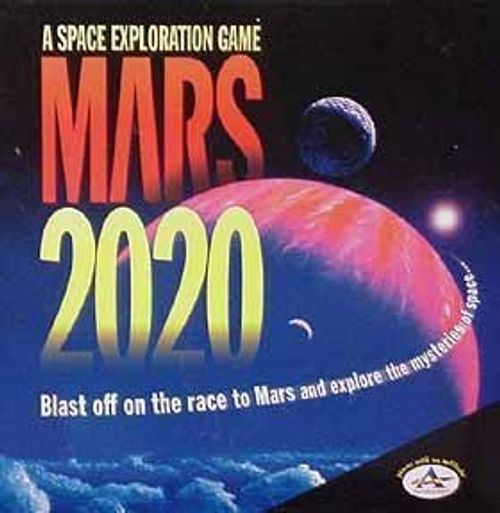
Mars 2020
Mars 2020 Rulebook
Table of Contents
Table of Contents
Game Contents
- Mars 2020 Game Board
- 6 Spaceship Playing Pieces
- 2 Jumbo Dice
- 1 Mars (red-colored marble)
- 8 Crew Member Cards
- 47 Mission Control Cards
- 275 Spaceport Repair Cards containing 550 questions
- Spaceport Repair Card Box
- Rule Booklet
Getting Ready to Play
-
THE QUESTIONS: Locate the Spaceport Repair Cards inside the Spaceport Repair Card Box and place the appropriate card divider between each of the five categories.
- Primary Mission (science)
- Technical (engineering)
- Life Support (medical)
- Propulsion (space flight)
- General (all areas of science)
-
LEVELS OF PLAY: Before starting play, each player chooses to play either level 1 (easier) questions or level 2 (more difficult) questions according to his or her knowledge of space science and technology. For a greater challenge, players can choose to answer questions in short answer format, without hearing the three multiple choices.
-
CREW MEMBERS: Locate the eight Crew Member Cards. There are two pilots (propulsion specialists), two engineers (technical specialists), two scientists (primary mission specialists), and two doctors (life support specialists). Players each choose one crew member to portray during the mission by selecting one of the Crew Member Cards. It is helpful to place each selected Crew Member Card where it can be seen throughout the game as a reminder of each player's specialty.
-
MISSION CONTROL CARDS: Locate and shuffle the Mission Control Cards. Place the deck facedown on the game board.
-
MARS: Place Mars (the red-colored marble) on any of the 11 red spaces (with holes cut out) on the outer path.
-
ORDER OF PLAY: Each player chooses a Spaceship playing piece and puts it on Earth near the center of the board. The youngest player goes first. Play continues to his or her left. You're now ready for lift-off!
Basic Play Of The Game
Players attempt to be the first to reach Mars from Earth by racing counterclockwise along the orbital path. Rolling the dice prompts each move: the white die controls the movement of your spaceship, the red die controls the movement of Mars along the outermost orbit. Along the way, players may encounter malfunctions which can occur when the white die indicates that they draw a Mission Control Card. Players with malfunctions must remain in their current orbit (continuously looping around) until they can repair their malfunction(s). One of the ways to fix malfunctions is to land on a Spaceport and correctly answer space-related questions from the Spaceport Repair Cards. Once a player is malfunction-free, he or she may travel freely to the next orbit at the asteroid "jump off" space. As a strategy, players may stop at Spaceports and answer questions even though they have no malfunctions. Players then save the cards that were answered correctly and "bank" them for future use as malfunctions occur. You win if "all systems are go" and you are the first to land on Mars!
Rules for Playing
-
TO TAKE A TURN: To zoom ahead, roll both dice. The red die controls the movement of Mars; the white die controls the movement of your ship.
- RED DIE: A 1 or 2 roll means to move Mars ahead in its orbit either one or two spaces. Always move Mars first and your ship second.
"Boost X 2" means that Mars moves two spaces and your ship moves twice as far as the number showing on the white die. For example, if the white die shows 3, move your ship 6 spaces.
- WHITE DIE: A 1, 2, or 3 roll tells how many spaces your ship can move. (Remember to move Mars first.)
"Mission Control" means to move Mars as indicated on the red die and to draw a Mission Control card instead of moving your ship (see rule 2). Even if you roll a "Boost X 2" on the red die and a "Mission Control," you still can't move.
-
MISSION CONTROL CARDS: Rolling "Mission Control" on the white die means that your Mission Control team back on Earth has a message for you — either good or bad. Draw the top Mission Control card and read it aloud. A draw from the Mission Control deck will present one of the following messages:
-
SPACEPORT FREE PASS: Each colored-coded orbital path on the board has a Spaceport. On your current turn or on any future turn, use this card to zoom directly to the Spaceport within your orbital path (or to either of the two Spaceports if you are in Mars' orbital path). Directly after using the Free Pass card, place it on the bottom of the Mission Control deck.
-
BACK-UP FUEL SUPPLY: On your current turn or on any future turn, use this card to take an extra turn. After using the card, place it on the bottom of the Mission Control deck.
-
GRAVITY ASSIST: This card allows you to advance to the next orbit. Place your spaceship on the first space after the asteroid in the next orbit — but only if you have no malfunctions. If you do have malfunctions, move to the Spaceport in your orbit instead. Answer a question that can fix your malfunction(s). If you are in Mars' orbit, you can't advance to a higher orbit but you can move to the nearest Spaceport — if you want to.
-
Automatic Repairs
If a malfunction is in your field of expertise (e.g., you're a doctor and it's a Life Support Malfunction), you're in luck. You can make an automatic repair. As soon as you get a malfunction, simply put the Malfunction Card on the bottom of the Mission Control deck and end your turn. Here are the four experts and the automatic repairs that each one can make:
- Pilot: Propulsion Repairs
- Engineer: Technical Repairs
- Scientist: Primary Mission Repairs
- Doctor: Life Support Repairs
Using Spaceport Repair Cards To Fix Malfunctions: What if the malfunction is not in your field of expertise? To fix it, you need to get to a Spaceport and correctly answer a matching Spaceport Repair Card question (e.g., a Life Support Repair Card fixes a Life Support Malfunction) or a General Repair Card question, which can fix all categories of malfunctions.
If you don't already have a matching Spaceport Repair Card, you'll have to earn one. Keep the Malfunction Card in front of you. On your next turn, try to travel to the Spaceport in your current orbital path and earn a Spaceport Repair Card. (See rule 3.)
If you already have collected a usable Spaceport Repair Card (because you chose to stop at a Spaceport and earn a Repair Card before you had a malfunction), discard it and put the Malfunction Card on the bottom of the Mission Control deck. Then end your turn.
-
SPACEPORTS: Each color-coded orbital path has a Spaceport. (The outer path — the orbit of Mars — has two Spaceports.) On any Spaceport, you can earn Spaceport Repair Cards by answering questions correctly.
How do you get to a Spaceport? There are four ways. 1) Land on one with an exact roll. 2) Stop on a Spaceport and give up any remaining moves on the white die. 3) Use a Spaceport Free Pass — a bonus card in the Mission Control deck. (See rule 2.) 4) If you start your turn on a Spaceport, simply stay there instead of rolling the white die. (You must still roll the red die and move Mars.)
While in Mars' orbit, a player is not required to travel to the two Spaceports located outside the orbit. If malfunctions occur, however, the player may want to detour to a Spaceport for repairs unless an automatic repair (a malfunction within the player's specialty) can be made or the player can use previously earned Spaceport Repair Cards.
In any case, while you are on a Spaceport (and whether or not you have a malfunction), you can use your turn to earn a Spaceport Repair Card as follows:
-
CHOOSE A CATEGORY. Four repair categories match the four types of malfunctions. (Remember: You don't need a Spaceport Repair Card for your field of expertise. So pick one of the other categories.) A General Repair Card can repair any and all of your current malfunctions. However, the questions are harder. For example, if you have a Propulsion and a Life Support malfunction, a correct answer to a General question will repair both of them.
-
ANSWER A QUESTION. The player on your left (or a designated reader) draws a card in your chosen category. He or she reads the easier level 1 or harder level 2 question. (See "Getting Ready to Play," page 1.) If your answer is incorrect, the reader discards the card; your turn is over. If your answer is correct, put the Spaceport Repair Card in front of you. Note: Many answers include an explanation in italic type inside parenthesis. Don't read this part when stating the multiple choices, unless you want to give hints.
-
USE IT, SAVE IT, OR LOSE IT. As soon as you earn a Spaceport Repair Card, you can use it right away to repair a malfunction and then end your turn. Simply discard the Spaceport Repair Card and put all matching Malfunction Cards on the bottom of the Mission Control deck. For example, a Propulsion Repair Card will fix all Propulsion Malfunctions. A General Repair Card will fix all malfunctions of any kind.
-
Strategy Tips
TAKE A CHANCE: Some players may choose to speed ahead, using all the moves on the white die to take the lead instead of stopping on Spaceports to collect Spaceport Repair Cards. This is a risky strategy because malfunctions can happen at any time. But with a little luck, players may get close to Mars before encountering too many malfunctions. The more confident you are that you can repair malfunctions by answering questions correctly, the more risk you can afford to take.
PLAY IT SAFE: A safer but slower strategy is to go to a Spaceport early in the game and stockpile Spaceport Repair Cards. You can save up any number of Spaceport Repair Cards to use against future malfunctions. Remember, however, that other players can steal unused cards by docking with you (landing on your space). Also, you only earn Spaceport Repair Cards if you answer questions correctly. Answering incorrectly is like losing a turn.
TIME YOUR LANDING: If Mars is far away when you reach the outer orbit, you can hang out at a Spaceport and wait for Mars to catch up to you. Answer questions and stockpile Spaceport Repair Cards while you are on the Spaceport. Then zoom back onto the orbital path when Mars draws near.
Game Variations
EASIER AND FASTER (NO QUESTIONS): Non-readers or those looking for a fast game can zoom from Earth to Mars without answering questions. You won't need the box of Spaceport Repair Cards, but you do need the shuffled deck of Mission Control Cards.
To begin, each player chooses a Crew Member Card and places his or her ship on Earth as usual. (See "Getting Ready to Play," page 1.) To begin each turn, roll both dice and move Mars (red die) and your ship (white die).
"Mission Control" on the white die means to draw a Mission Control Card instead of moving your ship. (Move Mars as usual.) If you draw a Malfunction Card in your area of expertise (e.g., you draw a Life Support Malfunction Card and your Crew Member Card says you are a doctor), make an automatic repair. Simply put the Malfunction Card on the bottom of the Mission Control deck and end your turn.
To fix any other malfunction, you have to get to a Spaceport. On your next turn(s), roll the dice and try to get to the Spaceport in your orbital path. As soon as you're on the Spaceport, discard any and all Malfunction Cards and end your turn.
Once all systems are go (you have no malfunctions), roll the dice and zoom off the Spaceport on your next turn. You might roll a "Mission Control" while on a Spaceport. If you then draw a Malfunction Card, simply discard the card and wait for your next turn.
To win, land on Mars or allow Mars to land on you as usual.
CHALLENGE QUESTION: Once you land on Mars, you must answer a question in your field of expertise in order to win the game. If you answer incorrectly, go to either Spaceport in the outer orbit and attempt another landing on a future turn.
LONGER GAME: For a longer game, players must land on Mars and then race back to Earth! As soon as you land on Mars, go back to the nearest asteroid. Then move backwards along the game track. All other rules still apply. You can't move down to an orbital path closer to Earth unless all systems are go.
EXTRA STRATEGY: If you dock with another player, you can either take a Spaceport Repair Card or send the player back to the nearest asteroid. Players can willingly trade cards at any time. The actual trades are up to the players.
COOPERATIVE PLAY: The goal is for all spaceships to land safely on Mars before Mars lands on you!
Whenever you dock with (land directly on) another player who is not on a Spaceport, you join spaceships. Two, three, or all four players can join together in this way.
Each player still takes a turn, but players move their joined spaceships together on the board. Both (or all) ships must be "all systems go" before moving up to the next orbital path. Players can use their Spaceport Repair Cards (or their areas of expertise) to repair either ship. For example, a doctor and a pilot can repair any Life Support or Propulsion Malfunctions that happen to either joined ship. Both players answer questions together.
If Mars lands on any ship during the game, everyone loses.
A Few Words About Mars
As you probably noticed, Mars 2020 isn't exactly like a real mission to Mars. We took a few liberties with the facts to make a fun, fast-paced game. Here's where we set the record straight:
-
THE CREW: No human will fly to Mars alone. The question is: How many astronauts should go, and what should their specialties be? A proposal called "Mars Direct" by Robert Zubrin (outlined in his book The Case for Mars; Touchstone; 1997) calls for just four astronauts — two scientists and two mechanics with field training in other disciplines. Other plans propose a larger crew, perhaps including a pilot and a doctor. What do you think?
-
THE ORBIT OF EARTH: Of course, Earth doesn't stay in one place. Like Mars, it orbits the sun in a continuous ellipse. If you play the "return to Earth" variation, remember that Earth would normally be a moving target.
-
THE ORBIT OF MARS: Mars doesn't orbit in random fits and starts of 1 or 2 leaps. However, it does change speed. Its orbit is very elliptical (elongated) for a planet, which takes it both farther from and closer to the sun relative to its average distance. As Mars draws closer, it gradually speeds up (following one of Kepler's laws of planetary motion). As Mars gets farther away from the sun, it gradually slows down.
-
THE TRAJECTORY (flight path): Mission planners take into account the movements of both Earth and Mars when planning a trajectory. One proposed trajectory begins as the planets are at conjunction — on opposite sides of the sun with the sun directly between them. Another begins as Mars is in opposition — both planets are on the same side of the sun; Earth is between Mars and the sun. The first method takes longer for a round-trip, but the second one requires more propellant. Space probes can afford the long, loopy, low-fuel route; Mars astronauts would benefit from less exposure to the dangers of space.
-
THE LAUNCH WINDOW: In Mars 2020, pilots can leave Earth anytime. That's not a great idea in the real world. The "launch window" is the ideal time to leave. That's when Mars and Earth are positioned relative to each other so as to require less time and fuel to get from one planet to the other. For a trip to Mars, the launch window opens every 26 months. (This makes sense: A Martian year is roughly twice as long as an Earth year—686 Earth days.)
To take advantage of these launch windows, NASA has planned missions to Mars every 26 months, starting with the Pathfinder mission in 1997 through a proposed piloted mission in the early 21st century. In 2005, for example, NASA hopes to send a robot to Mars to collect rocks and bring them back to Earth. For updates, check the NASA web site: www.nasa.gov.
-
THE LENGTH OF A JOURNEY: In Mars 2020, you can zip to Mars in about 20 or 30 minutes. A real round-trip mission will take two or three years. The outbound trip may be as short as 180 days, but astronauts have to wait for an Earth launch window before they can return.
-
ORBITAL INSERTION (getting into orbit): Even before a spaceship leaves for Mars, it is traveling very, very fast — at the speed of Earth. Earth orbits even faster than Mars does (because it's closer to the sun.) When the ship finally reaches Mars, it will be traveling close to the speed of Mars — close enough to be captured by the planet's gravity. In short, Mars will grab the ship as it draws near. A proper speed and angle of approach will place the ship into an orbital path around the planet.
-
SPACEPORTS: Spaceports along the way to Mars would serve the same functions as inns on a country road — safe stopping points to refuel and repair vehicles and catch up on the news. Unfortunately, none exist yet. If something goes wrong when astronauts are beyond the point of returning to Earth, they will have to either fix it in flight or live (or die) with the malfunction.
-
The space station: Currently, a coalition of countries is building what may become a stepping stone to space. Parts of the International Space Station (ISS) have been built in the United States, Canada, Russia and other countries. The parts are soon due to be flown into space and assembled in orbit over a period of many years. The station will have a continuous crew to conduct science experiments and manufacture space products.
Glossary of Space Words
(Each entry is transcribed as printed.)
- Acrophobia: Fear of heights.
- Aerobraking: Dipping into the atmosphere to allow friction to slow the ship down. Aerobraking saves on fuel.
- Albedo: How much light reflects off an object — sunlight reflecting off a planet or moon, for example. An albedo of 0 means a black surface reflects no light at all. An albedo of 1 means a surface reflects all light. Venus has a high albedo (.65) due to bright clouds, but dark, cloudless Mercury's albedo is just .11.
- All systems go: No malfunctions (problems) on board.
- Artificial gravity: A force that feels like gravitational pull (but isn't). Artificial gravity can be created by rotating a spaceship in a wide circle with a wide radius, for example.
- Asteroid: A minor planet – a chunk of debris that's smaller than one of the nine major planets. Ceres, the largest known asteroid, is about 780 kilometers (485 miles) in diameter. Most known asteroids orbit the sun between Jupiter and Mars.
- Astrology: A non-scientific (and unproved) belief that celestial bodies supposedly influence human events on Earth. Astrology gave rise to the scientific field of astronomy.
- Axis: An imaginary line that connects a planet's poles. Planets spin on an axis.
- Avionics: The electronic instruments involved in flight.
- Bends: A painful (and sometimes fatal) condition caused when a human experiences a sudden change in pressure. For example, divers who rise to the surface too fast undergo a rapid change from high water pressure to lower pressure. Astronauts who spacewalk change from a sea level air pressure inside the cabin to a lower air pressure inside the spacesuit. The change in pressure can cause the gas nitrogen to "bubble out" of the bloodstream like carbon dioxide out of soda pop. To avoid the bends, astronauts stop breathing nitrogen for several hours before a spacewalk.