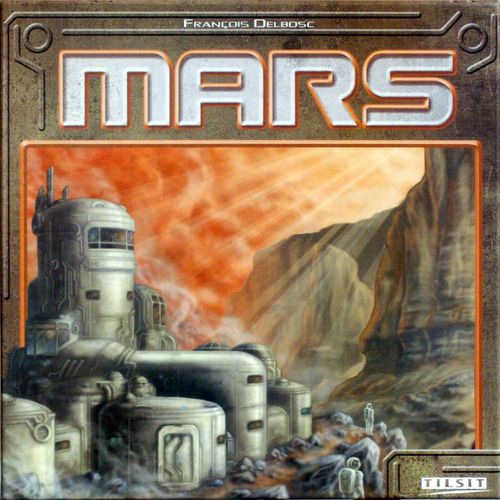
Mars
Mars Rulebook
Table of Contents
Table of Contents
Components
- 4 individual colony boards
- 4 player aids (showing all construction costs)
- 141 cards, of which:
- 60 raw material cards (12 iron, 12 carbon, 12 silicon, 12 water and 12 oxygen)
- 30 event cards
- 20 contract cards
- 15 Research and Development level 1 cards (R&D1)
- 15 Research and Development level 2 cards (R&D2)
- 1 "Magna Scientia" card
- 78 tiles, divided as follows:
- 16 mine tiles (4 iron, 3 carbon, 3 silicon, 3 water and 3 oxygen)
- 14 habitat tiles
- 12 power plant tiles
- 10 communications centre tiles
- 10 military installation tiles
- 8 Research and Development (R&D) centre tiles
- 6 silo tiles
- 2 spaceport tiles
- 8 wooden cubes: 4 energy cubes and 4 victory point cubes
- 80 wooden tokens representing the colonists
- 1 R&D die
- 1 rules booklet
Setup
Each player takes an individual game board representing their colony and places it in front of them.
Before the game starts, each player chooses 2 mines to place in their colony. This selection is made in two rounds. In the first, the oldest player chooses a mine first, then the other players do the same in clockwise order. In the second round the order is reversed: the last player to choose in the first round chooses first now, and then the rest follow in the opposite direction to the previous round. Each player will then have two mines, which they place in 2 of the 4 mine spaces of their colony.
Each player also receives 7 colonist tokens, which they place in their level 0 habitat.
Next, prepare the supply deck, made of 5 cards of each type of raw material, well shuffled. If this supply runs out during the game, it is replenished by the same procedure.
Each player draws 4 cards from this supply deck and keeps them hidden from the other players. The remaining raw material cards are divided into 5 face-up piles (1 per raw material).
The rest of the components are grouped by category and laid out as shown in the starting setup illustration.
All players place one of their 7 colonists on each of their starting installations (level 0 silo, level 0 power plant and the two mines). This allows them to activate those installations, since an installation without a colonist to operate it is considered inactive for all purposes [see 6) Construction for a more detailed explanation]. The remaining 3 colonists stay in the level 0 habitat.
They also place a red victory point cube on space 0 of the victory point track and a blue energy cube on space 4 of the energy consumption track, corresponding to the consumption of the four installations already running in the colony.
Once ready to start, all that remains is to set the length of the game. For a short game the target is 10 victory points, for a normal one 12, and 15 for a long one.
Playing the Game
The oldest player is the starting player, and play continues clockwise.
During their turn, each player carries out 7 phases in the order given below. When they finish, it is the turn of the player to their left.
Game Turn
- Event
- R&D
- Resupply
- Mining production
- Trade
- Construction
- End of turn
1) Event
Each player starts their turn by drawing an event card. They read the text aloud and immediately apply its effect. Used cards form a discard pile next to the event deck. If the deck ever runs out during the game, the discard pile is shuffled to make a new one.
Some event cards create a confrontation between players. There are two types of confrontation: conflicts (minor or major), which involve only two players, and supremacies, which involve all players.
a) Conflicts
Whenever a player draws a conflict card, it applies to the field indicated on it (military or communications). For the conflict to occur, the player must meet the prerequisite shown on the card.
-
If they do not meet it, no conflict occurs and the event is discarded.
Example: the minor communications conflict requires the player to have at least one active level 1 communications module. If that is not the case, the player who drew the card does not enter into conflict with any other player and simply discards it.
-
If they meet the prerequisite, the conflict is triggered. They choose another player to be involved, and the conflict is then resolved. To do so, compare the number of active installations in the field in conflict; whoever has more wins. In case of a tie, the winner is the player who has some benefit in that field granted by an R&D card. If the tie persists, it is resolved in favour of the player with more colonist tokens in their habitats. If even that does not break the tie, the conflict is discarded and nobody wins.
Example: Serge draws a minor communications conflict card. As he has an active level 1 communications module, he can trigger the conflict. He decides to enter into conflict with Nicolas, who also has a level 1 communications module. As both are equal in that respect and neither has any benefit in communications from Research and Development cards, they look at who has more colonists in their habitats. Nicolas has 3 while Serge has 4. Serge wins the minor communications conflict.
The winner immediately applies the effect shown on the card.
b) Supremacies
These work like conflicts, except that this time all players are involved.
If one of the players meets the prerequisite, it must be resolved who holds the supremacy in play. If nobody meets it, it is discarded.
As before, check who has the largest number of active installations in the field in which supremacy is assessed. In case of a tie, the winner is the player who has some benefit in that field granted by an R&D card. If the tie persists, it is resolved in favour of the player with more colonist tokens in their habitats. If even that does not break the tie, nobody holds the supremacy in question and the event is simply discarded, unless it is a "Suprématie contestée" (Contested Supremacy) card.
"Suprématie contestée" is an event card that allows a supremacy that has already been assessed to be assessed again, checking its attributes once more to see who holds it, with the exception that in case of a tie the card remains with the player who previously held it. If a new player holds the supremacy, they also take the card, and its former holder loses all the benefits it granted.
2) R&D
If the player has an active research and development centre, they may roll the R&D die.
- If they roll the R&D1 result, they may draw an R&D1 card.
- If they roll the R&D2 result and already have an active level 2 research and development centre, they may draw an R&D2 card. If they only have a level 1 centre, they draw nothing.
The great majority of R&D cards are played immediately, although some can be kept in the player's hand and played later. Played cards are placed face up in front of the player. All R&D cards only take effect if they are face up in front of the player.
3) Resupply
Earth sends raw materials. Draw one card from the raw material resupply deck and add it to your hand (stock). If that deck runs out, form a new one by shuffling five raw material cards of each type.
4) Mining Production
Each active mine produces one unit per turn. Draw from the raw material reserve the number of cards produced by your active mines and add them to your hand (stock).
5) Trade
During this phase, the player may make any exchanges they wish. There are three possibilities:
a) Trade with Earth: Three identical raw material cards may be exchanged for one raw material card of your choice, drawn from the reserve. The three cards are returned to the corresponding pile in the reserve.
b) Trade contracts: If the player has a trade contract, they may exchange one type of raw material for another as shown on the contract (but never the reverse), as many times per turn as they like.
Example: if you have the contract allowing silicon to be exchanged for iron, you may exchange silicon for iron as many times as you like that turn. However, the contract does not allow iron to be exchanged for silicon.
c) Trade with other colonies: It is also possible to trade with the other players' colonies, but to do so the player must have an active communications module that turn. Exchanges between players can be of any kind, and anything may be negotiated to obtain an advantageous deal. Cards may never be given away. There must always be a minimum return of one card.
6) Construction
During this phase, you may build new installations in your colony, receive new colonists or acquire trade contracts.
To build new installations, you must give up the required raw material cards. The exact number for each building is shown on the player aid. Once the required cards have been handed in (returned to their corresponding pile in the reserve), take the tile for the new installation and place it face up in its corresponding location in the colony. You must always have a building of the previous level to build one of a higher level. If you obtain a trade contract, place the corresponding card face up next to the colony.
Active or inactive installations
An installation is not considered active unless there is a colonist in it. All installations except habitats must be active, that is, staffed, in order to operate. An installation with no colonist assigned is considered inactive and out of operation: its abilities cannot be used and it generates no victory points. Likewise, it consumes no energy. As soon as there is a colonist in an installation, it becomes active [see phase 7) End of turn regarding moving colonists]. To activate a level 2 or 3 installation, all installations of the same type at lower levels must be active and connected.
Below is a list of the possible installations and their effects:
a) Habitats
Habitats are the colonists' life support. The starting habitat holds 7 colonists. Each time a new habitat is built, three colonists may be taken from the reserve and placed in it. Habitats have no other function and may be left empty during the game without further consequence. However, they do consume energy, and if one is ever built but not properly powered, no colonists may be placed in it until it has the corresponding energy. If for any reason a habitat is destroyed or loses power, the three colonists it houses are immediately lost. This can suddenly leave certain installations without staff and therefore inactive (level 0 installations can never be destroyed).
Each new habitat built provides 1 victory point and 3 new colonists [as shown graphically in the manual's illustration, together with its construction cost (1 carbon + 1 water + 1 oxygen + 1 silicon) and its energy consumption (1)].
b) Mines
These allow raw materials to be extracted and refined from the Martian subsoil.
Each game turn, during the mining production phase, you may draw one raw material card for each corresponding mine. There are as many types of mine as there are raw materials, but a maximum of 4 may be built per colony.
[The illustration shows each type of mine and its cost, regardless of type (1 carbon + 1 iron).]
c) Power plants
These allow the colony's various installations to be powered.
Each plant increases maximum energy production by 5 units per turn if it is active. Each installation (except the plants themselves) consumes one unit of energy per turn. You may not activate more installations than your maximum energy production allows.
The energy consumption track shows at all times the energy consumption of all the colony's installations.
[The illustration shows the different types of plant (level 1, giving +5 energy, allows a maximum consumption of 10; level 2 a maximum of 15; and level 3 a maximum of 20) and their cost (1 water + 1 silicon).]
d) Silos
These allow raw materials to be stored and determine the number of raw material cards you may hold in your hand at the end of the turn. The starting silo (level 0) allows 4 cards to be kept at the end of the turn, as long as it is active. If it is not, no cards may be kept. Each new active silo increases the hand by two additional cards. If at any point in the game you have more cards than the maximum allowed by your silos, you must discard the excess at the end of the turn.
Each new silo provides 1 victory point.
[The illustration shows the various types of silo and their cost (1 iron + 1 silicon).]
e) Communications modules
There are three levels of communications modules in the game. To build a higher-level module, a lower-level one must have been built first.
- The level 1 module allows trading during the player's turn with the other colonies, whether or not they have a communications module. Conversely, a player whose colony has no communications module cannot trade during their turn, whether or not other players have communications modules. It also allows the player whose colony has one to hold a second trade contract.
- The level 2 module allows trading during the player's turn with the other colonies, whether or not they have a communications module. It also allows up to four trade contracts.
- The level 3 module allows an unlimited number of trade contracts.
Each new communications module provides 1 victory point.
[The illustration shows the different types of communications modules and their cost (1 carbon + 1 oxygen for level 1, 2 carbon + 2 oxygen for level 2, 3 carbon + 3 oxygen for level 3).]
f) Trade contracts
These allow one type of raw material to be exchanged for another. The exchange only works in one direction, never the reverse. The exchange may be made as many times as you like. There is only one contract of each type for each possible exchange. Each time a contract is obtained, the player takes the card of their choice from those available and places it face up next to their colony. Without a communications module, you may only hold one trade contract card. However, you may cancel that contract to replace it with a new one (the cancelled contract becomes available again).
The cost of obtaining a trade contract is 1 carbon + 1 water.
g) Military bases
There are three levels of military bases in the game. To build a higher-level base, one of the previous level must have been built first. They allow you to protect your own colony or attack others. Each turn, after drawing the event card, you may start a military conflict against another player. This conflict is resolved in the same way as other conflicts [see 1 a) Conflicts]. The winner draws a raw material card at random from the loser's hand.
Each new military base provides 1 victory point.
[The illustration shows the different types of military base and their cost (1 water + 1 iron for level 1, 2 water + 2 iron for level [2] and 3 water + 3 iron for level 3).]
h) Research and Development (R&D) centres
There are 2 levels of Research and Development modules. To build a higher-level one, a lower-level one must have been built first. They allow you, after drawing the event card, to roll the R&D die and thereby obtain R&D cards (see 2: R&D) according to the result.
Research and Development cards are of two types: R&D1 and R&D2. Most of these cards have permanent effects and stay with the player; others are discarded to the corresponding pile once played. The effects of the cards only apply if they are visible in front of the player. Most R&D1 cards offer advantages in confrontations or provide science points. The rest are scientific discoveries that will improve the colony. Most R&D2 cards are scientific discoveries, some of which provide victory points.
Science points appear only on R&D cards.
The first player to obtain 3 science points receives the "Magna Scientia" card, which provides 1 victory point. The card passes to any player who exceeds its holder's number of science points.
Each new Research and Development centre provides 1 victory point.
[The illustration shows the different Research and Development centres and their cost (1 oxygen + 2 silicon for level 1 and 2 oxygen + 3 silicon for level 2).]
i) Spaceport
This improves trade between the colony and Earth. If you have one, during the trade phase you may exchange 2 identical raw material cards for one of your choice instead of the 3 identical cards of the original exchange.
A spaceport provides 1 victory point. Its cost is 3 iron + 1 silicon.
7) End of Turn
You now have the option of moving colonists. Colonists may move from a habitat to an inactive installation to activate it, or from one installation to another, or to a habitat. In general there is no restriction on movement; simply always bear in mind that if an installation is left without a colonist it becomes inactive, grants none of its advantages and provides no victory points, although on the other hand it consumes no energy (except habitats).
This is also the time to keep track of energy consumption and victory points. To do so, simply total the energy consumption of all active installations and count victory points, adjusting the markers on both tracks accordingly.
Note: victory points are not cumulative from one turn to the next, but simply the sum of the points provided by the colony's various active installations. The energy track is graduated in steps of 5 units, each corresponding to the energy generated by one power plant. If you do not have enough plants, you may not exceed the energy limit (5 for one plant, 10 for two, and so on).
At the end of the game turn you must also check whether the hand limit has been exceeded. If the capacity of your silos has been exceeded, you must discard the surplus cards, returning them to their corresponding piles in the reserve.
End of the Game
The game ends when a player, at the end of their turn, has the number of victory points set at the start of the game: 10 for a short game, 12 for a normal one and 15 for a long one.