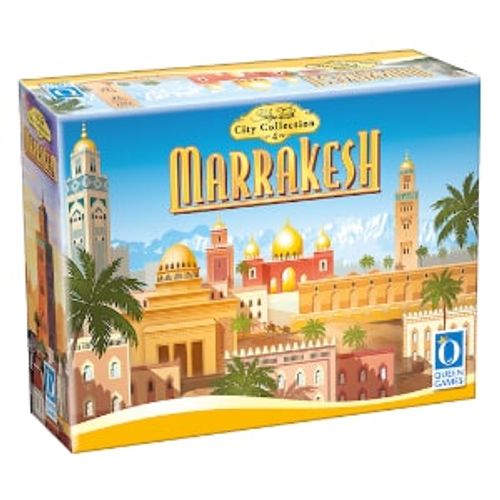
Marrakesh
Marrakesh Rulebook
Table of Contents
Table of Contents
Components
- 1 Game board
- 1 Cube tower (a tower with two intermediate layers and one funnel) and 1 cube tower base (a base and 3 walls to fold up, plus 2 separate wall pieces to be inserted). See the Cube Tower Assembly section.
- 4 Player boards, 1 in each player color
- 4 Supply boards, 1 per player
- 4 Screens, 1 in each player color
- 26 Pawns — 6 in each player color: 3x Assistant, 1x Imam's student, 1x Sultan's courtier, 1x Fisherman; plus (for Expansion 2) 1x Sultan (white) and 1x Imam (black)
- 1 Fountain tile (for Expansion 2)
- 4 Scoring markers, 1 in each player color
- 4 Scoring tiles "100/200", 1 in each player color
- 32 City gates (2x purple, orange, yellow, beige; 3x green, gray, white, black, pink, turquoise, brown, red)
- 300 Keshis (wooden octagon cylinders), 25 in each of 12 colors — these function as workers or goods and are named after the title MarraKESH
- 120 Resources: 40x water, 40x dates, 40x dinars
- 72 Scrolls: 21x gray, 21x yellow, 18x pink, 12x orange
- 25 Luxury goods: Slipper, Tajine, Dagger, Oil lamp, Necklace
- 12 Exchange offices (plus 6 more for Expansion 3)
- 4 Audience discs (plus 4 reverse-side discs for Expansion 4)
- 12 Provision tiles
- 9 Double-sided river tiles — 3 for each season
- 1 Season tracker (Stefan Feld figure) and 1 Round tracker (camel)
- 30 Oases and 12 Desert towns (for Expansion 5)
- 8 Covering tiles (2 per player, for Expansion 5)
The 12 keshi colors and their roles: Date picker (green), Scholar (gray), Noble (white), Cleric (black), Entertainer (pink), Fish (turquoise), Guard (beige), Caravan (brown), Water vendor (red), and the three Goods colors — Carpet (yellow), Lamp (purple), Spices (orange).
The resources and keshis are not limited. If the supply of any resource is spent you may use a substitute. In the rare case that the supply of all keshis of one color is empty, you may exchange keshis of that color from the player boards with keshis of another color from the supply; they still count as keshis of the corresponding district color.
The game is shown in two versions: DELUXE and CLASSIC. The DELUXE material can also be purchased separately. The rules are identical.
Game Concept and Object of the Game
Marrakesh is played over 3 seasons with 4 rounds each. At the beginning of each round, you choose which three sectors of your player board you will activate this round by deploying your assistants there. This also determines which keshis will be available this round, which are drafted by players in order to augment the actions in the different sectors (but do not determine which actions you take this round). One keshi matching the color of each district with an assistant is tossed in the tower, and all keshis that come through the tower will be selected by players.
At the end of each season you must provide dinars, water, and dates for the inhabitants of your sectors. Also, your fishermen may grant you valuable bonuses. The player who collects the most points over 3 seasons is the winner of the game.
Setup
General Components
- Place the game board in the center of the playing area. Put the cube tower base next to the game board and insert the cube tower in the provided slot.
- Keep the "100/200" scoring tiles next to the scoring track. When a player completes a full round on the scoring track, they take the tile in their player color and keep it next to their player board, "100" side up. If they complete another full round, they flip the tile to its "200" side.
- Sort the scrolls by their backs. Mix each type separately and stack the scrolls of each type facedown in 3 stacks of equal size on the corresponding academy on the game board. Reveal the top scroll of each stack.
- Mix the exchange offices facedown, choose three randomly, then stack them on the exchange office space. Reveal the top exchange office. The remaining exchange offices are not used and should be returned to the box.
- Mix the luxury goods facedown and deal them to the 5 souk shops on the game board in 5 stacks of equal size. Reveal the top luxury good of each stack.
- Sort the river tiles by their season icons and put them separately in the cloth bag, one season after the other. Randomly draw 1 tile per season. Place the 3 drawn tiles next to the game board with any side up, which will be the active side during the game. Place the river tile for the first season on the right end of the river track. The remaining river tiles are returned to the box. (For your first game, the tiles with numbers 01, 03, and 05 are recommended.)
- Put the city gates in the cloth bag and mix well. Randomly draw 8 city gates for each workshop space on the game board and place them there.
- Sort the resources (water, dates, dinars) by type and keshis by color and keep them next to the game board as a common supply.
Player Components
- Each player takes in their chosen player color: 1 player board, 6 player pawns, 1 scoring marker, 1 screen, and any 1 supply board plus any 1 audience disc.
- Each player's scoring marker starts on space 10 of the scoring track.
- Each player deploys 3 pawns on the game board: the fisherman on the starting space of the river track; the imam's student on the starting space of the mosque stairway; the sultan's courtier on the starting space of the palace stairway.
- The remaining 3 pawns are the player's assistants, for now kept next to the player board.
- Mix all oases facedown. Each player draws 6 oases and places them facedown on the designated Sahara spaces on their player board without looking at them. The remaining oases are returned to the box.
- Each player puts their supply board above their player board. On the left is the personal supply of resources. To the right, claimed oases will be placed during the game, starting from the left arrow. Next, put 8 keshis in the cloth bag, one of each color except yellow, purple, orange and brown. Each player draws 2 keshis randomly (3 keshis in a 2-player game), placing them in any order on the spaces showing a keshi on the oases track.
- Each player places their audience disc on the main square on their player board in any orientation they like, pink side up.
- Mix the provision tiles facedown and deal 3 to each player. These are placed above the supply board. Each player examines all 3 tiles and decides which will be active for the first season. This one is placed faceup and the other two kept facedown.
- Then, each player takes 1 water, 1 dinar, and 1 date, as well as 1 keshi each of all 12 colors. Players keep their keshis hidden behind their screen, whereas the resources remain visible on each player's supply board.
- Finally, choose a start player at random, giving them the season tracker and the round tracker.
Playing the Game
Marrakesh is played over 3 seasons with 4 rounds each. The player holding the round tracker (camel) is the start player during the complete round. Each round is divided into 4 phases, played in sequence:
- Select keshis & deploy assistants
- Claim keshis & deploy them
- Use your assistants
- River bonus & end of the round
After 4 rounds, players will no longer have any keshis behind their screen. At this point, season scoring takes place, followed by preparations for the next season. After season scoring, the player holding the season tracker (Stefan Feld figure) passes it to their left neighbor, who also takes the round tracker (camel); that player starts the first round of the next season.
The game ends after 3 complete seasons. Following the third season scoring a final scoring takes place during which players may gain additional points. The player with the most points after final scoring is the winner.
Round Sequence
Phase 1: Select keshis & deploy assistants
Simultaneously, all players select 3 of the hidden keshis from behind their screen and hold them in their hand. Once all players have done so, the selected keshis are revealed.
In turn order each player deploys their 3 assistants onto their player board on the designated spaces of the sectors corresponding to the colors of their selected keshis. Each assistant space can accommodate exactly 1 assistant. Exception: Up to 3 assistants may be in the souk.
The red water vendor keshi acts as a "wild" and allows the player to deploy their assistant to any sector they like.
After all players have deployed all their assistants, one player collects all selected keshis and tosses them in the cube tower all at once. The tower is constructed such that some keshis will get stuck, and perhaps some from previous rounds will be dislodged. This means the number and colors of the emerging keshis will hardly ever be the same as those just tossed in. The keshis which emerge from the tower are sorted in the base by color to be selected in the next phase.
Phase 2: Claim keshis & deploy them
In turn order each player chooses one color and takes up to 2 keshis of this color from the display (if there is only 1 keshi of the selected color, the player takes only 1). All claimed keshis are immediately placed on the sector of the matching color of the player board.
Special cases:
- If a player's sector is completely filled with keshis, they may not claim keshis of that color anymore.
- If there is only 1 free space left in a player's sector but there are 2 available keshis of that color, the player may take 1 keshi only and must leave the other in the tower base.
- If the only keshis left to claim for a player are of a color (or colors) of sectors they have completely filled, that player forfeits the remainder of this phase.
Players continue claiming keshis this way until there are no more keshis left in the display. Usually the number of claimed keshis will be different for all players. During their turn each player must claim at least 1 keshi if possible.
Water vendors: Red keshis are water vendors. In each sector except the souk there is 1 water vendor space where exactly 1 red keshi may be deployed. When a player has selected 1 or 2 red keshis, they may deploy them in any sector not containing a water vendor yet.
Deployment bonus: When deploying a green, pink, or brown keshi, the player immediately gains the deployment bonus indicated on that keshi space. These bonuses are explained with the associated action below.
Phase 3: Use your assistants
In turn order each player uses their 3 assistants, one after the other, in any order they like. However, 1 assistant must be done with their work completely before the next one can start. Assistants are removed from the player board once used. For each assistant the player decides between 1 of 2 options.
Option a) Take a new keshi. The player takes one keshi of the corresponding sector's color from the common supply and deploys it to a free space. When deploying a green, pink, or brown keshi, the player gains its deployment bonus immediately. For an assistant in the souk the player may take a yellow, purple, or orange keshi from the common supply and deploy them on the corresponding space. The souk may contain any number of keshis of the matching colors and is never filled. If a player's sector is completely filled with keshis, they may not use this option anymore. New keshis are always taken from the common supply.
Option b) Perform the sector action. Each sector is associated with a specific action. More keshis in a sector make the action more powerful. (See the Sector Actions section.)
Before either option, the player first gains 1 water if they had deployed a red water vendor in this sector during a previous turn.
Sector Actions
River
For each fish keshi (turquoise) the player's fisherman advances 1 step on the river track. If a player ends on a space containing another player's fisherman, the arriving player's piece is placed at the end of the line on that space.
Whenever the fisherman advances, the player may choose to pay as much water as they choose to advance a corresponding number of additional steps (1 water = 1 additional step).
When a player's fisherman lands at the jetty (final space of the river track), they anchor on the free spot with the highest number and immediately gain the indicated number of points. From now on, that player always gains 1 point for each further step they would advance on the river during this season.
At the end of each round all players select one bonus from any space their fisherman has passed (see River bonus below).
Date orchard
For each date picker keshi (green) the player gains 1 date from the common supply.
Deployment bonus: When deploying a green date picker, the player gains 1 point immediately.
Souk
With each of their assistants at the souk the player may use the exchange office once or acquire 1 luxury good.
- Exchange office: By spending (returning to the common supply) exactly 1 yellow, purple, or orange keshi from their player board, the player receives the respective resources indicated on the exchange office from the common supply.
- Acquire 1 luxury good: Luxury good tiles depict a cost in yellow, purple, and orange keshis that must be spent (returned to the supply) in order to purchase the tile. Each assistant may purchase one luxury good only by returning the required keshis and immediately receiving any depicted points and resources. The purchased luxury item is kept in front of the player for potential scoring.
New luxury goods are revealed only at the end of the player's turn, after they have used all 3 assistants. Once a souk shop is completely empty, take the largest stack from another shop and put half of it (rounded down) on the empty shop.
Main Square (Jemaa el-Fnaa)
First, the player rotates the audience disc clockwise one section. Then, they choose exactly 1 space containing an entertainer keshi (pink) and gain the indicated bonus of that space as many times as the number of spectators on the section pointing to that space.
Deployment bonus: When deploying a pink entertainer, the player gains the bonus shown next to the space once only.
Summary of bonuses on the main square:
- 1 water from the common supply
- 1 step forward on the black mosque staircase
- 1 step forward on the river track (+ more steps by spending water if desired)
- 1 dinar from the common supply
- 2 points
- 1 step forward on the white palace staircase
- 1 date from the common supply
- 1 yellow, purple, or orange goods keshi from the common supply (if the number of spectators allows more than one goods keshi, they must all be of the same color)
Mosque and palace
For each cleric keshi (black) in the mosque, the player moves their pawn one space upwards on the mosque staircase. The same applies for the palace: move your pawn 1 space for each noble keshi (white) when an assistant is placed in the palace.
Both staircases are divided into 5 segments. When a pawn crosses the threshold to a new segment, the player immediately receives two benefits: 1 dinar, and a connection bonus. For the connection bonus, follow the line connecting the segments the player's pawns currently occupy on the two staircases. Any 1 of the depicted bonuses may be selected.
If a player's pawn (black or white) crosses more than 1 threshold during its movement, they gain 1 dinar and the current line bonus for each crossing.
When a pawn arrives on the final space at the end of the mosque or palace staircase, it remains there for the rest of the game. From now on, the player gains 1 point for each further step they would advance on this track.
Summary of line bonuses between the mosque and palace staircases:
- 1 keshi of the depicted color from the common supply (to be deployed immediately, gaining deployment bonus if applicable)
- 1 date / 1 water from the common supply
- 1–4 dinars from the common supply
- 1 keshi or 2 keshis of the same color of your choice from the common supply (to be deployed immediately, gaining deployment bonus if applicable)
- 1 step forward on the river track (+ more steps when spending water if desired)
- 1–7 points
Madrasa
In the madrasa players acquire scrolls. The top left corner of a scroll indicates the minimum number of gray scholars the player needs to have deployed in their madrasa to acquire the scroll (1, 3, 5, or 7). Additionally, the player must pay up to 3 dates (as shown on the top right corner).
The player may acquire as many scrolls as the number of their deployed gray scholar keshis and the dates they can pay allow. The paid dates are returned to the supply and the scroll is placed in front of the player. While scholars are not spent, no scholar may be used to meet the requirements of more than one scroll.
Reveal new scroll(s) only at the end of the player's turn, after they have used all 3 assistants. If a stack of scrolls is empty, take the largest of the two other stacks of that color and put the lower half of it (rounded down) on the empty academy. Reveal the top scroll of that stack.
Just before their first purchase during each round, the player may pay 1 dinar to exchange the top scrolls of all three stacks of one color. They put each top tile at the bottom of the stack and reveal the new top tile. The player must acquire at least 1 of these new scrolls.
Exactly when a scroll you just bought can be used depends on the indicated activation timing:
- Instant action — performed once only and immediately when acquiring that scroll. You still keep that scroll in front of you.
- End of the round bonus action — used at the end of each round.
- End of the season bonus action — used at the end of each season.
- Permanent action enhancement — grants an enhancement for the rest of the game that may be used once per turn or in combination with a specific action, depending on the scroll.
(A detailed summary of the scrolls is in the Addendum section.)
Medina
Players always deploy guard (beige) keshis to the large watchtower space in the medina section of their player board when they are first acquired. Later, when they perform the sector action for the Medina, they may buy 1 city gate from 1 of the 4 workshops for each guard on their watchtower.
The player selects 1 city gate from a workshop of their choice and pays the price in dinars as shown in the top left. They then gain or lose points as shown in the top right immediately and build the gate on any unoccupied city gate space on their player board, deploying a guard from the watchtower next to it. That guard is now committed to that space. Then, the player takes 1 keshi of the color matching the city gate's color from the common supply and places it next to their player board. If the city gate's color matches the sector's color (also shown on the city gate space), the player gains 2 points immediately.
The player may buy as many city gates as they can afford and have uncommitted guards for. The keshis gained during the action are only deployed into the matching section after all gates have been purchased (gaining deployment bonus if applicable). If any of these sectors are filled completely, the keshi of that color must be returned to the common supply.
At the end of the game, any guard keshis still on the watchtower are deployed to unoccupied city gate keshi spaces. The Medina sector counts as completely filled when it contains 8 guards and 1 water vendor, irrespective of the number of city gates.
Sahara
In the Sahara players may discover and claim oases.
Discover an oasis (deployment bonus): Whenever a player deploys a brown caravan keshi, they discover the assigned oasis by revealing that tile.
Discovering the start-oasis: At the bottom-left of the Sahara is an oasis that can accommodate 2 brown caravan keshis. No oasis tile was placed here during setup, because this oasis had been discovered already. For keshis deployed here the player gains: 2 points (left space); any 2 resources from the common supply (right space). The right space must be occupied before the left space can be used.
Starting from the assistant space there are two paths, each with three oases. Players may discover oases along both paths simultaneously, but may not skip a space.
Claim oases: By using the Sahara sector action a player may claim one of their discovered oases by paying the resources shown on the highlighted space next to that oasis. The player places the claimed oasis on a storage space on the right side of their supply board. The first claimed oasis is placed on the left space (marked with a green arrow); following oases are placed on the next empty spaces from left to right.
If a keshi is standing on the space where they place the claimed oasis, the player may deploy that keshi to a matching sector on their player board immediately. When covering an exchange icon, the player may return any 1 keshi deployed on their player board to the common supply and take 1 keshi of another color and deploy it immediately (gaining deployment bonus if applicable). You may NOT return a brown caravan keshi standing next to a discovered or claimed oasis, nor a beige guard keshi committed to a city gate, nor any goods keshi (yellow, purple, orange) — but you may take one of these in exchange. When covering the scroll icon, the player may take 1 scroll from the display that requires exactly 3 scholar keshis, ignoring this requirement and without paying 1 date (paying 1 dinar to exchange the yellow scroll stacks is not allowed here).
With the Sahara sector action a player may claim as many discovered oases as they wish and can afford, one after the other. Claimed oases may earn additional points at the end of the game if the player meets the requirement shown on the tile. However, a player is only allowed to score 3 claimed oases in total. (A detailed summary of the oases is in the Addendum section.)
Water vendor
When a player uses one of their assistants in a sector containing a water vendor, they gain 1 water from the common supply immediately. This is regardless of whether the player deploys a keshi or takes the sector action.
Phase 4: River bonus & end of the round
The round ends after all players have used all 3 of their assistants. At this point the river bonus of the river track is resolved. Each player who has crossed at least the first rapid with their fisherman may take 1 bonus of their choice that is shown next to one of the rapids they have already passed.
Summary of bonuses on the river track:
- 1 point
- 3 points
- 1 resource of the player's choice from the common supply
- 1 yellow, purple, or orange keshi from the common supply
After choosing the bonus, the fisherman remains where he is. Before the next round starts, the start player passes the round tracker (camel) to their left neighbor; that player is the start player for the next round. Do not pass the season tracker (Stefan Feld figure) at this point.
Season Scoring and Preparation of the Next Season
After 4 rounds the players have no more keshis left behind their screens. That season is finished and players proceed to season scoring.
1) River evaluation
The player whose fisherman is farthest down the river track is the winner of the river evaluation, gaining the bonus shown on the tile at the river's end. In the third season the winner has the choice between two bonuses, with second place receiving the other bonus. In a two-player game second place is not rewarded with a bonus. Finally, discard the current river tile and return all fishermen to the starting space of the river track.
2) Providing for Citizens
Each player must pay the resources shown on their revealed provision tiles. If a player cannot pay the required resources shown on all their provision tiles, they must pay all of their resources (even those not required) and lose all points shown on their activated provision tiles. A player paying all required resources does not lose any points.
After all players have paid, each player chooses one of their provision tiles that is still face down and flips it. The resources shown on that tile must be paid at the end of the next season in addition to those shown on the previously revealed tiles, if the player does not want to lose points.
Preparing the 2nd and 3rd season
- Discard the exchange office tile from the game board. Reveal the next exchange office, which will be the active office for the next season.
- Place the river tile for the next season on the end of the river track.
- Again, each player takes 1 keshi of each color (12 in total) from the common supply and places them behind their screen.
- Pass the season tracker (Stefan Feld figure) to the next player clockwise. That player takes the round tracker (camel) as well, no matter who is holding it now.
This concludes the preparation, and the next season starts.
End of the Game and Final Scoring
After the 3rd season (including season scoring) is completed, the game ends and final scoring takes place. Players can gain additional points for the following:
- Completely filled sectors: For each sector of their player board (except the souk) completely filled with 8 keshis + 1 water vendor keshi, the player gains 10 points.
- Oasis tiles: Each player calculates the worth of their claimed oases according to their requirements and gains points for the 3 oases of the highest value.
- Remaining resources: Each player gains points for their remaining resources (dinars, water, dates) and/or goods keshis: add together all resources and goods keshis and divide the sum by 2, rounding down.
The player with the most points is the winner. In case of a tie for the most points, the tied player leading on the palace staircase is the winner. A further tie is broken in favor of the player leading on the mosque staircase. If there is still no winner, the remaining tied players share the victory.
Cube Tower Assembly
Assemble the cube tower from the tower with its two intermediate layers and one funnel, and set it into the cube tower base (a base and 3 walls folded up, with 2 separate wall pieces inserted). Keshis tossed into the funnel pass through the intermediate layers; some stick and some are dislodged, so the keshis emerging in the base differ from those thrown in.
Expansion Modules
Expansion 1: Staircase Tiles
Components: 20 double-sided staircase tiles.
Setup change: Put all staircase tiles in the cloth bag, mix well, draw one after the other with a random side up and place on a bonus space between the palace and mosque staircase, starting with the space on the bottom left. Do NOT cover the dinar and points spaces directly next to the staircases (these bonuses remain unchanged), nor the 2 topmost spaces ("any 2 keshis of identical color" and "any 1 keshi"), nor the lowermost space ("1 step on the river track"). This leaves 12 spaces to be covered by staircase tiles; return leftover tiles to the box. These tiles replace the printed bonus spaces, providing always-new combinations on the connecting lines. If all players agree, staircase tiles may be selected (which tile and side) instead of randomized.
Expansion 2: Imam & Sultan
Components: 1 Sultan (white), 1 Imam (black), 1 Fountain tile.
Setup change: Place these two special pawns on their respective starting space of the palace and mosque staircase (the stair showing a small image of the sultan and the imam). Place the fountain tile on the fountain between the palace and mosque.
Gameplay change: As soon as a player reaches the stair where the sultan or imam is waiting, they place that pawn next to their own and from now on move both pawns as one when ascending the palace or mosque staircase. A player taking along one of these special pawns gains a benefit (depicted on the fountain tile), which may be used more than once during the same turn:
- Sultan (white): When buying a scroll, the player pays 1 fewer date for each scroll.
- Imam (black): When buying a luxury good, the player pays any 1 goods keshi fewer.
If the player accompanying the sultan or imam is passed by another player later, that player now takes the pawn along (drawing level is not enough). As soon as a player in company of the sultan or imam reaches the final space of the staircase, the pawn is passed on to the player in second position on that staircase. If several players are tied for second, the pawn is placed one space directly above them.
Expansion 3: Additional Exchange Offices
Components: 6 new exchange offices (marked by an additional pattern between the lines).
Setup change: Mix the additional exchange offices and those of the base game together. There is no further change. If all players agree, they may use these new exchange offices only. One of the new tiles offers 1 additional bonus besides 1 resource, for example: 1 date + 1 step on the river track; 1 dinar + 1 point; or 1 water + 1 step on the white palace staircase OR 1 step on the black mosque staircase.
Expansion 4: Spectators
Components: 4 audience discs (reverse side).
Setup change: Before the game starts, players decide together whether to play with the pink or the purple sides of the audience discs. The purple side features 1 section without any spectators and 1 section with 4 spectators.
Expansion 5: Desert Towns
Components: 12 Desert towns, 8 Covering tiles (2 per player).
Setup change: Each player takes 2 covering tiles. They place the smaller one on the start oasis (this oasis and its keshi spaces are not available during this game). They place the larger one on their supply board (keeping resources on the table above the supply board); it has 2 cutouts each holding 1 keshi and 1 desert town. Put all desert towns in the cloth bag and mix well; draw tiles as shown: 2 players = 3 tiles, 3 players = 5 tiles, 4 players = 7 tiles. Place the drawn tiles next to the game board, night side up. Return the rest to the box.
Gameplay change: When discovering in the Sahara, there is now a fourth keshi space on both upper paths, leading the caravan to a far away desert town. If a player deploys a brown caravan keshi to such a space, they choose one of the desert towns from the display and insert it into the corresponding cutout, night side up, gaining an immediate deployment bonus of 4 points. There are not enough desert towns for every player to get 2, and they offer different bonuses that may not suit all players. When claiming a desert town with a Sahara sector action, the player pays a set of 3 goods keshis (yellow + orange + purple) and flips the desert town to its day side (leaving it in its cutout); it is claimed now and may be scored at the end of the game. With a Sahara sector action a player may claim oasis tiles as well as desert town tiles. Like oases, most desert towns yield points during final scoring if their requirements are met; 3 desert towns have an immediate effect (marked with a flash icon) resolved once when claimed. Desert towns are only flipped when claimed and are not stored with the oases.
Scoring change: Score at most 2 desert towns and 3 claimed oases of the highest value. Both keshi slots of the desert town covering tile must be occupied (in addition to all other keshi spaces) to score the Sahara as a completely filled sector.
Addendum
Summary of Icons
Key icons used across the components: gain or take something; return something to the common supply or discard; use something; gain points; lose points; any resource (dinar, date, water); keshi of the depicted color; any keshi; any keshi except goods keshis; goods keshi (yellow, orange, purple); deploy keshi of the depicted color from the common supply; city gate of the depicted color; any city gate; buy city gate and place on your player board; oasis tile; discover oasis; claim oasis; claimed oasis; any sector; perform sector action; 1 step on the river track; rapids of the river track; 1 step on the palace staircase; 1 step on the mosque staircase; 1 step on the palace OR mosque staircase; cross 1 threshold on the palace or mosque staircase; luxury good; exchange office; river tile; provision tile; 1 spectator on the audience disc; 1st/2nd/3rd season; final scoring; game round.
As a general rule, each time you move at least 1 step on the river track (no matter why) you may spend water to advance even further: 1 water = 1 additional step.
Scrolls
The scrolls have unique abilities or bonuses. Each scroll's reference number is in the bottom left corner. Effects that are essentially identical and differ only in minor details are merged in this summary. Activation timing: instant (u), permanent enhancement (v), end-of-round (w), end-of-season (x).
01–21: Need 1 scholar & pay 1 date.
- 01–12: You take the depicted keshi from the common supply and immediately deploy it according to the rules.
- 13–16: Each time you cross a threshold on the palace or mosque staircase, you gain the depicted bonus in addition to the dinar printed on the threshold — 1 water (13), 1 date (14), 1 dinar (15), or 1 step on the river track (16).
- 17: Each time you cross a rapid on the river track, you gain the depicted bonus once and immediately.
- 18: Each time you use the exchange office, you gain 1 additional resource of your choice (dinar, date, water).
- 19: You gain 2 water from the common supply immediately.
- 20: You gain 2 dinars from the common supply immediately.
- 21: You gain 3 dates from the common supply immediately.
22–42: Need 3 scholars & pay 1 date.
- 22: If you buy a city gate from the left workshop for 0 dinar, you do not lose points.
- 23–25: When you perform the "date orchard" sector action you may decide for each single keshi to take 1 date or: 1 water (23), 1 dinar (24), or 1 point (25).
- 26–27: When you advance on the palace or mosque staircase, you may buy further steps by spending: 1 date = 1 step (26), 1 water = 1 step (27).
- 28: At the start of each season scoring you gain one bonus from each of the rapids you have crossed.
- 29: When you perform the "main square" sector action, you gain additional points at the end of the action. The number of points depends on the number of spectators facing the space with 2 points. An entertainer keshi does not need to be deployed here.
- 30: You take 1 keshi of your choice from the common supply and immediately deploy it according to the rules.
- 31: As of now, there is 1 additional spectator in each section of your audience disc.
- 32: You pay 1 fewer dinar when buying a city gate. (If you buy a city gate for 0 dinar you do not get a dinar from the common supply.)
- 33: As of now, you may use dates and water instead of dinar whenever you have to pay a cost (but not vice versa).
- 34: When you perform the "souk" sector action, you may buy several luxury goods with 1 assistant if you can afford it.
- 35: You gain 2 water for each water vendor instead of 1 only.
- 36: When you buy a city gate, you may take 1 keshi of your choice from the common supply. It no longer has to match the color of the city gate.
- 37–42: You take both depicted keshis from the common supply and immediately deploy them to the "souk" according to the rules.
43–60: Need 5 scholars & pay 2 dates.
- 43: You take 2 keshis of your choice from the common supply immediately and deploy them according to the rules.
- 44: When providing for citizens at the end of a season you may pay 1 dinar; if you do, you only have to spend any 1 resource for each provision tile (this resource does not need to be shown on the tile; the dinar only needs to be paid once for all tiles).
- 45: As of now, you pay only 1 resource of your choice when you claim an oasis.
- 46: When you perform the "souk" sector action, you may use the exchange office several times with 1 assistant if you can afford it.
- 47: You check all sectors of your audience disc with 3 spectators and immediately gain 3 times each bonus facing these sectors. Entertainer keshis do not need to be deployed there.
- 48: Each time you move on the palace or mosque staircase you may move 1 additional step.
- 49: Once you have reached the final space of the mosque staircase, you gain 2 points for each further step instead of 1 only.
- 50: As of now, you receive 2 points in addition to 1 water for your water vendor keshi when performing the sector action.
- 51: When you perform the "main square" sector action, you gain all bonuses from spaces facing sections with 1 spectator at the end of the action. These bonuses are additional and no entertainer keshis need to be deployed there.
- 52: Once you have reached the final space of the palace staircase, you gain 2 points for each further step instead of 1 only.
- 53: You may perform a sector action of your choice immediately.
- 54: Each time you deploy an entertainer keshi to the "main square," you get the corresponding deployment bonus plus the deployment bonuses of both adjacent sections. These bonuses are additional and no entertainer keshis need to be deployed there.
- 55: You advance 3 steps on both the palace and mosque staircase immediately. You gain all appropriate bonuses, and you may choose the order in which you advance.
- 56: Once your fisherman has reached the jetty (final space of the river track), you gain 2 points for each further step instead of 1 only.
61–72: Need 7 scholars & pay 3 dates.
- 61: You may always claim 2 keshis of your choice from the tower's base during the "Claim keshis & deploy them" phase. They can be of the same color or different colors. (Exception: if only 1 keshi is left or you may not claim 2 because all your matching sectors are filled, you may claim 1 keshi only.)
- 62: You claim 3 of your discovered (revealed) oases immediately without paying any costs. (You CANNOT claim a desert town with this tile.)
- 63: Each time you get a connection bonus after crossing a threshold on the palace or mosque staircase you receive 2 different bonuses instead of 1 only.
- 64: You take 1 keshi of your choice from the common supply and deploy it immediately. Then, perform the sector action of that sector where you deployed that keshi.
- 65: As of now, you perform the "main square" sector action always twice in a row: rotate the audience disc and choose a bonus; rotate it a second time and choose a bonus again.
- 66: Each time you buy a city gate you gain 2 keshis of the matching color instead of 1 only.
- 67: You take 3 keshis of your choice from the common supply and deploy them according to the rules immediately.
- 68: Each time you discover an oasis (flip it to its front side), you score that oasis once immediately and in addition to final scoring. Leave that oasis in place in the Sahara face up ("discovered"); you may claim it later.
- 69: At the end of the round you get all bonuses from the rapids you have crossed instead of 1 only.
- 70: You gain all bonuses of your keshis deployed to the "main square" immediately. Multiply each bonus by the number of spectators facing that space.
- 71: You score one of your claimed oases immediately. That oasis remains claimed and can be scored again at the end of the game.
- 72: You may return any number of resources (dates, water, dinars) to the common supply and gain 2 points for each returned resource.
Oases & Desert Towns (Expansion 5)
Claimed oases (max. 3) and desert towns are scored at the end of the game. A player gains more points the more often they have met the requirements of each tile. To meet the requirements a player may ONLY use their own resources/components from their player board or personal supply. Reference numbers are in the upper left corner.
Oases:
- 01–04: You gain the indicated number of points for each of your built city gates of the matching colors.
- 05–13: You gain 3 points plus 1 point for each keshi of the shown color on your board (if none, 3 points only).
- 14–18: You gain the indicated number of points for each of your tiles with the depicted luxury good.
- 19–21: You gain 3 points plus 1 point for each of the shown resource you return to the common supply when scoring these tiles (maximum 12 resources of the shown type; if none, 3 points only).
- 22–23: You gain 3 points plus 1 point for each of your luxury goods (22) or scrolls (23) (if none, 3 points only).
- 24: You gain 4 points for each of your sectors with no more than 3 keshis (do not count the red water vendor keshi; do not score the "souk").
- 25: You gain 4 points for each of your completely filled sectors (8 keshis of that sector's color plus 1 red water vendor keshi; do not score the "souk").
- 26: You gain 3 points for each of your claimed oases (all claimed oases count, not only the 3 selected for scoring).
- 27, 28: You gain 7 points if you have reached the final space of the mosque staircase (27) or the palace staircase (28).
- 29: You gain 7 points if you have crossed at least 5 thresholds on the mosque staircase and the palace staircase combined.
- 30: You gain 7 points if your fisherman has reached a spot at the jetty (final space of the river track) at the end of the game.
Desert towns:
- 01: You gain 2 points for each of your built city gates.
- 02: You gain 2 points for each of your acquired luxury goods.
- 03: You gain 2 points for each of your acquired scrolls.
- 04: You gain 1 point for each step you have made on the palace staircase (steps taken after reaching the final space do not count).
- 05: You gain 1 point for each step you have made on the mosque staircase (steps taken after reaching the final space do not count).
- 06: You gain 1 point for every 3 keshis (any types) on your player board (do not count the goods keshis — yellow, orange, purple).
- 07: You gain 1 point for each step you have made on the river track (steps taken after reaching the jetty do not count).
- 08: You gain 2 points for each sector containing at least 4 keshis, including red water vendor keshis (do not score the "souk").
- 09: You gain points for each of your entertainer keshis on the "main square." Each entertainer is worth as many points as the number of spectators facing that entertainer.
Desert towns numbered 10–12 are not scored at the end of the game; when claiming these you perform a bonus action immediately:
- 10: You may take 1 scroll of your choice from the display. You do not have to meet the requirement nor pay any dates.
- 11: You may take 1 luxury good of your choice from the display. You do not have to pay any goods keshis.
- 12: You may take 1 city gate of your choice and build it on your board. You do not pay dinars, but you gain or lose points as usual, receive a keshi of the matching color, and 2 additional points if you build the city gate on the space of the matching color. (You must have at least 1 uncommitted guard keshi on your watchtower to commit to the new city gate.)
River Tiles
At the end of each season the player in first position on the river track gains the bonus of that season's river tile. In the last season, two players gain a bonus (not in a 2-player game). Reference numbers are in the bottom left corner.
- 01: You may perform one sector action of your choice.
- 02: Place 3 of the leftover oasis tiles face up next to the game board at the start of the game. At the end of the first season, you may take any 1 of these oases and claim it immediately. You may thus end up with a total of 7 claimed oases by the end of the game, which is allowed (place the 7th claimed oasis next to your supply board).
- 03: You may take 2 keshis of your choice from the common supply and immediately deploy them according to the rules, gaining the deployment bonus if applicable.
- 04: You gain 5 points.
- 05: The player in first position gains 7 points, the player in second position gains 3 points.
- 06: The player in first position gains 6 resources of their choice, the player in second position gains 3 resources of their choice.
- 07: You take 1 water vendor keshi from the common supply and immediately deploy it according to the rules.
- 08: You gain 3 points.
- 09: At the start of the last season your fisherman on the river track starts from the space with the crocodile, giving you a head start.
- 10: You take 3 goods keshis (1 of each color) from the common supply and immediately deploy them according to the rules.
- 11: The player in first position may advance 3 steps on the palace staircase or the mosque staircase; the player in second position may advance 1 step.
- 12: The player in first position selects one of these bonuses, the player in second position gains the other: 1 point for each built city gate on your board; or 1 point for each deployed date picker keshi on your board.
- 13: Take 1 entertainer, caravan, or guard keshi from the common supply and immediately deploy it according to the rules.
- 14: You gain 1 water, 1 dinar, and 1 date from the common supply.
- 15: You may claim 2 of your discovered (revealed) oases immediately for free.
- 16: You perform the sector action "main square" twice in a row. Between the two actions you rotate the audience disc by 1 section as usual.