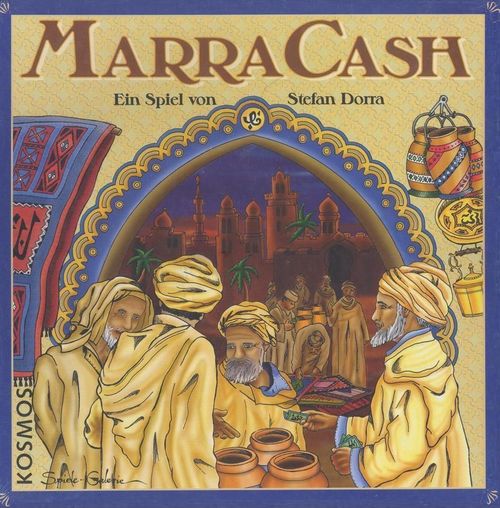
MarraCash
MarraCash Rulebook
Table of Contents
Table of Contents
Components
- 1 game board (actual size: 56 x 44 cm), showing a walled city with 3 entrances (gates). The city contains shops (of different colors) and fountains (light or dark).
- 25 cards representing precious goods (souvenirs), distributed as follows:
| Color | Values |
|---|---|
| Red | 50, 75, 100, 125, 150 |
| Purple | 75, 100, 125, 150, 175 |
| Green | 100, 125, 150, 175, 200 |
| Blue | 125, 150, 175, 200, 225 |
| Yellow | 150, 175, 200, 225, 250 |
- 54 visitor pieces (14 yellow, 10 green, 10 red, 10 blue, 10 purple)
- 1 blue auction stone
- 24 player pieces and their stands (6 Omar, 6 Ali, 6 Anfa, 6 Leila)
- Banknotes (500, 200, 100, and 25 Dirham)
- 4 game aid cards (note: in the original version, the aid cards are in German)
Goal of the Game
Have the most money at the end of the game.
Setup
- Place the 24 player pieces (each labeled with a first name) in their stands.
- Each player receives a game aid card.
- Each player chooses a name (Ali, Anfa, Omar, Leila) and takes the 6 pieces matching that name.
- All the visitors are put into the black cloth bag, then drawn one at a time and placed as follows:
- First, place 3 visitors on each of the 3 blue fountain spaces (the 3 entrance spaces of the souk). On a given space, there cannot be 2 visitors of the same color. If the 2nd visitor drawn is the same color as the 1st, it is put back in the bag and the draw is repeated until a different color is drawn.
- The remaining 45 visitors are also drawn one at a time and, as they are drawn, lined up outside the wall of the souk. There cannot be more than 3 visitors of the same color lined up side by side. This "line of visitors" can only have 2 ends (see the illustration in the German rules). [This simply means that a new visitor can only be taken from one of the 2 ends of the line — it cannot be taken from the middle of the line, which would create a gap.]
- The player designated as banker distributes 1200 Dirham to each player.
- The auction stone is placed next to the game board.
- The 25 souvenir cards are not used in the basic rules.
Course of the Game
A player is designated to start, then play continues clockwise.
First Round
The only action performed during the first round is auctioning off shops. The player whose turn it is chooses a shop and places the auction stone on it. This player is the auctioneer and must bid first. The minimum bid is 100 Dirham.
Continuing clockwise, the other players may bid or pass. A bid must be higher than the previous one. Once a player passes, that is final with respect to the current auction. The auction continues until all players but one have passed. The player who made the highest bid then places one of their pieces on the shop. The auction stone is then handed to the next player.
The amount of the winning bid is paid to the bank. However: the auctioneer receives a commission based on the amount of the bid.
| Bid amount | Commission |
|---|---|
| Up to 500 Dirham (inclusive) | 100 Dirham |
| More than 500 Dirham | 200 Dirham |
If the auctioneer is the one who wins the shop, no commission is paid out, and the full bid amount goes to the bank.
The first round ends once every player has been auctioneer exactly once. It is quite possible for players to begin the second round without having bought any shops.
From the 2nd Round Onward
Each player, in turn, must choose one of 3 possible action combinations, and each action must be carried out in the order given. The 3 possible combinations are:
Combination A
- Choose a group of visitors located on a fountain space and move it to an adjacent fountain space.
- Perform a second movement of visitors (with the same group or a different one).
Combination B
- Choose a group of visitors located on a fountain space and move it to an adjacent fountain space.
- Choose an unowned shop and put it up for auction (following the usual auction rules).
Combination C
- Choose an unowned shop and put it up for auction (following the usual auction rules).
- Choose a second unowned shop and also put it up for auction (following the usual auction rules).
Note that it is not possible to auction a shop and then move a group of visitors.
IMPORTANT: If, at the end of a player's turn, a blue fountain space (entrance space) is empty, that player must bring new visitors into the city (see New Visitors).
Moving a Group of Visitors
When a player moves a group of visitors, ALL the visitors in the group must be moved, one by one, to the same adjacent fountain space. When a group of visitors is moved onto a fountain space already occupied by another group of visitors, the 2 groups merge to form a single group.
When a group of visitors passes in front of an unowned shop, nothing happens. However, the consequences of visitors passing in front of a shop owned by a player can differ...
When Does a Visitor Enter a Shop?
If a visitor passes in front of a purchased shop and that shop is the same color as the visitor, the visitor enters through the first door it passes. This visitor is now a customer of the shop and spends money there. The money spent by the visitor is collected by the shop's owner, and the amount depends on the number of customers (including the new visitor) present in the shop.
| Customers | 1 | 2 | 3 | 4 | 5+ |
|---|---|---|---|---|---|
| Amount | 100 | 200 | 300 | 400 | 500 |
So, the first customer of the shop pays the owner 100 Dirham, the 3rd to arrive pays 300, the 6th pays 500... The money paid to the owner comes from the bank. Once a customer enters a shop, it stays there until the end of the game.
Commissions
If a player moves a group of visitors and, during that move, a visitor enters a shop belonging to another player, the player who made the move receives a commission based on the TOTAL amount collected by the shop's owner.
For example: Ali moves a group of visitors that includes 2 red visitors. This group passes in front of a red shop belonging to Omar. This shop already has 2 customers in it, so Omar collects 700 Dirham (300 + 400). Ali's commission is not 150 Dirham (50 for bringing in the 3rd customer + 100 for the 4th), but 200 Dirham, because since the amount collected by Omar exceeds 300, Ali receives 100 Dirham per customer he brought in.
Note: If you are playing with the "Souvenirs" variant, the amount collected by the owner through those cards counts toward this total as well!
| Owner's earnings | Commission |
|---|---|
| Up to 300 (inclusive) | 50 per customer |
| More than 300 | 100 per customer |
The commission is always paid by the owner of the shop the customers entered, and this happens immediately after the owner collects their money. Naturally, no commission is collected when a player brings customers into their own shop.
Special Case
If a shop is assigned (bought at auction) while a group of visitors is already sitting on a fountain space in front of one of its doors, all visitors of that shop's color immediately become customers, and the owner immediately receives their earnings according to the normal rules.
New Visitors
If, at the end of a player's turn, a blue fountain space is empty (entrance space), the player must bring new visitors into the souk. To do this, they choose one of the two ends of the line of visitors and choose 2, 3, or 4 consecutive visitors. These visitors are then placed on the empty entrance fountain space. The player repeats this operation until all 3 entrance spaces are occupied.
End of the Game
As soon as there are no more visitors outside the wall of the souk, the last round begins. Every player then takes one final turn. The player who brought in the last visitors will therefore play last. The winner is the player with the most cash on hand.
Tips
- The amount offered to buy a shop should be in proportion to the number of customers it can attract. A shop bought for 500 Dirham that only brings in 2 customers loses 200 Dirham, because 2 customers only bring the shop's owner 300 Dirham.
- When a player buys a shop of a certain color, they should try to buy more shops of that same color. This way, there should theoretically be few potential customers left for the other players, since visitors are likely to end up entering one of your own shops.
- When buying a shop, try to make sure neighboring shops also have an owner. Indeed, the more a district is made up of owned shops, the more visitor traffic passes through that area (since every player is bringing customers to their own shops).
- When bringing new visitors into the souk, don't choose visitors that only benefit you. Remember that once you've placed the new visitors, it's the player to your left who plays next. They must be motivated to move that group in a direction favorable to both of you.
- Sometimes you must apply the "lesser evil" policy. Indeed, it's better to bring 2 customers to Ali, who has none, earning him 300 Dirham minus the 50 Dirham commission, than to let those 2 visitors be moved by another player who brings them into one of their own shops where 4 customers are already present (that player would then collect 1000 Dirham and no one would get a commission on it...).
- Yellow is the most common color. There are 14 yellow visitors, while there are only 10 visitors of each other color. The yellow souvenir cards are the ones that earn the most money (see the "Souvenirs" variant).
"Souvenirs" Variant
Tourists buy souvenirs, represented by 25 cards. With this variant, players can earn extra money by selling souvenirs to their customers.
The souvenir cards are shuffled and form a draw pile placed next to the game board. At the start, 2 souvenir cards are drawn and placed face up next to the draw pile.
Whenever a visitor enters a shop of the same color as a revealed souvenir card, the shop's owner takes that souvenir card, and the bank pays them the amount shown on the card. The souvenir card is then permanently discarded.
If the 2 revealed souvenir cards are the same color, the shop's owner chooses which souvenir they sell.
When a player finishes their turn and one or both souvenirs were sold during it, that player must reveal as many cards as needed so that there are always 2 souvenir cards revealed at the start of the next player's turn.
IMPORTANT: Earnings from selling souvenir cards are added to the earnings from customers entering shops to make a total amount. It is this total amount that is used to calculate any commission owed (see Commissions).
Examples
Auctioning a Shop
We are in the first round of the game. It is Ali's turn to play. He already owns a green shop. Ali puts the red shop up for auction and offers 100 Dirham. Leila does not yet own a shop and offers 200 Dirham. Omar, although he already owns the purple shop, raises the bid to 250 Dirham. Anfa doesn't own a shop either and offers 300 Dirham. That's too expensive for Ali, so he passes. Leila raises to 325 Dirham. Omar raises to 350 Dirham. Anfa wants this shop and offers 400 Dirham. Leila and Omar pass. Anfa places her marker on the red shop and pays 400 Dirham. Of that amount, Ali receives 100 Dirham and the rest (300 Dirham) goes to the bank.
Moving a Group of Visitors
- During their turn, a player may move any group of visitors of their choice. There is no restriction.
- The player must move the entire group of visitors to an adjacent fountain.
- The player moves all the visitors one by one to the fountain they chose.
- The yellow visitor is moved to the fountain on the right (it does not pass in front of any yellow shop).
- The green visitor passes in front of the green shop belonging to Ali and enters it immediately.
- The blue visitor is moved to the fountain on the right. Since there is a blue shop, belonging to Leila, adjacent to that fountain, the visitor enters it immediately.
Game Example: Move Then Move
It is Leila's turn to play, and she chooses action combination A (move a group of visitors, then move a group of visitors). She moves the group of 4 visitors to the adjacent fountain on the right, including the yellow visitor in it, then moves that group to the adjacent fountain above.
The green visitor enters Ali's green shop. Ali receives 200 Dirham from the bank (this is the second customer to enter that shop), but he must pay 50 Dirham in commission to Leila.
The two blue visitors enter Leila's blue shop. Leila receives 300 Dirham from the bank (1st and 2nd visitors).
All the visitors now on the destination fountain become part of the same group (here, the two yellow visitors).
Now Leila carries out the second part of her combination. Leila moves the two yellow visitors up toward the adjacent fountain.
The two visitors enter Leila's yellow shop. She therefore receives 300 Dirham from the bank (1st and 2nd customers).
With this combination, Leila earned 650 Dirham in total.
Game Board
The game board (actual size 56 x 44 cm) shows a walled city with 3 entrances (gates). Inside this city are shops (of various colors) and fountains (light or dark).