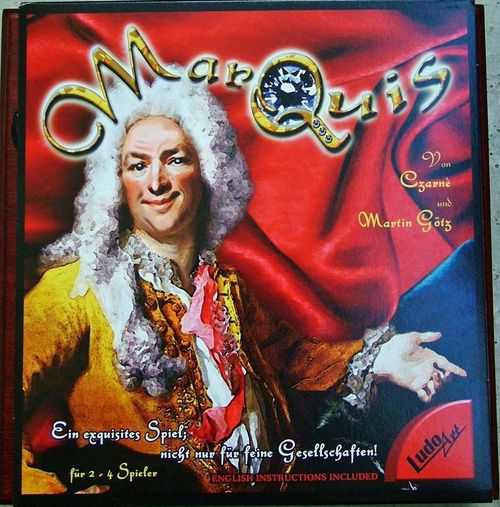
Marquis
Marquis Rulebook
Table of Contents
Table of Contents
Components
- 48 character cards (12 per colour)
- 16 coins
- 36 jewels: 21 diamonds and 15 rubies
- 1 character summary
- 1 German/English rulebook
Setup
- Sort the jewels by colour and place them in the centre of the table.
- Place the character summary where everyone can see it.
- Fill the State Treasury (Caisses de l'Etat) by placing 4 coins per player in the centre of the table (unused coins go back in the box).
- Each player takes the 12 cards of one colour (according to the card back).
- To determine the first player, each player shuffles their cards and turns one face up: the character whose initial is closest to the beginning of the alphabet designates the first player (see the order on the summary).
- The first player then receives 2 coins from the State Treasury, the player on their left receives 1 coin. All other players receive no coins.
- Each player shuffles their 12 cards again to form a face-down draw pile in front of them, and takes the first 4 cards as their starting hand.
Course of the Game
Play proceeds (initially) clockwise. On their turn, a player must choose one of the characters in their hand and place it in front of them, visible to all players (all characters played by a player must form one single pile).
The actions represented by the symbols on the character card are carried out one after the other, as described below (basic principle: "take first, give afterwards"):
- Receive one or more coins from the State Treasury
- Take one or more coins from one or more players
- Give one or more coins to one or more players
- Buy jewels
In addition, each character has a special power, summarized on each card. Depending on its nature, each power is used at a specific moment of the turn (see the powers in detail at the end of these rules). Each card shows the initial and colour of the character.
Note: for each description of the actions below, an example is given with the Pickpocket.
1. Receive one or more coins from the State Treasury
The number written on the coin symbol indicates how many coins the character receives.
Example: The Pickpocket receives 1 coin at the start of her turn. If the Treasury is empty at that point in the game, she goes away empty-handed.
2. Take one or more coins (from one or more players)
Under the "coin" symbol are found, depending on the character card, various symbols whose letter and colour designate other characters. All those depicted there will be robbed of the number of coins indicated by the number to the right of the symbol.
Example: the Pickpocket steals 1 coin from each Assassin and Jeweller, and 2 coins from each Marquis.
For a fellow player to be robbed, they must have in front of them, face up, one of the characters designated by the card played.
If a player has no more money in front of them, they cannot be robbed.
3. Give one or more coins (to one or more players)
After the player has or has not enriched themselves in action 2, they must give one coin to each character identical to their own (exception: the Marquis). They pay first the one who was placed first, then the second, and so on, as far as they can afford*; this means that one or more players may receive nothing.
Example: the Pickpocket must give one coin to each other Pickpocket present.
* Whatever their fortune at the start of their turn, a player may play any character.
4. Buy jewels
The first value shown on the transaction symbol indicates the purchase price. The second value indicates the number of diamonds the player takes from the table for that sum. The coins used go back into the State Treasury.
Although the purchase of jewels is unlimited, it is also optional.*
Example: the Pickpocket will have to pay, for instance, 3 coins to obtain 1 diamond, 6 coins for 2 diamonds, and so on. She may also decline to buy anything.
* Purchase is mandatory when the Treasury is empty: if there are no coins at all in the centre of the table during a player's turn, that player is obliged, if their finances allow it, to carry out at least one transaction so that the State Treasury fills up again.
ATTENTION
Buying is always the last action of a character (exception: the Jeweller) and takes place at the start of the following turn, before changing character. Thus, when their turn comes round again, a player may first make a purchase with the visible character, then place a new character on top of it, with which they carry out the various actions in the usual order.
At the end of their turn, the player draws a new card from their draw pile so as to again have 4 cards in hand. If their draw pile is empty, they cannot take a new card and continue to play with 3 cards. On the next turn they will play with 2 cards, and so on.
Jewels
As soon as a player has 5 diamonds, they exchange them for 1 ruby.
Veto - the Marquis's seal
To defend against an opponent's action, it is possible to play 1 Veto exceptionally. The "Veto" card is given to the opponent, who keeps it in front of them until the end of the game. The player who played a Veto card immediately draws a new card so as to again have 4 cards in hand. A Veto cannot be played against another Veto. A Veto is a special card and cannot be played in place of a "character" card and placed on the "characters" pile.
The Powers of the Characters
The Assassin
He eliminates a character of his choice and takes 2 coins from it. If he eliminates another Assassin, he likewise takes 2 coins from it, without giving it a coin in phase 3. If he is countered by a Veto, he cannot choose a new victim.
The card of an eliminated character is turned face down and slid to the very bottom of the "characters" pile.
The character now at the top of the "characters" pile can likewise be robbed or eliminated. When their turn comes round again, its player automatically benefits from the purchasing ability of this character. If a player, after an elimination, has no more face-up character on their pile, they can no longer be robbed... but can also no longer buy jewels.
The Jeweller
He can buy twice: immediately after receiving 1 coin from the State Treasury, he can buy at a rate of 2/1 (Note: if the Treasury is empty, he is not obliged to buy). The second purchase can be made - as with the other characters - at the start of the following turn, but at the more advantageous rate of 1/1.
The Blackmailer
If at least two Blackmailers are present, they benefit from a rate of 1/1. To signal this, the players place one of their coins on the card. Following the elimination of a Blackmailer or the use of new characters, the 1/1 rate remains valid for the remaining Blackmailer(s).
The Forger
He imitates the character previously placed on the "characters" pile and benefits from the same action ability and power: in short, the previous character is played a second time.
In addition, the direction of play changes. When a Forger is played for the first time, the game continues counterclockwise: it is therefore the player to the right of the active player who plays next. Each time a Forger is played, the direction is reversed. The Forger card must be placed on the "characters" pile in such a way that the arrow indicates the new direction of play.
The Astrologer
After playing the Astrologer, a player does not take a card from their draw pile to complete their hand but secretly chooses a card from their pile of characters already played. They cannot choose a character that has been eliminated.
Clarification: if the Forger takes on the identity of the Astrologer, the player can take back neither the Astrologer nor the Forger.
The Countess
In return for payment, she protects any character. The price is negotiable and can be paid with coins, diamonds and/or "Veto" cards. She cannot be forced to protect a character. If the Countess agrees to protect a character, the two players turn their card on top of the "characters" pile by 90 degrees. A protected character can be neither robbed nor eliminated. If the Countess is eliminated, the protection no longer exists. When a Countess protects a character and she herself is under the protection of another Countess, the player signals this by placing one of their coins on the card.
If the Countess offers no protection, she receives 1 coin from the first player who makes a purchase. This coin must be paid before the transaction. As a result, a purchase may turn out to be impossible. The Countess may, however, voluntarily waive this coin.
The Cleric
He buys at the same rate as his neighbour on the left (cf. the direction of the arrow on the transaction symbol). If the player on his left also plays the Cleric, it will be impossible for him to buy jewels.
The Marquis
The second Marquis receives 1 coin from the first Marquis placed. The third Marquis receives 2 coins from the second Marquis and 1 from the first Marquis. The fourth Marquis receives 3 coins from the third Marquis, 2 from the second and 1 from the first, and so on.
If the direction of play is reversed because of a Forger, the positions of the Marquis are no longer taken into account. The next Marquis, played or imitated, automatically becomes the "first Marquis".
(Translator's note: the French source then repeats a fragment, "un marquis devient le premier Marquis", which appears to be a stray duplicate of the preceding sentence.)
The Prosecutor
If a player plays a Veto to counter an opponent's action, a third player may exceptionally intervene as Prosecutor and neutralize the Veto (make it "disappear"). The Prosecutor may freely negotiate his intervention with the player who was countered, in exchange for coins, jewels and/or Vetos. A player may intervene as Prosecutor at any time, whether his "Prosecutor" card is on top of his "characters" pile or still in his hand. In the latter case, he shows his card and undertakes to play it as soon as his turn comes.
If the Prosecutor is played, he "calls a witness": that is, he may choose his next card from his draw pile instead of taking the top one (then shuffle the draw pile).
(Cross-check, Dutch translation: the Prosecutor receives the Veto, the defence is thereby lifted, and the aggressor can carry out his action unhindered.)
The Pickpocket
She robs the richest player, whose fortune is determined by the total value of their jewels (their money is not taken into account). If several players have the same fortune in jewels, or if the Pickpocket is the richest, this action is not carried out.
The Barbarian Thief
He receives nothing from the State Treasury. Embittered, he threatens all the other characters and receives 1 coin from each, except the other Barbarians, to whom he instead gives a coin ("take first, give afterwards"). He eliminates any character unable to pay him.
End of the Game and Victory
If on their turn a player can no longer play a character, they make a final purchase. For this purchase, each Veto card (placed in front of them or in their hand) is worth one coin and can be used to buy jewels. However, the player who played a Marquis as their last card, or who imitated it with the Forger, cannot use their Veto card(s) to make a transaction. After their final purchase, a player can no longer act against another player or be the target of other players. Their last card played nevertheless retains all its influence on the other players until the end of the game: if they receive coins, they will be able to buy jewels again.
It is possible that the last player still has several cards in hand. In that case, they may play their remaining characters in succession.
Scoring
Each diamond counts 1 point and each ruby 5 points. The player with the highest total is declared the winner. In case of a tie, the player with the most coins wins. If the tie persists, the Marquis loses against any other character and finishes second. If no Marquis was played on the last turn, then the players are tied.
Tip: Playing with up to 8 Players
It is possible to play with up to 8 people by combining 2 copies of "Marquis".
Special rules:
- The jewels of the two sets are combined in the centre of the table.
- For each additional player, add 4 coins to the State Treasury.
Notes:
- To estimate the approximate length of a game, count 15 minutes per player.
- It is advisable to first play in a small group before starting a game with 7 or 8 players.