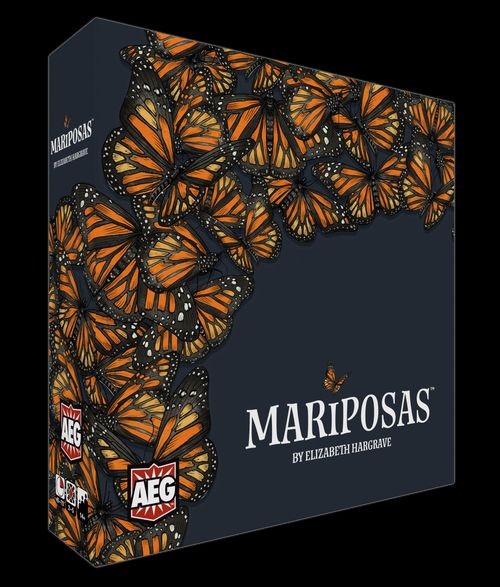
Mariposas
Mariposas Rulebook
Table of Contents
Table of Contents
Overview
Mariposas is played in 3 seasons. In general, your butterflies will try to head north in spring, spread out in summer, and return south in the fall.
There are an increasing number of turns per season: 4 turns per player in spring, 5 turns in summer, and 6 turns in fall.
Each season ends with scoring. The player with the most victory points at the end of fall wins the game.
Components
- 50 wooden butterfly markers (10 of each color)
- 1 flower die
- 120 flower tokens
- 5 score markers (1 of each color)
- 16 waystation tokens
- 20 season goal cards (5 spring, 10 summer, 5 fall)
- 1 map board
- 1 waystation board
- 60 life cycle waystation cards
- 6 life cycle ability tokens
- 36 action cards
- 15 bonus move waystation cards
Setup
- Place the map board in the center of the play area.
- Randomly place 3 season goal cards facedown on the map board in the indicated area. Choose 1 from each set: green for spring, yellow for summer, and orange for fall. The other goal cards can go back in the box. Turn the spring card faceup.
- Shuffle and set out the action cards (in a facedown deck) and flower tokens (in piles) where everyone can reach them.
- Deal each player a hand of 2 action cards.
- Give each player the butterfly markers and score marker of their color. Sort the butterflies in the player's supply by generation, 1 through 4.
- Players put their generation 1 butterfly marker on the large Michoacán space at the bottom of the map board.
- Each player places 1 generation 2 butterfly marker on the facedown summer goal card and 2 generation 3 butterfly markers on the facedown fall goal card.
- Place the players' score markers on the beginning of the score track on the map board.
- Randomly choose a first player.
- Place the flower die next to the map board.
- Shuffle the 16 waystation markers and place 1 facedown on each of the marked cities randomly.
- Place the waystation board next to the map board.
- Place the bonus move waystation cards next to the waystation board.
- Place the life cycle waystation cards on the waystation board in their indicated locations.
- Finally, randomly select 3 life cycle ability tokens and place 1 faceup to the right of each life cycle set. These special abilities are awarded to players when they complete a life cycle set (horizontal row of 4 cards). Return the unused life cycle ability tokens to the box.
On Your Turn
Play proceeds in clockwise turn order, starting with the first player.
- Play 1 card from your hand, placing the card faceup in front of you. Take the action(s) shown on it.
- You may reproduce if you land next to a milkweed symbol (see Hatching/Breeding).
- Draw back up to 2 action cards. Note: If you have 2 of the same action card or 2 action cards that reuse other cards, you may trade in 1 or both for replacements.
When you play a card, it stays in front of you until the end of the season, with each one in view for all players. This helps track how many turns you've had and when the season ends.
Playing the Game
Movement
Each action card shows 1 or more butterflies moving and then landing on a space. You can use each set of arrows to move the same butterfly marker more than once, or if you have more than 1 butterfly marker on the board, you can use each set of arrows to move different butterfly markers. When you land on a space, you collect the flower token(s) or waystation marker shown there.
Examples of action card movement:
- Move 1 space three times (can be used by 1 butterfly or split among multiple butterflies).
- Move 2 spaces twice (can be used by 1 butterfly or split among multiple butterflies).
- Move 1 space and move 3 spaces (in any order, can be used by 1 butterfly or split among multiple butterflies).
- Move 5 spaces.
- Move 4 spaces and take a flower from an adjacent space in addition to the space you land on.
- Reuse an action card that you have played during the current season.
- Reuse an action card that someone else has played during the current season.
The "reuse" cards cannot be used to reuse bonus move waystation cards.
Landing
Any number of butterfly markers can occupy the same space, including butterfly markers of multiple players.
Each space that you land on is either a flower space or a waystation space. Some spaces are also next to a milkweed symbol, which you can use to hatch a new butterfly.
Landing on Flowers
When you land on a flower space, pick up a flower token (or tokens) to match the flower(s) shown there. However:
- A player can never collect flowers from the same space twice in a turn.
- A butterfly can never collect flowers from the space on which it started the turn.
Landing Next to Milkweed
If your landing space is next to a milkweed symbol, the butterfly that landed there may immediately hatch a butterfly from the next generation by discarding flower tokens (see Hatching Butterflies). Hatching a butterfly is in addition to picking up a flower token or waystation card (life cycle card or bonus move card).
If your action card or bonus movement card shows multiple landings (such as move 1 space 3 times), you can hatch a new butterfly each time you land, as long as you land next to a milkweed symbol.
You may collect a flower from the space you landed on before hatching.
Waystations
Habitat loss has led to dramatic declines in the monarch population. People can create "waystations" that provide nectar plants for butterflies and milkweed plants for caterpillars—the only plants that monarch caterpillars can eat.
Landing on a Waystation
- When you land on a waystation marker that you have not landed on before, collect the item shown there.
- All waystation markers start facedown. If you are the first person to land on the waystation marker, flip it over, roll the flower die, and take a token of the flower that you rolled. Leave the marker faceup for the rest of the game. Other players' butterflies do not prevent you from collecting on a waystation.
- You can never have a second copy of any waystation card (life cycle card or bonus move card).
Life Cycle Sets
Most waystation markers will give you a life cycle card. At the end of the game, each life cycle card collected will be worth 1 point.
There are 3 sets of life cycle cards, each a different color (green, pink, and blue) and showing a different species of milkweed in the background. There are 4 cards in each set (egg, caterpillar, chrysalis, and adult).
Each collected life cycle card is worth 1 point.
Life Cycle Ability Tokens
When you have collected all 4 life cycle cards of one color, you get the benefit shown next to that set on the waystation board.
The possible abilities are:
- Score 1 point at the end of the game.
- Score 1 point at the end of the game.
- After the 6th turn in fall, all players who have completed this set refill their hands and take an another turn in turn order.
- For the rest of the game, every time you hatch a butterfly, you immediately score 1 point.
- Immediately gain 1 of each flower token.
- Score an additional 3 points at the end of the game.
- Gain any 2 life cycle cards or bonus move cards that you do not already have.
- When counting points for butterflies in Michoacán at the end of the game, you score as if you have 1 extra butterfly there.
Wild Flowers
One waystation marker becomes a wild flower space on the map board. Any player can land here and gather the flower of their choice.
Note that this symbol also appears on one side of the flower die. When rolled, this symbol lets you choose a flower of your choice.
Waystation Bonus Move Cards
Three of the waystation markers give you a bonus move card.
These cards can be held until needed (including across seasons). This card is not a normal action card and cannot be copied by action cards that copy other action cards.
These cards are added to your hand of action cards as extra cards but are not replaced after you play them (you go back to having just 2 cards to choose from each turn). After it is played, keep the card to remember that you cannot collect the same card again.
Bonus move cards:
- Move 3, Move 2 — This card is played instead of a normal action card on your turn. It gives you one move of 3 spaces and one of 2 (in any order).
- Add 1 Move — This card is played at the same time that you play another card. It adds an additional separate single space move to that card.
- Add 2 to a Move — This card is played at the same time that you play another card. It adds an additional 2 spaces of movement to one of the movement actions already on the card. The extra 2 spaces can only be added; they are not a separate move.
Hatching Butterflies
If your landing space is next to a milkweed symbol, the butterfly that landed there may immediately reproduce. It hatches a butterfly from the next generation.
Take one of your butterfly markers from the next generation and place it in the same space as its parent. To pay for it, discard the number of flower tokens required for the generation you hatched (see Hatching Costs).
The two butterfly markers now move completely separately, but they start on the same space.
Hatching a butterfly is in addition to the other actions that happen when you land. You still have the opportunity to collect a flower token or use a waystation before you reproduce.
When hatching a butterfly, you must always take the butterfly markers placed on the season goal cards (see Setup) before you take any from your supply.
If you remove the last butterfly from a season goal card, flip the card over to reveal what the scoring goals will be for the next season.
If you do not have any butterflies from the next generation available, that butterfly can't reproduce.
Generation 1 butterflies can only hatch generation 2 butterflies, generation 2 butterflies can only hatch generation 3 butterflies, and so on.
Hatching Costs
In general, more butterflies on the map board will earn you more points, but only if you can get them where they need to be. Before you reproduce, think about where you want your new butterflies to hatch.
The cost for a new butterfly goes up with each generation.
- Generation 1 butterflies make generation 2 butterflies. The cost is 2 matching flower tokens, or any 3 flower tokens.
- Generation 2 butterflies make generation 3 butterflies. The cost is 3 matching flower tokens, or any 4 flower tokens.
- Generation 3 butterflies make generation 4 butterflies. The cost is 4 matching flower tokens, or any 5 flower tokens. Make sure to place the generation 4 butterfly so the side with a single butterfly is facing up.
- Generation 4 butterflies can flip over and become double butterflies. The cost is 4 matching flower tokens, or any 5 flower tokens. Double butterflies count as 2 toward goals (such as butterflies back in Michoacán), but they have the advantage of moving as one marker. They can be powerful at the end of the game.
Revealing Seasons
The monarch migration each year is affected by variable conditions such as wind, weather, temperatures, and changes in land use.
The goal cards for each season in Mariposas represent some of these changing factors. You will use one goal card for each season in the game.
Of course, the butterflies do not know in advance what each year will bring. The goal card for each season is only revealed once all the butterflies that were placed on top of that card during setup have been hatched onto the map board. If you ever reach the end of a season and the next season goal card has not been revealed, then immediately reveal it and return the butterfly markers on it to their owner's supply.
When, as a result of hatching, all of the butterflies have been removed from on top of a facedown season goal card, it is revealed to all players. Season goal cards only ever affect the season that is current; for example, a summer goal card revealed in spring has no impact on spring.
Spring
The spring goal card is revealed at the start of the game. When all players have taken 4 turns, you've reached the end of spring.
At the end of spring take the following steps in order:
- Place all action cards played during spring into the discard pile.
- Score the goals shown on the spring goal card.
- Determine summer's first player. The player with the fewest total points at the end of spring will be the first player for summer. (Ties go to the first player clockwise from spring's first player.)
- If you have any generation 2 butterflies that are not on the map board, you may hatch one for free (no flower token cost and does not need to be next to a milkweed symbol). Put it on top of your generation 1 butterfly.
- Remove all generation 1 butterflies from the map board.
- Reveal the summer goal card if it has not been revealed.
You're ready for summer.
Summer
When all generation 2 butterflies have been removed from the facedown summer goal card, reveal the summer goal card. When all players have taken 5 summer turns, you've reached the end of summer.
At the end of summer take the following steps in order:
- Place all action cards played during summer into the discard pile.
- Score the goals shown on the summer goal card.
- Determine fall's first player. The player with the fewest total points at the end of summer will be the first player for fall. (Ties go to the first player clockwise from summer's first player.)
- If you have any generation 3 butterflies that are not on the map board, you may hatch one for free (no flower token cost and does not need to be next to a milkweed symbol). Put it on top of one of your generation 2 butterflies.
- Remove all generation 2 butterflies from the map board.
- Reveal the fall goal card if it has not been revealed.
You're ready for fall.
Fall
When all generation 3 butterflies have been removed from the facedown fall goal card, reveal the fall goal card. When all players have taken 6 fall turns, you've reached the end of fall.
At the end of fall take the following steps in order:
-
Score the goals shown on the fall goal card.
-
Score points for the number of generation 4 butterflies that are in Michoacán:
Generation 4 Butterflies 1 2 3 4 5 6 Points 3 7 12 17 21 24 Each subsequent generation 4 butterfly scores an additional 2 points.
-
Score 1 point for each waystation life cycle card you collected.
The player with the most points after all 3 seasons is the winner.
If 2 or more players have the same number of points, the tie breakers are (in order):
- Number of butterflies in Michoacán
- Number of flower tokens
- Number of life cycle cards
- Still tied? You all win!
Season Card Iconography & Clarifications
In the following section, you'll find more detailed explanations of examples of the goals on the season goal cards. You may not be able to complete all the goals for each season. Choose wisely with the action cards you have available.
Geographical Goals
- Horizontal line from the top corners: Draw an imaginary horizontal line from the top left and top right corners of the space. All spaces on the map that are in all the rows above that line are considered for the card.
- Horizontal line from the bottom corners: Draw an imaginary horizontal line from the bottom left and bottom right corners of the space. All spaces on the map that are in all the rows below that line are considered for the card.
- Vertical line from the right corners: Draw an imaginary vertical line from the top right and bottom right corners of the space. All spaces on the map that are in all the columns to the right of that line are considered for the card.
- Vertical line from the left corners: Draw an imaginary vertical line from the top left and bottom left corners of the space. All spaces on the map that are in all the columns to the left of that line are considered for the card.
Examples of Season Goals
Repeatable goals. In some cases, season goals will give you points for each time that you have fulfilled them at the end of the season. These are written on the card as the number of points followed by a "/" and then followed by the criteria for scoring. Examples:
- At the end of the season, you score 1 point for each butterfly you have that is above the row Atlanta is in.
- At the end of the season, you score 2 points for each butterfly that is on a double flower space.
- At the end of the season, you score 1 point for each butterfly that is on a red space.
- At the end of the season, you score 2 points for each butterfly that is around Boston. Around a city also includes on the city space itself.
- At the end of the season, you score 2 points for each butterfly that is in a space on the East Coast. The East Coast runs from the blue space with 2 white flowers immediately below Orlando to the green space adjacent to Quebec with 2 purple flowers.
One-off goals. If a season goal gives certain criteria and is followed by a number of points, then you have to meet those criteria to score the points. However, you only score the points once. Achieving them multiple times does not give you additional points. Examples:
- At the end of the season, if you have at least 1 butterfly around each of the 3 named cities (Quebec City, Toronto, Winnipeg), you score 7 points.
- At the end of the season, if you have at least 1 butterfly on yellow, orange, and green spaces, you score 4 points.
- At the end of the season, if you have at least one of each flower token type, you score 3 points.
- At the end of the season, if you have 2 butterflies both above Atlanta with at least 1 on a red space and 1 on a yellow space, you score 6 points.
Compound goals. If a card has a number of butterflies with the word "AND", then you must have at least that many butterflies on the map at the end of the season and meet the other criteria in order to score. If the card has a red circle and line through a butterfly, that means no butterflies. Examples:
- If you have at least 3 butterflies on the map and no butterflies at all below Atlanta, you score 5 points.
- If you have at least 3 butterflies on the map and no butterflies at all to the left of Atlanta, you score 5 points.
Breeding goals. If a card has a chrysalis hatching symbol, that means the reward is for breeding in certain areas. Examples:
- Each time a butterfly breeds a next generation butterfly in the columns indicated to the right of Houston and left of Atlanta, you immediately score 2 points.
- When a generation 3 butterfly breeds above the row Atlanta is in, it immediately becomes a double generation 4 butterfly.
Immediate scoring. Any time a point scoring symbol has an exclamation mark, the points are scored immediately rather than at the end of the season.
Designer's Note
Visiting a monarch butterfly preserve in Michoacán, Mexico in early 2003 remains one of the most awe-inspiring and memorable experiences of my life. But the direct spark for this board game was the book Flight Behavior by Barbara Kingsolver, which brings the amazing story of monarch migration alive in novel form.
Thank you to everyone who is working to help this species continue making its epic journey every year, whether it's planting milkweed, limiting pesticide use, preserving natural areas, or fighting to list monarchs as a threatened species under the Endangered Species Act.
— Elizabeth Hargrave, game designer