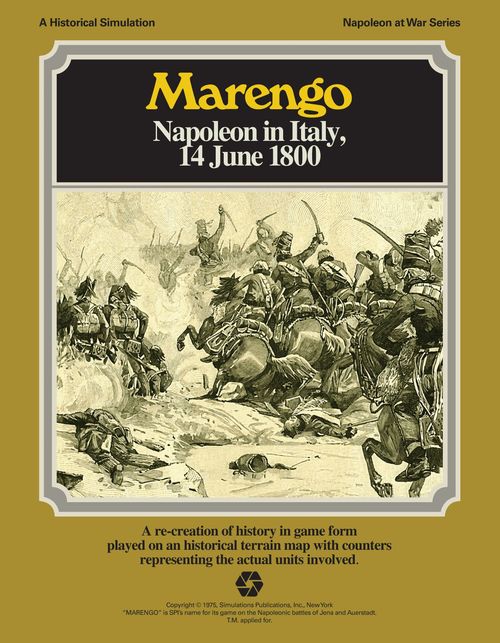
Marengo: Napoleon in Italy, 14 June 1800
Marengo: Napoleon in Italy, 14 June 1800 Rulebook
Table of Contents
Table of Contents
- 1.0 Introduction
- 2.0 Game Equipment
- 3.0 Setting Up the Game
- 4.0 Sequence of Play
- 5.0 Movement
- 6.0 Zones of Control
- 7.0 Combat
- 8.0 Artillery
- 9.0 Terrain Effects Chart
- 10.0 Night Game-Turns
- 11.0 Developer's Notes
- 12.0 Introduction
- 13.0 Initial Deployment Chart
- 14.0 Reinforcements
- 15.0 Special Rules
- 16.0 Victory Conditions
- Transcriber's Notes
1.0 Introduction
The Napoleon at War game system is an operational simulation of warfare during the era of the Napoleonic Wars. Each game in the system represents one of the great battles in the period. The Playing Pieces represent the actual units which participated in the battles, and the Map represents the terrain over which those units fought.
The rules for each game in the Napoleon at War Series are contained in two sections. The first contains Standard Rules, which are common to all the games in the series. The second section contains Exclusive Rules, Initial Deployment and Reinforcement Rules, which are different in each game.
This game has been designed to insure maximum playability and maximum reality (in that order). In order to achieve these goals, the physical components, as well as the game rules, have been designed to make the game easier to understand and play. The components include a smaller, more compact playing map, never more than a hundred playing pieces, and standardized rules.
The standardization makes it easier for the gamer to go from one game to another within the series. It also enables the games' designers to concentrate on the realism aspect of the games (the standardization generally takes care of any playability problems).
2.0 Game Equipment
2.1 The Game Map
The map sheet portrays the area in which the battle was fought. It includes all the significant terrain in the battle, a Terrain Key, and a Turn Record Track. A hexagonal grid is superimposed over the terrain features printed on the map sheet in order to regularize movement and positioning of the playing pieces.
2.2 Game Charts and Tables
Various visual aids are provided for the Players in order to simplify and illustrate certain game functions. These are the Terrain Effects Chart, the Combat Results Table, the Reinforcement Chart and the Deployment Chart.
2.3 The Playing Pieces
The pieces represent the actual military units that took part in the original battle. The numbers and symbols on the pieces represent the strength, movement capability, and type of unit represented by that piece. These playing pieces will hereafter be referred to as units.
2.4 How To Read the Units
Unit Designations
Units are identified by numerals in this sequence: division/corps (roman numeral) or brigade/division
Combat Strength is the relative strength of a unit when attacking and defending, expressed in terms of Strength Points.
Movement Allowance is the maximum number of clear terrain hexes that a unit may be moved in a single Movement Phase, expressed in Movement Points. More than one Movement Point may be expended for each hex entered according to the terrain in the hex.
2.5 Game Scale
Each hexagon on the map represents between 400 and 800 meters of real terrain. Each Strength Point represents between 500 and 1,000 men. Each Game-Turn represents between one and two hours of real time.
3.0 Setting Up the Game
The blue colored pieces represent French forces; the other colored pieces represent the force(s) opposing the French. In order to determine which Player is the first Player and which the Second Player, consult the Exclusive Rules Folder. There Players will also find rules for bringing in the reinforcement units which are given on the Reinforcement Chart. Play proceeds according to the Sequence of Play through the final Game-Turn.
4.0 Sequence of Play
The game is played in successive Game-Turns composed of alternate Player-Turns. During each Player-Turn, the Player maneuvers his units and resolves combat in sequence, according to the following outline, and within the limits provided by the rules which follow. At the conclusion of the final Game-Turn, the Victory Conditions are consulted and a winner is determined.
4.1 Sequence Outline
The Game-Turn is divided into a First Player-Turn and a Second Player-Turn. The Player whose Player-Turn is currently in progress is termed the Phasing Player. The activity which may take place during each Phase is outlined below:
1. First Player-Turn
A. Movement Phase: The Phasing Player may move all, some or none of his units as he desires within the limits and restrictions of the rules of Movement and Zones of Control, and the Exclusive Rules of the game. The Phasing Player may bring reinforcement units onto the map as allowed by his Reinforcement schedule and the Reinforcement rules. The non-Phasing Player's units may not move.
B. Combat Phase: The Phasing Player uses his units to attack the non-Phasing Player's units according to the rules of Combat and Artillery. During this Phase neither Player may move his units except when forced to, as a result of the Combat Resolution procedure.
2. Second Player-Turn
The Second Player now becomes the Phasing Player and accomplishes movement and combat in the manner described above.
5.0 Movement
General Rule: During the Movement Phase, the Phasing Player may move as many or as few of his units as he desires. They may be moved in any direction or combination of directions.
Procedure: Units are moved one at a time tracing a path of contiguous hexes through the hex grid. As a unit enters each hex, it must pay one or more Movement Points from its Movement Allowance.
Cases:
5.1 Prohibitions
5.11 Movement may never take place out of sequence. A Player's units may be moved during his own Movement Phase. During the Combat Phase, a unit which is either attacking or defending may be called upon to advance or retreat after its combat is resolved. During the Enemy Player's Movement Phase, and during both Players' Combat Phases, except when advancing or retreating as a result of combat, Friendly units must not be moved.
5.12 A unit may never enter a hex containing an Enemy unit.
5.13 A unit may never exit an Enemy controlled hex during any Movement Phase. An Enemy controlled hex may be left only during a retreat or advance as a result of combat (see 7.7).
5.14 No combat takes place during the Movement Phase. Once a Player has begun to resolve combat, and has thrown the die, he has irreversibly initiated the Combat Phase.
5.15 The number of Movement Points expended by a unit during a single Movement Phase may not exceed the Movement Allowanced a unit may expend any portion of the Movement Allowance, but unused Movement Points may not be accumulated until another Movement Phase or transferred to another unit. (Transcriber's note: the source text is garbled at this point; reproduced as printed. See Transcriber's Notes.)
5.16 Movement from hex to hex must be consecutive; that is to say, a unit may not skip hexes.
5.17 Once a unit has been moved, and the Player's hand is taken from the piece, it may not be moved any further during that Movement Phase, nor may it change its move without the consent of the opposing Player.
5.2 Effects of Terrain
5.21 A unit must expend one Movement Point to enter a clear terrain hex. To enter other types of terrain, a unit must often expend more Movement Points. And some hexes are prohibited to movement entirely. See 9.0, Terrain Effects Chart.
5.22 A unit which moves from one road hex directly into an adjacent road hex through a road hexside expends only 1/2 Movement Point regardless of other terrain in the hex.
5.23 A unit which moves from one trail hex directly into an adjacent trail hex through a trail hexside expends only one Movement Point regardless of other terrain in the hex.
5.24 Units may cross river hexsides only by moving through a bridge hexside. There is no additional cost for moving through a bridge hexside.
5.25 Units may cross Stream hexsides. Movement through a Stream hexside costs two additional Movement Points. Example: If a unit moves through a Stream hexside into a forest hex, the cost is four Movement Points.
5.26 A unit which moves from a slope hex (containing the slope terrain symbol) through a slope hexside into a clear terrain hex must expend one additional Movement Point. A unit which moves from a clear terrain hex through a slope hexside, into a slope hex expends no additional Movement Points.
5.3 Effects of Friendly Units
5.31 A Friendly unit may move through hexes occupied by other Friendly units. There is no additional cost for entering a Friendly-occupied hex.
5.32 A Friendly unit may not end any Phase stacked in the same hex with another Friendly (or Enemy) unit. There may never be more than a single unit in a hex at the end of any Phase.
5.33 There is no limit to the number of Friendly units which may pass through a single hex in one Movement Phase.
5.34 Friendly controlled hexes never inhibit the movement of Friendly units.
6.0 Zones of Control
General Rule: The six hexagons immediately surrounding a hex constitute the Zone of Control of any unit in that hex. Hexes upon which a unit exerts a Zone of Control are called controlled hexes and inhibit the movement of Enemy units: All units must cease movement when they enter an Enemy controlled hex.
Cases:
6.1 All units exert a Zone of Control throughout the Game Turn, regardless of the Phase or Player-Turn. The presence of Zones of Control is never negated by units, Enemy or Friendly.
6.2 Units do not pay any additional Movement Points to enter an Enemy controlled hex, as in some other SPI games.
6.3 There are only two ways to exit a hex in an Enemy Zone of Control: Either by retreat or advance as a result of combat, or by removal of the Enemy unit exerting the Zone of Control as a result of combat.
6.4 Obviously, if a given unit is in an Enemy controlled hex, the Enemy unit is also in its controlled hex. The two units are equally and mutually affected.
6.5 If there is an Enemy and Friendly Zone of Control exerted over the same hex, both Zones co-exist, and that hex is mutually controlled by both Players. There is no additional effect from having more than one unit exerting Zones of Control onto a single hex.
6.6 Zones of Control always extend into all six hexes adjacent to the controlling unit's hex, with this exception: Zones of Control never extend through a non-bridged river hexside.
7.0 Combat
General Rule: Combat between adjacent opposing units is mandatory. Artillery units (8.0) are the only units which may attack units to which they are not adjacent. The Phasing Player is termed the Attacker; the other Player is the Defender, regardless of the overall situation.
Procedure: The Attacker totals the Combat Strengths of all the units attacking a given hex and compares the total to the Combat Strength of the defending unit in the hex under attack. The comparison is expressed as a ratio between attacking and defending Strength Points (attacking Strength Points divided by defending Strength Points) and is simplified by rounding down to one of the odds ratios on the Combat Results Table. Example: If thirteen Strength Points were attacking four, the combat odds ratio would be 3.25 to 1, rounded off (always in favor of the defender) to three to one.
Having determined the actual combat odds, the attacker rolls the die. The result indicates a line on the Combat Results Table (7.6), which is cross-indexed with the column representing the combat odds. The intersection of line and column yields a combat result. Separate combats may be resolved in any order that the Attacker wishes, so long as all combats are resolved during that Combat Phase.
Cases:
7.1 Which Units Attack
7.11 All Enemy units that have Friendly units in their Zones of Control must be attacked by the Friendly (Phasing) Player's units in the Combat Phase. He may resolve these attacks in any fashion desired, as long as all adjacent units are attacked, within the requirements of 7.2.
7.12 All of the Phasing Player's units which end the Movement Phase in an Enemy controlled hex must attack some Enemy unit during the ensuing Combat Phase. The Phasing Player may choose which attacking units will attack each defending unit, as long as all adjacent Friendly units participate in an attack.
7.13 An Enemy-occupied hex may be attacked by as many units as can be brought to bear in six adjacent hexes, and by as many artillery units as are within range (see 8.0).
7.14 No unit may attack more than once per Combat Phase, and no Enemy unit may be attacked more than once per Combat Phase.
7.15 Units may only attack when adjacent to the defending unit (exception: see 8.0).
7.2 Multiple Unit and Multi-Hex Combat
7.21 If a Phasing Player's unit is in the Zone of Control of more than one Enemy unit, it must attack all those adjacent Enemy units which are not engaged by some other attacking unit. The Combat Strengths of the defending units are totaled into one combined Strength to which the attacking unit compares its Strength to determine the odds.
7.22 Units in two or more different hexes may combine their Combat Strengths and attack a single hex, if all the attacking units are adjacent to (or within range of) the Enemy occupied hex. The Combat Strengths of the attacking units are totaled into one combined Combat Strength, and then compared to that of the defending unit in order to determine the odds.
7.3 Combat Strength Unity
A given unit's Combat Strength is always unitary; it may not be divided among different combats either in attacking or defending.
7.4 Effects of Terrain
Units defending in certain types of terrain may have their Combat Strength increased. This increase is always a multiple of the original Combat Strength. Example: A unit with a Combat Strength of '5' would defend, on a Rough Terrain hex, at an effective Strength of '10' See the Terrain Effects Chart (9.0) for a complete summary.
7.5 Diversionary Attacks
A unit may make attacks at poor odds in order that adjacent attacks against other defenders may be made at higher odds (by allotting most of the attacking force to the major objective). These attacks are known as "Diversionary" or "Holding" Attacks.
7.6 Explanation of Combat Results
Ae = Attacker Eliminated. All Attacking units are eliminated (remove from the map).
De = Defender Eliminated. All Defending units are eliminated.
Ex = Exchange. All Defending units are eliminated. The Attacking Player must eliminate Attacking units whose total, printed (face value) Combat Strength at least equals the total printed Combat Strengths of the eliminated Defending units. Only units which participated in a particular attack may be so eliminated.
Ar = Attacker Retreat. All Attacking units must retreat one hex (see 7.7).
Dr = Defender Retreat. All Defending units must retreat one hex.
7.7 Retreating and Advancing As A Result of Combat
7.71 When the Combat Result requires that a Player's units be retreated, the Owning Player must immediately move those units one hex so that they are no longer in an Enemy controlled hex. The Owning Player may decide the direction that each of his retreating units moves.
7.72 A retreating unit may not retreat into a prohibited hex, cross a prohibited hexside, or enter an Enemy controlled hex. If no hex is open to retreat into, the unit is eliminated.
7.73 A retreating unit may enter a vacant hex (within the restrictions of 7.72). If there is no permissible vacant hex, the retreating unit may displace an adjacent Friendly unit (see 7.8).
7.74 Whenever a hex is vacated as a result of combat, one victorious unit which participated in that combat may advance into the vacated hex. This advance may be made regardless of Enemy Zones of Control. The option to advance must be exercised immediately, before any other combat resolution. A unit is never forced to advance. A unit may never advance more than one hex as a result of combat. After advancing, units may neither attack nor be attacked that Phase (see 7.14), even if their advance places them next to Enemy units whose battles are yet to be resolved, or who were not involved in combat. However, advances are useful in cutting off the retreat of Enemy units whose combat has not yet been resolved.
7.75 Only one victorious unit may advance into a vacated hex. If two hexes are vacated as a result of a single combat, the victorious Player may still advance only one unit.
7.8 Displacement
7.81 If the only hex available to the retreating unit is one which is already occupied by another uninvolved Friendly unit, then the uninvolved unit is displaced (pushed out of its hex) by the retreating unit. The displaced unit is moved back by the Owning Player (as if it were retreating as a result of combat) and its position is taken by the retreating unit. The displaced unit itself may not be forced into Enemy controlled or other prohibited hexes.
7.82 If the displacement would cause the displaced unit(s) to be eliminated, the retreating unit is instead eliminated. Displaced units can themselves displace other Friendly units in a sort of chain reaction of displacement, if that is the only permitted path of displacement open to them. A unit may be displaced more than once per Combat Phase, if that is the only alternative. Displaced Artillery units which have not yet engaged in combat, may not fire during that Combat Phase. Units may not displace other Friendly units if they have other paths of retreat open to them.
8.0 Artillery
General Rule: Unlike infantry and cavalry units, Artillery units may participate in attacks by bombarding the defending unit. Artillery bombards a unit from two hexes distance. Artillery units must participate in combat when adjacent to opposing units. In other words, artillery may participate in two types of attack, depending on their distance from the defending unit (adjacent or not). Unlike other units, Artillery units are never destroyed or forced to retreat when bombarding a unit, although they are affected by all combat results when they are adjacent to the unit they are attacking.
Procedure: Determine the odds of the attack in exactly the same fashion as any other attack. All results are applied in the same fashion, except that bombarding Artillery units (i.e., units firing from a non-adjacent hex) are not affected by combat results. Thus, if an Exchange were the result in an attack solely by bombarding artillery, the defending unit would be eliminated, but the bombarding units would not be affected. Of course, other units cooperating with the bombarding Artillery units from an adjacent position (including adjacent Artillery units) would be affected by combat results, and they would suffer the effects of an Exchange result.
Cases:
8.1 Bombardment Attacks
8.11 Artillery units may attack non-adjacent Enemy units, up to two hexes distant, but they are never forced to attack an Enemy unit merely because it is in range.
8.12 Range from the bombarding Artillery unit to the target hex is counted by including the target hex, but not the bombarding unit's hex.
8.13 Artillery units may only attack a single Enemy occupied hex when bombarding, except when making a combined attack with infantry or cavalry (see 8.2).
8.14 Artillery attacking from a non-adjacent hex (that is, bombarding) suffer no combat results; they are never destroyed or retreated as a result of their own attacks.
8.2 Combined Attack
8.21 Artillery units may attack alone, in concert with other bombarding Artillery units, or in concert with any Friendly units which are adjacent to Enemy units within range, adding their bombarding Combat Strength to the attack.
8.22 If, in a combined attack, Friendly units are attacking Enemy units in more than one hex, the Artillery units need only be within range of one of the defending hexes to add their Combat Strength to the attack.
8.23 When making a combined attack with bombarding Artillery units, infantry and cavalry units always suffer all combat results, though bombarding Artillery units do not.
8.3 Line of Sight
8.31 To determine if an Artillery unit may bombard a given hex, a straight-edge from the hex of the bombarding Artillery unit to the target hex. This straight line is the Line of Sight. If any of the hexes intervening between the bombarding hex and the target hex is blocking terrain, the target hex may not be bombarded by that Artillery unit.
8.32 If the Line of Sight is congruent to a hexside (that is, falling exactly between two hexes) it is blocked only if both hexes adjacent to that hexside are blocking terrain.
8.33 Forest and Town hexes are the only blocking terrain hexes (not Slope or Rough Terrain hexes or hexsides).
8.34 The terrain in the target hex and in the hex of the bombarding Artillery does not block the Line of Sight.
8.35 Artillery units may fire over other units, Enemy and/or Friendly.
8.4 Adjacent Attacks
8.41 When in the controlled hex of an Enemy unit, Artillery units must participate in an attack against adjacent Enemy unit(s). When an Artillery unit is in an Enemy controlled hex, it is treated like an infantry or cavalry unit, and may not bombard.
8.42 When attacking from a controlled hex, Artillery units may attack as many units as they are adjacent to, but may not attack non-adjacent units.
8.43 Artillery units attacking from a controlled hex must suffer all the combat results of their attacks.
8.44 Terrain does not prohibit artillery attacks into adjacent hexes.
8.45 Although normal combat is not permitted across an unbridged river hexside, an Artillery unit may attack any Enemy unit within range across such a hexside according to the Bombardment Attack rules (8.1).
8.5 Defense
8.51 Artillery units may never add their Combat Strength to another unit's Defensive value by bombardment. They may only bombard during their own Combat Phase.
8.52 When Artillery units are themselves attacked, they suffer all combat results in the same manner as other units, even when bombarded by Enemy Artillery units.
9.0 Terrain Effects Chart
The Terrain Effects Chart is a separate printed chart (see the other help files for the Napoleon at War series). It is not part of this text and is not reproduced here.
10.0 Night Game-Turns
General Rule: The tinted Game-Turns on the Turn Record Track are night Game-Turns, and have a different Sequence of Play than Day Game-Turns, in that the Combat Phase is omitted.
Cases:
10.1 Effect on Combat There is no Combat Phase during a Night Game-Turn, and no combat is allowed. Opposing adjacent units do not engage in combat; they simply remain in place. Artillery units may not bombard during Night Game-Turns.
10.2 Effect on Movement Movement restrictions during Night Game-Turns are identical to Day Game-Turn movement restrictions, with one addition. Units may not enter Enemy controlled hexes during a Night Game-Turn, nor may units already in Enemy controlled hexes exit them.
11.0 Developer's Notes
The Napoleon at War game series is based on the game system developed in 1972 for the SPI Introductory Game, Napoleon at Waterloo. Despite the popularity of NAW and its well received descendants, Borodino and Austerlitz, limited interest in the pre-Twentieth Century eras prohibited the publication of additional Napoleonic games until the QuadriGame and Folio concepts were initiated by SPI in 1975.
While the QuadriGame allows a wider range of games to be published, it also introduces the two-edged concept of standardization. Each series of games shares a common set of basic rules. This permits the Player to learn four games at once, in effect. After he is familiar with the basic rules, the Player is free to concentrate on the more enjoyable aspects of game play. On the other hand, however, standardization involves some compromises in the areas of both realism and historical accuracy. Such compromises appear in the Napoleon at War series as a result of the physical limits of the game components. Thus, it was necessary to omit distinct artillery units in the Battle of Nations game. But, in all other respects, the essence of Napoleonic warfare is remarkably preserved throughout the four games in this series. Equally important, the introduction of Special Rules tailored to each situation bestows an individual character to each game, thus ensuring that standardization does not make a game series monotonous.
All in all, we feel the Napoleon at War game series achieves an admirable balance between playability and realism.
12.0 Introduction
The Exclusive Rules introduction (12.0) is the Table of Contents passage at the top of this rulebook.
13.0 Initial Deployment Chart
On the Initial Deployment and Reinforcement Charts, an "a" following the unit's Strength-Type means the unit is artillery; a "c" means cavalry; all other unspecified units are infantry.
13.1 French Army
| Hex | Strength/Type | Designation |
|---|---|---|
| 1111 | 4-4 | 44 |
| 1110 | 2-4 | 101 |
| 1312 | 5-5 | 24 |
| 1412 | 5-4 | 43 |
| 1411 | 4-4 | 96 |
| 2310 | 4-5 | 69 |
| 2311 | 2-4 | 28 |
| 2409 | 3-4 | 22 |
| 2410 | 4-4 |
13.2 Austrian Army
| Hex | Strength/Type | Designation |
|---|---|---|
| 0608 | 6-3 | Rousseau (Rous) |
| 0708 | 3-5 | Frimont (Frim) |
| 0508 | 3-3 | Bellegarde (Bell) |
| 0507 | 5-3 | St.Julien (StJu) |
| 0406 | 5-3 | Kneswich (Knes) |
| 0407 | 2-3 | Lamarsaille (Lama) |
| 0408 | 4-3 | De Berry (DeBe) |
| 0308 | 7-3 | Latterman (Latt) |
| 0307 |
13.3 Player Sequence
13.31 The Austrian Player is the first Player. His Player-Turn is first in each Game-Turn.
13.32 The Game Length is fourteen Game-Turns.
14.0 Reinforcements
General Rule: The French Player receives reinforcements according to the Reinforcement Chart. These units are placed on the edge of the map in the hex indicated. Reinforcing units arrive during the French Player's Movement Phase of the Game-Turn indicated.
14.1 The French Player may enter his reinforcement units onto the map at any time during his Movement Phase.
14.2 Once a unit has entered the map, it may move and engage in combat freely, just as any other unit already present.
14.3 Each reinforcing unit expends one Movement Point to be placed on the entry hex. Units may exceed the stacking restrictions when entering the map in the same hex, as long as they conform to stacking restrictions by the end of the Movement Phase.
14.4 Units forced off the map by combat are considered eliminated for Victory Conditions.
14.5 There are no Austrian reinforcements.
14.6 French Reinforcement Chart
Reinforcements may enter the map in Enemy controlled hexes. They may not enter the map if their specified entry hex is occupied by any unit. Instead, they are delayed until the hexes are vacant.
Arriving on Game-Turn Two on hex 3912:
| Strength/Type | Designation |
|---|---|
| 3-4 | Consular Guard (CnGd) |
Arriving on Game-Turn Four on hex 3912:
| Strength/Type | Designation |
|---|---|
| 4-5 | 19 |
| 3-4 | 70 |
| 4-4 | 72 |
Arriving on Game-Turn Five on hex 3912:
| Strength/Type | Designation |
|---|---|
| 2-4a | DeSaix (DeSa) |
Arriving on Game-Turn Six on hex 3925:
| Strength/Type | Designation |
|---|---|
| 5-5 | 9 |
| 2-4 | 30 |
| 4-4 | 59 |
Arriving on Game-Turn Eight on hex 2401:
| Strength/Type | Designation |
|---|---|
| 2-7c | Murat (Mura) |
Arriving on Game-Turn Eight on hex 2501:
| Strength/Type | Designation |
|---|---|
| 1-7c | DuMoulin (DuMo) |
Arriving on Game-Turn Eight on hex 2301:
| Strength/Type | Designation |
|---|---|
| 2-6a | Cavalry (Cav) |
Arriving on Game-Turn Nine on hex 3301:
| Strength/Type | Designation |
|---|---|
| 2-6c | Rivaud (Riva) |
14.7 Game Length
Marengo consists of 14 Game-Turns. All are Day Game-Turns.
15.0 Special Rules
(The source prints this heading as ".0 Special Rules"; the number 15.0 is supplied by the transcriber from the Contents list.)
15.1 Special French First Game-Turn Restrictions
For the First Game-Turn (only), all French units have their Movement Allowance halved. In addition, French units are prohibited from entering Austrian Zones of Control during the French Movement Phase of the First Game-Turn.
15.2 Special French Counterattack Rule
At the beginning of the French Combat Phase on Game-Turn Nine or any subsequent Game-Turn, the French Player may initiate his counterattack by announcing it to the Austrian Player. All French units have their Combat Strength doubled for three consecutive French Combat Phases, which immediately follow the French Player's announcement. Example: The French Player announces his counterattack at the start of the French Combat Phase on Game-Turn Ten. All French units would have their Combat Strength doubled during the French Combat Phase on Game-Turns Ten, Eleven and Twelve (only). Note that the French units use their normal (printed) Strength for defensive purposes during the Austrian Combat Phases of these three Game-Turns.
16.0 Victory Conditions
General Rule: At the end of the Fourteenth Game-Turn, play ceases and the victor is determined according to the criteria given in the following cases.
Cases:
16.1 The game is considered a French victory if the French Player has eliminated at least 33 Austrian Combat Strength Points and there are a minimum of 10 French Combat Strength Points within four hexes of Marengo (hex 1412) at the end of the game.
16.2 The game is considered an Austrian victory if the Austrian Player has eliminated at least 30 French Combat Strength Points and both Marengo (hex 1412) and Pietrabuona (hex 1111) are occupied by Austrian units at the end of the game.
16.3 If neither Player eliminates the required number of Enemy Combat Strength Points, victory is awarded to the Player who has satisfied his geographical objectives.
16.4 If both Players satisfy their geographical objectives, the game is automatically considered a draw and no consideration is given to the elimination of Combat Strength Points.
16.5 Any other result is automatically considered a draw.
Transcriber's Notes
- The source HTML is the HexWar wiki copy of the two rule sections. Copyright lines and the navigation/contents lists of the web pages are not transcribed.
- Section 9.0 (Terrain Effects Chart) is referenced by the rules but is a separate chart not present in the source text.
- Section 5.15 is garbled in the source ("...Movement Allowanced a unit may expend..."); reproduced as printed.
- Section 8.52 contains a run-together word ("samemanner") in the source; read as "same manner".
- The Exclusive Rules heading for section 15.0 is printed as ".0 Special Rules" in the source; the number is supplied here.
- Unit designations in 13.2 and 14.6 (for example "Weiednfield", "Gotter sheisheimer") are reproduced as printed.