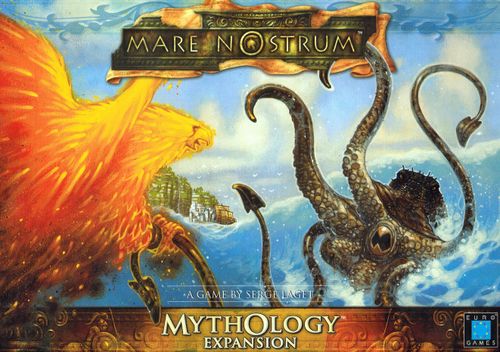
Mare Nostrum: Mythology Expansion
Mare Nostrum: Mythology Expansion Rulebook
Table of Contents
Table of Contents
Components
The expansion contains:
- 1 Game Board used to expand the board beyond the basic game.
- 6 Player Aid sheets: redesigned for this expansion.
- 1 Rule Book with all of the additional rules included.
- 10 Cardboard Building Tokens including: 1 temple, 2 cities, 2 markets, 5 caravans.
- 1 Set of 33 Wooden Game Pieces for the Atlantian Player, consisting of: 12 influence markers, 8 legions, 5 triremes, 8 Fortresses.
- 18 Mythological Creature Pawns: 3 pawns in 6 different colors.
- 78 Cards consisting of:
- 1 New Player Role Card: High Priest.
- 1 Civilization Specific Hero: Atlas.
- 21 New General Heroes: Achilles, Adonis, Ajax, Antigone, Ariane, Castor & Pollux, Circe, Croesus, King of Lydia, Aeneas, Gilgamesh, Hamilcar, Hercules, Imhotep, Jason, Medusa, Midas, Minos, Moses, Penthesilee: Queen of the Amazons, Queen of Sheba, and Spartacus.
- 8 Gods: Isis, Ishtar, Athena, Baal, Hermes, Mars, Poseidon, and Vulcan.
- 6 Mythological Creature Pawns, one for each civilization: Centaur, Behemoth, Phoenix, Kraken, Titan, Griffon.
- 24 Resource Cards including: 5 Tax cards, 1 card each of: Fruit, Gems, Gold, Papyrus, Perfume, 2 cards each of: Fish, Grain, Livestock, Metal, Olive Oil, Slaves, Wine.
- 6 New Resource Cards: Pottery.
- 11 Updated Cards to replace the ones in the Basic Game.
Object of the Game
The winner of the game is the first player to either build the pyramids, or to own 4 heroes and/or wonders.
Players who want a longer, more strategic game can agree to change the victory conditions to 5 heroes and/or wonders and change the cost of the pyramids to 13 cards (because the expansion introduces a 13th resource). Advanced players will appreciate this modification on a strategic level, but it will lengthen the game by about 1 hour.
Do you need 4 wonders OR 4 heroes, or a mixture of both? Either 4 of one kind OR a mixture of both will win the game.
Starting Setup
The expansion board is placed on the western edge of the basic board and represents the western part of the Mediterranean including the "Pillars of Hercules" and the mythical island of Atlantis.
The 6th player will represent the civilization of Atlantis, and its starting capital is Poseidonis.
For 6 players, all the Resource Cards and Building Tokens are sorted and placed, face up, beside the game board. If there are fewer than 6 players, use the chart below to choose the appropriate number of Building Tokens for the game.
The new Heroes and Wonders in the expansion are shuffled together with the ones from the basic game. Then take 8 Heroes and Wonders at random from this pile and set them aside; these 8 will not be used in the game.
Number of Building Tokens
| Marker | 3 players | 4 players | 5 players | 6 players |
|---|---|---|---|---|
| Caravan | 18 | 23 | 28 | 33 |
| City | 8 | 10 | 12 | 14 |
| Market | 8 | 10 | 12 | 14 |
| Temple | 4 | 5 | 6 | 7 |
NOTE: With 3-5 players, use a smaller number of building markers (caravans, cities, markets, and temples). The table above indicates the quantity of each marker that is available. Remove the excess markers from play.
Predetermined Setup
Each player randomly chooses one of 6 Starting Civilizations and the corresponding Player Aid Card and follows the Basic Setup. The players then take their Civilization Specific Hero cards (Hannibal for Carthage, for example), and possibly a Player Role Card, if indicated in the Basic Setup (for example, at the beginning of the game, the Rome player takes the Military Leader card) placing these cards face up in front of themselves. Referring to the Basic Setup for their civilization, they then place the indicated number of influence markers, building tokens and 3 mythological creature pawns in the appropriate spaces on the game board.
Playing with Fewer than 6 Players
If there are fewer than 6 players, any civilizations not chosen by a player are made "neutral civilizations" by placing in the appropriate capital province: 1 influence marker, 1 mythological creature pawn, 1 legion, 1 fortress. Further, this neutral civilization is expanded by placing in each region adjacent to the capital: 1 influence marker, 1 legion, and 1 fortress. If the Greek or Atlantis civilization is neutral, the regions adjacent to its capital are the same as shown on the player aid sheet. These neutral civilizations never grow, move or change. They simply remain on the board and defend their province if they are attacked.
Free Setup
When the players are more experienced, they can skip the predetermined setup, and instead construct their empire as they choose by adopting these free setup rules. In this method, instead of using the set starting positions for the pieces as shown on the Player Aid cards, each player now starts with 45 construction points (instead of 36 points as in the basic game) to spend on Influence Markers, Buildings, Military Units, Creatures and/or their Civilization Specific Hero (but not the General Heroes or Wonders) as they choose. The cost for each item is shown on the Construction Cost Chart in the Construction Phase section of these rules. The Capital Province for each civilization is the same as in the predetermined setup, except for the Greek player, who can occupy any region adjacent to the Aegean sea, and for the Atlantian player, who can also settle on the western-most regions of Europe and Africa.
Please note that all items built may be placed only in the players' Capital Provinces and the provinces immediately adjacent thereto, and all normal construction rules apply. Also note that any Legions or Triremes built must begin in the player's Capital Province, and can then move out on the first movement phase.
Building proceeds as follows: First, randomly determine the order in which the players will build. Then starting with the first-building player, each player picks and places on the board 9 construction points' worth of the player's total. The second-building player does the same and so on until each player has built 5 times, thus spending all of their 45 construction points. During this building phase, each player MUST place at least one influence marker on their capital.
Is it necessary to obey the rules of placement during the initial setup when using the free setup? Yes, it is necessary for example to initially place an influence marker in a province before you are able to build but you do not have to wait for a subsequent turn to build there. However, when buying heroes, each player may only buy their national hero (for 9), and, except for Hannibal's free legion and Pericles' free trireme, the hero's abilities WILL NOT apply during the setup phase (Caesar cannot buy the legions for 2 after he is purchased, for example); no other heroes or wonders may be purchased during the initial setup.
When using the free setup does a player have to buy their Civilization Specific Hero at the beginning of the game? No, you may choose to spend your construction points on other things instead. This Hero will be available to buy normally during the rest of the game. However, the only player that can buy this Hero will always be that specific civilization.
How are the Role Cards given out when doing the Free Setup? After the initial deployment has been completed, count up the appropriate buildings each player has, to determine which roles they will receive (for example the player with the most caravans and Markets gets the Director of Commerce Card). Then during normal game play, the role cards will only change hands at the end of the game turn based upon the same building criteria.
Source note: the answer above says the Role Cards change hands at the end of the game turn. The Roles section below says they are reassigned at the start of each new turn. Both are printed as such in the source.
When using the predetermined setup with fewer than 6 players, how are the role cards given out if their starting civilizations are not used? Use the normal rules of building possession for each role. For example if Egypt is not taken, either Greece or Babylon could take the Political Leader card (they both have 2 cities and the others have only 1 city). In the case of a tie, like this, the tied players determine randomly who will receive the role at the beginning of the game. However, in all cases during set up, you should avoid giving one player 2 roles. So, in the Greece/Babylon example above, Babylon should get the Political Leader Card, as Greece already has the High Priest Role.
Roles
At the start of the game, each role (and the appropriate Role Card) is given to the player indicated on the Player Aid Card. After that, the Role Cards are only reassigned at the start of each new turn as follows:
- Director of Commerce: Is the player with the most caravans and markets in their provinces.
- High Priest: Is the player with the most temples and markets in their provinces.
- Political Leader: Is the player with the most cities and temples in their provinces.
- Military Leader: Is the player with the most military units (legions, triremes, creatures and fortresses combined) deployed on the game board.
In case of a tie between the current owner of the Role Card and another player, the current owner keeps the card. If two (or more) OTHER players are tied for the role, the current owner of the card decides which of the tied players will inherit the role.
Note: Certain heroes in the basic game give bonuses to obtain role cards (Agamemnon, Archimedes and Solomon). In this expansion Moses gives a bonus to be High Priest and the Goddess Athena gives a bonus of 2 towards any of the role cards.
The High Priest, the Military Leader and the Political Leader decide the turn order in their respective phases. Do they have to announce complete turn order at the beginning of the phase? Or do they choose the players, one at a time, only after the previous player has completed their turn? The latter.
Phases of a Turn
Each turn is divided into 4 phases: the Commerce Phase, the Offering to the Gods Phase, the Construction Phase, and then the Military Phase. Players take their turns in a particular order (described below) during each phase, before proceeding to the next phase. During each of these phases, one privileged player will play the role (and thus determine the turn order) indicated by one of the following special Role Cards: The Director of Commerce determines the number of cards to be traded during the Commerce Phase. The High Priest determines the turn order in the Offerings to the Gods Phase. The Political Leader determines the turn order during the Construction Phase, and The Military Leader determines the turn order during the Military Phase.
Commerce Phase
Collect Revenues.
Note: The heroine Circe makes it possible to use legions in lieu of caravans. And, the Gods Hermes & Isis make it possible to obtain additional cards.
Trading Between the Players.
Note: The heroine Antigone makes it possible to be voluntarily excluded from the trade phase.
Can a player voluntarily opt out of the trade phase? No, if you have the cards to take part, you must do so. Unless you have Antigone, a heroine in this expansion that allows you to opt out if you wish.
Offering to the Gods Phase
In Mythology, an additional phase is inserted between the Commerce and Construction phases. A corresponding Role (and Role Card) controls this phase: the High Priest. When using the predetermined setup, the Greek player starts with this role. After that, the role is given to the player with the most temples and markets.
The High Priest chooses the order in which players call upon the assistance of a God by making an offering. Making an offering to a God is always optional, so when the High Priest tells you it's your turn, you can opt to make an offering or not.
To make an offering you have to spend a set of 3 cards (as defined in the Construction Phase section, below) to enlist the aid of any available God of your choice. Once the cards have been spent, the player takes the appropriate God card and places it (face up) in front of themselves. This God Card remains in front of this player until the next Offering Phase (the Gods are capricious and often change their minds about whom they would favor). At any point during the time the player holds this God card (face up), the player can decide to activate the power of the God. The God's effects are applied immediately and the God card is flipped face down to indicate its powers have been used. At the beginning of each new Offering Phase, all God Cards (used or unused) are returned to "the heavens" (beside the board) and are made available for further offerings. There are 8 Gods and Goddesses in the game (see Effects of the Gods section).
Can there be conflicts of timing when using the powers of the Gods? That cannot occur except between Hermes and Isis during the trade phase. In this case Hermes uses his power before Isis.
Can a player have several Gods at the same time? Normally no. However, the hero Adonis allows an exception to this rule.
Construction Phase
The Political Leader chooses the order in which players may improve and expand their empires.
When it is a player's turn to expand, that player cashes in one or more Sets of Resource Cards in order to purchase Heroes or Creatures, construct Buildings and Military Units, and place Influence Markers.
A set of Resource cards is composed of either: Tax Cards ONLY, or Non-matching Commodity Cards ONLY (see the example in the basic game).
The value of a set is equal to the number of cards in the set. This value determines what sort of item can be built with that set of cards (see the rules summary on the Player Aid Cards for the construction values of each item). Thus, a player can make sets of:
- 3 Cards to buy the majority of buildings and markers,
- 6 Cards to buy some particularly powerful buildings and creatures,
- 9 Cards for the heroes and wonders, and
- 12 Cards to build the ultimate wonder (the Pyramids) which brings instant victory!
Construction Cost Chart
| Marker, Token or Card Type | Cost |
|---|---|
| Influence Marker (marker to indicate control of a province) | 3 |
| City Token (Produces income of 1 tax) | 3 |
| Caravan Token (Produces income of 1 commodity) | 3 |
| Legion (a military land unit) | 3 |
| Trireme (a military sea unit) | 3 |
| Fortress (a military land unit that may never be moved) | 3 |
| Temple (doubles income from cities in the province) | 6 |
| Market (doubles income from caravans in the province) | 6 |
| Mythological Creature (military unit unique to each civilization) | 6 |
| Hero or Wonder (confers various effects to the owner of the card) | 9 |
| The Pyramids (win the game) |
Rules for Construction
- Players may construct buildings and military units, including creatures, only in provinces in which they already have an influence marker. They may not build in an un-owned province or in an opponent's province, even if they have legions present in the province.
Note: The Statue of Zeus makes it possible to build 2 fortresses per province.
NOTE: The Queen of Sheba allows you to build legions even in a province where you do not have an influence marker.
Although several hero and wonder cards grant a reduced cost to build various things (Caesar, Pericles, Atlas, Mausoleum, Croesus, Minos, Spartacus, and Imhotep), these reductions are not cumulative; the player simply takes the single best reduction available.
Military Phase
The Military Leader decides in what order players will take turns in the Military Phase. On each player's turn, that player first performs all of their naval moves and resolves all naval combats that they wish to occur. Once all naval movement and combat is complete, the player performs all of their ground moves, immediately resolving any combats that result. Full Movement and combat rules are detailed below:
A) Movement
The player may move as many units as he chooses: all, some, one or none.
-
Naval Movement: The player begins by moving Triremes (if any). If they were just constructed, they move to an adjacent sea space. If already at sea, they may move to an adjacent sea space. Naval battles are NOT required when moving into an occupied sea space (except in the special case of a "Greek Blockade", see rules below). However, if a player chooses to attack, that player must do so before moving any Legions, since the results from the naval battle may impact using the Triremes to move Legions.
-
Naval Battles (Optional): are conducted using the Rules for Battle detailed below, if the moving player chooses to fight.
Please Note: Atlas, the Civilization Specific hero of Atlantis, allows its triremes to move 2 times, but if these triremes fight after their first move, they lose the ability to make a second move this turn. Aeneas, the mythological hero, allows a player to transport ground units through 1 sea space in absence of a fleet. The God Poseidon allows a player to destroy an opponent's trireme at any time. For full descriptions of these powers see card descriptions below.
-
Legion Movement: The player then moves their Ground units (Legions and Mythological Creatures). Ground Units may only move to an adjacent province through a shared border, or through a chain of Triremes.
-
Ground Battles (Obligatory): are conducted using the Rules for Battle detailed below. Legions and Creatures MUST fight when in a space occupied by opposing units (Legions, Creatures or Fortresses).
Note: Two mythological units have special movement rules. The Kraken can dive under the seas and the Griffon can fly from region to region. These units cannot be used as Ground Unit convoys like triremes. For full descriptions of these powers see card descriptions below.
Can a trireme that was built on a previous turn, but which has not been moved out to sea yet, be Sacked, Occupied or Converted by an attack in the province where the trireme was built? No. There is no interaction of any kind between sea combat units and ground combat units (The Mythological creature Titan allows an exception to this). The trireme is simply ignored by the conqueror.
B) Combat
General Rules for Battle:
- All battles last a single round only.
- Ground units (Legions, Mythological Creatures and Fortresses) may only fight ground units, and naval units (Triremes) may only fight naval units.
- Each civilization has a specific Mythological Creature unit which has a special ability that only it can confer (see Mythological Creatures below). However ALL Mythological Creatures have a further advantage. They "roll" an automatic 6 in combat where they are involved (just like a fortress), so no die roll is necessary. Creatures are the most powerful military units in the game; they are limited to 3 per player and it is necessary to build a set of 6 cards to build a single creature.
- Note: The heroine Penthesilee grants its owner the ability to lose units every 6 points instead of 5 (just like a fortress).
Many heroes confer an advantage in combat: Ajax makes it possible to re-roll some of the dice; Ariane gives a bonus in defense based on buildings in the province; Midas makes it possible to use one's taxes to pay off an opponent's legion; Hamilcar makes it possible to "roll" 4 automatically on some or all die rolls instead of actually rolling them; Medusa makes it possible to prohibit, once per turn, the battles in a province. The God Mars grants a bonus of +6 after having seen the result of a combat die roll. For full descriptions of these powers see card descriptions below.
1. More than one player's Military Units (Legions, Creatures, Fortresses or Triremes) survive the battle (or battles, if more than 2 players are involved): If there are military ground units (Legions, Creatures and Fortresses) belonging to two (or more) players in a land province, the province is considered "At War". The invading military units remain in the province after the battle. As long as opposing units remain in the province, they must continue to fight during their subsequent Combat Phases.
If there are triremes belonging to two (or more) players in a sea space, the sea space is NOT considered to be "At War", and players may still move into, out of, and transport Legions through this space freely.
2. Only one invading player survives: The invader must choose to allocate the remaining invading legions in one of the following three ways:
a. Sack the Province: The player destroys ONE BUILDING in the province (a city, caravan, temple or market, but NOT a fortress, which is considered a military unit.) The destroyed building is returned to the general stock.
b. Occupy the Province: A single Legion or Creature Token may be placed on each City or Caravan in the province to claim the income associated with that city or commodity. A single Legion or Creature Token may also be placed on each Market or Temple in the province in order to double income gained by another Legion or Creature on a City or Caravan in that same province. As soon as the units of the invader leave the province, its legitimate owner (influence marker) again takes control of it.
c. Convert the Province: A single Legion or Creature Token may be placed on top of an opponent's Influence Marker in the province. During the next building phase, the invading player MAY construct their own influence marker to replace the existing one respecting the normal rules of construction (the province must be adjacent to the converting player's empire, and the cost to construct the new influence marker must be paid as usual). The province (and any buildings in it) will now be controlled by the new owner. Until the influence marker changes, the province (and anything it produces) remains in control of the player with the influence marker in it.
Strategic Notes: Sacking a province does not gain the attacker anything, but makes it possible to slow down an opponent by having an immediate impact on his resource income. Occupation makes it possible for the attacker to immediately (next turn), albeit temporarily, gain additional resources (or possibly take a Role Card) from an area but leaves the player a bit more vulnerable in the long term. And, finally, Conversion is potentially more lucrative long-term, at the sacrifice of the short term gain, but it still has elements of risk since the invader may not be able to meet all of the requirements to actually convert the province on their next turn (adjacency to your empire can be cut off by another player's successful conquests, for example).
Other factors to consider are the effects of the heroes a player controls. Many heroes confer some advantage to the options of conquest: Nebuchadnezzar makes it possible to gain resources when sacking, Achilles makes it possible to devastate 1 building per military unit present, Gilgamesh makes it possible to place a free fortress at the same time you place an influence marker, Jason makes it possible to move 1 controlled caravan marker per round, and so on.
The Greek Blockade
NEW RULE: "The Greek Blockade"
The Greeks naturally draw their powers from the sea and they have a tendency to extend their empire by colonizing Islands. As naval battles are not mandatory in Mare Nostrum, The Greek Player often has difficulties defending its territory from enemy invasions. To address this problem, the rule of the "Greek blockade" has been added. Please note that these special rules apply only to the Greek player, and other civilizations do not have this special defensive ability.
- If a player is attacking a province under Greek control (it has a Greek Influence Marker in it) and the attacking player is using triremes to transport the invading ground units, the attacking player must first declare that they are attempting to break the Greek blockade, and declare which units they are attempting to move and on which triremes.
- Once the move is declared, the Greek player can, if they wish, use their own triremes to attack any of that opponent's triremes that are transporting an invading unit. The Greek player can attack in any sea space where the transportation of opposing units takes place as long as the Greek player also has a trireme in this sea space.
- This special attack can only be used against opposing triremes that are transporting invading units; it cannot be used to attack triremes elsewhere.
- If the Greek player is successful in destroying a trireme transporting an enemy unit, that unit is not lost, just the trireme transporting it. The unit is moved back to its starting space and may make another move.
- If the Greek player is unsuccessful in destroying the trireme (or triremes), and the invading player still maintains an uninterrupted chain of triremes to support the proposed invasion, the invading player may move his ground units normally.
Combat Example
An Example of Combat: The Atlantian player attacks the capital province of Carthage with 4 legions and 1 kraken (via the sea). Carthage contains: 1 fortress, 1 behemoth and 2 legions.
The Atlantian player will roll 5 dice because the kraken doesn't benefit from the automatic 6, since there is a behemoth on the opponent's side.
The Carthaginian player will roll 2 dice (for the legions) and adds 12 (6 for its Fortress + 6 for its Creature). The Carthaginian player will also benefit from a bonus of +2 (Hannibal's power adds +1 to each legion).
The Atlantian rolls: 2+4+1+5+4 = 16. This kills 3 Carthaginian units.
The Carthaginian rolls: 3+3+(12+2 of bonus) = 20 and kills 4 Atlantian units.
The Carthaginian chooses to lose its 2 legions and its fortress in order to keep the Behemoth (which cost 6 to build).
The Atlantian makes the same observation and loses its 4 legions to save the Kraken. Some units remain belonging to the 2 players, so the province remains at war. However, since this is a capital city, the Carthaginian player will be able to build there on the next round. The kraken will have no choice but to dive back in the sea quickly!
The Cards in the Game
Effects of the Wonders of the World
Hanging Gardens: Keep 2 Commodity Cards. Normally all Commodity cards are discarded at the end of the Construction Phase. You may now keep two Commodity Cards from one turn to another (face down).
Statue of Zeus: Allows you to build 2 fortresses per province. Normally a player may only build 1 fortress per province. You may now build 2 per province. This card comes with 1 free fortress placement when it is acquired.
Lighthouse: Allows you to place influence markers in provinces that are not adjacent to provinces under your control. You may now place influence markers anywhere you like, as long as you follow all other rules for placing influence markers. This card comes with 1 free Influence Marker placement when it is acquired.
Nebuchadnezzar: Earn 1 Resource Card from sacking. When your legions sack a province, take one Commodity card for the destroyed caravan, or one Tax card for the destroyed city, or 1 of any resource produced in this province for a destroyed temple or market.
Mausoleum: Construction of Influence Markers and Buildings (cities, caravans, temples and markets) costs -1. A set of only 2 cards is needed for influence markers, cities and caravans, and only 5 cards are needed for temples and markets. This "reduction" does not apply towards Heroes or Wonders.
Archimedes: Bonus of +3 towards becoming the Military Leader. When roles are assigned, before each new turn of the game, add 3 to your total number of legions, fortresses, creatures and triremes to determine if you are the Military Leader.
Solomon: Bonus of +3 towards becoming the Political Leader. When roles are assigned, before each new turn of the game, add 3 to your total Cities and Temples to determine if you are the Political Leader.
Effects of the General Heroes
Agamemnon: Bonus of +3 towards becoming the Director of Commerce. When roles are assigned, before each new turn of the game, add 3 to your total Caravans and Markets to determine if you are the Director of Commerce.
Antigone: Can exclude herself voluntarily from the trade phase after having heard the number of cards requested by the Director of Commerce.
Ariane: Each building in the province gives a bonus to the dice in combat. Cities and caravans give +1 each; markets and temples give +2 each.
Castor & Pollux: Completely copy the abilities of any opponent's HERO in the game, excluding civilization specific heroes.
Circe: Allows a player to use its legions as caravans to produce resources that they control (need to have influence in the province). Further, a market doubles the revenue of the Circe-powered legion, just like a caravan.
Effects of the Civilization Specific Heroes
Atlas – Atlantis: Triremes cost 2 to build and they can be moved 2 sea spaces. If a player chooses to fight after the 1st movement, the trireme cannot move again.
Julius Caesar – Rome: Legions cost only 2 to build. (Note: This bonus no longer applies to Fortresses).
Hannibal – Carthage: Legions gain a bonus of +1 to each die rolled in combat. This card comes with 1 free Legion placement when it is acquired. This Legion must be placed in Carthago.
Pericles – Greece: Triremes cost only 2 to construct, and gain a bonus of +1 on each die rolled in naval combat. This card comes with 1 free Trireme placement when it is acquired. This Trireme must be placed in Athenae/Sparta.
Effects of the Gods
Athena: Bonus of +2 towards becoming any Role.
Baal: Can destroy an opponent's city anywhere on the board.
Hermes: Produces 3 additional resource cards of any resource that the player produces. This ability occurs during the commerce phase, after production but before Isis.
Ishtar: Protect against the power of another God (usable only if you are the target).
Isis: Secretly give 1 resource card to each player (including yourself). This ability occurs during the commerce phase, after production, after Hermes and before trading begins.
Mars: Add +6 to the total of a single combat roll after having seen the result.
Poseidon: Can destroy an enemy trireme anywhere on the board, even as its owner tries to use it for conveying or fighting.
Vulcan: Can destroy an opponent's caravan anywhere on the board.
Effects of the Civilization Specific Creatures
Behemoth – Carthage: When fighting a Behemoth the units which "roll" 6 automatically (fortresses and mythological creatures) lose this advantage and must roll the dice normally.
Centaur – Greece: At the beginning of a combat where it is involved (before dice are rolled), each centaur destroys one enemy legion (not a fortress, trireme or a mythological creature).
Griffon – Babylon: The Griffon can move a distance of up to 2 regions by flying over an area (even a sea space or even an area occupied militarily). However, a Griffon cannot be convoyed by a trireme.
Kraken – Atlantis: On land, the Kraken can only move in coastal territories. At sea it can move into sea spaces and attack triremes there. A Kraken cannot be convoyed by a trireme. In lieu of its normal move, a Kraken can dive/emerge. To perform this maneuver, the Kraken token is removed from the board and placed on the Kraken card. On ANY subsequent turn the Kraken can emerge in ANY Sea Space AND Move.
Phoenix – Egypt: When a Phoenix token is eliminated place it on the Phoenix Card. This token may re-emerge in the Egyptian capital for the cost of a 3-card set on any subsequent construction phase.
Titan – Rome: Each Titan may attack units in adjacent provinces (even sea provinces), in lieu of attacking in the province the Titan occupies. For this special attack you must roll dice (as in normal combat, the automatic 6 does not apply). Several Titans can combine in this special attack, rolling 1 die per Titan.
Effects of the Mythological Heroes
Achilles: Sack 1 building per military unit present after a successful combat.
Croesus, King of Lydia: Allows you to build in a new province during the same round you put an influence marker. This build is at a cost of -1 per build type (this ability is non-cumulative with any other reductions and this reduction can only be applied once per province).
Aeneas: Allows a player to move through a single sea space without triremes (the selected space is the same one for the entire round, but the player announces it when he wants).
Gilgamesh: Place 1 free fortress in a new province (at the time the player places their influence marker).
Adonis: Allows a player to take a God for free, at the end of the Offering Phase, once all other players have made their offerings. Note: By using Adonis, a player may get two gods on the same turn, one via normal offering, and a second after the offerings have been completed.
Ajax: When rolling dice in ground combat, this player can re-roll once any dice they wish.
Hamilcar: Allows a player to get an automatic 4 on any dice to be rolled in Ground combat, rather than rolling them (you can decide to use this power for some or all dice to be rolled).
Hercules: Once a round this player can use 1 legion as if it were a mythological unit belonging to that player.
Imhotep: Allows a player to build the Wonders (not heroes) for 1 card less than the usual cost (including the Pyramids).
Jason: Captures occupied caravans. Once per turn, during the construction phase, this player can hijack 1 caravan that it occupies (has a legion standing on it). A caravan may only be hijacked if the player controlling Jason has a commodity space available to place the captured caravan.
Medusa: Once per round, can prohibit all combat in a single province where the player has units. This prohibition must be announced before the throw of the dice.
Midas: Use the taxes in combat (attacking or defending): Pay 2 taxes to the bank to convert 1 opponent's legion to your own.
Minos: Allows a player to build on Islands with a cost of -1 per build type. This is non-cumulative with any other reductions, and the reduction only applies to 1 unit of each type built each round. (see Q&A below for an Example)
Moses: Gains a bonus of +2 towards becoming the High Priest. Further, Moses grants ground units passage through Messina, the Bosporus, The Pillars of Hercules (modern Gibraltar) and of course crossing the Black Sea. Passage means Moses can transport units and allow the establishment of influence, without needing a trireme.
Penthesilee: Queen of the Amazons: Her ground units are eliminated on a 6 instead of 5.
Queen of Sheba: Allows a player to "recruit mercenaries". These mercenaries are built from the legions the Queen's player holds in their reserve. These mercenaries can be built in any space at the edge of the game board without the need of an influence marker, and can even be built in a space controlled by an opponent.
Spartacus: Once per round, during the construction phase, this player can build 1 legion with 1 slave card (non cumulative with other reductions).
Questions and Answers
Why are some of the heroes and Wonders from the basic game included in this expansion with modified abilities? This was done to address game balance issues that arise with the addition of a 6th player and the abilities of all of the new heroes. Certain heroes and wonders from the basic game seemed to be inadequate when compared to the new heroes in the expansion, and thus would tend to be ignored by the players. Therefore, the author decided to redesign their abilities for more balanced play in the new game.
What are all of the tokens used for? Each player has 12 influence markers which are used to indicate control of the land provinces and 24 military units (8 fortresses, 5 triremes, 8 legions and 3 mythological creatures). The other cardboard tokens (caravans, cities, temples and markets) are used by all the players. If a province has a caravan on the oil resource, and the province changes ownership, the caravan remains in place and profits its new owner.
Can Ajax re-roll a die that has already been re-rolled? No. After the initial roll, Ajax allows the player to re-roll as many of the rolled dice he wants, but the result from the re-roll stands.
If the player that recruits Castor & Pollux decides to copy Adonis for example, in which order do the 2 Adonises act? The original will always act first (if he so chooses), then the copy.
Does Circe's power mean that her owner can take advantage of the resources in a new province on the round immediately after he places an influence marker (assuming he thought to move legions into that province after placing the influence marker)? Yes, and Circe is quite useful in defense against the power of Vulcan, if you have 1 legion in the province Vulcan attacks, of course.
For Croesus what does "-1 per build type" mean exactly? Let us imagine that the player wants to build 2 caravans and 3 legions. 1 caravan and 1 legion will get the reduced cost. The remaining 1 caravan and 2 legions will be at normal cost. The same principle is true for Minos.
Can the automatic 4 roll of Hamilcar combine with the Hannibal bonus and allow one automatic 5 roll? Yes, and that's an historical "combo".
Can Hercules temporarily change his legion into ANY mythological unit of the game? No, only the mythological unit corresponding to the civilization of the player controlling Hercules.
Does Midas have to (like Helene of Troy), have a legion in reserve to be able to use his power? Yes, on the other hand he doesn't have the province/influence restriction.
Does having 2 behemoths in the same region gain any additional defensive advantage? No, one behemoth would have been enough.
Can a kraken emerge the round it is created? Yes, however, that replaces its normal movement.
Can the Titans attack adjacent triremes? Yes.
Can Baal or Vulcan use their power during the construction phase to regain a city or a caravan and rebuild it immediately? A: Yes, and it can have interesting side effects...
When Poseidon destroys a trireme, after the player announces it's convoying, are the units transported lost? A: No, but the convoying is canceled.
What's so cool about Isis? Generally, Isis allows you to take resources you do not produce and give them to the other players that do produce them. The hope is that these players will offer these doubles for trade. But there can be uses of Isis that are even more twisted, and you will undoubtedly discover these while playing...
If a player has Adonis and the role of High Priest, can he play first and take the 2 Gods he wants? No. He can play first thanks to the title of High Priest, but the power of Adonis only applies at the end of the phase, once all the players had the opportunity to make an offering.
Strategy Notes
Some Strategic Advice
The Roles and their corresponding phases
The roles are vital, and experience shows that if a player succeeds in controlling 2 of them at once during at least some of their turns he will almost certainly win. Some players even use the role card as an alternative victory condition to the basic game. Instead of the usual victory conditions, any player who controls 3 of the role cards at once immediately wins the game.
The Director of Commerce is very advantageous because it avoids wasting cards (in theory!) and allows its holder to force the other players to follow your rhythm, trading only a few cards when you need small combinations, and trading more if you are trying to form a combination of 9 cards, when getting a hero or a wonder becomes a priority.
The High Priest is quite useful since the abilities of the Gods are unique and it is almost always better to choose your god first and force your strongest opponent to choose last. When the battle is fierce for the titles of Director of Commerce or the Political Leader, being able to control which player has the opportunity to take Vulcan or Baal is often a deciding factor in the game.
The Political Leader role allows a player to build first when there is going to be "a turn of wonders" (several players have sets of 9 or more cards, and are likely to build heroes & wonders). In these instances it is always better to choose before the others because you will get the cards you want, and force the worst choice upon your strongest opponent. Moreover, this role makes it possible to play last when you want to see what building might take place near the borders of your kingdom. By doing this, you can decide not to buy caravans this turn, but invest in legions instead! Also remember that the victory conditions are the FIRST to meet one of the 2 conditions. Therefore being able to choose turn order is extremely important when there are several players that could possible win on the same turn.
Lastly, The Military Leader is of primary importance for players who either want to expand their empire or who want to defend it. Using the power of this role to move last on one turn, then first in the following turn, makes it possible to raid an opponent's province in succession without them being able to react. You can also force a neighbor that is threatening you to slow down, or reduce the force that is on your border, by making him play before an opponent that is threatening to do the same to him. By doing this you will often force the potential invader to divide their troops on 2 fronts instead of decisively invading you. When playing last with this role, it is often practical to occupy or sack 1 building, after a successful invasion. Doing this can sometimes force a role card to change hands...
Civilization Specific Heroes
These heroes, in general, confer an advantage that reinforces the "natural tendencies" of the civilization that it champions. For this reason they are automatically included when using the predetermined starting setup. Certain abilities are particularly advantageous at the beginning of the game: Hammurabi makes it easy to expand the Babylonian empire. Caesar & Pericles makes it possible to avoid attack thanks to reduced cost of building military units. Cleopatra, while appearing to be only useful at the end of the game when trying to build sets of 9 or 12 cards to buy heroes/wonders or the pyramids, is actually quite useful at the beginning by converting commodities to tax that can be saved from turn to turn. Hannibal, while remaining extremely useful in the heat of battle, in his new guise, becomes more worthwhile from the very beginning thanks to his free legion. Atlas, thanks to the movement bonus of his triremes, allows the Atlantian player to easily reach the other players while remaining protected on his remote island.
With the 21 new heroes this expansion provides, many "combos" become possible. For Example: Nebuchadnezzar, who gains resources plundering, combined with Achilles, who ransacks as many resources as of units present; Gilgamesh combined with Hammourabi make it possible to place an influence marker and a free fortress each turn; Hamilcar combined with Hannibal make it possible to "roll" 5 with all the combat die rolls; Ariane combined with the Mausoleum; etc. Some combos extend even to 3 heroes, for example Cleopatra, Antigone and Imhotep will make you a "frightening" builder...
The Gods
The interest in each god varies according to the players and their position at various points in the game. In the beginning, Hermes is perfect for players that produce rare resources that would be interesting to other players. Athena is great for players that are fighting over a particular role. Later in the game the Gods of Destruction (Baal, Mars, Poseidon and Vulcan) come into play and allow you to slow down opponents that would be otherwise difficult to attack because they are either far away or are too well defended (early in the game these gods are seldom taken, because the costs of building your own empire does not allow such an investment). Poseidon and Mars often make the difference in turns where combat is a player's primary focus.
Mythological Creatures
Creatures are powerful and, in general, compensate for a specific weakness in each civilization. The Greek Centaur makes it possible to counter the Roman legions. The Titan makes it possible to attack the triremes remotely. The Babylonian Griffon and the Atlantian Kraken (the two players at the edges of the board) provide increased mobility. The Egyptian Phoenix makes it possible to maintain an armed force at lower cost. And, finally, the Carthaginian Behemoth, by neutralizing the other mythological units and enemy fortresses, provides necessary protection to Hannibal's armies, that, while being more powerful, are also more expensive to rebuild than those of Rome.
Heroes and Wonders
The advantages that the different Heroes/ Wonders confer are extremely varied and their utility will always be a function of the game and the opponents you play with. It is incorrect to say that some are good or bad, because in each case their power depends entirely upon the context in which they are used. Heroes that grant reductions (even exemption from payment, like Adonis) are particularly valuable if you are late in developing your empire or if you play Greece or Egypt, who cannot expand easily. Heroes that are defensive are more useful if you are in the lead toward building the heroes & wonders, because all of the other players are now attempting to prevent you from winning. Heroes that allow you to obtain commodities or additional taxes, in a direct way (like the Colossus) or a more subtle way (like Ulysses), allow you to continue the race to victory even in the face of reduced trade set by the Director of Commerce. Lastly, among the various heroes that give a bonus in combat, one or two will be a good fit for your playing style and the Civilization you are playing (look for them).