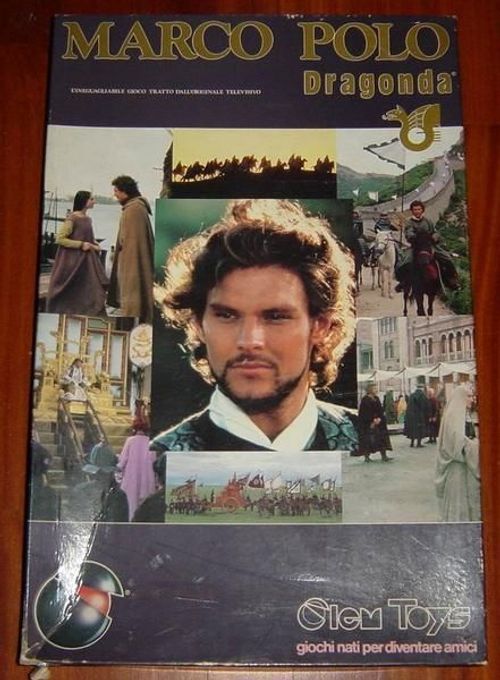
Marco Polo: Dragonda
Marco Polo: Dragonda Rulebook
Table of Contents
Table of Contents
The Map
The map represents Eastern Europe, part of Africa and almost all of Asia as far as Japan. It depicts some of the most important cities of the historical period concerned.
The map is printed with small dots (spaces) connected to one another by a line. It is also divided into ZONES, both on land and at sea; the zones are where the "EVENTS" take place. The zones are marked with letters or numbers, which distinguish seas and geographic areas respectively.
Zone key:
- A = Mediterranean
- B = Red Sea
- C = Black Sea
- D = Arabian Sea
- E = Bay of Bengal
- F = Yellow Sea
- I = Balkans / Italy (printed as "1" in the scan; read here as the letter I, matching the other letter zones)
- 2 = Africa / Arabia
- 3 = Caucasus Steppe
- 4 = Persia
- 5 = India
- 6 = China
- 7 = Islands
- 8 = Siam
How to Play
"MARCO POLO" can be played by a minimum of 2 and a maximum of 4 players. They choose among themselves who will perform the functions of the "BANK", distributing and taking back the equipment for the game from time to time. Each player decides which colour they intend to use by choosing among the available tokens.
Before starting the game, 2 dice are thrown; whoever obtains the highest number starts first. The others sit to his right in the descending order obtained from the throw of the dice. In case of a tie the throw is repeated.
The Bank assigns to each participant the token they chose, a box of 230 coins (zecchini) each, a TRADE TABLE (TABELLA DEGLI SCAMBI ECONOMICI) and a sheet from the TRANSPORT pad.
Once the distribution is done, one at a time the players buy from the Bank a "TRANSPORT MEANS" card (HORSE, CARAVAN OR SHIP), according to the speed at which they want to move along the board and based on the quantities of goods they want to transport. They may also buy pass cards (only the Papal Letter can be bought by players before the start of the game), which may be useful to save themselves from some "Event Cards", and the products (Textiles, Manufactured Goods, Silk, Porcelain, Spices and Precious Stones) which they want to use for their own trades along the route.
The products purchased are marked on the transport pad. Whenever they are sold or bought, the movements and any balances must be recorded on the transport pad sheet.
ATTENTION: NO ONE CAN EVER BUY OR POSSESS MORE THAN ONE TRANSPORT MEANS CARD AT A TIME.
Movement
Movement takes place from one SPACE (dot or node) to another. Cities or ports crossed along the path also count as spaces, provided a line joins the SPACES in which the token moves. There are no restrictions regarding direction, but it is forbidden to pass from one space to another by skipping over a space, or to move the token when it is not your turn.
A player can embark only in a city with a port or in a port. Alexandria serves as a port both for the Mediterranean and for the Red Sea, even though this is not realistic; it is an artifice for the functionality of the game.
The division into different ZONES is shown on the map by the varying shades of colour from one zone to another, and by the progressive letter and number labels.
Ships can never move over land, and land units (Horses and Caravans) can never enter sea spaces. All units may cross or stop at Ports.
Transport Capacity
The various units have different transport capacities; the transport capacity of each means is indicated on its card.
Transport capacity is the maximum quantity of goods (of any kind) that a means can carry from one place to another. Money is not a good, so there is no limit to the amount of money that can be transported.
Transport means can move from one place to another only carrying goods and the character token; they can never, for any reason, carry another transport means.
Example:
- A Horse card can carry UP TO 5 GOODS.
- A Caravan card can carry UP TO 12 GOODS.
- A Ship card can carry UP TO 16 GOODS.
- The character token can carry UP TO 3 GOODS.
Summary table of transport means and tokens
| Character | Caravan | Horse | Ship | |
|---|---|---|---|---|
| Purchase price (zecchini) | 0 | 16 | 6 | 100 |
| Maintenance cost (zecchini) | 0 | 8 | 3 | 30 |
| Transport capacity | 3 | 12 | 5 | 16 |
| Movement capacity | — | 6 | 9 | 10 |
ATTENTION: when the character token is transported by another means, whatever it is, it loses its own movement and transport capacities. These capacities are never added to those of the means that carries it.
Purchase Prices
Each participant pays the Bank at the moment of purchase:
- 5 zecchini for each Pass (Salvacondotto)
- 6 zecchini for the Horse card
- 16 zecchini for the Caravan card
- 100 zecchini for the Ship card
- the price shown in the TRADE TABLE for each Product
When a player is in a city, they may sell and/or buy any type of good. There are no limits to the number of goods that can be bought or sold, nor to the order in which these exchanges are made. Purchases and sales are carried out on the basis of the TRADE TABLE (see attached table).
Example: a merchant (token) arrives in the city of ORMUZ and decides to sell 5 "Pieces" of spices that he transported by horse. The line starting from the name of the city concerned (ORMUZ) is crossed with the line corresponding to the type of good sold (SPICES); on the table this gives two values, the first relating to purchases and the second relating to sales. The player takes the value relating to sales and multiplies it by the quantity of goods sold (5), obtaining how many zecchini the Bank must pay out for the goods sold. The player thus collects (5 x 21) 105 zecchini, which he can reinvest again in ORMUZ by buying other goods to carry away in the hope of further profit. To buy other products the same procedure is followed, using the value relating to purchases.
Start of the Game
Distribute the pieces: buy the cards, the pass cards and the goods. The tokens are placed in Venice and the game can begin. The first player draws a card from the deck; it may be an "EVENT" card or an "ADVENTURE" card.
If it is an EVENT card, the player reads it aloud and carries out what it says, keeping in mind that if the token is in a zone different from the one indicated on the card, the card has no effect.
Example: the card drawn reads:
Save from an ambush a traveller who turns out to be a great prince. Roll two dice: with a result from 2 to 6 he dies, but gives you a necklace worth 20 zecchini. From 5 to 10 the prince survives and reveals the existence of a plot against the Khan; gain 5 experience points. With 11 and 12 the bandits return and force you to flee without gaining anything.
ZONE 2-4-5-6
Note: as printed, the ranges 2 to 6 and 5 to 10 overlap at 5 and 6.
If the token is in one of the four zones indicated (2, 4, 5 or 6), the player rolls the dice and, according to the result, pays or collects zecchini and/or gains experience points.
The involved player may acquire experience, in which case they mark the points accumulated on the Transport Sheet at the bottom, putting an X on as many circles as the points gained. Remember: only the player who draws the EVENT card is involved in what it says, and no one else, except for exceptions contained in the cards themselves.
If, because of an EVENT card, a transport means is lost, along with it all the goods transported must be returned, except THREE (those the character token itself can carry).
If the card drawn is an ADVENTURE card, the player may keep it or play it immediately against another participant. Adventure cards are of two types, offensive and defensive; the offensive ones are best played immediately, while the defensive ones are better accumulated in hand to reduce the effects of enemy attacks. Players may never hold more than three cards in hand. If a player does not wish or is unable to make an attack, they may discard a card by placing it back under the deck from which it was taken.
Adventure cards are recognised by the word ATTACK or DEFENCE written on them. An attacked player who holds a suitable defensive card, if they want to use it, must play it immediately, without waiting for their turn. A player who cannot defend must pay immediately what is requested; if they cannot, they are penalized by one experience point, which is cancelled from those they possess.
After drawing the card and carrying out what it requests, if the player has not suffered limitations relating to movement (e.g. "Stay still for a turn"), they move their token in the direction they want, starting from Venice and travelling by land or by sea (sea only with a Ship card) towards another city.
Movement does not depend on the dice roll; it depends exclusively on the "Transport Means" card bought and on the player's choice. A token moves as many spaces (dots on land and nodes at sea) as its card permits:
Example:
- A Horse card allows the token a movement of UP TO 9 SPACES (land only).
- A Caravan card allows the token a movement of UP TO 6 SPACES (land only).
- A Ship card allows the token a movement of UP TO 10 SPACES (sea only).
- The character token alone has a movement of UP TO 4 SPACES (land only).
The number of spaces travelled may be less than the maximum, but never more. The movement capacity of each means is also reported on its card.
A player, even if attacked more than once before their turn, may never remain still for more than one consecutive turn.
Example with 4 players A/B/C/D: A attacks C and forces it to stay still for a turn. B attacks C and, even if it would force C to stay still on the following turn, this is useless, because A had already succeeded first. D attacks C, but uselessly, since C was already stopped this turn and cannot remain still for two consecutive turns.
After drawing and playing cards and moving the token, the player who is in a city may, at their discretion, decide to sell all, part or none of the goods transported and indicated on the transport sheet, or to buy new goods. Every time this takes place the exchanges must be recorded on the transport sheet itself, updating the situation and taking into account the different load capacities of horses, ships, caravans and characters. Obviously each player will sell where prices are highest and buy where they are lowest; the greater the distance travelled by merchants, the greater the profit.
Example: a good (Manufactured Goods) bought in Venice will yield much more if sold in Beijing rather than in Constantinople.
It is wise to consult the TRADE TABLE carefully before making a sale or a purchase, since the Map does not always show distances at first glance. The table also marks the places where exchanges can take place more conveniently, both for sellers and for buyers.
Finally, after buying and/or selling, the player pays the Bank for the maintenance of the transport means, or gives it up, buying a new one if they wish. In the first case the maintenance is paid as follows:
- Horse: 3 zecchini
- Caravan: 8 zecchini
- Ship: 30 zecchini
- Character token: nothing
In the second case the player returns to the Bank the means they possess and pays the price due for the new means. Having done this, the player's turn is finished and the turn passes to the next player, who repeats the whole procedure from the beginning.
ATTENTION: A SHIP CAN BE PURCHASED ONLY WHEN IN A PORT. OTHER MEANS MAY NEVER BE PURCHASED AT SEA.
Victory
As explained at the beginning, the winner in the game is whoever among the players manages to accumulate experience points, each of which is marked on their own transport sheet by putting an X on the appropriate circles. Players gain points by facing and overcoming the trials set by the EVENT cards, or by reaching certain geographic objectives: NAGASAKI and MANILA/PELEMBANG each give 5 points to the first player who enters them.
The winner is whoever first manages to reach all of the following objectives:
- Have accumulated 51 Experience Points.
- Have passed through PECHINO, SAMARCANDA, DAMASCO, ORMUZ and YUNNAN.
- Return to Venice.
Component List
- 1 map
- 4 tokens (segnalini)
- 2 dice
- 4 trade tables ("Scambi Economici")
- 1 transport pad ("Trasporti")
- 76 cards, of which 40 are Events and 36 are Adventure cards
- 12 transport means cards ("Mezzi di Trasporto")
- 16 pass cards ("Salvacondotto")
- 150 zecchini
Note: the component list above gives 150 zecchini for the supply, while the rules under "How to Play" give each player a box of 230 zecchini. Both figures are as printed.
Map Legend
- A strip of rope knot drawn on the map indicates the sea route that can be followed on the map.
- Two round balls joined by a rope indicate the land route that can be followed on the map.
- A drawing of a city indicates the city; it counts as a space for the purposes of land movement.
- A drawing of a port indicates the port; it counts as a space for the purposes of land and sea movement.
- A line drawn on the map indicates the various zones into which the map is divided.
- A circular symbol with a number indicates the places where the Events determined by the cards drawn by individual players take place.
Trade Table
Each player has a trade table and uses it for purchases and sales. The table serves to determine the value of goods both at the time of purchase and at the time of sale.
Example: the printed example shows the following values, given as ACQ (purchase) and VE (sale) for each product:
| Textiles ACQ | Textiles VE | Spices ACQ | Spices VE | |
|---|---|---|---|---|
| COLOMBO | 43 | 41 | 17 | 15 |
| ORMUZ | 41 | 39 | 23 | 21 |
In the example, the player buys Spices at Colombo at 17 zecchini per piece, carries them to Ormuz and sells them at 21 zecchini per piece, with a profit of 4 zecchini for each piece sold.
The value varies according to the product and the place where purchases and sales take place. The table is designed so that it is not profitable to buy and sell the same product in the same city.
Note: the complete Trade Table is a separate printed sheet, not part of the scanned rulebook; only the values printed in the example above are reproduced here.
Transport Pad
This sheet is used by each player for two purposes:
- Recording on it the quantities of goods transported, sold and bought.
- Recording the accumulation of experience points as the game earns them for the player. The X marks indicate the points accumulated.
The pad has rows for REMAINING (RIMANENZE), PURCHASES (ACQUISTI), SALES (VENDITE) and REMAINING again, for each means of transport, and a row of circles for EXPERIENCE (ESPERIENZE).
Pass Cards
There are two types:
- Papal Letter (Missiva Papale). Can be bought ONLY in Venice.
- Command Tablet (Tavola del Comando). Can be bought ONLY in Beijing.
Players may use these cards to face certain EVENT cards, allowing them to gain experience points or to save themselves from dangerous situations.
Event Cards
There are 40 in the deck. They represent "Chance", and the player who draws one must face what it requests only if they are in the zone indicated in the margin of the card.
Adventure Cards
There are 36 in the deck. They give players the possibility to interfere with one another and make victory more difficult.
These cards are of two types, ATTACK and DEFENCE. They may be accumulated in hand up to a maximum of three. The attack cards may be played against a player, while the defence cards serve only to reduce the strength of an attack suffered. On the cards it is written what effect they have in the game.
Example attack card, "DESERT": If you own a Horse or Caravan card, you must return it to the Bank and not move this turn. This card has no effect on one who travels with a ship.
Example defence card, "OASIS": The player attacked by the "Desert" card may cancel it by playing this card.
Note: the small print on the card illustrations is difficult to read in the scan; the card texts above are transcribed from the scan as legibly as possible.